Why I Stopped Using Instant-Read Thermometers (And What I Use Instead)
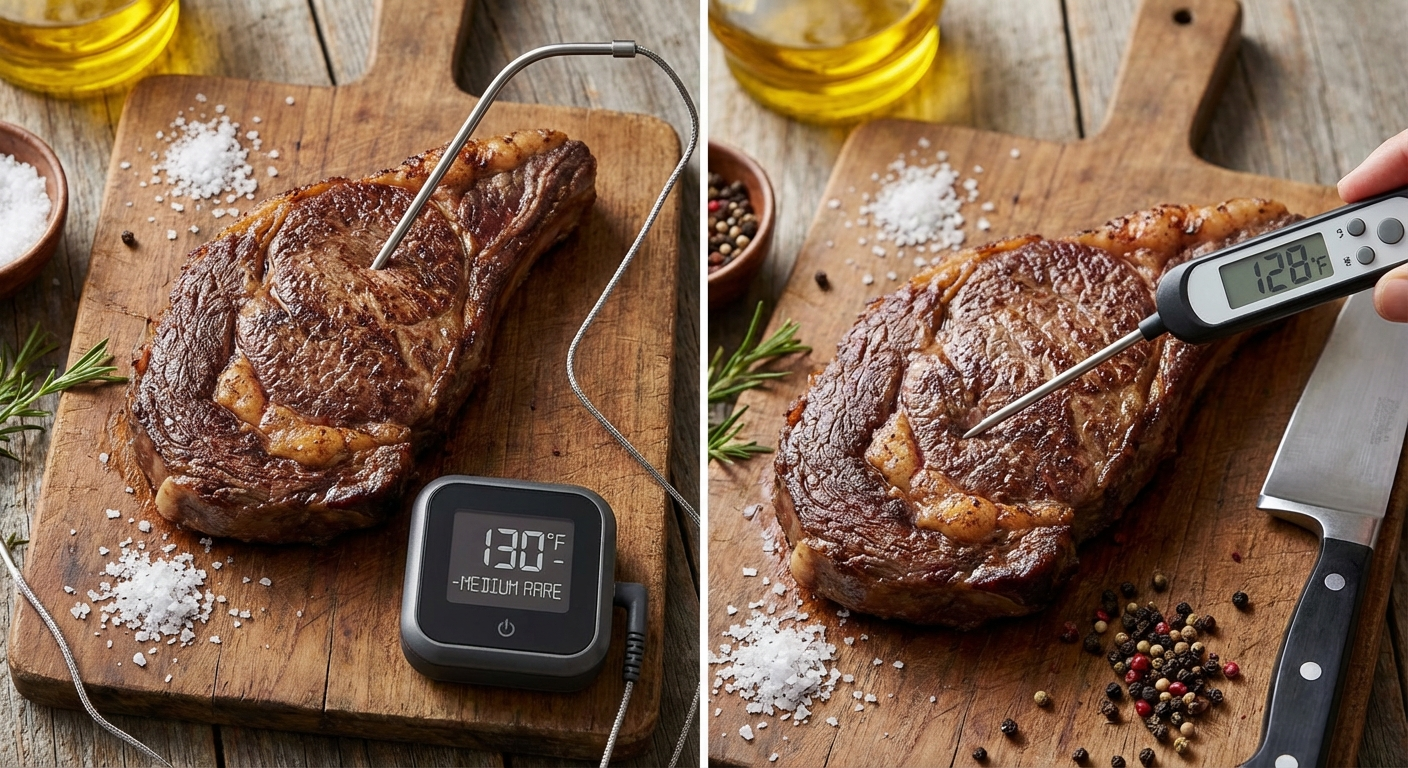
I own a ThermoWorks Thermapen ONE. It's a $105 instant-read thermometer that stabilizes in under 1 second. It's a beautiful piece of engineering, and I've used it thousands of times in the lab and at home. And for steak cooking — specifically for the reverse sear method — I almost never reach for it anymore.
Instead, I use a leave-in probe system. Specifically, a ThermoWorks Signals (four-channel) or the simpler Smoke (two-channel). The probe goes into the steak before it enters the oven and stays there through the entire cook. Temperature data transmits wirelessly to a base station or my phone. I watch the curve in real time without opening the oven, poking the steak, or guessing.
The Problem with Instant-Read
Instant-read thermometers measure temperature at a point in time. You open the oven, pull the rack out, insert the probe, wait for a reading, and make a decision. The steak is losing heat the entire time the door is open. Your oven temperature drops 50–75°F every time you open the door, and it takes 5–10 minutes to recover.
If you're checking every 5 minutes during the oven phase of a reverse sear, you've opened the door 6–8 times during a 40-minute cook. That's adding 10–15 minutes to the total time and creating temperature fluctuations that affect cooking consistency.
There's also the accuracy issue. An instant-read measures a single point. If you insert it slightly off-center — even by half an inch — you might read 120°F when the actual geometric center is 112°F. With a leave-in probe, you place it once (carefully), and it stays in that exact position for the entire cook.
What a Leave-In Probe Shows You
The real advantage isn't convenience — it's the temperature curve. A leave-in probe doesn't just show you where the steak is right now. It shows you the rate of temperature change, which lets you predict where the steak will be in 5 or 10 minutes.
When the center temperature is climbing at 2°F per minute, you know the steak is still absorbing heat actively. When the rate slows to 0.5°F per minute, you're approaching equilibrium — the steak is nearing the oven temperature and will plateau soon. This rate information lets you anticipate the pull point instead of reacting to it.
After pulling from the oven and searing, I leave the probe in during the rest. I can watch carryover cooking happen in real time — the temperature climbing, peaking, then slowly declining. I know exactly what the final internal temperature was. No guessing, no cutting open the steak to check.
The Setup I Recommend
For most home cooks, the ThermoWorks Smoke ($99) is the sweet spot. It has two probes — one for the steak (ambient in the meat), one for the oven/grill (ambient air). The wireless range is 300 feet, and the base station shows both temperatures with high/low alarms.
For more serious setups, the Signals ($229) has four probes and Bluetooth + WiFi connectivity. I use this when cooking multiple steaks or a steak alongside a roast.
The key specs to look for in any leave-in probe:
- Temperature accuracy: ±1°F or better. Cheap probes can be off by 5–10°F, which defeats the purpose.
- Response time: Under 3 seconds for meaningful real-time monitoring.
- Probe cable rated to 700°F+: The cable runs through the oven or near the searing pan. It needs to handle high ambient temperatures without melting.
- Wireless range: 100+ feet minimum so you can monitor from another room.
When I Still Use the Instant-Read
The Thermapen isn't retired — it has specific roles:
- Final verification: After the rest, I'll spot-check with the Thermapen to confirm the leave-in probe's reading. A 2-second confirmation from a different device at a different point gives me confidence.
- Quick checks on thin steaks: For a 3/4-inch skirt steak that cooks in 3 minutes total, there's no time to set up a leave-in probe. The Thermapen is fast enough for a mid-cook check on quick-cooking proteins.
- Oil and pan surface temperature: I use the Thermapen to check pan temperature before searing (some models have a surface probe attachment). This tells me if the cast iron is hot enough — 600°F+ — before the steak goes in.
The Bottom Line
Use both. But if I had to choose one tool for reverse searing a thick steak, it's the leave-in probe every time. The continuous data stream, the ability to monitor without opening the oven, and the carryover tracking during rest — these advantages compound into consistently better results. The Thermapen tells you where the steak IS. The leave-in probe tells you where the steak is GOING. And in precision cooking, predicting the future matters more than measuring the present.
More from the Blog
The 130°F Myth: Why Medium-Rare Isn't One Temperature
Every recipe says "cook to 130°F for medium-rare" — but 129°F and 134°F produce noticeably different steaks. Here's what's happening at each degree.
I Tested 5 Searing Methods — Here's What the Data Shows
Five searing methods, identical steaks, measured results. Cast iron, chimney sear, torch, infrared, and deep-frying — here's what performed best.