I Tested 5 Searing Methods — Here's What the Data Shows
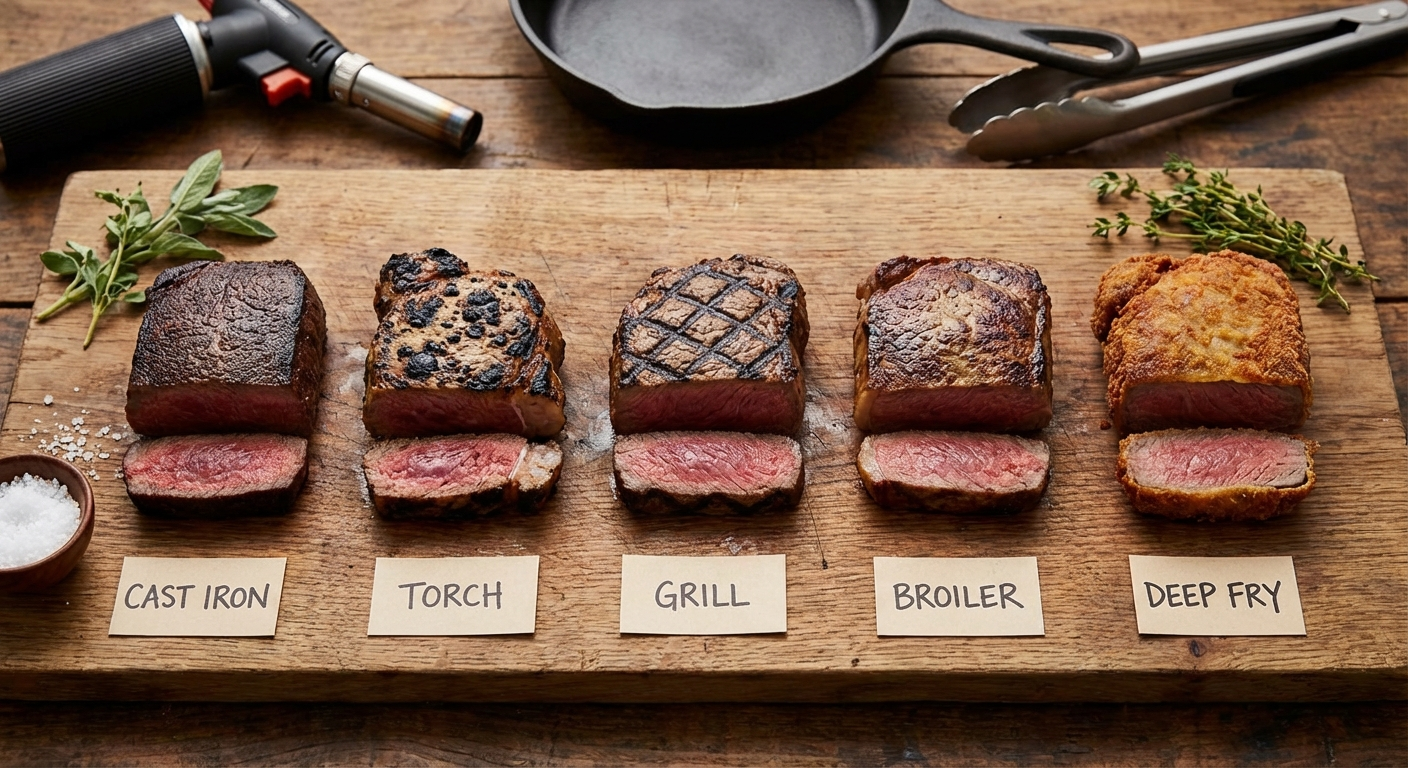
I get asked constantly: "What's the best way to sear a steak?" So I ran a controlled test. Five searing methods. Ten steaks (two per method, for replication). All steaks cooked to 131°F in a sous vide bath, patted equally dry, and seared using the same target: deep mahogany crust on both sides.
I measured three things: crust depth (digital caliper on cross-section), gray band width (the overcooked zone below the crust), and searing time per side. Flavor was assessed qualitatively — because I don't have a gas chromatograph at home. (I wish.)
The Methods
1. Cast Iron Skillet
12-inch Lodge preheated for 7 minutes on maximum heat. Surface temp: 660°F (infrared thermometer). Avocado oil applied to the steak. Seared 60 seconds per side.
2. Charcoal Chimney Sear
Full Weber chimney of Kingsford briquettes, fully lit (white-gray ash). Grill grate placed directly on top of the chimney. Surface temp at grate: ~1,000°F. Seared 45 seconds per side.
3. Torch (Bernzomatic TS8000 + MAP-Pro)
Handheld torch swept across the surface at a distance of 2 inches. Flame temp: ~3,600°F, but effective surface heating depends on sweep speed and distance. Approximately 90 seconds per side for equivalent browning.
4. Infrared Searing Station
Otto Wilde O.F.B. — a dedicated overhead infrared unit. Emitter temp: ~1,500°F. Steak placed 2 inches from the ceramic element. Seared 30 seconds per side.
5. Deep Fry in Beef Tallow
Dutch oven with 3 inches of rendered beef tallow heated to 450°F. Steak submerged for 30 seconds per side (60 seconds total). Full 360° surface contact with hot fat.
The Results
| Method | Time/Side | Crust Depth | Gray Band | Notes |
|---|---|---|---|---|
| Cast Iron | 60 sec | 1.2mm | 1.5mm | Even, consistent crust. Excellent flavor with butter baste. |
| Chimney | 45 sec | 1.1mm | 1.0mm | Good crust with grill marks. Smoky flavor from fat drippings. |
| Torch | 90 sec | 0.8mm | 2.0mm | Uneven browning. Slight metallic/fuel taste on one sample. |
| Infrared | 30 sec | 1.0mm | 0.5mm | Best gray band performance. Even, deep crust. No smoke flavor. |
| Deep Fry | 30 sec | 1.3mm | 0.8mm | Deepest, most uniform crust. Beefy flavor from tallow. Messy. |
Analysis
Best Overall Crust: Deep Fry
This surprised me, but it shouldn't have. Hot tallow at 450°F contacts 100% of the steak's surface simultaneously — even the sides and irregular edges that a flat pan can't reach. The fat acts as both heat transfer medium and flavor contributor. The crust was the deepest (1.3mm) and the most uniform of any method. The gray band was thin (0.8mm) because the searing time was only 30 seconds per side.
The downside: it's messy. Three inches of 450°F tallow is not weeknight-friendly. Cleanup is significant. But for pure crust quality, nothing else matched it.
Best Practical Method: Cast Iron
The cast iron skillet produced the most consistent results with the least fuss. Even, deep crust. Reasonable gray band. The ability to butter-baste adds a flavor dimension none of the other methods can match (melted butter undergoes its own Maillard reaction, adding complexity). For a weeknight steak, cast iron is still my default.
Best Precision Method: Infrared
The infrared unit won on gray band — 0.5mm is essentially nothing. For sous vide cooks who have spent 2 hours achieving perfect edge-to-edge doneness, the infrared's ability to add crust without adding gray band is genuinely valuable. The 30-second sear time is unmatched.
The Torch Disappointed
Torch searing has vocal fans, but my data doesn't support it. Despite the flame's extreme temperature, the heat delivery is inconsistent — the torch tip sweeps across the surface, creating hot spots and cool spots. The result was the thinnest crust of any method and one of the wider gray bands (because achieving uniform browning required more total time). One of the two torch-seared steaks had a faint metallic taste, possibly from incomplete combustion of the MAP-Pro gas. I'm not a torch searing advocate.
The Chimney Is Underrated
The charcoal chimney sear is the best free upgrade available to anyone who owns a charcoal grill. You're already lighting charcoal — just put a grate on top before you dump the coals. The 1,000°F+ surface temperature at the grate is dramatically hotter than a normal grill setup, and the results showed it: tight gray band, good crust, plus the irreplaceable smoky flavor from fat hitting the white-hot coals.
What I Actually Use
Weeknight steak: cast iron, every time. It's fast, reliable, and butter basting is the best 15 seconds you can spend on a steak.
Weekend/special occasion: chimney sear if I'm already grilling. The flavor is worth the extra effort, and the gray band performance is excellent.
Post-sous-vide with expensive protein: if I had an infrared unit, I'd use it here. Since I don't cook sous vide frequently enough to justify the cost, I use cast iron with an aggressive preheat and very quick sear times.
Deep fry: once or twice a year, when I want to show off or test a theory. The results are spectacular, but the cleanup keeps it in the "special occasion" category.
More from the Blog
Why I Stopped Using Instant-Read Thermometers (And What I Use Instead)
Instant-read thermometers are great — but they require you to open the oven, poke the steak, and react. Leave-in probes let the data come to you.
The 130°F Myth: Why Medium-Rare Isn't One Temperature
Every recipe says "cook to 130°F for medium-rare" — but 129°F and 134°F produce noticeably different steaks. Here's what's happening at each degree.