BBQ Bark Formation: The Complete Science Behind That Perfect Crust
BBQ Bark Formation: The Complete Science Behind That Perfect Crust
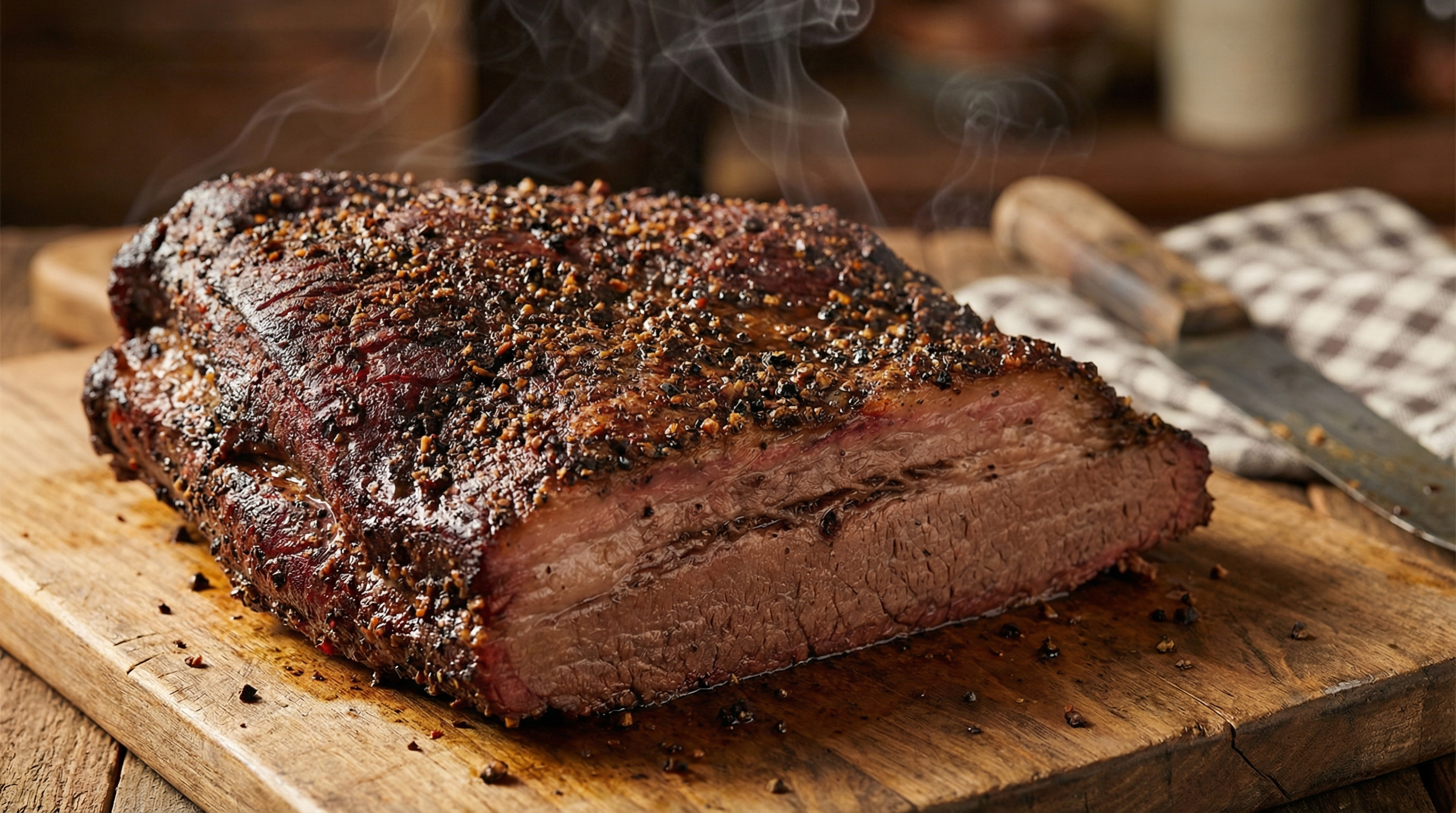
Every competition pitmaster, backyard smoker, and BBQ obsessive chases the same thing: perfect bark. That dark, complex, slightly crunchy crust on the outside of a smoked brisket or pork shoulder is not an accident. It is the result of specific chemical reactions occurring over hours of controlled heat, smoke, and airflow.
Bark is not char. It is not burned seasoning. It is a multi-layered crust created by the Maillard reaction, fat rendering, spice polymerization, and moisture evaporation working in concert. Understanding the science behind bark formation does not just make you sound smart at cookouts — it gives you direct control over one of the most important variables in low-and-slow barbecue.
What Is BBQ Bark?
Bark (sometimes called "the crust" or "the pellicle") is the dark, firm outer layer that forms on meat during extended smoking at low temperatures. On a well-smoked brisket, the bark is typically 2–4 millimeters thick — a concentrated layer of flavor that contrasts with the tender, juicy interior.
The bark is composed of several elements fused together:
- Dehydrated meat surface — the outermost muscle fibers lose moisture and concentrate flavor
- Maillard reaction products — hundreds of flavor compounds from amino acid and sugar reactions
- Polymerized spices — the dry rub doesn't just sit on the surface; it chemically bonds to the meat
- Rendered and resolidified fat — fat that melted, mixed with spices, and set into a glaze
- Smoke compounds — deposited phenols, carbonyls, and organic acids from wood combustion
The color of good bark ranges from deep mahogany to almost black. This is not burning — it is the visual result of Maillard browning and caramelization happening slowly over 8–16 hours.
The Chemistry: Three Reactions Building Bark
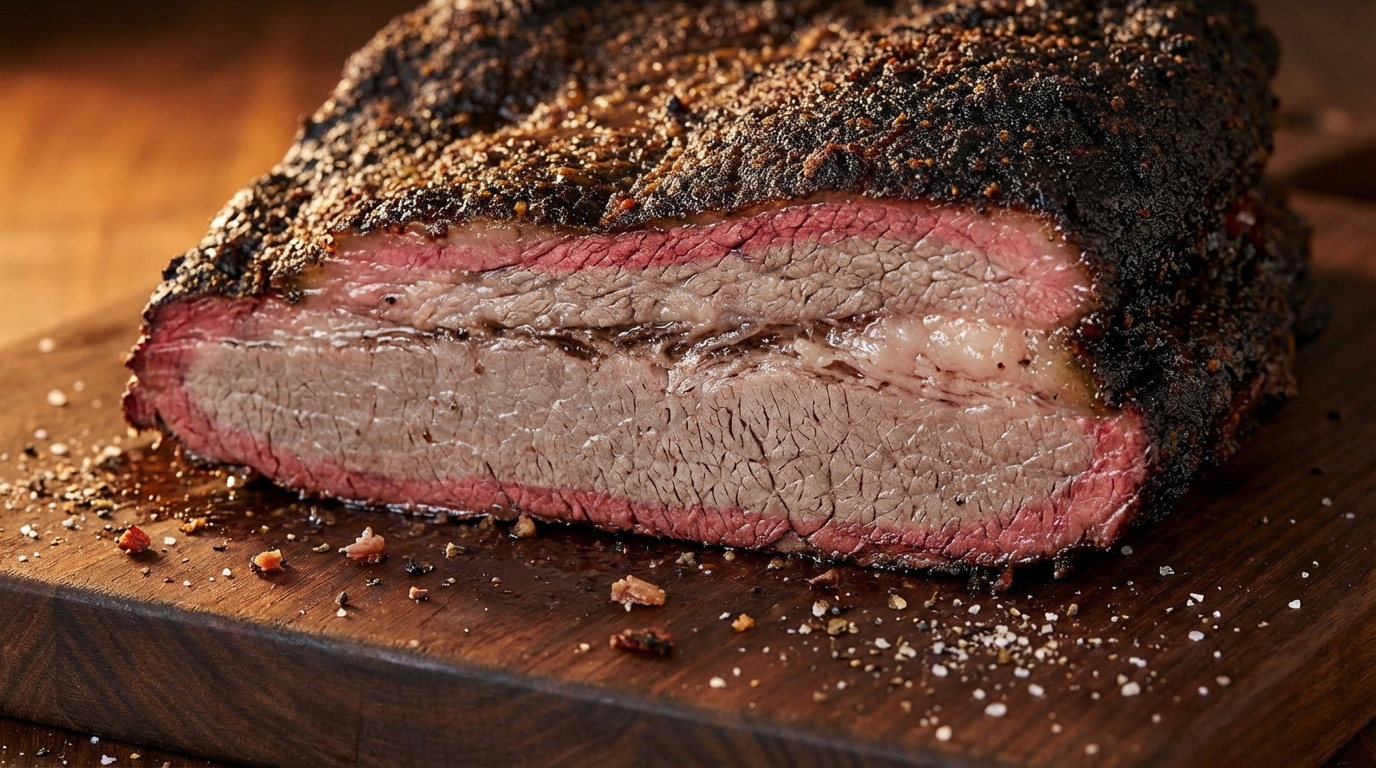
Bark formation is not a single event. It is three overlapping chemical processes that occur simultaneously on the meat's surface over hours of smoking.
1. The Maillard Reaction
The Maillard reaction is the primary driver of bark flavor and color. When amino acids (from the meat's surface proteins) react with reducing sugars (from the rub or the meat itself) at temperatures above 250°F, they produce hundreds of new flavor compounds and brown pigments called melanoidins.
In high-heat grilling, the Maillard reaction happens in minutes. In low-and-slow smoking at 225–275°F, it happens gradually. The surface temperature of the meat must exceed 235°F for significant Maillard activity — which is why bark doesn't start forming until the exterior dries out and heats up past the boiling point of water. As long as the surface is wet, evaporative cooling keeps it below 212°F.
This is a critical insight: bark cannot form on a wet surface. The meat must first develop a dry pellicle before Maillard reactions can begin accelerating.
2. Caramelization
If your rub contains any sugar — brown sugar, turbinado, honey powder, or even the natural sugars in paprika and onion powder — caramelization contributes to bark formation. Caramelization is the thermal decomposition of sugars, which begins around 320°F for sucrose.
On a smoker running at 250°F, the air temperature is below the caramelization point. But the meat surface, especially on thin edges and fat cap areas exposed to radiant heat, can exceed the air temperature. Sugar-heavy rubs develop deeper color and a slightly sweet, brittle texture in the bark from this caramelization.
Too much sugar is a risk, though. If the surface temperature spikes (from a flare-up or hot spot), sugar burns quickly and creates bitter, acrid flavors that ruin the bark.
3. Polymerization of Fats and Spices
This is the least understood part of bark formation but arguably the most important for texture. As fat renders out of the meat and mixes with the dry rub, it creates a slurry on the surface. Over hours of heat exposure, this fat-spice mixture undergoes polymerization — the molecules cross-link and form larger, more complex structures.
Think of it like seasoning a cast iron pan. The oil doesn't just sit there — it polymerizes into a hard, bonded layer. The same process happens on the surface of smoked meat. The rendered fat acts as a binding agent, locking spice particles and Maillard products together into a cohesive crust.
This is why bark has structure. It's not just dried-out seasoning — it's a chemically bonded matrix of fat, protein, spice, and smoke compounds.
The Role of the Dry Rub
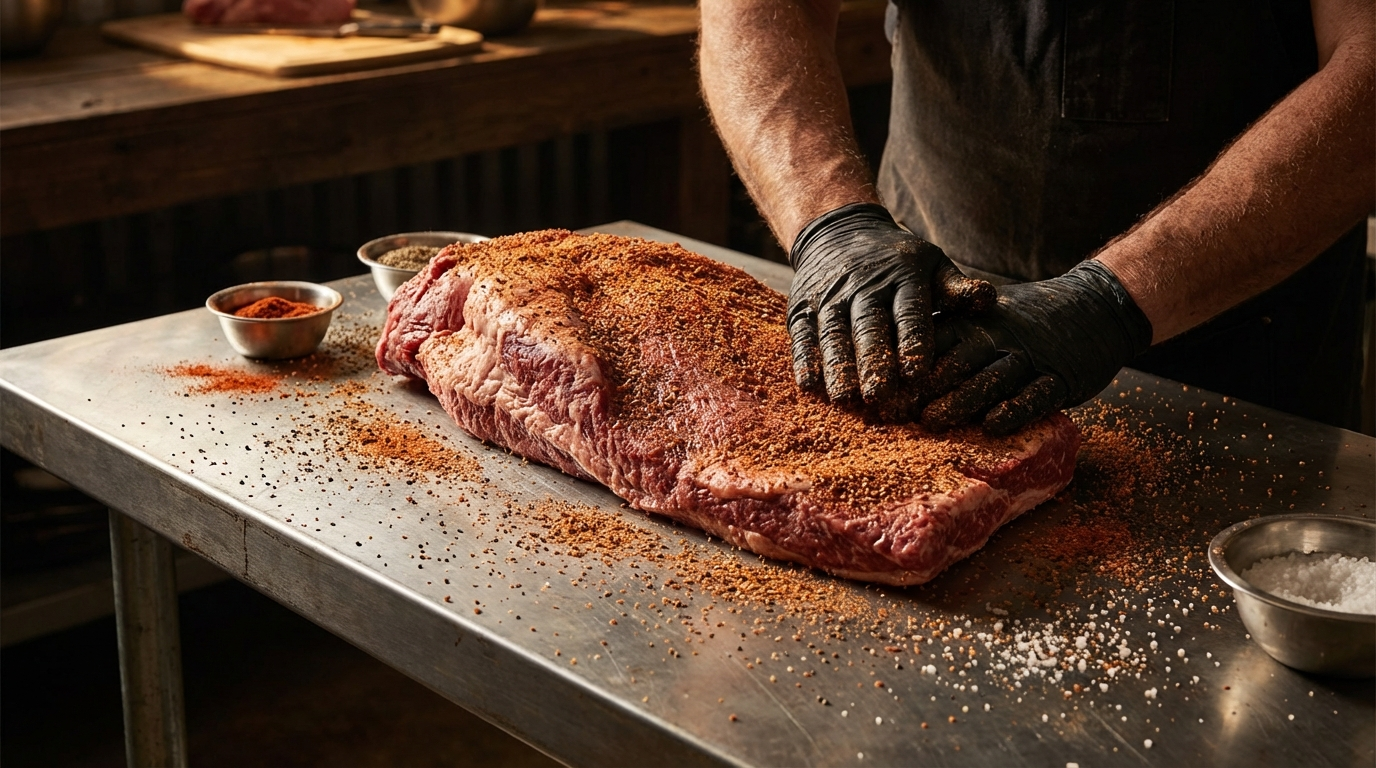
The dry rub is not just flavor seasoning — it is a structural component of bark. The composition, grind size, and application method all directly affect the bark you get.
Salt
Salt serves two roles. First, it draws moisture to the meat's surface through osmosis, which initially delays bark formation. But once that moisture evaporates, the salt-concentrated surface undergoes faster Maillard reactions because the amino acids are more concentrated. Second, salt crystals (especially coarse kosher salt or flaked salt) create physical texture in the bark — tiny pockets of crunch.
Black Pepper
Coarse-ground black pepper is the backbone of Texas-style bark. The cracked peppercorns embed in the fat-spice matrix and hold their structure through the entire cook. Fine-ground pepper tends to dissolve into the surface and contributes less to bark texture. The volatile oils in black pepper (piperine) react with rendered fat to create flavor compounds unique to long-cooked bark.
Paprika and Chili Powders
Paprika is the primary color contributor in most rubs. It contains carotenoid pigments that deepen from red to near-black during prolonged Maillard and polymerization reactions. Paprika also contains natural sugars that participate in caramelization. Smoked paprika adds an extra layer of smoke flavor that complements the wood smoke already being deposited.
Sugar
Brown sugar and turbinado sugar caramelize slower than white sugar and are less prone to burning. Sugar creates a glaze-like component in the bark — the slightly sticky, sweet counterpoint to the savory Maillard flavors. Keep sugar to 10–15% of total rub volume. Above 20%, the risk of bitter burned sugar increases significantly, especially on hot spots.
Grind Size Matters
Coarser rubs produce better bark. Large salt crystals, cracked pepper, and granulated garlic maintain their particle identity throughout the cook, creating a bark with varied texture — crunchy bits, smooth glazed areas, and chewy pockets. Fine-ground rubs produce a uniform, thinner bark that can taste muddy because the individual flavors merge into one note.
Moisture: The Enemy and Ally of Bark
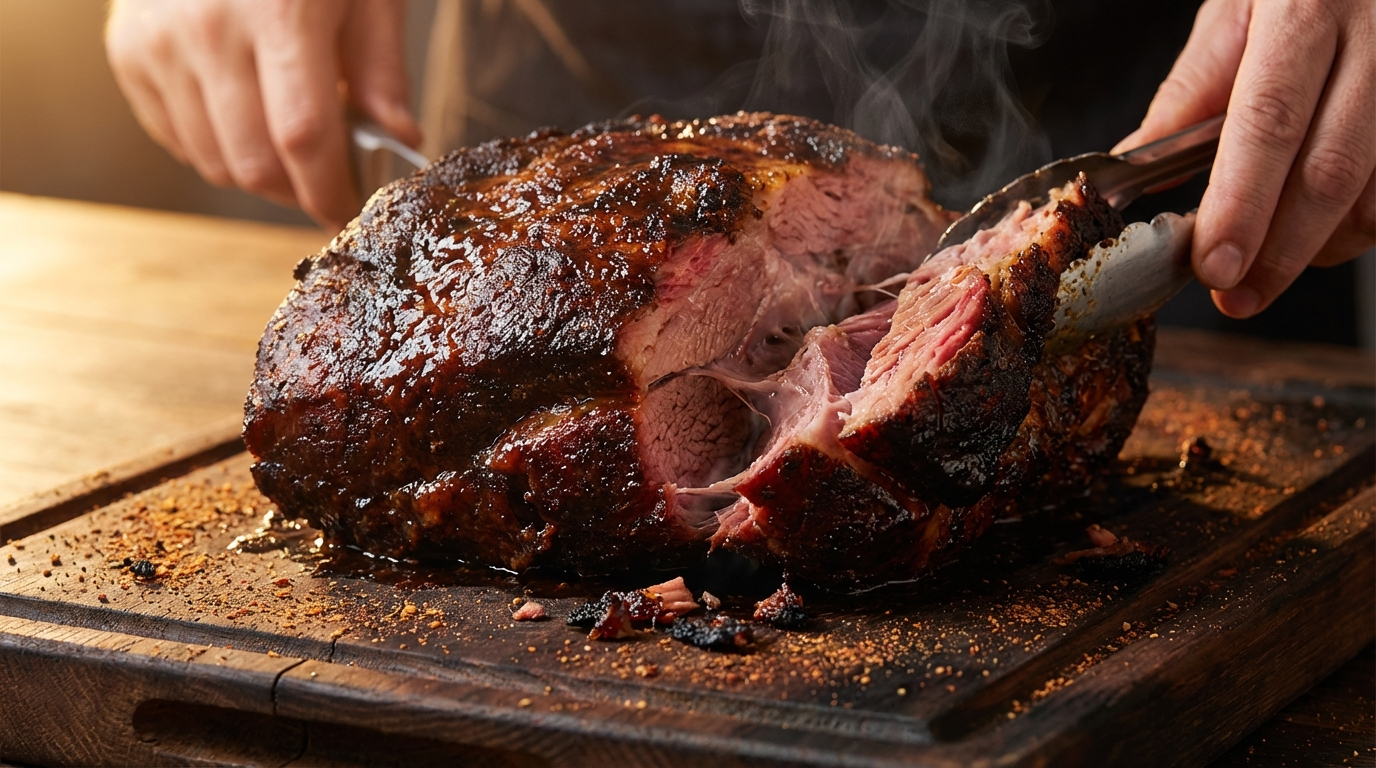
Moisture management is the single most controllable variable in bark formation. Too much moisture and the bark never sets. Too little and the meat dries out before bark chemistry can complete.
Phase 1: The Wet Surface (0–2 hours)
When meat first goes on the smoker, the surface is wet. Applied moisture (mop, spritz, or the meat's natural juices) keeps the surface below 212°F through evaporative cooling. During this phase, smoke compounds are actively depositing on the wet surface — moisture helps smoke adhesion. But Maillard reactions are minimal because the temperature is too low.
Phase 2: Pellicle Formation (2–4 hours)
As surface moisture evaporates, a tacky layer called the pellicle forms. The pellicle is a thin film of dried proteins and dissolved spices on the meat's surface. It is sticky to the touch and slightly glossy. This is the foundation layer of bark — smoke compounds adhere to it, and it provides the substrate for Maillard reactions to accelerate.
The pellicle is why many competition pitmasters let their meat sit uncovered in the refrigerator overnight before smoking. Starting with a pre-formed pellicle means bark chemistry starts sooner on the smoker.
Phase 3: Bark Formation (4–8+ hours)
Once the surface is dry enough for Maillard reactions to outpace evaporative cooling, bark formation accelerates. The surface temperature climbs past 250°F, spices begin polymerizing with rendered fat, and the bark darkens progressively. This is the critical phase — and it is also when most people make their biggest mistakes.
The Wrapping Dilemma
Wrapping meat in aluminum foil (the Texas crutch) creates a steam environment that rapidly softens bark. The moisture trapped inside the foil essentially reverses hours of careful dehydration. Foil-wrapped briskets push through the stall faster, but the bark suffers significantly.
Butcher paper is the compromise. It is semi-permeable — it allows some moisture vapor to escape while still providing enough insulation to speed through the stall. Bark wrapped in butcher paper stays firmer than foil-wrapped bark, though it won't be quite as crisp as unwrapped bark.
The unwrapped approach produces the best bark at the cost of a longer cook time and potentially drier meat. Many pitmasters split the difference: smoke unwrapped until the bark is fully set (typically around 165°F internal), wrap in butcher paper to push through the stall, then unwrap for the final 30 minutes to re-crisp the surface.
Airflow and Smoke: The Environmental Factors
Bark formation doesn't happen in a vacuum. The smoker environment — temperature stability, airflow patterns, smoke density, and humidity — all affect how bark develops.
Airflow
Moving air accelerates surface drying, which speeds up pellicle and bark formation. Offset smokers with good draft produce excellent bark because hot air continuously flows over the meat surface. Kamado-style cookers with restricted airflow produce bark differently — the high humidity environment delays bark but can yield a glossy, lacquer-like finish.
Convection plays a role too. In a smoker, hot air rises and cycles around the cooking chamber. Meat positioned in the direct path of airflow develops bark faster on the exposed side. This is why pitmasters rotate briskets during long cooks — to equalize bark formation across the entire surface.
Smoke Density
Clean, thin blue smoke deposits a moderate amount of phenolic compounds on the meat surface. These compounds contribute a subtle smoky flavor and slightly darken the bark. Heavy white smoke (from smoldering, oxygen-starved wood) deposits excessive creosote and soot, which creates a bitter, ashy bark that overwhelms the Maillard and spice flavors.
The ideal smoke contribution to bark is additive, not dominant. You should taste the meat, the rub, and the smoke as distinct layers — not just smoke.
Temperature Stability
Temperature swings hurt bark formation. A smoker that fluctuates between 200°F and 300°F alternates between stalling the Maillard reaction (too cool) and risking sugar burning (too hot). Stable temperatures between 225–275°F give the Maillard reaction, caramelization, and polymerization time to develop at a controlled pace.
Thick vs. Thin Bark: What Controls It
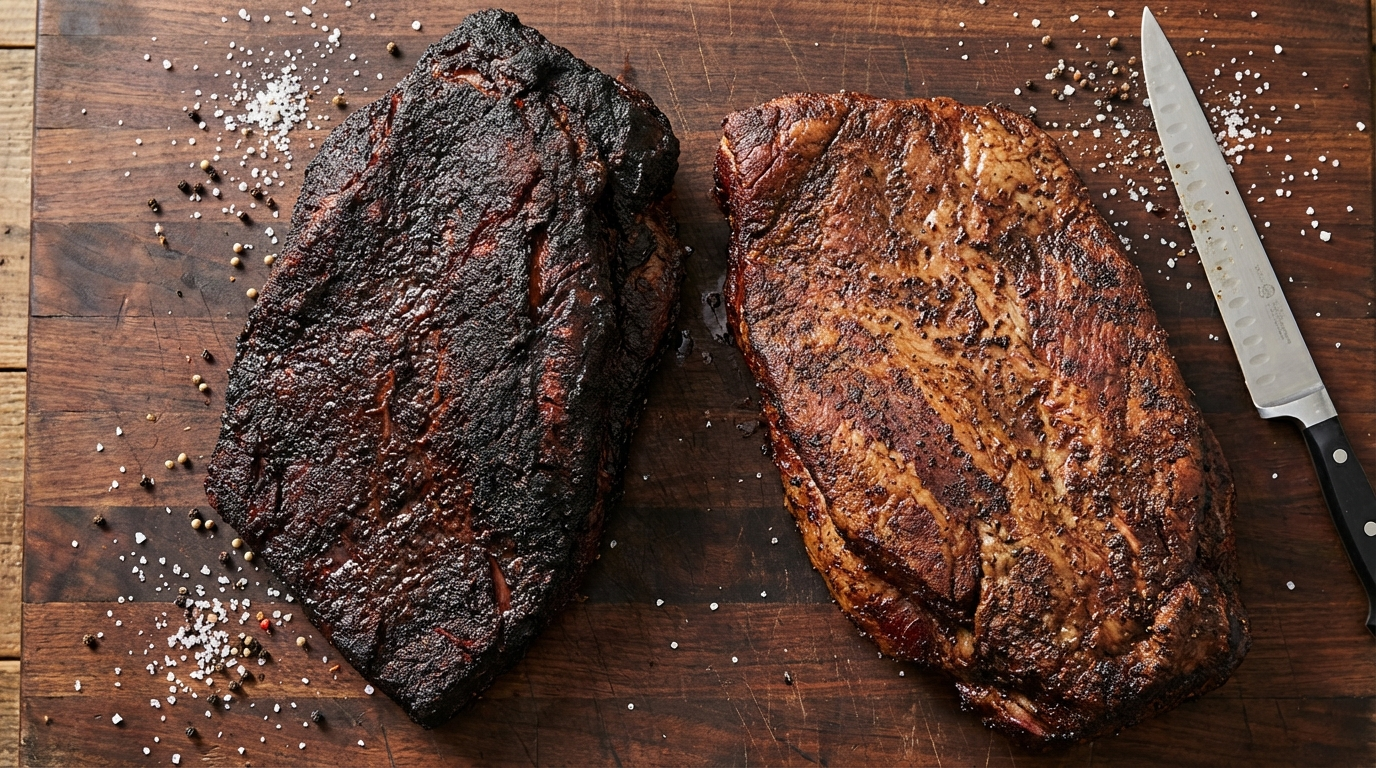
Not all bark is created equal. Some briskets come off the smoker with a thick, crunchy bark you can practically snap off. Others have a thin, soft coating that's more like a skin. The difference comes down to a few key variables:
- Rub thickness — More rub means more material for the polymerization matrix. A heavy hand with the rub (applied in layers if needed) creates thicker bark.
- Cook time — Longer cooks develop thicker bark. A 16-hour brisket will have more bark than a 10-hour brisket, all else being equal.
- Surface area and geometry — Thin edges, corners, and the point end of brisket develop bark faster because they heat up and dry out quicker. The flat's large surface area develops more uniform but sometimes thinner bark.
- Fat cap orientation — Fat cap up bastes the meat but slows bark formation on top. Fat cap down protects the bottom from direct heat but allows the top surface to dry and bark faster.
- Mop and spritz frequency — Every time you spritz, you add moisture that must evaporate before bark chemistry continues. Frequent mopping produces thinner, smoother bark. Less mopping produces thicker, more textured bark.
Troubleshooting: Why Your Bark Failed
When bark doesn't form properly, there's always a scientific explanation. Here are the most common failures and their root causes:
Problem: Bark is soft and rubbery
Cause: Excess moisture. Either the smoker humidity was too high (oversized water pan), you wrapped in foil too early, or you mopped/spritzed too frequently. The surface never got dry enough for Maillard reactions to fully develop.
Fix: Reduce water pan size or remove it. Wrap later (after 165°F internal). Spritz no more than once per hour after the first 3 hours.
Problem: Bark is ashy and bitter
Cause: Dirty smoke (too much white smoke from smoldering wood) or sugar in the rub burned from a temperature spike. Creosote deposits taste acrid and coat the tongue.
Fix: Manage your fire for clean blue smoke. Use a chimney starter to fully ignite wood chunks. Reduce sugar in the rub if your smoker runs hot.
Problem: Bark is thin and patchy
Cause: Not enough rub, too short of a cook time, or the meat was placed in a dead-air zone of the smoker. Some areas formed bark while others didn't get enough heat or airflow.
Fix: Apply rub more generously. Rotate the meat during the cook. Ensure your smoker has good draft and even heat distribution.
Problem: Bark peeled off when slicing
Cause: The fat-spice polymerization didn't fully bond to the meat surface. This usually happens when the rub was applied to a very wet surface or when the meat was pulled too early before the fat rendering cycle completed.
Fix: Pat the meat dry before applying rub. Let the rubbed meat rest uncovered in the fridge for 1–12 hours to form an initial bond. Cook to full doneness — bark adhesion improves in the final hours of cooking.
The Bark Timeline: What Happens Hour by Hour
Understanding when bark forms helps you make better decisions during the cook. Here's a typical timeline for a full packer brisket at 250°F:
- Hour 0–1: Surface is wet. Smoke is depositing. Rub absorbs moisture and forms a paste. No visible bark.
- Hour 1–3: Surface begins drying. Pellicle forms — the meat looks tacky and slightly glossy. Color shifts from raw meat to a reddish-brown tint.
- Hour 3–5: Maillard reactions accelerate. Surface darkens to medium brown. Bark begins to feel firm to the touch. Rub particles are bonding to the surface.
- Hour 5–8: Bark is actively forming. Color deepens to dark brown or mahogany. The fat-spice matrix is polymerizing. This is the critical window — don't wrap until this phase completes.
- Hour 8–12: Bark is set. Further cooking deepens the color toward near-black. Texture becomes firm and slightly crunchy. Wrapping at this point preserves bark while pushing through the stall.
- Hour 12–16: If unwrapped, bark continues to thicken and harden. Interior collagen is breaking down to gelatin. The contrast between crunchy bark and tender interior reaches its peak.
Bark Science Applied: Building Your Best Bark
Now that you understand the chemistry, here is a systematic approach to building competition-quality bark every time:
- Start dry. Pat the meat surface with paper towels. Apply a thin binder (yellow mustard or Worcestershire) only if needed for rub adhesion — it adds minimal moisture and the flavor cooks off.
- Go coarse. Use a coarse-ground rub with large salt crystals and cracked pepper. Fine powders produce thin bark.
- Apply generously. Don't be timid with the rub. For brisket, use approximately 1 tablespoon of rub per pound of meat. The more material on the surface, the thicker the bark matrix.
- Rest before smoking. Let the rubbed meat sit uncovered in the refrigerator for 2–12 hours. This forms an initial pellicle and allows salt to penetrate, which improves bark adhesion.
- Maintain steady temperature. Keep the smoker at 250°F (±10°F). Stability matters more than the exact number.
- Burn clean. Thin blue smoke only. If you see thick white smoke, adjust your fire.
- Minimize opening the lid. Every lid opening drops temperature and introduces moisture via condensation. Plan your spritz schedule and stick to it.
- Wrap smart. Use butcher paper, not foil. Wrap only after the bark is visibly set (firm to touch, dark brown to mahogany color, typically 165°F+ internal).
- Finish unwrapped. If time allows, unwrap for the final 30–45 minutes to re-firm the bark surface.
- Rest without steaming. Rest the finished meat in a cooler or cambro with the wrap slightly loosened. Sealed containers trap steam that softens bark.
Bark is not luck. It is applied chemistry. Every variable — rub composition, moisture management, smoke quality, airflow, and temperature stability — contributes to the final result. Control the inputs and the bark takes care of itself.
Frequently Asked Questions
What temperature does bark form on smoked meat?
Bark formation begins when the surface temperature of the meat exceeds 235°F (113°C). The Maillard reaction accelerates above 250°F, and significant polymerization of spices and rendered fats occurs between 250–300°F. Smoker temperatures of 225–275°F allow bark to develop gradually over several hours.
Why is my BBQ bark soft and not crispy?
Soft bark is almost always caused by excess moisture on the meat surface. Common culprits include wrapping too early in foil or butcher paper, opening the smoker lid too frequently (causing condensation), using a water pan that raises humidity too high, or applying a mop sauce too often. Let the pellicle form before wrapping, and keep the smoker closed.
Does wrapping brisket in foil ruin the bark?
Foil (the Texas crutch) traps steam and can soften bark significantly. Butcher paper is a better alternative — it is semi-permeable, allowing some moisture to escape while still speeding through the stall. If you use foil, unwrap for the final 30–60 minutes to re-firm the bark surface.
What is the difference between bark and char?
Bark is a desirable crust formed over hours through Maillard reactions, spice polymerization, and fat rendering at temperatures between 225–300°F. Char is burned carbon from temperatures exceeding 500°F. Bark is flavorful, complex, and slightly chewy. Char is bitter, acrid, and indicates the surface burned.
Does sugar in a rub help or hurt bark formation?
Sugar helps bark color and flavor through caramelization, but too much sugar at high temperatures can burn and turn bitter. Brown sugar and turbinado sugar are preferred because they caramelize at slightly higher temperatures than white sugar. Keep sugar to 10–15% of your total rub for the best balance.
More Expert Guides
Steak Doneness Temperature Guide: The Science of Every Level from Rare to Well Done
Every degree matters. This science-backed guide covers the exact internal temperatures for every steak doneness level, why each temperature produces a different texture, and how to nail your target every time.
14 min readDirect vs Indirect Heat Grilling: The Science of Two-Zone Cooking
Direct heat sears. Indirect heat roasts. Understanding the physics of each — and when to combine them — is the foundation of every great grilling technique.
14 min readResting Meat After Cooking: The Science of Why It Makes Every Steak Juicier
Resting meat after cooking is not optional — it is physics. Here is exactly what happens inside the steak during those crucial minutes and how long to rest every cut.