The BBQ Stall Explained: Why Your Meat Stops Cooking and How to Beat It
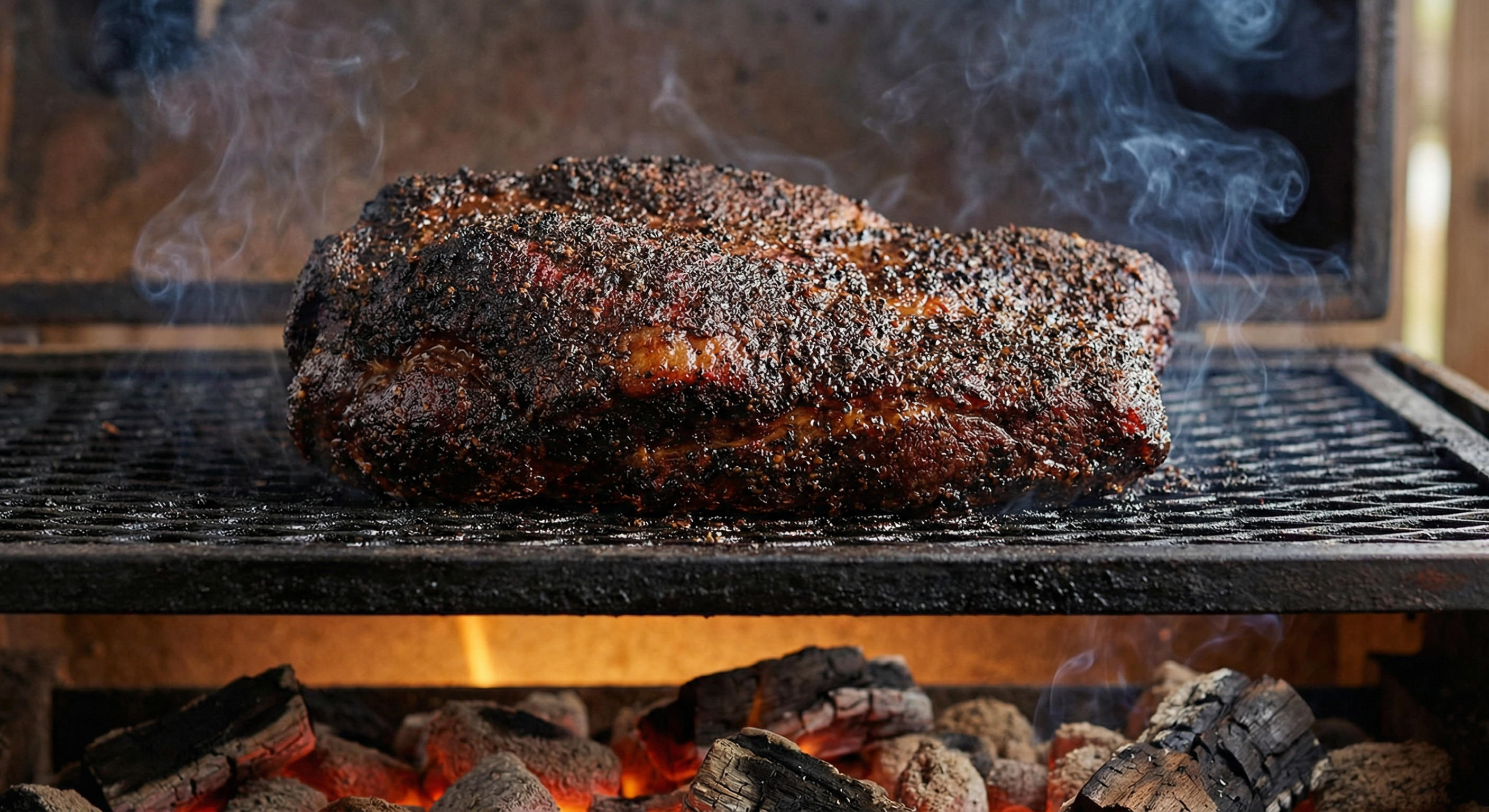
The BBQ Stall Explained: Why Your Meat Stops Cooking and How to Beat It
You light the smoker at dawn. The brisket goes on at 225°F. The internal temperature climbs steadily — 100°F, 120°F, 140°F. You're feeling good. Then somewhere around 150°F, the thermometer stops moving. An hour passes. Still 150°F. Two hours. Maybe 152°F. Three hours later, you're questioning everything you know about heat transfer.
This is the BBQ stall — and it's not your smoker malfunctioning. It's physics working exactly as intended.
What Is the BBQ Stall?
The BBQ stall (also called "the plateau" or "the zone") is a period during low-and-slow smoking where the internal temperature of a large cut of meat stops rising — sometimes for 2 to 6 hours. It typically occurs between 145°F and 170°F, with the most common stall point around 150–160°F.
The stall affects large, thick cuts cooked at low temperatures:
- Beef brisket — the most notorious stall victim
- Pork butt (Boston butt) — commonly stalls around 155–165°F
- Pork shoulder — similar behavior to pork butt
- Large beef roasts — chuck, round, or any cut over 4 pounds
Steaks, chicken breasts, and other thin or small cuts don't stall because they cook through before the mechanism has time to establish itself.
The Science: Evaporative Cooling
For decades, pitmasters attributed the stall to collagen breakdown, fat rendering, or some vague "protein transformation." In 2009, food scientist Dr. Greg Blonder (later co-author of Meathead: The Science of Great Barbecue and Grilling) ran controlled experiments that definitively identified the mechanism: evaporative cooling.
Here's what happens:
Phase 1: Temperature Rises (Room Temp to ~150°F)
When you first place meat in a 225°F smoker, heat flows from the hot air into the cooler meat. The internal temperature rises steadily because the rate of heat absorption far exceeds any heat loss. Some surface moisture evaporates, but not enough to significantly affect the temperature climb.
Phase 2: The Stall (~150–170°F)
As the meat warms, moisture from inside the muscle fibers migrates to the surface. At around 150°F, the rate of evaporation reaches a critical point where the cooling effect of evaporation equals the heating effect of the smoker.
Think of it like sweating. When you exercise, your body produces sweat that evaporates from your skin. That evaporation absorbs heat energy (the latent heat of vaporization of water is 2,260 kJ/kg — an enormous amount of energy). Your body temperature stays at 98.6°F even though you're generating heat through muscle activity, because sweat is carrying that heat away.
The brisket is doing the same thing. Moisture on its surface evaporates into the dry smoker air, absorbing heat energy that would otherwise raise the internal temperature. The meat is literally sweating, and that sweat is cooling it as fast as the smoker heats it.
The temperature flatlines. Energy input equals energy output. The system reaches a temporary equilibrium.
Phase 3: Breaking Through (~170°F+)
Eventually, the meat's surface dries out. As less moisture remains available for evaporation, the cooling effect diminishes. Heat absorption once again exceeds heat loss, and the internal temperature resumes climbing. The stall breaks, and the temperature rises toward your target (typically 195–205°F for brisket).
Dr. Blonder's Proof
Blonder's experiment was elegant. He placed identical cuts of beef in a smoker at 225°F. One was a normal piece of meat. The other was a wet sponge wrapped around a temperature probe — no protein, no fat, no collagen. Just water and cellulose.
Both stalled at approximately the same temperature. The wet sponge — which has no proteins to denature, no collagen to melt, no fat to render — stalled because its surface moisture was evaporating. This proved definitively that the stall is an evaporative phenomenon, not a chemical one.
He also tested meat sealed in a waterproof bag (preventing evaporation). No stall. The temperature rose steadily to the smoker temperature without plateauing. This confirmed that evaporation is the necessary and sufficient cause.
Factors That Affect the Stall
Humidity in the Smoker
Evaporation rate depends on the difference in humidity between the meat's surface and the surrounding air. A dry smoker (no water pan, dry wood) allows faster evaporation and can produce a more pronounced and longer stall. A humid smoker (water pan, wet wood) slows evaporation and can reduce or shorten the stall.
Smoker Temperature
At 225°F, the stall is most pronounced because the heat input is modest — evaporative cooling can match it relatively easily. At 275°F or higher, the heat input is stronger, and the stall is shorter (though it still occurs). At 325°F+, the stall may be barely noticeable because the heat overwhelms the evaporative cooling.
Meat Size and Surface Area
Larger cuts with more surface area have more area for evaporation and longer stalls. A 15-pound packer brisket stalls longer than an 8-pound flat. Surface-area-to-volume ratio matters — a flat, thin cut stalls differently than a thick, round one.
Fat Cap and Bark
A thick fat cap can slow evaporation from the surface it covers, potentially reducing the stall on that side. Bark formation (the dried, seasoned crust) also reduces evaporation as it develops, which is one reason the stall eventually breaks even without intervention.
Three Proven Methods to Beat the Stall
Method 1: The Texas Crutch (Wrapping)
The most popular stall-busting technique. When the internal temperature hits 150–165°F and stalls, wrap the meat tightly in aluminum foil or butcher paper and return it to the smoker.
Why it works: Wrapping traps moisture against the meat's surface, preventing evaporation. No evaporation means no evaporative cooling. The temperature resumes climbing immediately.
Aluminum foil: Creates a completely sealed environment. Fastest way through the stall. Downside: trapped steam softens the bark you worked hard to develop. The exterior comes out tender but not crispy.
Butcher paper (pink/peach paper): Semi-permeable — allows some moisture vapor to escape while still dramatically reducing evaporation. Preserves more bark texture than foil. This is the preferred method for competition brisket pitmasters like Aaron Franklin.
When to wrap: Most pitmasters wrap when the bark has set (usually around 160–170°F internal). If you wrap too early, the bark hasn't had enough time to develop. Too late, and you've already endured hours of unnecessary stall.
Method 2: Cook Hotter
Running your smoker at 275–300°F instead of 225°F increases the heat input enough to overwhelm evaporative cooling. The stall still occurs, but it's shorter and less dramatic.
Trade-off: Higher temperatures reduce the total time in the smoke zone, which means less smoke flavor penetration. The smoke ring may be thinner. But the time savings can be significant — a 14-hour brisket cook at 225°F might take only 8–10 hours at 275°F.
Many modern competition pitmasters run at 275°F for exactly this reason. The flavor difference between 225°F and 275°F is subtle; the time difference is enormous.
Method 3: Wait It Out
The stall always breaks eventually. If you have the time and patience, you can simply leave the meat in the smoker and let physics run its course. The surface will eventually dry enough that evaporation slows, and the temperature will resume climbing.
How long? A typical brisket stall lasts 2–6 hours at 225°F. Plan accordingly — if your brisket goes on at 6 AM and stalls at noon, you might not be eating until 8 PM or later.
The advantage: No wrapping means the bark continues developing through the entire cook. Pitmasters who wait through the stall often produce the crispiest, most developed bark. The smoke flavor continues building as well.
The Stall and Collagen Conversion
While the stall is caused by evaporative cooling (not collagen), it does coincide with important structural changes in the meat. Collagen — the tough connective tissue protein — begins converting to gelatin at around 160°F. This conversion is time-dependent: the longer the meat stays at or above 160°F, the more collagen converts.
This is actually a silver lining of the stall. While the temperature flatlines, collagen is steadily converting to gelatin, making the meat more tender. A brisket that stalls for 4 hours at 160°F may actually be more tender than one that rockets through without stalling, because it spent more time in the collagen conversion zone.
This is also why target temperatures for brisket (195–205°F) are so much higher than for steak. You're not just cooking the meat — you're dissolving collagen. The final temperature matters less than the total time spent above 160°F.
When Does the Stall NOT Happen?
- Thin cuts (under 2 inches): They cook through before enough surface moisture accumulates for significant evaporative cooling.
- Wrapped or bagged meat: No evaporation pathway means no stall.
- Very high temperatures (350°F+): Heat input overwhelms evaporative cooling so quickly that the stall is negligible.
- Humid environments: If the air in the smoker is already saturated with moisture (extreme humidity or sealed offset with a full water pan), evaporation slows dramatically.
Practical Timeline: Brisket with and without the Crutch
| Phase | No Wrap (225°F) | Wrapped at 165°F (225°F) | Hot & Fast (275°F, No Wrap) |
|---|---|---|---|
| Room temp to 150°F | 3–4 hours | 3–4 hours | 2–3 hours |
| The stall (150–170°F) | 3–6 hours | 1–2 hours (wrapped) | 1–2 hours |
| 170°F to 203°F | 3–4 hours | 2–3 hours | 2–3 hours |
| Total cook time | 12–16 hours | 8–11 hours | 7–10 hours |
| Bark quality | Maximum | Good (paper) / Soft (foil) | Good |
| Smoke flavor | Maximum | Good (less after wrap) | Moderate |
Reading the Stall: What Your Thermometer Tells You
If you're using a leave-in probe thermometer (which you should be for any long cook), the stall has a distinctive signature:
- Steady climb: Temperature rises 5–10°F per hour in the early phase.
- Deceleration: The rate slows as you approach 150°F — maybe 2–3°F per hour.
- Flatline: Temperature holds within a 2–3°F range for 1–6 hours. This is the stall.
- Breakthrough: Temperature begins climbing again, slowly at first, then more steadily. The stall is breaking.
- Final climb: Temperature rises at 3–5°F per hour toward your target of 195–205°F.
If you see the temperature actually drop during the stall (which can happen by 1–3°F), don't panic. This means evaporative cooling momentarily exceeded heat input — usually due to a draft or temperature fluctuation in the smoker. Close any vents slightly and ensure your fire is steady.
The Bottom Line
The BBQ stall is not a problem to solve — it's physics to understand. Once you know it's evaporative cooling (the same mechanism that keeps you cool on a hot day), you can make an informed decision:
- Wrap it (Texas Crutch) if you want to save 2–4 hours and don't mind slightly softer bark.
- Cook hotter (275°F) if you want to shorten the entire cook without wrapping.
- Wait it out if you want maximum bark, maximum smoke, and have the patience to match.
All three approaches produce excellent brisket. The stall isn't your enemy — it's just your meat sweating. And like any good workout, the results are worth the wait.
Frequently Asked Questions
What temperature does the BBQ stall happen?
The BBQ stall typically occurs between 145°F and 170°F internal temperature, with the most common stall point around 150–160°F. The exact temperature depends on the cut size, smoker temperature, and humidity. The stall can last anywhere from 2 to 6 hours at standard smoking temperatures (225°F).
What causes the BBQ stall?
Evaporative cooling. As the meat heats up, moisture from inside migrates to the surface and evaporates. This evaporation absorbs heat energy — the same physics behind sweating. At around 150°F, the cooling effect of evaporation equals the heating from the smoker, causing the temperature to flatline. It is not caused by collagen breakdown or fat rendering.
How do you get past the BBQ stall?
Three proven methods: (1) The Texas Crutch — wrap in foil or butcher paper at 160–170°F to stop evaporation. (2) Cook hotter at 275–300°F so heat input overwhelms evaporative cooling. (3) Wait it out — the surface eventually dries, evaporation slows, and the temperature resumes climbing. All three produce excellent results.
Does wrapping brisket ruin the bark?
Aluminum foil traps steam and significantly softens the bark. Butcher paper (pink/peach paper) is semi-permeable — it reduces evaporation enough to shorten the stall while allowing some moisture to escape, preserving more bark texture. Most competition pitmasters prefer butcher paper for this reason.
Do all meats experience the BBQ stall?
Only large, thick cuts cooked at low temperatures (225–275°F) experience a significant stall. Brisket, pork butt, and pork shoulder are the most common. Thin cuts like steaks and chicken breasts cook through too quickly for the evaporative cooling mechanism to establish equilibrium.
Is the BBQ stall the same as collagen breaking down?
No. The stall is caused by evaporative cooling, not collagen breakdown. However, the stall temperature range (150–170°F) does overlap with the temperatures where collagen begins converting to gelatin (160°F+). The stall actually benefits tenderness by giving collagen extra time to convert while the temperature is plateaued.
More Expert Guides
Steak Doneness Temperature Guide: The Science of Every Level from Rare to Well Done
Every degree matters. This science-backed guide covers the exact internal temperatures for every steak doneness level, why each temperature produces a different texture, and how to nail your target every time.
14 min readDirect vs Indirect Heat Grilling: The Science of Two-Zone Cooking
Direct heat sears. Indirect heat roasts. Understanding the physics of each — and when to combine them — is the foundation of every great grilling technique.
14 min readResting Meat After Cooking: The Science of Why It Makes Every Steak Juicier
Resting meat after cooking is not optional — it is physics. Here is exactly what happens inside the steak during those crucial minutes and how long to rest every cut.