Carryover Cooking: How Temperature Continues Rising After Heat Removal
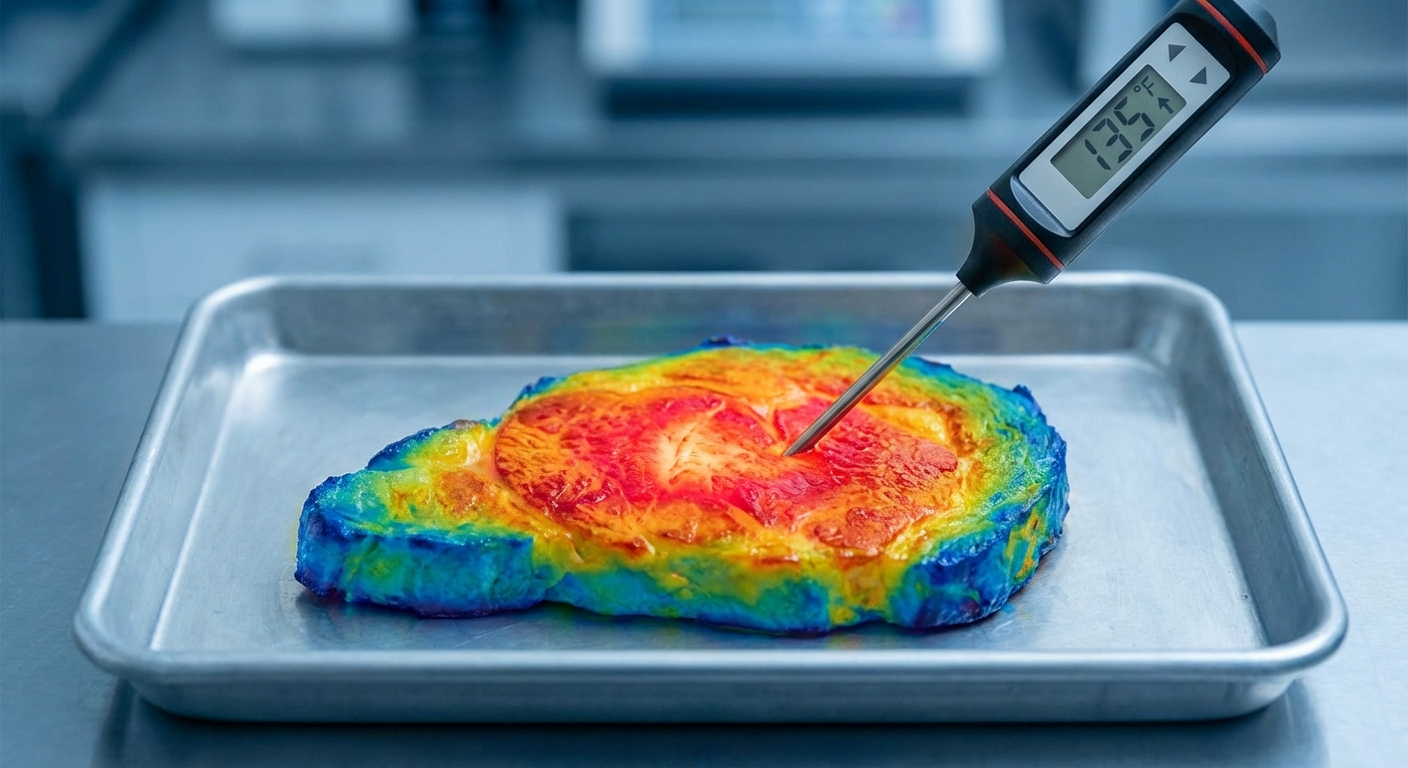
Carryover cooking is the phenomenon where a steak's internal temperature continues to rise after it's been removed from the heat source. It's not magic — it's basic thermodynamics. And failing to account for it is the single most common reason home cooks overshoot their target doneness.
Here's the key concept: when you pull a steak off the grill, the outer layers are much hotter than the center. The surface might be 400°F (from the sear), the layer just below might be 180°F, and the geometric center might be 130°F. Heat flows from hot to cold — always. So that stored thermal energy in the outer layers continues flowing inward, raising the center temperature even though no external heat is being applied.
How Much Carryover to Expect
Carryover varies significantly based on several factors. Here are the ranges I've measured across hundreds of tests:
| Cooking Method | Typical Carryover | Why |
|---|---|---|
| High-heat grill (direct) | 8–15°F | Very hot outer layers, steep gradient |
| Conventional sear-first | 5–10°F | Hot outer layers from sear + oven finish |
| Reverse sear (after sear) | 3–5°F | More uniform temperature, less stored heat in outer layers |
| Sous vide (after sear) | 2–4°F | Very uniform internal temp, brief sear adds minimal heat |
| Large roast (oven) | 10–20°F | Massive thermal mass, significant stored energy |
The Physics: Fourier's Law in Your Kitchen
Carryover cooking is governed by Fourier's law of heat conduction: heat flux is proportional to the temperature gradient. The steeper the gradient between the steak's outer layers and its center, the more heat flows inward after removal from the heat source, and the higher the carryover.
This is precisely why the reverse sear produces less carryover than conventional cooking. The reverse sear's low-and-slow first phase creates a shallow thermal gradient — the difference between the outer layers and the center might be only 20–30°F. A conventionally grilled steak might have a 200°F differential between the seared surface and the center. More stored energy in the outer layers = more carryover.
Thickness and Thermal Mass
Thicker steaks have more carryover than thin ones because they contain more total thermal energy and the heat has farther to travel. A 2-inch ribeye pulled off a hot grill can carryover 12–15°F. A 3/4-inch flank steak might carryover only 3–5°F. The relationship isn't perfectly linear, but thickness is the strongest predictor of carryover magnitude.
How to Account for Carryover
The practical application is simple: pull your steak before it reaches the target temperature. This is especially critical with high-end cuts like A5 wagyu steaks, where even a few extra degrees can mean the difference between transcendent and overcooked.
For the Reverse Sear
Pull from the oven when the center reads 10–15°F below your target (accounting for the sear). After the 45–60 second sear adds its heat contribution, the center will approach your target. Then 3–5°F of carryover during the 5-minute rest brings you to final temp.
Example for 131°F medium-rare:
- Pull from oven at 115°F
- Sear adds ~12°F → center reaches ~127°F
- Rest carryover adds ~4°F → final center temp ~131°F
For Conventional Grilling
Pull the steak when the center reads 5–10°F below your target.
Example for 131°F medium-rare:
- Pull from grill at 123°F
- Carryover during 8-minute rest adds ~8°F → final center temp ~131°F
For Sous Vide
The steak is already at your target temperature in the bag. The sear adds heat to the outer layers, which slightly increases the center temperature (2–4°F). Account for this by setting the bath temperature 2–3°F below your ideal final temp, or simply accept a slightly higher final reading.
Monitoring Carryover in Real Time
If you're using a leave-in probe thermometer (which I recommend for the oven and rest phases), you can watch carryover happen in real time. After pulling the steak from the heat, leave the probe inserted and observe the temperature continue climbing, plateau, then slowly begin to decline. The peak reading is your actual final internal temperature.
On my ThermoWorks Smoke, I can see the temperature graph curve upward for 2–5 minutes after pulling from heat, flatten at the peak for 30–60 seconds, then begin a slow descent. The peak usually occurs 3–4 minutes after removal for a standard 1.5-inch steak.
Reducing Carryover When Needed
If your steak is running hotter than intended and you need to minimize carryover:
- Transfer to a cool wire rack — this allows air circulation on all sides, pulling heat away from the surface faster.
- Place in a cool area — not the countertop next to the hot stove. A cooler ambient temperature speeds surface cooling.
- Don't tent with foil — foil traps heat and slows cooling, increasing carryover.
- For emergencies: a brief ice bath (2–3 seconds) stops carryover cold. Not ideal, but saves a steak that's about to overcook.
Frequently Asked Questions
How many degrees does a steak rise after cooking?
It depends on the cooking method and thickness. High-heat grilling: 8–15°F. Conventional sear-and-oven: 5–10°F. Reverse sear: 3–5°F. Sous vide: 2–4°F. Thicker steaks and higher cooking temperatures produce more carryover.
Why does the reverse sear have less carryover?
The reverse sear creates a shallow thermal gradient — the outer layers are only slightly hotter than the center. Less stored heat in the outer layers means less heat flows inward after removal. Conventional high-heat methods create steep gradients with much more thermal energy stored in the exterior.
What temperature should I pull steak for medium-rare?
For the reverse sear: pull from oven at 115°F (the sear and rest will add ~16°F total). For direct grilling: pull at 123°F (rest will add ~8°F). For sous vide: the bath is already at your target temp; the sear adds 2–4°F. All methods target a final center temp of 129–133°F.
Does carryover cooking affect thin steaks?
Less so. A 3/4-inch steak has less thermal mass and a shorter distance for heat to travel from surface to center. Carryover is typically only 3–5°F for thin cuts. The thinner the steak, the less you need to account for carryover.
More Expert Guides
Grill Vent Management: The Science of Airflow and Temperature Control
Oxygen controls fire. Fire controls temperature. Vents control oxygen. Master your vents and you master your grill.
12 min readHow Often to Flip Steak: The Science of Multiple Flips vs Single Flip
The traditional advice to flip your steak only once is wrong. Science shows that flipping every 30 seconds produces better crust, more even doneness, and 30% faster cooking through improved heat transfer.
12 min readThe Science of Plancha Grilling: How High Heat and Flat Surfaces Create Superior Crust
Plancha grilling delivers more surface contact, higher heat, and better crust than traditional grates. Here is the science behind why flat-top cooking produces superior results.