Carryover Cooking Temperature Chart: The Science of Resting Meat
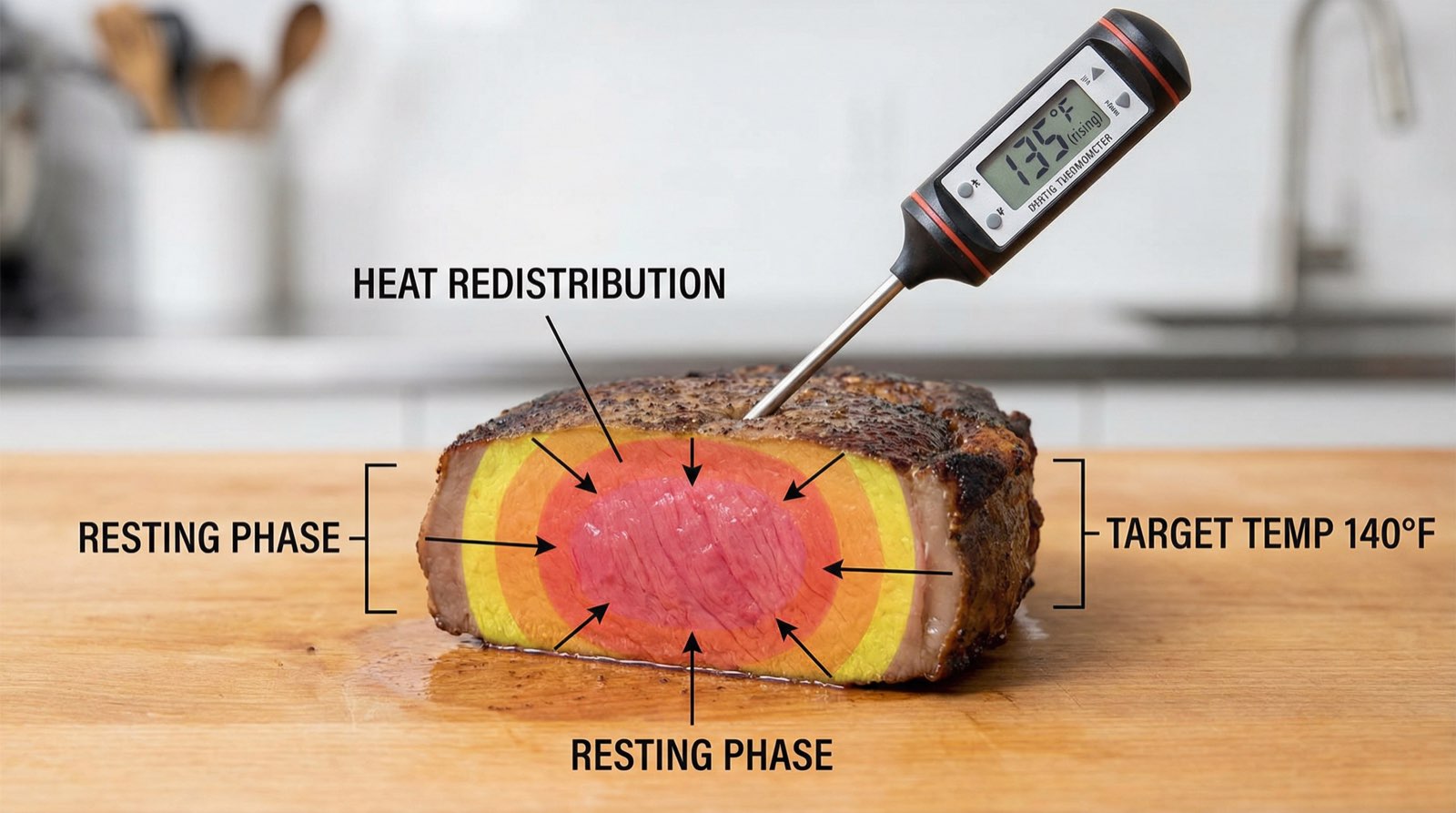
As a food scientist who's spent years studying protein denaturation and heat transfer, I can tell you that carryover cooking is one of the most misunderstood—yet critical—concepts in cooking meat. The phenomenon is simple: meat continues cooking even after you remove it from the heat source. But the implications for your cooking technique are profound.
When you pull a steak, roast, or whole chicken from the grill or oven, residual heat stored in the outer layers continues to migrate toward the cooler center. This internal heat transfer can raise the core temperature by 5 to 15°F (3 to 8°C) or more, depending on the size and cooking method. Ignore this principle, and you'll consistently overcook expensive cuts. Master it, and you'll achieve steakhouse-level precision at home.
The Physics of Carryover Cooking
Carryover cooking occurs due to thermal momentum. During cooking, the outer portions of meat reach significantly higher temperatures than the center—often 20-40°F higher in larger roasts. When you remove the meat from heat, this temperature gradient doesn't disappear instantly. Heat energy flows from hot to cold (second law of thermodynamics), causing the interior temperature to rise while the exterior cools.
The magnitude of carryover depends on four primary factors:
- Mass and thickness: Larger, thicker cuts have more thermal mass and experience greater carryover (up to 15°F in large roasts)
- Cooking method: High-heat methods (searing, grilling) create steeper temperature gradients and more carryover than low-and-slow methods
- Final cooking temperature: Meat cooked to higher temperatures has more stored heat and greater carryover
- Resting environment: Covering meat with foil traps heat and increases carryover; resting uncovered reduces it
Comprehensive Carryover Cooking Temperature Chart
This chart shows the pull temperature (when to remove from heat), expected carryover, and final resting temperature for optimal doneness. All temperatures are in Fahrenheit for internal temperature measured at the thickest part.
| Meat Type | Doneness | Pull Temp | Carryover | Final Temp |
|---|---|---|---|---|
| Beef Steaks (1-2 inch thick) |
Rare | 115-120°F | 5°F | 120-125°F |
| Medium-Rare | 125-130°F | 5°F | 130-135°F | |
| Medium | 135-140°F | 5°F | 140-145°F | |
| Medium-Well | 145-150°F | 5°F | 150-155°F | |
| Well Done | 155-160°F | 5°F | 160-165°F | |
| Beef Roasts (prime rib, tenderloin) |
Medium-Rare | 120-125°F | 10-15°F | 130-140°F |
| Medium | 130-135°F | 10-15°F | 140-150°F | |
| Pork Chops (1 inch thick) |
Medium (recommended) | 140-145°F | 5°F | 145-150°F |
| Medium-Well | 145-150°F | 5°F | 150-155°F | |
| Well Done | 155-160°F | 5°F | 160-165°F | |
| Pork Tenderloin | Medium | 140-145°F | 5-8°F | 145-153°F |
| Pork Shoulder/Butt | Pulled Pork | 195-200°F | 5-8°F | 200-208°F |
| Lamb Chops (1 inch thick) |
Medium-Rare | 125-130°F | 5°F | 130-135°F |
| Medium | 135-140°F | 5°F | 140-145°F | |
| Medium-Well | 145-150°F | 5°F | 150-155°F | |
| Lamb Leg (Roast) | Medium-Rare | 125-130°F | 10-15°F | 135-145°F |
| Chicken Breast | Fully Cooked | 155-160°F | 5-8°F | 160-168°F |
| Chicken Thighs | Fully Cooked | 165-170°F | 5-8°F | 170-178°F |
| Whole Chicken | Fully Cooked | 155-160°F | 10-15°F | 165-175°F |
| Turkey (Whole) | Fully Cooked | 155-160°F | 10-15°F | 165-175°F |
| Duck Breast | Medium-Rare | 125-130°F | 5°F | 130-135°F |
| Venison (Steaks) | Medium-Rare | 125-130°F | 5°F | 130-135°F |
| Brisket | Sliceable | 195-200°F | 5-10°F | 200-210°F |
Resting Time Guidelines
Proper resting time allows carryover cooking to complete and permits myoglobin-rich juices to redistribute through the meat fibers. The general rule: rest for approximately one minute per 100 grams of weight, with these minimums:
- Steaks and chops (6-12 oz): 5-8 minutes
- Whole chickens and small roasts (3-5 lbs): 15-20 minutes
- Large roasts and turkeys (8-15 lbs): 20-30 minutes
- Prime rib and very large roasts (15+ lbs): 30-45 minutes
For competition-level results, tent meat loosely with aluminum foil during resting. This traps enough heat to facilitate carryover while allowing surface moisture to escape, preserving crust quality on steaks and roasts.
Common Carryover Cooking Mistakes
1. Not Accounting for Size Differences
A 6-ounce filet mignon experiences minimal carryover (3-5°F), while a 5-pound prime rib can rise 15°F or more. Adjust your pull temperature based on mass, not just meat type.
2. Cutting Immediately After Cooking
Slicing meat immediately after cooking releases pressurized juices that haven't had time to redistribute. The result is dry meat and a puddle on your cutting board. Those juices contain water-soluble proteins, flavor compounds, and dissolved minerals—everything that makes meat taste juicy.
3. Covering Too Tightly
Wrapping meat tightly in foil creates a steam environment that softens crispy crusts. For steaks with a good sear, rest uncovered or under a loose foil tent.
4. Using Final Temperature as Your Target
Many home cooks cook until they reach their target temperature, not realizing the meat will overshoot during rest. Always pull 5-15°F early depending on size.
The Science of Temperature and Protein Denaturation
Understanding why specific temperatures matter requires knowledge of protein behavior. Meat is primarily water (65-75%), protein (15-20%), and fat (3-15%). When heated, muscle proteins denature—their coiled structures unfold and bond together, squeezing out water in the process.
Key temperature thresholds for beef:
- 120°F: Myosin (motor protein) begins denaturing; meat is still very soft and red
- 140°F: Actin (structural protein) denatures; meat firms significantly and turns pink
- 150°F: Collagen begins converting to gelatin in connective tissue
- 160°F: Most proteins fully denatured; meat is firm, gray-brown, and releases substantial moisture
For poultry, the critical temperature is 165°F, where salmonella dies instantly. However, salmonella also dies at lower temperatures with longer hold times (155°F for 60 seconds, 150°F for 3 minutes). This is why pulling chicken at 155-160°F and allowing carryover to reach 165°F can yield juicier results.
Frequently Asked Questions
Does carryover cooking happen with all cooking methods?
Yes, but the magnitude varies. High-heat methods (grilling, pan-searing, roasting at 400°F+) create steeper temperature gradients and more carryover. Low-and-slow methods (smoking at 225°F, sous vide) produce minimal gradients and less carryover—often just 2-3°F.
How do I minimize carryover cooking?
Use reverse searing: cook meat slowly to within 10°F of your target, then sear briefly at high heat. This minimizes the temperature gradient. Alternatively, cook thin cuts (under 1 inch) which have less thermal mass.
Can I skip resting if I want to eat immediately?
Technically yes, but you'll sacrifice juice retention. If you must skip resting, pull your meat at the exact final temperature you want rather than accounting for carryover—but expect drier results.
What's the best thermometer for measuring carryover?
Use a leave-in probe thermometer (digital or wireless) that stays in the meat during resting. This lets you monitor the temperature rise in real-time. Instant-read thermometers work but require repeated probing, which releases juices.
Does covering with foil increase carryover cooking?
Yes, by 2-3°F compared to uncovered resting. Foil traps heat and creates a warmer microenvironment. If you've already pulled meat on the early side, tenting with foil helps ensure you reach your target. If you pulled late, rest uncovered.
Why does my thermometer show different temperatures in different spots?
Temperature distribution in meat is rarely uniform. The geometric center is typically coolest, while areas near the surface and bones are hotter. Always measure at the thickest part, away from bone and fat, for the most conservative (lowest) reading.
Is carryover cooking different for grass-fed vs. grain-fed beef?
Not significantly. The physical properties (thermal conductivity, specific heat capacity) are nearly identical. The main difference is that grass-fed beef is typically leaner, so it's more prone to drying out if overcooked—making proper carryover technique even more important.
Can I apply carryover cooking principles to sous vide?
Sous vide produces minimal carryover (1-3°F) because the entire piece of meat reaches the target temperature uniformly. However, if you sear after sous vide, the searing can add heat—pull from the bath 5°F early if you plan a hard sear.
Dr. Claire Whitfield holds a PhD in Food Science from UC Davis and has published peer-reviewed research on protein denaturation kinetics in meat systems. She consults for restaurants and meat producers on cooking science and quality optimization.
More Expert Guides
Steak Doneness Temperature Guide: The Science of Every Level from Rare to Well Done
Every degree matters. This science-backed guide covers the exact internal temperatures for every steak doneness level, why each temperature produces a different texture, and how to nail your target every time.
14 min readDirect vs Indirect Heat Grilling: The Science of Two-Zone Cooking
Direct heat sears. Indirect heat roasts. Understanding the physics of each — and when to combine them — is the foundation of every great grilling technique.
14 min readResting Meat After Cooking: The Science of Why It Makes Every Steak Juicier
Resting meat after cooking is not optional — it is physics. Here is exactly what happens inside the steak during those crucial minutes and how long to rest every cut.