Cast Iron vs Grill: Heat Transfer Science for Perfect Sear
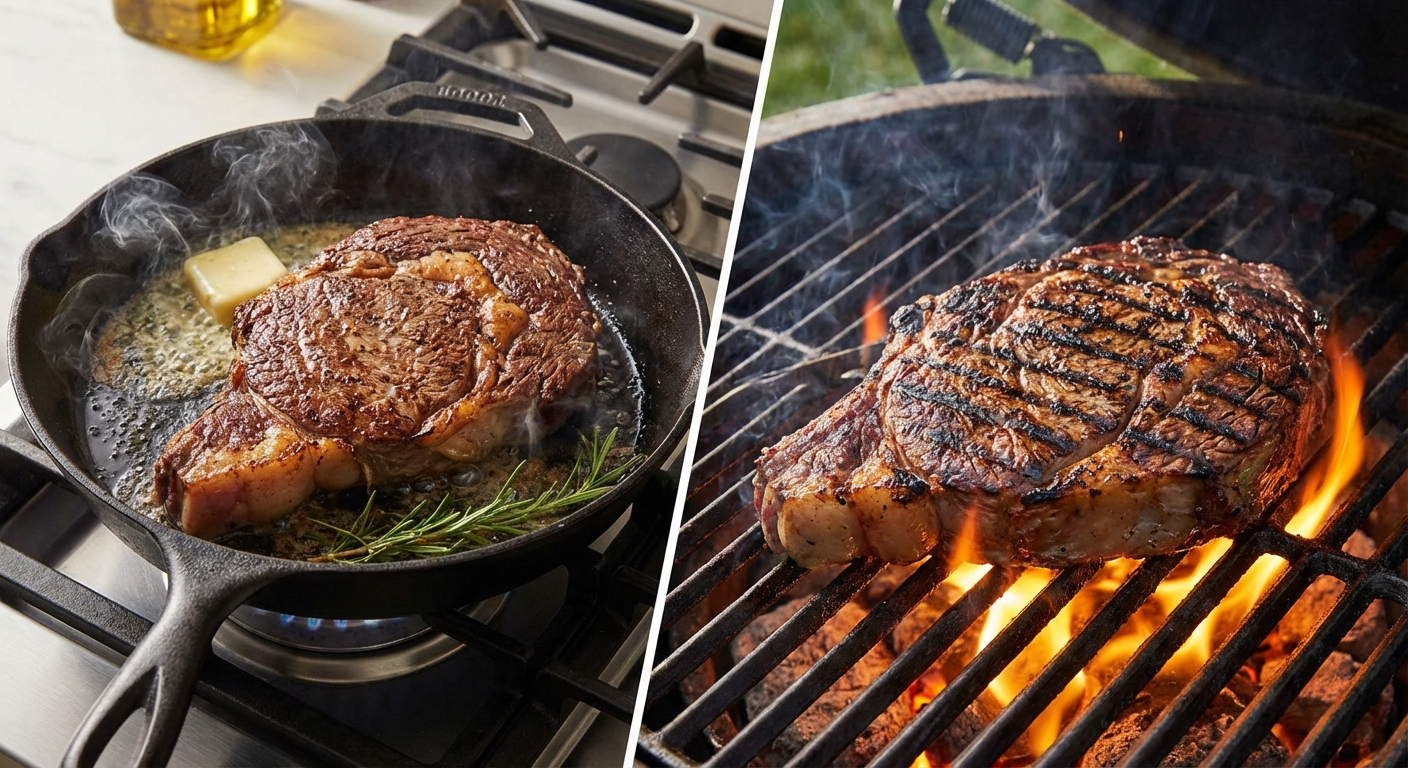
The debate between cast iron and grill for searing steak usually focuses on flavor preference. That's valid — but there's a more precise way to think about it. Cast iron and grills transfer heat through different physical mechanisms, and those mechanisms produce measurably different results on the steak's surface.
Cast iron searing is predominantly conduction: direct metal-to-meat contact. Grilling involves a mix of radiation (infrared energy from hot coals or gas burners), convection (hot air movement), and some conduction (where the steak contacts the grill grates). These different heat transfer mechanisms create different crust characteristics.
Conduction: The Cast Iron Advantage
When a steak sits flat on a 600°F cast iron surface, the contact area is essentially 100% of the bottom face. Every square inch of the steak's surface is touching 600°F metal. Conduction — heat flowing from hot metal directly into the cooler meat — is the most efficient form of heat transfer for creating a crust.
The rate of conductive heat transfer depends on three things: the temperature difference between the pan and the steak, the contact area, and the thermal conductivity of the materials in contact. Cast iron has a thermal conductivity of about 52 W/m·K — not the highest among metals (copper is 385, aluminum is 205), but combined with its enormous thermal mass, it's ideal for searing.
Why Thermal Mass Matters
A 12-inch Lodge cast iron skillet weighs about 8 pounds. All that mass stores a huge amount of thermal energy. When a cold (or even room-temp) steak hits the surface, the pan's temperature drops — but because of that stored energy, the drop is much smaller than it would be with a thin pan.
I've measured this with infrared thermometry. A 12-inch cast iron skillet preheated to 650°F drops to roughly 550°F when a 1-pound room-temperature ribeye is placed on it. A thin stainless steel pan under the same conditions drops to 380°F. That 170°F difference in searing temperature means the cast iron produces a Maillard crust roughly 3–4x faster than the stainless pan.
The Grill: Radiation and Convection
On a grill, the steak sits on thin metal grates, not a solid surface. Contact area is maybe 15–20% of the steak's bottom face — just the narrow strips where grate meets meat. The rest of the heat arrives via infrared radiation from the coals/burners below and hot convection currents around the steak.
Radiation doesn't require contact. Hot coals at 1,200°F emit infrared radiation that heats the steak's surface directly. But because air is between the coals and the steak (and air is a poor thermal conductor), the heat delivery is less concentrated than conduction from a solid surface.
The result: grill marks where the grates touch (those dark brown lines are Maillard reaction zones from conduction), with lighter browning between them (from radiation and convection). The crust is uneven — deeply browned in stripes, less browned between.
The Grill's Advantage: Airflow and Flavor
Grills have advantages that cast iron can't match. The open airflow means surface moisture evaporates faster — hot, dry air carries steam away from the steak's surface efficiently. This is why a steak on a hot grill can develop browning quickly despite the lower overall contact.
There's also the flavor contribution from fat dripping onto hot coals or flavorizer bars. The fat vaporizes and the smoke carries volatile compounds back up onto the steak. This isn't the Maillard reaction — it's a separate flavor contribution from pyrolyzed fat. It's the taste people describe as "grilled flavor," and no indoor cooking method perfectly replicates it.
Head-to-Head: Crust Quality Comparison
I've seared identical steaks (same cut, thickness, temp, and surface moisture level) on cast iron vs. a charcoal grill. Measured crust depth with a digital caliper (yes, I'm that person). Results:
- Cast iron (650°F, 60 seconds/side): Average crust depth 1.2mm. Even browning across entire surface. No gray band below crust (reverse sear oven phase first).
- Charcoal grill (direct heat, grates at 700°F, 60 seconds/side): Average crust depth 0.8mm. Deep browning on grate contact lines (1.5mm), lighter browning between. Slightly more gray band due to longer overall exposure.
Cast iron wins on crust uniformity and depth. The grill wins on the smoky flavor dimension and the overall cooking experience. There's no wrong answer — just different physics producing different results. Both methods shine with high-quality beef, whether it's USDA Prime or The Meatery's wagyu selection.
When to Choose Cast Iron
- Indoor cooking (obviously)
- When you want the most uniform crust possible — no grill marks, just an even mahogany sear
- For the reverse sear finishing step
- When butter basting (difficult on a grill without a pan)
- For thin steaks that cook quickly — the intense, even conduction is an advantage
When to Choose the Grill
- When you want smoke flavor from fat drippings
- For very thick steaks using the indirect-to-direct method (grill reverse sear)
- When cooking multiple steaks (more surface area available)
- For bone-in cuts that don't sit flat in a pan
- When the weather's nice and you want to be outside (honestly a valid reason)
The Hybrid Approach
My favorite method for a special steak combines both: reverse sear in a low oven, then finish on a cast iron skillet that's been preheating on the grill's side burner (or on the grill grates themselves). You get the thermal mass and even contact of cast iron plus the open-air cooking environment.
For infrared searing alternatives that change the equation entirely, there are dedicated searing stations that produce surface temperatures above 1,500°F. At that heat intensity, the physics shift — radiation dominates regardless of contact area. But for most home cooking, the cast iron vs. grill debate covers the two most practical options.
Frequently Asked Questions
Which produces a better sear: cast iron or grill?
Cast iron produces a more uniform sear because the steak has 100% contact with the hot surface (conduction). Grills produce concentrated browning on grate lines with lighter browning between. Cast iron gives better overall crust depth; grills add smoky flavor from vaporized fat drippings.
What temperature should a cast iron skillet be for searing?
Aim for 600–700°F surface temperature. Preheat for at least 5 minutes on maximum heat. Use an infrared thermometer if you have one. You should see wisps of smoke from the oil when you add it — that confirms you're in the right temperature range.
Why does my cast iron smoke so much when searing?
Because you're doing it right. At 600°F+, oils exceed their smoke point and produce visible smoke. Avocado oil (smoke point 520°F) smokes less than olive oil (375°F). Some smoke is unavoidable and expected during a proper sear. Open a window and turn on the range hood.
Can I get grill marks on a cast iron pan?
A standard flat cast iron skillet produces an even sear, not grill marks. If you want lines, use a cast iron grill pan with raised ridges. However, grill marks are mostly cosmetic — the even sear from a flat pan produces more total Maillard browning (and therefore more flavor) because more surface area contacts the heat.
More Expert Guides
Grill Vent Management: The Science of Airflow and Temperature Control
Oxygen controls fire. Fire controls temperature. Vents control oxygen. Master your vents and you master your grill.
12 min readHow Often to Flip Steak: The Science of Multiple Flips vs Single Flip
The traditional advice to flip your steak only once is wrong. Science shows that flipping every 30 seconds produces better crust, more even doneness, and 30% faster cooking through improved heat transfer.
12 min readThe Science of Plancha Grilling: How High Heat and Flat Surfaces Create Superior Crust
Plancha grilling delivers more surface contact, higher heat, and better crust than traditional grates. Here is the science behind why flat-top cooking produces superior results.