Charcoal vs Gas Grilling: The Science Behind Flavor, Heat, and Performance
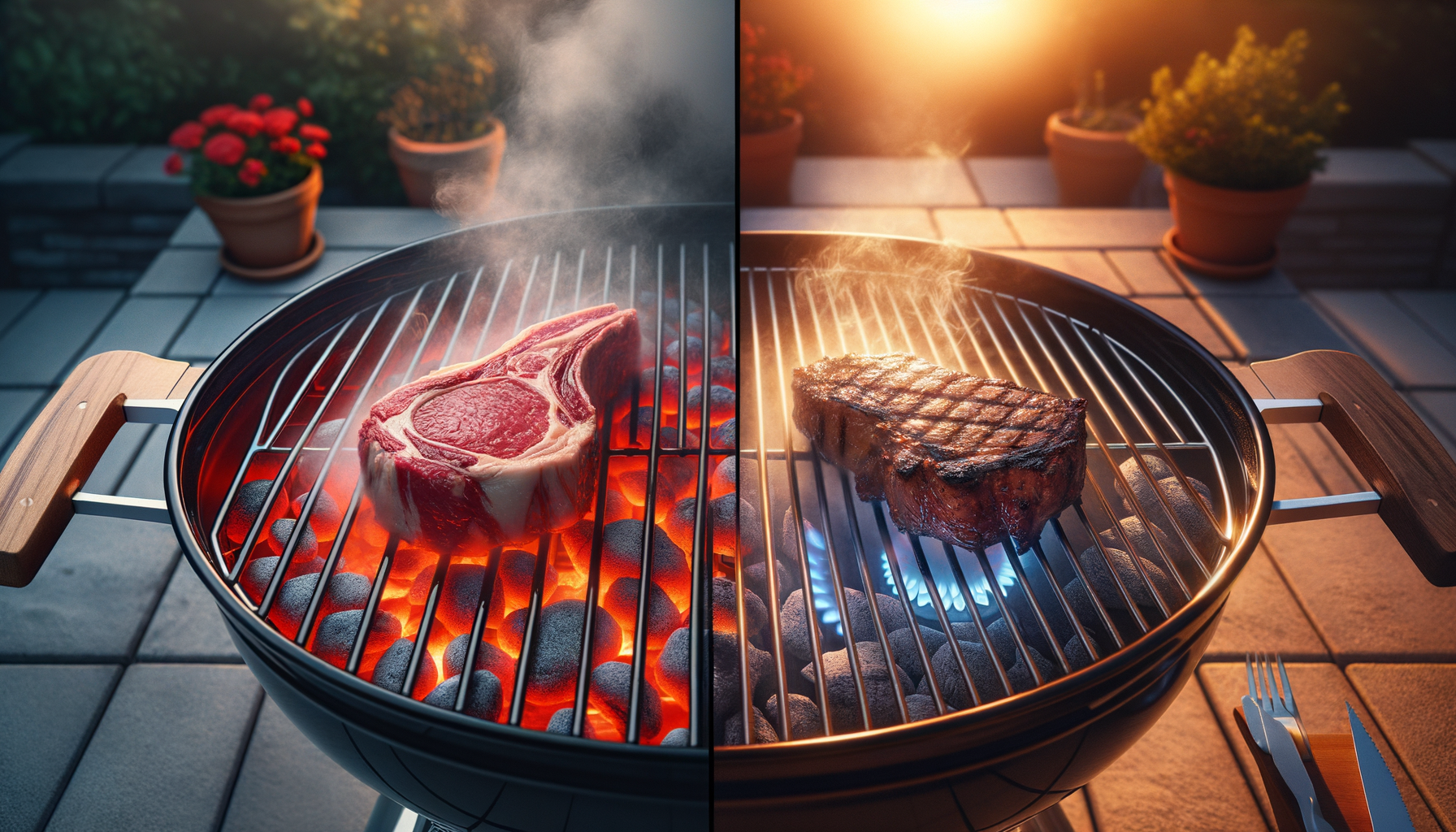
Charcoal vs Gas Grilling: The Science Behind Flavor, Heat, and Performance
The charcoal-versus-gas debate has divided backyard grillers for decades. Charcoal loyalists insist nothing matches the flavor of live fire. Gas advocates point to convenience and temperature control. Both sides have strong opinions — but the science is clear on exactly why these two fuels produce different results.
This is not a subjective taste comparison. It is a breakdown of combustion chemistry, radiant heat physics, and flavor compound formation that explains what is actually happening at the molecular level when you cook over each fuel type.
Combustion Chemistry: What Each Fuel Actually Burns
Charcoal
Charcoal is wood that has been heated in a low-oxygen environment (pyrolysis) until all moisture and most volatile organic compounds have been driven off. What remains is roughly 75-90% carbon by weight, depending on quality. When charcoal burns in a grill, it undergoes a solid-phase combustion reaction:
C + O₂ → CO₂ + heat (393 kJ/mol)
In oxygen-limited zones — which exist throughout a charcoal bed because airflow is never perfectly uniform — incomplete combustion also produces carbon monoxide (CO) and a range of volatile organic compounds (VOCs). These VOCs include phenols, furans, carbonyls, and organic acids, many of which contribute directly to flavor.
Lump charcoal retains more of the original wood structure and produces more aromatic smoke than briquettes, which are compressed with binders (typically starch and limestone). Briquettes burn more uniformly but generate fewer flavor compounds from combustion.
Gas (Propane and Natural Gas)
Propane (C₃H₈) and natural gas (primarily methane, CH₄) are clean-burning hydrocarbons. In a well-tuned burner with adequate oxygen, propane combustion is nearly complete:
C₃H₈ + 5O₂ → 3CO₂ + 4H₂O + heat (2,220 kJ/mol)
The key difference: gas combustion produces almost no volatile organic compounds. The exhaust is essentially carbon dioxide and water vapor. There are no phenols, no furans, no guaiacol, no syringol — none of the aromatic molecules that create "smoky" flavor. Gas is, from a chemistry perspective, a flavor-neutral fuel.
Where Does Grilled Flavor Actually Come From?
This is the most misunderstood part of the debate. Most of the flavor in grilled food — regardless of fuel — comes from the Maillard reaction and fat pyrolysis, not from the fuel itself.
The Maillard Reaction
When proteins and sugars on the meat surface reach 280-330°F, they undergo the Maillard reaction, producing hundreds of unique flavor and aroma compounds. This reaction is identical whether the heat source is charcoal, gas, electric, or a blowtorch. The Maillard reaction depends on surface temperature and time, not fuel type.
Fat Drip Pyrolysis
When fat and juices drip from the meat onto hot surfaces — charcoal, lava rocks, flavorizer bars, or burner covers — they undergo flash pyrolysis. The fat decomposes instantly at 500°F+ into volatile compounds that rise as smoke and vapor, coating the meat. These compounds include:
- Fatty acid decomposition products — aldehydes, ketones, and short-chain fatty acids
- Glycerol breakdown products — acrolein (sharp, pungent) and other aldehydes
- Protein fragment volatiles — from amino acids in the drippings
This is significant because both charcoal and gas grills produce drip pyrolysis flavor. The difference is that charcoal provides a much larger hot surface area for drippings to contact. An even bed of charcoal directly below the cooking grate creates hundreds of contact points. A gas grill's flavorizer bars or heat tents provide far fewer.
In controlled studies — including Harold McGee's analysis and the team at America's Test Kitchen — the flavor difference between charcoal and gas is small in fast-cooking items (burgers, thin steaks, vegetables) and more pronounced in longer cooks where cumulative smoke exposure matters.
Charcoal-Specific Flavor Compounds
The compounds unique to charcoal cooking come from two sources:
- Incomplete combustion VOCs: Phenolic compounds (guaiacol, syringol, cresol) from the carbon matrix. These are the same compounds found in wood smoke and are responsible for the "smoky" note in charcoal-grilled food.
- Ash and mineral interactions: The alkaline ash (potassium carbonate and calcium carbonate) can subtly affect the surface chemistry of food cooked directly above it, though this effect is minor.
The total concentration of these charcoal-specific compounds is measurably higher in food cooked over charcoal, but the magnitude depends heavily on grill design, airflow, cook time, and the type of charcoal used. Lump hardwood charcoal over a long cook produces the most. Briquettes on a quick sear produce barely more than a well-designed gas grill with vaporizer bars.
Radiant Heat: The Physics of Each Fuel
Heat transfer in grilling happens through three mechanisms: radiation (infrared energy from hot surfaces), convection (hot air movement), and conduction (direct contact with the grate). The ratio of these three differs significantly between charcoal and gas.
Charcoal: Radiation-Dominant
A bed of glowing charcoal at 900-1100°F emits intense infrared radiation. This radiant energy travels in straight lines from the coals to the food surface. The intensity follows the inverse-square law — doubling the distance from the coals reduces radiant heat to one-quarter.
Key characteristics of charcoal radiant heat:
- High peak temperature: A fully lit chimney of lump charcoal can produce surface temperatures exceeding 1,200°F at grate level
- Uneven distribution: Hot spots directly above deeper coal beds, cooler spots at edges
- Declining over time: Charcoal burns down, reducing heat output as the cook progresses
- Adjustable by airflow: Opening vents increases combustion rate and temperature; closing vents chokes the fire
Gas: Convection-Dominant
Gas burners heat metal surfaces (burner covers, flavorizer bars, ceramic briquettes) which then radiate heat upward. However, a significant portion of the energy rises as heated air (convection) rather than direct infrared radiation.
Key characteristics of gas heat:
- Consistent temperature: A gas burner delivers steady BTU output as long as fuel flows
- More uniform: Multi-burner systems create even heat across the cooking surface
- Lower radiant peak: Flavorizer bars and heat tents rarely exceed 700-800°F, producing less intense radiant heat than live coals
- Instant adjustment: Turn a knob to change heat output in seconds
Why This Matters for Searing
The higher radiant heat intensity of charcoal means it can drive the Maillard reaction faster at the meat surface. A steak placed 3 inches above a full chimney of lump charcoal will develop a crust in 60-90 seconds per side. The same steak on a gas grill at maximum may need 2-3 minutes per side for equivalent browning.
This speed advantage matters because faster searing means less internal overcooking. The heat has less time to penetrate past the surface. This is why many competition cooks who use gas for convenience still finish steaks over a charcoal chimney for the final sear.
Temperature Control and Precision
This is where gas grills have an unambiguous advantage. Temperature control on a gas grill is linear and predictable: turn the knob, the flame adjusts, the temperature responds within 30 seconds. Multi-zone cooking is effortless — simply set different burners to different levels.
Charcoal temperature control is a skill. It requires managing:
- Fuel quantity: More charcoal = more heat (but also more fuel consumption and longer preheat)
- Airflow: Bottom vents (intake) and top vents (exhaust) control oxygen supply. More air = hotter fire
- Coal arrangement: Two-zone setups (coals on one side), banked coals, snake method, minion method — each creates different heat profiles
- Fuel depletion: Charcoal loses mass as it burns, requiring replenishment on long cooks
For low-and-slow cooking (225-275°F), maintaining a steady temperature on a charcoal grill requires attention and experience. A gas grill set to low will hold 250°F indefinitely with no intervention.
Moisture and the Cooking Environment
Gas combustion produces water vapor as a byproduct (4 moles of H₂O per mole of propane). This makes the cooking environment inside a closed gas grill slightly more humid than inside a charcoal grill. The practical effects:
- Slightly slower surface drying: The humid environment can delay the transition from steaming to searing on the meat surface
- Marginally better moisture retention: In long cooks, the humid environment may reduce surface dehydration
- Less crispy bark on long smokes: Pitmasters smoking on gas report softer bark compared to charcoal, partly due to this moisture
Charcoal combustion produces only CO₂ (and CO in oxygen-starved zones), so the cooking environment is drier. This promotes faster surface dehydration, which accelerates the Maillard reaction onset — another reason charcoal tends to produce a faster, crispier crust.
Health Considerations: PAHs and HCAs
Both charcoal and gas grilling can produce potentially harmful compounds, but the mechanisms differ:
Polycyclic Aromatic Hydrocarbons (PAHs)
PAHs form when fat drips onto hot surfaces and the resulting smoke deposits on food. Charcoal grilling generally produces higher PAH levels because:
- The coals are hotter than gas flavorizer bars
- The larger hot surface area creates more drip pyrolysis
- Incomplete combustion of the charcoal itself generates PAHs
However, PAH formation is highly dependent on grill management. A well-managed charcoal grill with proper airflow and minimal flare-ups produces far fewer PAHs than a neglected one with constant fat fires.
Heterocyclic Amines (HCAs)
HCAs form in the meat itself when amino acids and creatine react at high temperatures (above 300°F). HCA formation depends on meat surface temperature and cook time, not fuel type. Both charcoal and gas grills produce equivalent HCA levels when cooking at the same temperature for the same duration.
The practical takeaway: cook at the right temperature, manage flare-ups, and avoid charring — regardless of fuel type.
When Charcoal Wins
- High-heat searing: Peak radiant temperatures exceed what most consumer gas grills achieve
- Smoky flavor on long cooks: Extended exposure to charcoal combustion VOCs adds genuine smoke flavor
- Bark formation: Drier cooking environment promotes better bark on smoked meats
- Versatility with wood chunks: Adding smoking wood to charcoal is seamless; the existing fire ignites chunks naturally
- Portable setups: A chimney starter and a Weber Kettle work anywhere with no gas line or tank
When Gas Wins
- Precision temperature control: Linear, instant, reproducible
- Speed and convenience: Push-button ignition, up to temperature in 10-15 minutes, no ash cleanup
- Consistent results: Eliminates the variables of fuel quantity, airflow management, and coal arrangement
- Multi-zone cooking: Independent burners make it trivial to maintain different temperatures across the grate
- Long cooks without babysitting: Set the temperature and walk away for hours
- Lower PAH production: Cleaner combustion produces fewer carcinogenic compounds by default
The Hybrid Approach
Many serious grillers use both. Gas for weeknight convenience — burgers, chicken breasts, vegetables where speed matters and the flavor difference is negligible. Charcoal for weekend projects — whole chickens, brisket, thick ribeyes where the higher heat and smoke exposure make a measurable difference.
Some high-end gas grills now include sear stations — dedicated high-BTU burners (up to 16,000 BTU in a small area) or infrared ceramic burners that narrow the radiant heat gap. These can reach grate temperatures of 900°F+, approaching charcoal-level searing intensity.
Adding a smoke box (a perforated metal container of wood chips placed over a gas burner) can introduce some smoke flavor to gas-grilled food, though the effect is modest compared to a full charcoal-and-wood setup.
The Bottom Line
The charcoal-versus-gas debate is not about one being objectively better. It is about understanding the tradeoffs:
- Charcoal gives you higher radiant heat, more combustion-derived flavor compounds, and a drier cooking environment — at the cost of convenience, consistency, and a steeper learning curve
- Gas gives you precision, speed, and reproducibility — at the cost of lower peak heat and no combustion-derived smoke flavor
Both produce excellent Maillard reactions. Both produce drip-pyrolysis flavor. The difference is at the margins, and it depends on what you are cooking and how long it cooks. For a two-minute sear on a thin steak, the difference is barely detectable. For a twelve-hour brisket, it is significant.
The best fuel is the one that matches your cooking style, your time, and the result you are after. The science does not pick a winner — it explains why each excels where it does.
Frequently Asked Questions
Does charcoal-grilled food actually taste different from gas-grilled food?
Yes, but the magnitude depends on cook time. Charcoal combustion produces volatile organic compounds (phenols, furans, guaiacol) that gas combustion does not. On long cooks, these compounds accumulate and create a measurably smokier flavor. On quick-searing items like burgers or thin steaks, the difference is small because most flavor comes from the Maillard reaction and fat drip pyrolysis, which both fuels produce equally.
Is charcoal grilling less healthy than gas grilling?
Charcoal grilling can produce higher levels of polycyclic aromatic hydrocarbons (PAHs) due to hotter drip contact and incomplete combustion. However, both fuels produce equivalent heterocyclic amines (HCAs) at the same cooking temperatures. Managing flare-ups, avoiding charring, and proper grill technique matter more than fuel choice for minimizing health risks.
Can a gas grill reach the same searing temperature as charcoal?
Standard gas grills typically max out at 700-800°F at the grate, while a full chimney of lump charcoal can exceed 1,200°F. However, high-end gas grills with dedicated infrared sear burners can reach 900°F+, which narrows the gap significantly. For most home cooks, the searing difference becomes noticeable primarily on very thick steaks where speed of crust formation matters.
Why does gas combustion produce water vapor and charcoal does not?
Gas fuels (propane, methane) are hydrocarbons — molecules containing both carbon and hydrogen. When hydrogen burns, it produces water (H₂O). Charcoal is nearly pure carbon with very little hydrogen, so its combustion produces primarily CO₂ with negligible water. This makes the cooking environment inside a closed gas grill slightly more humid than a charcoal grill.
More Expert Guides
Steak Doneness Temperature Guide: The Science of Every Level from Rare to Well Done
Every degree matters. This science-backed guide covers the exact internal temperatures for every steak doneness level, why each temperature produces a different texture, and how to nail your target every time.
14 min readDirect vs Indirect Heat Grilling: The Science of Two-Zone Cooking
Direct heat sears. Indirect heat roasts. Understanding the physics of each — and when to combine them — is the foundation of every great grilling technique.
14 min readResting Meat After Cooking: The Science of Why It Makes Every Steak Juicier
Resting meat after cooking is not optional — it is physics. Here is exactly what happens inside the steak during those crucial minutes and how long to rest every cut.