Cold Smoking vs Hot Smoking: The Science, Temperatures, and When to Use Each
Cold Smoking vs Hot Smoking: The Science, Temperatures, and When to Use Each
Smoking is one of the oldest food preservation and flavoring techniques in human history — archaeological evidence suggests humans have been smoking meat for at least 90,000 years. But "smoking" is not a single technique. It is two fundamentally different processes that share a name and a fuel source but operate on entirely different scientific principles.
Hot smoking cooks and flavors food simultaneously at temperatures between 225°F and 275°F. Cold smoking flavors food without cooking it, holding temperatures below 90°F. The difference is not just a matter of degree — it changes the chemistry, the food safety profile, the texture, and the final product in ways that matter enormously.
The Fundamental Difference: Temperature
Everything about cold smoking vs hot smoking comes down to one variable: temperature. That single difference cascades into every aspect of the process.
| Factor | Cold Smoking | Hot Smoking |
|---|---|---|
| Temperature range | 68–86°F (20–30°C) | 225–275°F (107–135°C) |
| Duration | Hours to days (sometimes weeks) | 1–20 hours |
| Does it cook the food? | No | Yes |
| Protein denaturation | Minimal | Complete |
| Collagen breakdown | None | Yes (in long cooks) |
| Smoke penetration | Deep — raw protein absorbs more | Surface-level — cooked protein resists |
| Curing required? | Yes — essential for safety | No (but enhances flavor) |
| Ready to eat after? | Depends on the product | Yes |
| Primary purpose | Flavor + preservation | Flavor + cooking |
Hot Smoking: Cook and Flavor Simultaneously
Hot smoking is what most people think of when they hear "smoking." It is the technique behind Texas brisket, pulled pork, smoked ribs, and smoked chicken. The food sits in an enclosed chamber where burning wood (or wood combined with charcoal) generates both heat and smoke.
The Science of Hot Smoking
At temperatures between 225°F and 275°F, several processes happen simultaneously:
- Protein denaturation: Muscle proteins (myosin denatures at ~130°F, actin at ~150°F) unfold and coagulate, transforming raw meat into cooked meat with a firm texture.
- Collagen conversion: In connective-tissue-rich cuts like brisket and pork shoulder, collagen begins converting to gelatin above 160°F. This is why low-and-slow smoking at 225°F for 10–14 hours turns tough collagen into silky, melt-in-your-mouth gelatin.
- Fat rendering: Intramuscular and subcutaneous fat melts and bastes the meat from within, contributing moisture and flavor.
- Maillard reaction: At the meat's surface, amino acids and reducing sugars react above 280°F to create hundreds of flavor compounds — the source of that deep, complex crust.
- Bark formation: The combination of smoke compounds depositing on the surface, Maillard browning, rendered fat, and dehydration creates the prized dark exterior crust known as bark.
- Smoke ring formation: Nitrogen dioxide (NO₂) from wood combustion dissolves into the moist meat surface, reacts with myoglobin, and creates the pink ring beneath the bark that pitmasters prize.
All of these processes require heat. Cold smoking cannot produce any of them.
Best Foods for Hot Smoking
Hot smoking works for virtually any protein or vegetable, but it excels with:
- Tough, collagen-rich cuts: Brisket, pork shoulder, beef cheeks, short ribs — cuts that need hours of low heat to become tender
- Poultry: Whole chickens, turkey, duck — hot smoking renders the fat and crisps the skin
- Ribs: Pork spare ribs, baby backs, beef ribs — the combination of smoke flavor and collagen breakdown is unmatched
- Sausages: Kielbasa, andouille, summer sausage — hot smoking cooks the ground meat to safe temperatures
- Fish: Hot-smoked salmon (kippered salmon) has a flaky, cooked texture completely different from cold-smoked lox
Equipment for Hot Smoking
Any device that can hold 225–275°F and contain smoke works for hot smoking:
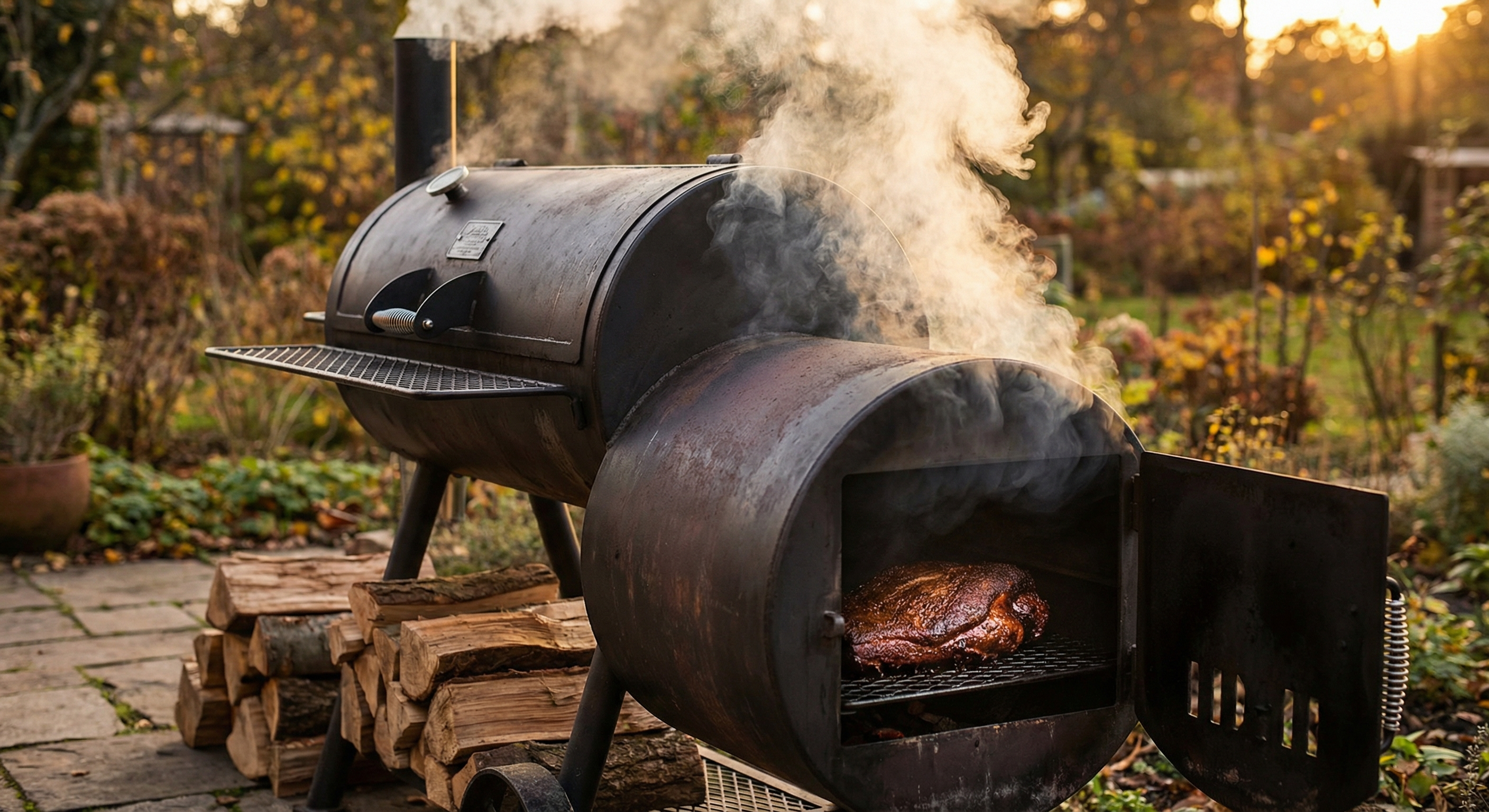
- Offset smokers: The traditional choice. Firebox on one side, cooking chamber on the other. Burns logs or a charcoal-and-wood combination.
- Kamado grills: Ceramic cookers like the Big Green Egg excel at holding steady low temperatures with minimal fuel.
- Pellet grills: Auger-fed hardwood pellets offer set-and-forget temperature control with genuine wood smoke.
- Kettle grills: A Weber kettle with a two-zone setup (coals banked to one side with wood chunks) is an effective entry-level smoker.
- Cabinet/vertical smokers: Water smokers and insulated cabinets stack food vertically above the heat source.
Cold Smoking: Flavor Without Heat
Cold smoking is the older technique — predating hot smoking by millennia. Before refrigeration, cold smoking was one of the few reliable ways to preserve meat and fish for months. Today, it is primarily used to add deep smoke flavor to foods without changing their texture through cooking.
The Science of Cold Smoking
At temperatures below 90°F, the food remains essentially raw from a cooking standpoint. This changes the smoke interaction fundamentally:
- Deeper smoke penetration: Raw protein has an open, uncoagulated structure that allows smoke compounds (phenols, carbonyls, organic acids) to penetrate far deeper than they can in cooked, denatured protein. This is why cold-smoked salmon has smoke flavor throughout, while hot-smoked brisket has smoke flavor concentrated in the outer quarter-inch.
- No Maillard reaction: Without temperatures above 280°F, no browning occurs. Cold-smoked foods retain their original color (or take on a golden-amber hue from smoke deposition).
- No protein denaturation: The proteins remain in their native state. Cold-smoked salmon retains its raw, silky texture — fundamentally different from the flaky texture of hot-smoked salmon.
- Preservation through chemistry: Smoke contains over 200 compounds, many of which are antimicrobial. Phenols inhibit bacterial growth. Formaldehyde (present in trace amounts) acts as a preservative. Organic acids lower the surface pH. Combined with curing salt, these compounds create an environment hostile to pathogenic bacteria.
The Critical Role of Curing
This is the most important food safety distinction between cold smoking and hot smoking: cold smoking without prior curing is dangerous.
When you hot smoke, the internal temperature of the food rises above 140°F, passing through and beyond the "danger zone" (40–140°F) where pathogenic bacteria multiply rapidly. The heat itself kills bacteria. Hot smoking is inherently self-sanitizing.
Cold smoking does not provide this protection. The food sits at temperatures between 68°F and 86°F — the warmest part of the danger zone — for hours or days. Without curing, you are creating ideal conditions for Clostridium botulinum, Listeria monocytogenes, and other pathogens.
Curing with sodium nitrite (Prague Powder #1 or Instacure #1) serves two critical functions:
- Prevents botulism: Nitrite specifically inhibits the growth of Clostridium botulinum, the bacterium that produces botulinum toxin — one of the most potent toxins known to science. Without nitrite, cold-smoked meats in anaerobic conditions (vacuum sealed, tightly wrapped) can develop botulism with no visible signs of spoilage.
- Reduces water activity: The salt in curing mixtures draws moisture from the meat through osmosis, lowering the water activity (aw) below the threshold where most bacteria can reproduce (aw < 0.91 for most pathogens).
Never cold smoke uncured meat. This is not a suggestion — it is the single most important rule in smoking.
Best Foods for Cold Smoking
- Salmon (lox): The quintessential cold-smoked product. Cured with salt and sugar, then cold-smoked for 12–24 hours to create that translucent, silky, intensely smoky delicacy.
- Bacon: Traditional bacon is cured pork belly that is cold-smoked for 8–12 hours. The smoking adds flavor without cooking the bacon (you cook it later in the pan).
- Cheese: Cold smoking is the only way to smoke cheese — hot smoking would melt it. Cheddar, gouda, mozzarella, and gruyère all take smoke beautifully. No curing needed since cheese already has low water activity.
- Charcuterie: Many traditional cured meats (bresaola, lonza, coppa) include a cold-smoking step as part of the curing and aging process.
- Sausages: Some traditional European sausages (like German Mettwurst) are cold-smoked after curing.
- Salt and spices: Smoked salt, smoked paprika, smoked black pepper — cold smoking adds a layer of flavor to dried goods that are shelf-stable without curing.
- Butter: Cold-smoked butter is an extraordinary compound butter for finishing steaks.
Equipment for Cold Smoking
The key engineering challenge in cold smoking is generating smoke without generating heat. Several approaches work:
- Smoke generators (maze/tube): A-MAZE-N pellet trays or tube smokers burn wood pellets at extremely low temperatures, producing smoke with negligible heat. Place them in an unheated chamber or grill.
- External smoke generators: Devices like the Smoke Daddy or smoke chief generate smoke in an external chamber and pipe it through a tube into the food chamber. The tube length allows smoke to cool before reaching the food.
- Offset cold smoking: Generate smoke in a firebox connected to the smoking chamber by a long pipe (6+ feet). The distance cools the smoke to ambient temperature before it contacts the food.
- Dual-chamber setups: Some smokers have a dedicated cold-smoking attachment — a lower chamber generates smoke that rises through a baffle into the upper food chamber.
In all cases, ambient temperature matters. Cold smoking works best in cool weather (40–60°F). In summer heat, keeping the chamber below 90°F becomes difficult or impossible without ice pans or air conditioning.
Smoke Chemistry: What Actually Flavors the Food
Whether you are cold smoking or hot smoking, the flavor comes from the same chemical compounds produced by wood combustion. The difference lies in how those compounds interact with the food at different temperatures.
The Key Smoke Compounds
- Phenols (guaiacol, syringol): Responsible for the characteristic "smoky" aroma and flavor. Guaiacol is the single compound most associated with the smell of smoke. Phenols also have antimicrobial properties that contribute to preservation.
- Carbonyls (glycolaldehyde, acetaldehyde): Contribute to the golden-brown color of smoked foods and react with amino acids on the meat surface in browning reactions.
- Organic acids (formic acid, acetic acid): Lower the surface pH of the food, contributing both to flavor (tanginess) and to preservation by creating an acidic environment hostile to bacteria.
- Polycyclic aromatic hydrocarbons (PAHs): Produced when fat drips onto flames or when wood combustion is incomplete. PAHs are carcinogenic and are the reason to avoid bitter, acrid, heavy smoke. Clean, thin, blue smoke minimizes PAH production.
Why Wood Species Matters
Different woods produce different ratios of these compounds because of their varying lignin, cellulose, and hemicellulose content:
- Fruitwoods (apple, cherry, peach): Higher in syringol, producing a sweeter, milder smoke. Ideal for poultry, pork, and cold-smoked salmon.
- Hardwoods (oak, hickory, mesquite): Higher in guaiacol, producing a stronger, more assertive smoke. Best for beef, game, and bold-flavored products.
- Mesquite: Burns hot and produces intense smoke quickly — excellent for hot smoking but can overpower in long cold smokes.
For cold smoking, mild woods (apple, cherry, alder) are generally preferred because the extended smoking time amplifies the smoke flavor. Using hickory or mesquite for a 24-hour cold smoke can produce an acrid, bitter result.
Food Safety: The Danger Zone Difference
Understanding the USDA danger zone (40–140°F) is essential for safe smoking.
Hot smoking safety: The food passes through the danger zone relatively quickly (typically within 2–4 hours for the interior) and then remains above 140°F for the rest of the cook. At 225°F smoker temperature, even a large brisket's interior reaches 140°F within the first 3–4 hours. Pathogen kill occurs naturally as part of the cooking process.
Cold smoking safety: The food sits entirely within the danger zone for the entire smoking period. Safety depends entirely on:
- Proper curing: Adequate nitrite concentration (typically 156 ppm for commercial products, or 1 teaspoon Prague Powder #1 per 5 pounds of meat)
- Adequate salt: Minimum 2.5% salt by weight to lower water activity
- Temperature control: Keeping chamber temperature below 90°F (ideally below 80°F)
- Time management: Limiting exposure time based on the product
- Starting with quality product: Fresh, properly handled meat or fish from a reputable source
Cold smoking is an advanced technique. If you are new to smoking, start with hot smoking and develop your skills before attempting cold smoking. The consequences of error in hot smoking are dry or tough food. The consequences of error in cold smoking can be serious illness.
Flavor Profile Comparison
The sensory differences between cold-smoked and hot-smoked products are dramatic, even when using the same protein and the same wood:
Cold-Smoked Salmon vs Hot-Smoked Salmon
This is the clearest example of how temperature changes everything:
- Cold-smoked (lox-style): Silky, translucent, raw texture. Intensely smoky flavor that penetrates the entire fillet. Sliced paper-thin. Served uncooked on bagels, in sushi, or on canapés. Shelf life of 2–3 weeks refrigerated.
- Hot-smoked (kippered): Flaky, opaque, cooked texture. Milder smoke flavor concentrated near the surface. Breaks into chunks. Served as an entrée, in salads, or in dips. Shelf life of 5–7 days refrigerated.
Same fish, same wood, completely different products. The temperature difference creates two foods with almost nothing in common except the base ingredient.
Can You Combine Both Methods?
Yes — and some of the best smoked products use both techniques in sequence.
- Traditional bacon: Cure the pork belly (5–7 days), cold smoke for 8–12 hours (flavor), then cook (hot smoke or pan fry) before eating.
- Double-smoked ham: Hot smoke a cured ham to cook it, then cold smoke for additional flavor depth.
- Smoked sausages: Some recipes cold smoke cured sausages for flavor, then finish with a brief hot smoke to set the casing and bring to safe internal temperature.
This combined approach gives you the deep smoke penetration of cold smoking with the cooking benefits of hot smoking — the best of both worlds.
Quick Reference: Choosing Your Method
| You Want To... | Use This Method | Why |
|---|---|---|
| Make Texas-style brisket | Hot smoking | Needs collagen breakdown, bark formation, and cooking |
| Make lox / smoked salmon | Cold smoking | Raw texture is the point; cooking would destroy it |
| Smoke cheese | Cold smoking | Hot smoking would melt the cheese |
| Make pulled pork | Hot smoking | Needs 195°F+ internal for shreddable texture |
| Make traditional bacon | Cold smoking + pan cooking | Smoke for flavor, cook later for texture |
| Smoke ribs | Hot smoking | Needs heat for collagen conversion and bark |
| Add smoke to butter or salt | Cold smoking | Heat would melt butter or clump salt |
| Smoke a whole turkey | Hot smoking | Must reach 165°F internal for food safety |
| Make bresaola or coppa | Cold smoking (as part of curing) | Adds flavor during the air-drying phase |
Common Mistakes to Avoid
Cold Smoking Mistakes
- Skipping the cure: The most dangerous mistake. Never cold smoke uncured meat or fish. Cheese, salt, and spices don't need curing because they don't support pathogen growth.
- Smoking in hot weather: If ambient temperature is above 80°F, your chamber will exceed safe cold-smoking temperatures. Wait for cooler conditions or use ice pans.
- Using too-strong wood: Mesquite or heavy hickory for 24 hours of cold smoking will produce bitter, inedible results. Use mild fruitwoods or alder.
- Insufficient drying time: After curing, a pellicle (tacky, dried surface layer) must form on the food. This pellicle helps smoke adhere evenly. Skip it and you get blotchy, poorly flavored results.
Hot Smoking Mistakes
- Too much smoke: Creosote buildup from smoldering, oxygen-starved fires produces a bitter, acrid flavor. Aim for thin blue smoke, not thick white billows.
- Opening the lid constantly: Every peek releases heat and smoke, extending cooking time and creating temperature fluctuations that can dry out the meat.
- Ignoring internal temperature: Time-based cooking ("smoke for 8 hours") is unreliable. Use a meat thermometer. Brisket is done at 195–205°F when the probe slides in like butter — not at an arbitrary hour mark.
- Not resting the meat: Cutting into hot-smoked meat immediately causes moisture loss. Rest brisket for at least 1 hour (ideally 2–4 hours in a cooler) for optimal juice redistribution.
The Bottom Line
Cold smoking and hot smoking are not interchangeable techniques — they are different tools for different jobs. Hot smoking is more forgiving, more accessible, and the right choice for most backyard cooking. Cold smoking is an advanced preservation art that rewards patience and precision with flavors you cannot achieve any other way.
Start with hot smoking. Master temperature control, wood selection, and timing. Then, when you are ready for the challenge, explore cold smoking with proper curing knowledge and food safety fundamentals. Both traditions offer extraordinary results — they just take entirely different paths to get there.
Frequently Asked Questions
What temperature separates cold smoking from hot smoking?
Cold smoking stays below 90°F (ideally 68–86°F), while hot smoking operates between 225°F and 275°F. The gap between 90°F and 225°F is generally avoided because it sits fully in the bacterial danger zone without providing enough heat to cook the food safely.
Do you have to cure meat before cold smoking?
Yes — curing with sodium nitrite (Prague Powder #1) is essential for cold smoking meat and fish. Without curing, the food sits in the bacterial danger zone (40–140°F) for hours, creating ideal conditions for botulism and other pathogens. Cheese, salt, and spices do not require curing because they do not support bacterial growth.
Can you cold smoke on a regular grill?
Yes, with the right accessories. A pellet tube smoker or maze smoker placed in an unlit grill generates smoke without significant heat. The key is keeping the chamber temperature below 90°F, which works best in cool weather (below 60°F ambient temperature).
How long does cold smoking take?
Cold smoking times vary widely by product: cheese takes 2–4 hours, salmon takes 12–24 hours, and bacon takes 8–12 hours. Some traditional European products are cold-smoked intermittently over several days or weeks as part of a curing and aging process.
Is cold-smoked salmon safe to eat raw?
Properly cured and cold-smoked salmon from a reputable source is safe to eat without further cooking. The combination of salt curing (lowering water activity) and smoke compounds (antimicrobial phenols and acids) inhibits pathogen growth. However, pregnant women, elderly individuals, and immunocompromised people should avoid cold-smoked fish due to residual Listeria risk.
What is the best wood for cold smoking?
Mild fruitwoods (apple, cherry, peach) and alder are the best choices for cold smoking. Because cold smoking involves extended exposure times (often 12+ hours), strong woods like hickory and mesquite can overpower the food with bitter, acrid flavors. Save the stronger woods for shorter hot smoking sessions.
More Expert Guides
Brisket Flat vs Point: Anatomy, Flavor Differences, and How to Cook Each Cut
A whole packer brisket contains two distinct muscles with radically different properties. Understanding the flat and the point — their fiber direction, fat distribution, and collagen content — is the difference between great barbecue and dried-out disappointment.
15 min readSteak Doneness Temperature Guide: The Science of Every Level from Rare to Well Done
Every degree matters. This science-backed guide covers the exact internal temperatures for every steak doneness level, why each temperature produces a different texture, and how to nail your target every time.
14 min readDirect vs Indirect Heat Grilling: The Science of Two-Zone Cooking
Direct heat sears. Indirect heat roasts. Understanding the physics of each — and when to combine them — is the foundation of every great grilling technique.