Cold Weather Grilling: The Science of Why Your Grill Behaves Differently in Winter
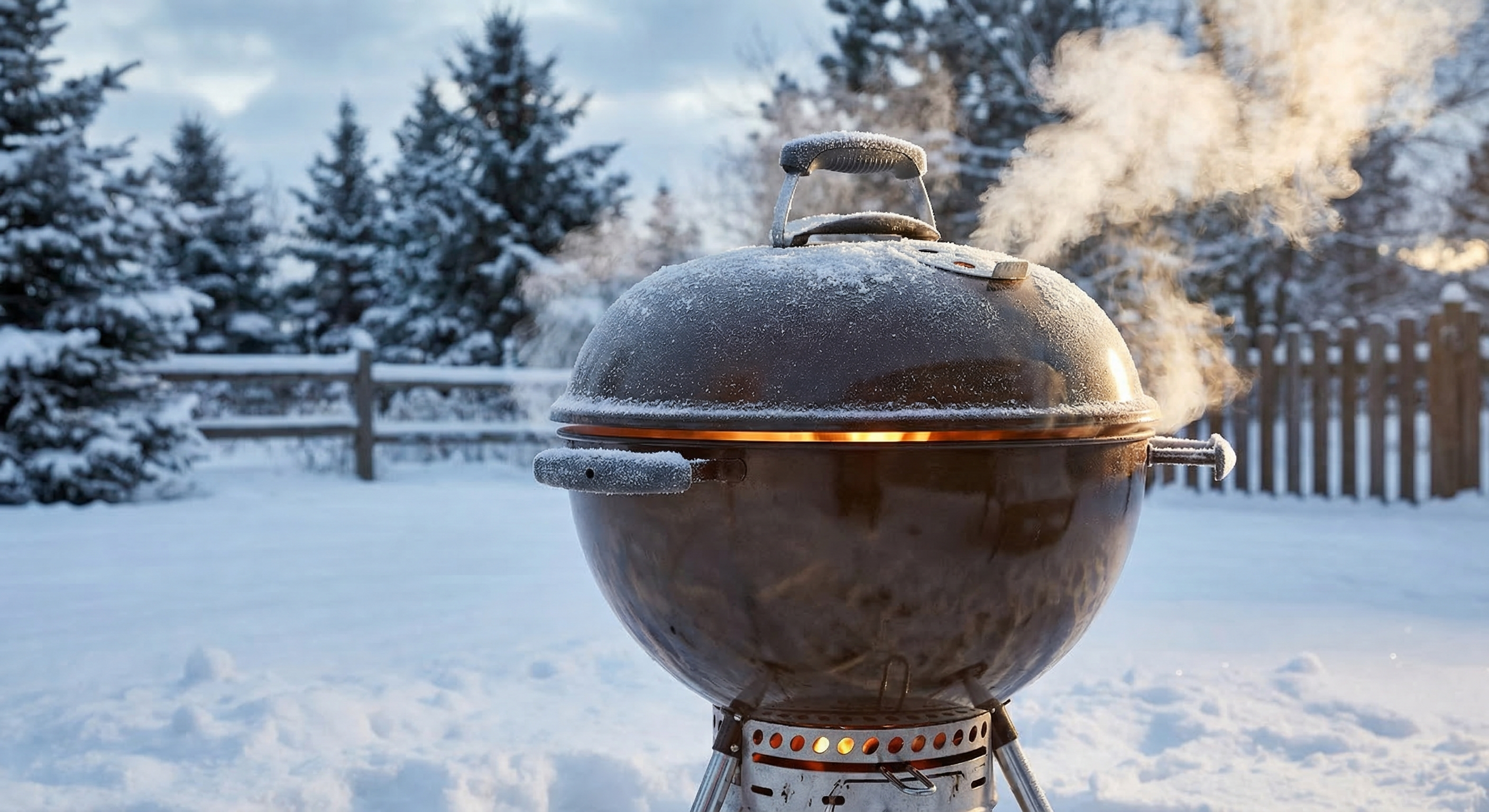
Cold Weather Grilling: The Science of Why Your Grill Behaves Differently in Winter
You fire up the grill on a 35°F January evening and something feels off. The charcoal takes longer to get going. The grill never seems to reach the temperatures you hit effortlessly in July. A steak that normally takes 8 minutes per side now needs 11. You are not imagining it — cold weather fundamentally changes how your grill performs, and the physics behind it affects every step from ignition to plating.
Understanding why cold air disrupts grilling lets you compensate precisely instead of guessing. The core issue is heat transfer: cold ambient air steals thermal energy from your grill faster than warm air does. Every degree the outside temperature drops increases the rate of heat loss, which means your grill works harder to maintain cooking temperature — and often fails to reach the same peak it hits in summer.
The Thermodynamics of Heat Loss in Cold Air
Heat always moves from hot to cold. The rate of that movement — called the heat flux — is proportional to the temperature difference between two objects. This is Newton's Law of Cooling, and it governs everything happening on your grill.
On a 90°F summer day with your grill running at 450°F, the temperature differential is 360°F. On a 30°F winter evening at the same grill setting, the differential jumps to 420°F — a 17% increase in heat loss rate. That extra energy does not just vanish; it gets stripped away by the cold air flowing over and around your grill.
This effect compounds through three simultaneous mechanisms:
- Convective loss: Cold air moving across the grill exterior carries heat away. Wind amplifies this dramatically — a 15 mph breeze can double the convective heat loss coefficient.
- Radiative loss: The grill's outer surfaces radiate infrared energy into the environment. Colder surroundings absorb more of this energy because the radiation differential is larger.
- Conductive loss: The grill body itself — steel, cast iron, or ceramic — conducts heat from the interior to the exterior surfaces, where it is then lost to convection and radiation.
The net result: your fuel generates the same BTUs, but a larger percentage of those BTUs escape to the environment instead of cooking food. Your grill's effective cooking power drops even though the fire itself has not changed.
Why Fuel Burns Faster in Winter
Cold-weather grillers consistently report using 25–50% more charcoal or propane for the same cook. The physics explains why.
To maintain a target temperature — say 250°F for low-and-slow cooking — you need to open the vents wider to increase airflow and combustion rate. More oxygen means faster fuel consumption. On a kamado grill, the excellent insulation reduces this effect, but thin-walled steel kettles and offset smokers are especially vulnerable.
Propane has its own winter problem. At temperatures below 32°F, the vaporization rate of liquid propane slows significantly. The gas pressure inside the tank drops, which can reduce the BTU output at the burner by 10–20%. In extreme cold (below 0°F), a propane tank can struggle to deliver adequate pressure for high-heat searing. This is not a grill malfunction — it is a phase-change physics problem caused by reduced molecular kinetic energy in the liquid propane.
For charcoal, the startup phase is the hardest. Cold charcoal has higher thermal mass — it takes more energy to bring each briquette up to ignition temperature (~600°F). A chimney starter that lights coals in 15 minutes during summer may need 20–25 minutes in freezing weather. Using a chimney starter with newspaper or wax fire starters still works, but expect to wait longer before dumping the coals.
How Cold Metal Affects Cooking Performance
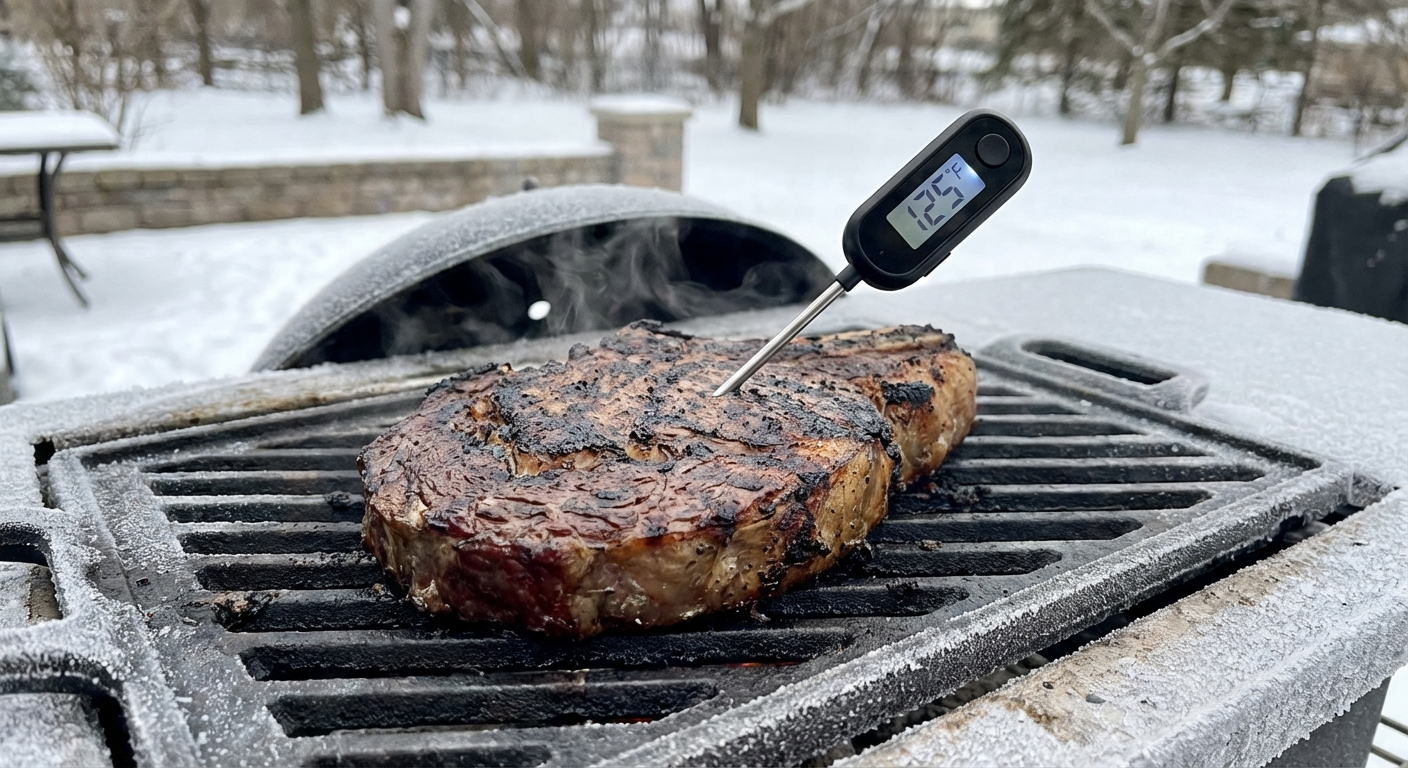
Your grill grates, firebox, and lid start at ambient temperature. On a 30°F day, that means every piece of metal needs to absorb significantly more heat before reaching cooking temperature compared to an 85°F summer start.
The thermal mass of cast iron grates is around 0.11 BTU per pound per degree Fahrenheit. A set of cast iron grates weighing 15 pounds needs to absorb roughly 90 additional BTUs just to make up the 55-degree ambient temperature difference between summer and winter. That is a small number, but when you add the firebox, lid, and body of the grill, the total thermal mass that needs preheating can be substantial — especially on heavy ceramic kamados that may weigh 150+ pounds.
This is why preheating time increases in winter. A grill that reaches 500°F in 10 minutes during summer may need 15–18 minutes in freezing conditions. Resist the urge to start cooking before the grill is fully preheated — putting food on cold grates means poor Maillard reaction development and more sticking.
The Lid-Lift Problem
Every time you lift the lid, hot air escapes and is replaced by cold ambient air. In summer, you lose maybe 50–75°F of chamber temperature per lid lift. In winter, that number can exceed 100–150°F because the replacement air is so much colder and the convective cooling during the open period is more aggressive.
Recovery time — how long it takes the grill to return to target temperature after a lid lift — also increases. On a charcoal grill in 30°F weather, expect 3–5 minutes of recovery compared to 1–2 minutes in warm weather. This means the old rule of “if you're looking, you're not cooking” is even more critical in cold weather. Every unnecessary lid lift extends your total cook time.
Wind: The Invisible Performance Killer
Cold weather often brings wind, and wind is the single biggest external threat to grill performance. A steady 10–15 mph wind can:
- Double the convective heat loss from the grill exterior
- Create uneven heating by forcing cold air through vents on the windward side while pulling heat out the leeward side
- Disrupt temperature control on charcoal grills by blowing extra oxygen through the vents, causing temperature spikes followed by faster fuel depletion
- Extinguish gas burners if the wind gusts are strong enough to blow out the flame
Wind chill affects your grill body just as it affects your skin. A 30°F day with 20 mph wind creates an effective heat-loss rate equivalent to a calm day at roughly 15°F. Your grill does not “feel” wind chill the way a human body does (it does not have moisture to evaporate), but the increased forced convection has a very real cooling effect on the exterior surfaces.
Position your grill with the back (not the vents) facing the wind. Better yet, use a natural windbreak — a solid fence, house wall, or dedicated wind screen. Never grill inside a garage, enclosed porch, or any structure that traps carbon monoxide.
Adjusting Technique for Cold-Weather Grilling
Now that you understand the physics, here are the specific adjustments that compensate for cold-weather performance loss:
1. Increase Fuel Load by 25–50%
For charcoal, start with a full chimney instead of a partial one. For extended cooks (brisket, pork shoulder), have extra charcoal or briquettes staged nearby and add them before the temperature drops rather than after. Reactive fueling — adding charcoal only after the temperature falls — creates long recovery valleys that extend cook time.
2. Extend Preheat Time by 50–100%
If you normally preheat for 10 minutes, plan for 15–20 minutes in cold weather. Use a grill thermometer (not the built-in lid gauge, which reads air temperature near the dome, not at grate level) to confirm the cooking zone has reached target temperature before putting food on.
3. Minimize Lid Lifts
Use a wireless meat thermometer to monitor internal food temperature without opening the lid. This single tool eliminates the biggest source of avoidable heat loss. If you must check food visually, batch your tasks — flip, baste, and check in one quick lid-open session rather than separate ones.
4. Adjust Vent Settings
On a charcoal grill, you will need the intake vent 15–25% more open than your summer setting to maintain the same temperature. The exhaust vent stays fully open as always — restricting exhaust creates bitter, dirty smoke regardless of weather. Monitor temperature closely after adjusting, as the increased airflow also increases fuel burn rate.
5. Account for Meat Temperature
If your meat comes straight from the refrigerator (38°F), it will cook the same regardless of outside temperature. But if you usually let meat come to room temperature before grilling, know that “room temperature” outside in winter might be 35°F. Consider letting the meat temper indoors for 30–45 minutes before bringing it to the grill.
Grill Types Ranked by Cold-Weather Performance
Not all grills handle winter equally. The key differentiator is insulation — how well the grill body retains heat against ambient cold:
Best: Kamado Grills (Ceramic)
Thick ceramic walls (1–2 inches) provide exceptional insulation. Kamado grills lose less heat to the environment than any other grill type, which means they maintain temperature stability in cold weather with minimal extra fuel. The dense ceramic also stores enormous thermal energy once heated, acting as a heat battery that buffers against temperature swings.
Good: Insulated Cabinet Smokers
Double-walled steel smokers with insulation between the layers (like some pellet grills) perform well in cold weather. The insulation reduces conductive and convective loss, though not as effectively as ceramic.
Moderate: Kettle Grills
Standard steel kettle grills (Weber Kettle, etc.) have thin walls that lose heat readily in cold weather. They are still perfectly usable — you just need more fuel and more attention to vent management. The spherical shape helps somewhat by minimizing surface area relative to internal volume.
Challenging: Offset Smokers
Thin-walled offset smokers have the largest surface area and the least insulation. In winter, maintaining stable temperatures on an offset requires near-constant fire management. Cold wind hitting the firebox side can cause dramatic temperature swings. Serious cold-weather offset users often add welding blankets or purpose-built insulation jackets to the cooking chamber.
Special Case: Gas Grills
Gas grills face the unique propane vaporization issue below 32°F. However, their on-demand flame means recovery from lid lifts is faster than charcoal. If you use a natural gas hookup instead of propane tanks, you avoid the cold-tank pressure problem entirely.
The Science of Smoke Behavior in Cold Air
Cold, dense air changes how smoke moves around your food. In warm weather, hot smoke rises quickly in a thin column. In cold weather, the smoke is denser relative to the super-cold ambient air, but the temperature differential actually creates a faster initial draft — hot smoke accelerates upward more aggressively because the density contrast with cold surrounding air is greater.
However, once smoke exits the grill, it cools rapidly and tends to settle around the grilling area instead of dispersing. This is purely cosmetic and does not affect food flavor, but it can reduce visibility if you are grilling in an enclosed patio area.
Inside the grill, the smoke ring formation may actually be enhanced in cold weather. Cold meat placed in a smoky environment absorbs more nitrogen dioxide (NO₂) and carbon monoxide (CO) before the myoglobin denatures — because the surface stays below the critical 140°F threshold for longer when ambient temperature is low. This means your brisket may develop a slightly deeper smoke ring in winter than in summer, all else being equal.
Safety Considerations for Winter Grilling
Cold-weather grilling introduces a few safety factors that warm-weather cooks do not face:
- Carbon monoxide: Never move a grill into a garage, covered porch, or enclosed space to escape the cold. CO poisoning is invisible and lethal. Grills must always operate outdoors with adequate ventilation.
- Icy surfaces: Grease drips on frozen concrete or icy decks create serious slip hazards. Lay down a grill mat or keep sand or cat litter nearby.
- Propane tank handling: Cold metal tanks can cause frostbite on bare skin. Wear gloves when connecting or moving propane tanks in freezing weather.
- Reduced dexterity: Cold hands are clumsy hands. Wear heat-resistant gloves that also provide some insulation, and keep long tongs and spatulas so you can work at arm's length without leaning over the fire.
- Shorter daylight: Winter means early darkness. Have a grill light (clip-on LED or headlamp) so you can judge food color and doneness accurately. Guessing in the dark leads to under- or overcooked food.
A Practical Cold-Weather Grilling Checklist
Bring this mental checklist to every winter cook:
- Check the forecast: Temperature, wind speed, and precipitation all matter. Sustained wind over 25 mph may make grilling impractical on thin-walled grills.
- Stage extra fuel: 25–50% more charcoal or verify propane is above 30% full. Cold tanks read lower than actual capacity.
- Position the grill: Back to the wind, near a windbreak, NEVER in an enclosed space.
- Extend preheat: Wait until grate-level temperature confirms target. Do not trust the dome thermometer alone.
- Temper meat indoors: 30–45 minutes before grilling.
- Deploy wireless thermometer: Eliminate unnecessary lid lifts.
- Open intake vent wider: 15–25% more than your summer baseline.
- Plan for longer cook times: Add 15–30% to your normal time estimate.
- Have a warm-up station: Keep a table nearby for resting meat — cover it with foil and a towel. Meat rests faster in cold air, so resting time may need to be shortened or the meat should be brought indoors to rest.
Cold weather does not stop grilling — it just changes the math. Once you understand that every degree of ambient temperature drop increases heat loss and fuel demand, you can plan accordingly and produce results every bit as good as your summer cooks. The fire does not care what season it is. You just need to give it the right conditions to do its job.
Frequently Asked Questions
How much longer does grilling take in cold weather?
Expect cook times to increase by 15-30% in temperatures below 40°F. The exact increase depends on wind, grill type, and how well-insulated your grill is. Kamado grills see the smallest increase (5-10%) while thin-walled offset smokers can see increases of 30-50% in freezing, windy conditions.
Can I grill in the snow or rain?
Yes, you can grill safely in snow or light rain. Snow on the grill lid actually has minimal impact because it melts and evaporates quickly from the hot surface. Rain is more disruptive because water droplets hitting hot grates can cause temperature drops and steam. Keep the lid closed as much as possible and add 10-15% extra fuel to compensate for moisture-related heat loss.
Why does my propane grill lose power in cold weather?
Propane is stored as a liquid that must vaporize into gas before the burners can use it. Below 32°F, the vaporization rate slows because the liquid propane molecules have less kinetic energy. This reduces tank pressure and can cut BTU output by 10-20%. If your tank is also low (below 25% full), the reduced liquid surface area compounds the problem. Switching to a full tank or using natural gas eliminates this issue.
What is the best type of grill for winter cooking?
Kamado-style ceramic grills are the best performers in cold weather due to their thick, insulating walls. They lose the least heat to the environment and require the least extra fuel. Double-walled insulated pellet grills are the second best option. Standard steel kettle grills work fine with extra fuel and attention. Thin-walled offset smokers are the most challenging to use in winter.
Should I use a grill blanket or insulation jacket in winter?
Insulation jackets designed for your specific grill model can significantly reduce heat loss and fuel consumption in cold weather. They are most beneficial for thin-walled steel smokers and pellet grills. Do not use improvised insulation (blankets, cardboard) as these can be fire hazards. Only use manufacturer-approved or purpose-built grill insulation products rated for the temperatures your grill reaches.
More Expert Guides
Grill Vent Management: The Science of Airflow and Temperature Control
Oxygen controls fire. Fire controls temperature. Vents control oxygen. Master your vents and you master your grill.
12 min readHow Often to Flip Steak: The Science of Multiple Flips vs Single Flip
The traditional advice to flip your steak only once is wrong. Science shows that flipping every 30 seconds produces better crust, more even doneness, and 30% faster cooking through improved heat transfer.
12 min readThe Science of Plancha Grilling: How High Heat and Flat Surfaces Create Superior Crust
Plancha grilling delivers more surface contact, higher heat, and better crust than traditional grates. Here is the science behind why flat-top cooking produces superior results.