Convection in Grilling: How Air Currents Shape Heat, Smoke, and Flavor
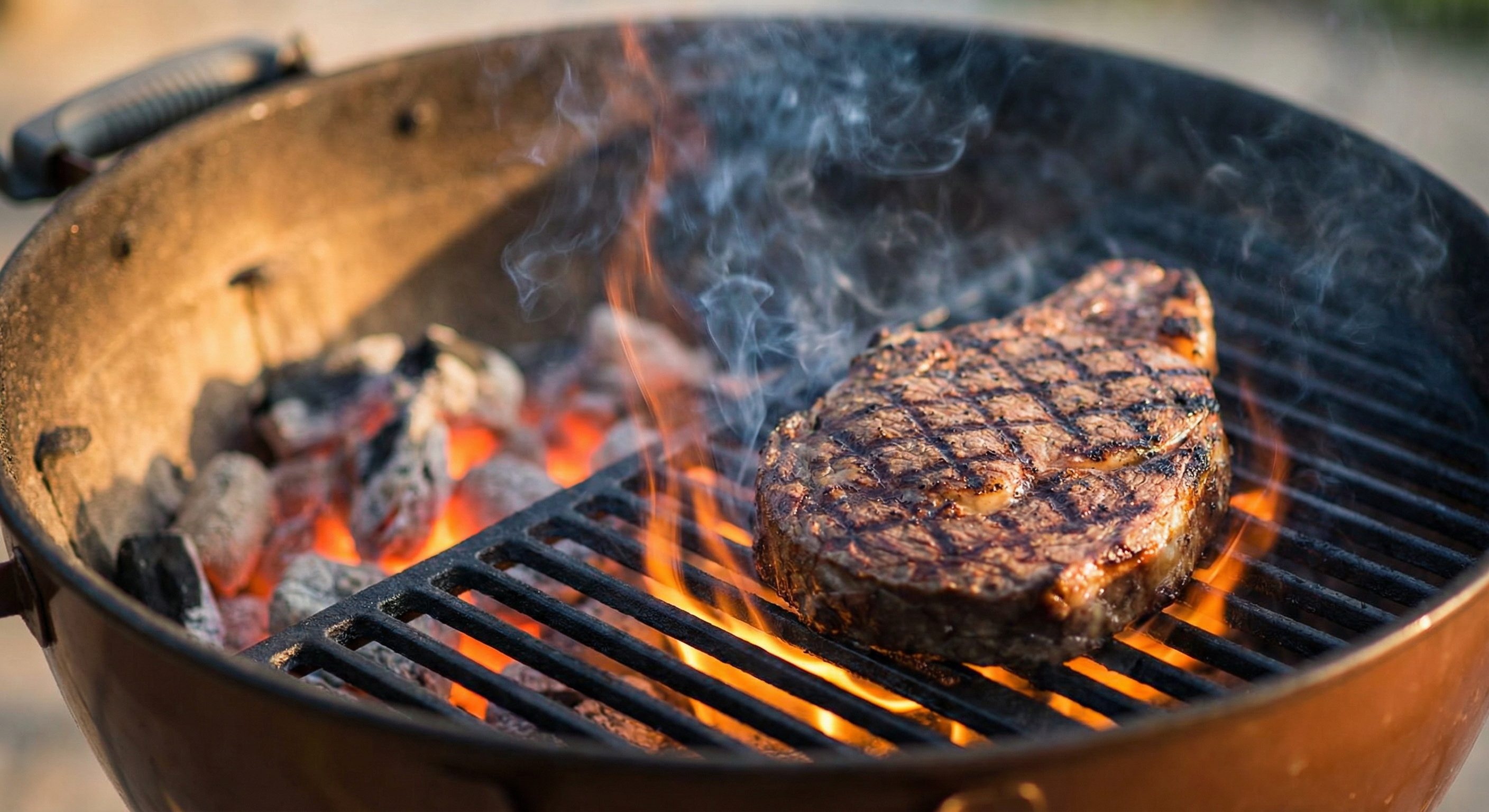
Every time you close the lid on your grill, you set an invisible force in motion. Hot air rises from the coals or burners, sweeps across your food, transfers energy, cools slightly, sinks back down, and cycles again. That continuous loop of moving air is convection—and understanding it is arguably the single biggest lever you have for improving your grilling results.
Most backyard cooks think about grilling in terms of direct heat: how close the food sits to the fire. But convection often contributes more total energy to your cook than the radiant heat coming off the coals, especially in lid-down and offset-smoker scenarios. Master convection, and you'll gain precise temperature control, more even cooking, and richer smoke penetration.
What Is Convection? The Physics in Plain Language
Convection is one of three mechanisms of heat transfer, alongside conduction (direct contact) and radiation (infrared energy). While conduction heats the side of a steak touching the grate and radiation warms it from glowing coals below, convection transfers heat through moving fluid—in grilling, that fluid is air.
The process follows a predictable cycle:
- Heating: Air near the heat source absorbs energy and expands, becoming less dense.
- Rising: The lighter, hotter air rises (buoyancy).
- Transfer: As hot air contacts cooler surfaces—your brisket, the inside of the lid—it releases thermal energy.
- Cooling and sinking: Now cooler and denser, the air drops back toward the heat source.
- Repeat: The cycle continues as long as a temperature differential exists.
This natural loop is called free convection (or natural convection). When you add a fan—as in a kamado with a powered controller or a convection-enhanced pellet grill—you get forced convection, which accelerates airflow and increases the rate of heat transfer significantly.
The rate of convective heat transfer is governed by Newton's law of cooling: Q = hA(Ts − T∞), where h is the convective heat transfer coefficient, A is the surface area of the food, Ts is the surface temperature, and T∞ is the ambient air temperature in the cooking chamber. In practical terms, hotter air, faster airflow, and more exposed surface area all mean faster cooking.
How Convection Differs Across Grill Types
Not all grills create convection equally. The geometry of the cooking chamber, the location of the heat source, and the vent system all shape the convective patterns inside your cooker.
Kettle Grills
The classic Weber kettle is a convection machine in disguise. With the lid on, hot air rises from the charcoal, hits the domed lid, spreads outward, and descends along the sides before being drawn back toward the intake vents at the bottom. The dome shape naturally encourages a toroidal (donut-shaped) airflow pattern that circulates heat around the food from all directions.
This is why a kettle with the lid on can roast a whole chicken almost as evenly as a convection oven—the circulating air envelops the bird. When the lid is off, you lose nearly all convective cooking and rely primarily on radiant heat from below, which is why lid-off grilling is only effective for thin, fast-cooking items like burgers and hot dogs.
Offset Smokers
In an offset smoker, convection follows a linear path: hot air and smoke enter through the firebox opening, travel across the cooking chamber, and exit through the smokestack on the opposite end. This creates a horizontal convective flow rather than the circular pattern of a kettle.
The challenge is that air closest to the firebox is significantly hotter than air near the stack. Temperature differentials of 50–75°F from one end to the other are common in unmodified offsets. Tuning plates, baffles, and reverse-flow designs exist specifically to redistribute this convective flow and equalize temperatures across the grate.
Kamado Cookers
Kamado-style grills (Big Green Egg, Kamado Joe) use thick ceramic walls that absorb and re-radiate heat, but convection still plays a major role. The tall, narrow shape creates a strong chimney effect: air enters the bottom vent, passes through the charcoal, rises past the food, and exits the top vent. The tight geometry concentrates convective flow, which is why kamados are exceptionally efficient—they achieve high temperatures with very little fuel.
At low-and-slow temperatures (225–275°F), the restricted airflow in a kamado means the convective coefficient h is relatively low. The ceramic walls contribute more via radiation. But at high heat (500°F+), the increased air velocity through the vents creates strong forced-like convection that's ideal for pizza and searing.
Gas Grills
Standard gas grills have relatively weak natural convection because their thin metal walls lose heat quickly, and the venting is often poorly designed. The heat rises from the burners, hits the lid, and much of it escapes through gaps rather than recirculating. This is why gas grills often have "hot spots" directly over each burner—the convective distribution is uneven.
Higher-end gas grills address this with ceramic briquettes, heat plates, or infrared emitters that improve radiant heat distribution, partially compensating for weak convection. Some models include rear-mounted convection burners specifically designed to create circulating airflow for rotisserie cooking.
Pellet Grills
Pellet grills are arguably the most convection-dependent cookers on the market. A fan forces air through the firepot and into the cooking chamber, creating forced convection from the start. The fan speed, combined with the pellet feed rate, determines the cooking temperature. This is why pellet grills excel at even, consistent low-and-slow cooking—the forced airflow distributes heat more uniformly than any natural-convection cooker.
The tradeoff is that the constant airflow can dry out food surfaces faster, which is why many pellet grill users spritz their meat or use water pans to maintain surface moisture.
Vent Position and Convection Control
Your intake and exhaust vents are convection throttles. Understanding how they work together is the key to temperature control on any charcoal-fueled cooker.
Intake vents (bottom): These control how much oxygen reaches the fire, but they also determine the velocity of incoming air. A wide-open intake creates a fast-moving column of air that accelerates convection. A nearly closed intake restricts airflow, slowing the convective cycle and dropping the chamber temperature.
Exhaust vents (top): The exhaust acts as the chimney. The general rule is to keep the exhaust at least partially open at all times—closing it completely can starve the fire and cause incomplete combustion, producing bitter, acrid smoke. A partially open exhaust creates a gentle draw that maintains steady convective flow.
The relationship between intake and exhaust is what creates draft—the pressure differential that drives air through the system. Think of it like plumbing: the intake is the faucet, the exhaust is the drain, and the convective flow is the water moving through the pipe. Both must be open for the system to function.
A practical technique for dialing in temperature:
- Start with both vents fully open to establish a strong fire and convective cycle.
- Once the cooker reaches 25°F above your target temperature, begin closing the intake vent in small increments (about 1/4 turn at a time).
- Wait 10–15 minutes between adjustments—convective systems have thermal inertia, and changes take time to stabilize.
- Leave the exhaust vent at least 1/4 open. Adjust the intake only.
The Role of Convection in Smoke Penetration
Smoke flavor isn't just about burning wood—it's about how smoke contacts your food, and that contact is governed entirely by convection. Smoke particles are carried by the convective airstream; they don't simply drift upward and settle. The velocity, temperature, and humidity of the convective flow all affect how much smoke flavor your food absorbs.
Slower airflow = more contact time. When convective velocity is low (restricted vents, low temperature), smoke particles spend more time in contact with the meat surface, resulting in deeper smoke penetration. This is one reason low-and-slow cooking at 225°F produces more smoke flavor than hot-and-fast at 350°F—it's not just the extra time, it's the slower convective velocity.
Surface moisture matters. Smoke compounds (phenols, carbonyls) dissolve more readily in moisture. A wet meat surface in a convective stream captures more smoke than a dry one. This is the science behind spritzing: you're not just preventing dryness, you're creating a sticky surface that grabs smoke particles as they flow past.
The stall is a convection phenomenon. The infamous temperature stall during long cooks (typically around 150–170°F) occurs when evaporative cooling from the meat surface balances the convective heat input. The meat is essentially sweating, and the convective airstream carries away moisture and heat at the same rate it delivers them. Wrapping in foil or butcher paper reduces evaporative cooling by blocking the convective airstream from directly contacting the wet surface.
Convection vs. Radiation: When Each Dominates
Understanding when convection dominates versus radiation helps you choose the right technique for different foods.
Convection dominates when:
- The lid is closed and air is circulating
- Food is positioned away from direct heat (indirect grilling)
- Cooking at moderate temperatures (225–400°F)
- Using a fan-assisted cooker (pellet grill, powered kamado controller)
Radiation dominates when:
- The lid is open and food is directly over coals
- Cooking at very high temperatures (500°F+)
- Using infrared burners or searing stations
- Food is very close to the heat source (within 2–3 inches)
Most great grilling involves both. A reverse-seared steak, for example, uses convection first (lid-down indirect heat at 250°F to bring the interior to 115°F) and then radiation (lid-open, directly over screaming-hot coals for 60–90 seconds per side to build the crust). Understanding which mechanism is doing the work at each stage lets you optimize your setup for each phase.
Practical Techniques for Harnessing Convection
Here are specific, actionable ways to use convective heat transfer to improve your grilling:
1. Use a Water Pan as a Heat Sink
A pan of water placed between the fire and the food serves two purposes. First, it absorbs radiant heat and re-emits it as convective heat, softening hot spots. Second, the evaporating water adds humidity to the convective stream, which increases the heat transfer coefficient (moist air transfers heat more efficiently than dry air) and improves smoke adhesion. This is standard practice in bullet smokers (Weber Smokey Mountain) for good reason.
2. Don't Open the Lid Unnecessarily
Every time you lift the lid, you break the convective cycle completely. The hot air escapes, the temperature drops 50–100°F, and it takes 10–15 minutes to re-establish stable convection. The old saying "if you're lookin', you ain't cookin'" is really about convection—you're disrupting the airflow pattern that's doing most of the cooking work.
3. Position the Exhaust Over the Food
On a kettle grill, placing the exhaust vent directly over the food (opposite the coals in an indirect setup) ensures the convective stream must pass over the food on its way out. This maximizes contact time between the hot, smoky air and your meat. It's a simple adjustment that can noticeably improve smoke flavor and cooking evenness.
4. Manage the Thermal Mass
A full grill cooks differently than an empty one. Each piece of food absorbs heat from the convective stream, cooling it. Loading a smoker to capacity can drop the effective air temperature reaching the last items in the flow path. Account for this by allowing extra time or arranging items strategically—place thicker cuts upstream (closer to the heat source) and thinner items downstream.
5. Use Deflectors and Baffles
In offset smokers, tuning plates or convection plates redirect airflow to equalize temperatures across the grate. These work by forcing the hot convective stream downward and across the full width of the chamber before allowing it to rise past the food. Even a simple arrangement of aluminum pans or firebricks can serve as crude baffles in a pinch.
Common Convection Mistakes
Even experienced grillers make these convection-related errors:
- Closing the exhaust completely: This kills the draft, causing the fire to smolder and produce creosote-laden, bitter smoke. Always keep the exhaust at least partially open.
- Ignoring wind: External wind creates forced convection on the outside of your cooker, stripping heat from the walls and affecting internal temperatures. On windy days, position the cooker so the intake vent faces away from the wind, or use a windbreak.
- Overcrowding the grate: Too much food blocks convective flow, creating dead zones where air can't circulate. Leave at least 1 inch between items for airflow.
- Neglecting preheating: Convection needs a fully heated cooking chamber to establish stable air patterns. Rushing to put food on before the cooker is thermally stable leads to uneven cooking during the first 30–45 minutes.
The Bottom Line
Convection isn't a fancy feature found only in expensive ovens—it's a fundamental physical process that happens in every covered grill and smoker. The difference between a good cook and a great one often comes down to how well you manage this invisible airflow. Control your vents, understand your cooker's airflow geometry, and think of the air inside your grill as an active cooking medium, not just empty space. Once you see it that way, temperature control and smoke management become intuitive rather than mysterious.
More Expert Guides
Steak Doneness Temperature Guide: The Science of Every Level from Rare to Well Done
Every degree matters. This science-backed guide covers the exact internal temperatures for every steak doneness level, why each temperature produces a different texture, and how to nail your target every time.
14 min readDirect vs Indirect Heat Grilling: The Science of Two-Zone Cooking
Direct heat sears. Indirect heat roasts. Understanding the physics of each — and when to combine them — is the foundation of every great grilling technique.
14 min readResting Meat After Cooking: The Science of Why It Makes Every Steak Juicier
Resting meat after cooking is not optional — it is physics. Here is exactly what happens inside the steak during those crucial minutes and how long to rest every cut.