Direct vs Indirect Heat Grilling: The Science of Two-Zone Cooking
Direct vs Indirect Heat Grilling: The Science of Two-Zone Cooking
Every grilling technique you will ever learn comes down to one decision: where is the heat source relative to the food? Directly beneath it, or off to the side. That single variable — direct versus indirect heat — determines whether you are searing a steak or slow-roasting a chicken. It controls the Maillard reaction, moisture retention, internal temperature gradients, and whether your dinner ends up charred on the outside and raw in the middle.
Understanding the physics behind each method gives you the ability to cook anything on a grill — not by following recipes, but by understanding heat transfer.
What Is Direct Heat Grilling?
Direct heat grilling means the food sits directly over the heat source — whether that is a bed of charcoal, a gas burner, or glowing wood embers. The primary heat transfer mechanism is infrared radiation, with secondary contributions from conduction (where the food contacts the grate) and convection (rising hot air).
The key characteristic of direct heat is intensity. The food surface receives concentrated radiant energy from the heat source below, driving surface temperatures above 500°F rapidly. This is what triggers the Maillard reaction — the browning chemistry that creates grilled flavor.
The Physics of Direct Radiant Heat
Infrared radiation follows the inverse-square law: double the distance between the heat source and the food, and the radiant intensity drops to one-quarter. This is why grate height matters enormously in direct grilling. A steak 3 inches above glowing coals receives roughly four times the radiant energy as the same steak 6 inches above.
On a charcoal grill, a full chimney of lit lump charcoal produces surface temperatures of 900–1,200°F at the coal bed. At the grate (typically 4–6 inches above), this translates to roughly 550–700°F of effective cooking temperature. Gas burners with flavorizer bars typically produce 450–600°F at the grate on maximum.
This intense radiant heat creates a steep thermal gradient in the food — the surface temperature rises rapidly while the interior remains cool. For thin foods (burgers, vegetables, shrimp, thin steaks under 1 inch), this gradient does not matter because the interior cooks through before the surface burns. For thick foods, this gradient becomes a problem — the outside overcooks long before the center reaches your target temperature.
When to Use Direct Heat
- Thin steaks and chops (under 1 inch) — cook through quickly before the surface burns
- Burgers — especially smash-style where maximum surface contact and fast cooking are the goal
- Vegetables — high heat chars the outside while keeping a crisp interior
- Shrimp, scallops, fish fillets — fast-cooking proteins that need a sear but not extended time
- Sausages and hot dogs — quick browning with occasional turning
- The searing phase of a reverse sear — 60–90 seconds of maximum heat to build crust
What Is Indirect Heat Grilling?
Indirect heat grilling means the food sits away from the heat source, with the grill lid closed. The primary heat transfer mechanism shifts from radiation to convection — hot air circulating around the food, cooking it from all sides like an oven.
With the lid closed, the grill becomes an enclosed cooking chamber. Hot air rises from the heat source on one side, circulates over and around the food, and exits through the top vent. The food cooks by absorbing energy from this moving air, not from direct radiant exposure.
The Physics of Convective Cooking
Convective heat transfer is gentler and more uniform than radiant heat. The temperature of the air inside a grill with indirect setup typically ranges from 225–375°F, depending on fuel quantity and vent settings. Because the air surrounds the food equally from all directions, the thermal gradient inside the food is much shallower than with direct heat.
This shallow gradient means the interior and exterior temperatures converge more closely. A chicken breast cooked over indirect heat at 350°F will have maybe a 20°F difference between the surface and center. The same breast over direct heat at 600°F might show a 100°F difference — burnt outside, undercooked inside.
The tradeoff is time. Convective heat transfers energy more slowly than radiant heat. A steak that sears in 2 minutes over direct heat might take 30–45 minutes to reach the same internal temperature with indirect heat. But the result is dramatically more even.
When to Use Indirect Heat
- Whole chickens and turkeys — need even cooking throughout without burning the skin
- Thick roasts (pork loin, prime rib, tri-tip) — require extended time for the center to reach temperature
- Ribs — low and slow at 225–275°F for collagen-to-gelatin conversion
- Brisket and pork shoulder — the classic low-and-slow cuts that need 12+ hours of gentle heat
- Thick steaks (1.5 inches+) — the low-heat phase of a reverse sear
- Anything with sugary glazes or sauces — sugar burns rapidly over direct heat but caramelizes gently over indirect
- Pizza — indirect heat with a pizza stone creates oven-like conditions
The Two-Zone Fire: Combining Both Methods
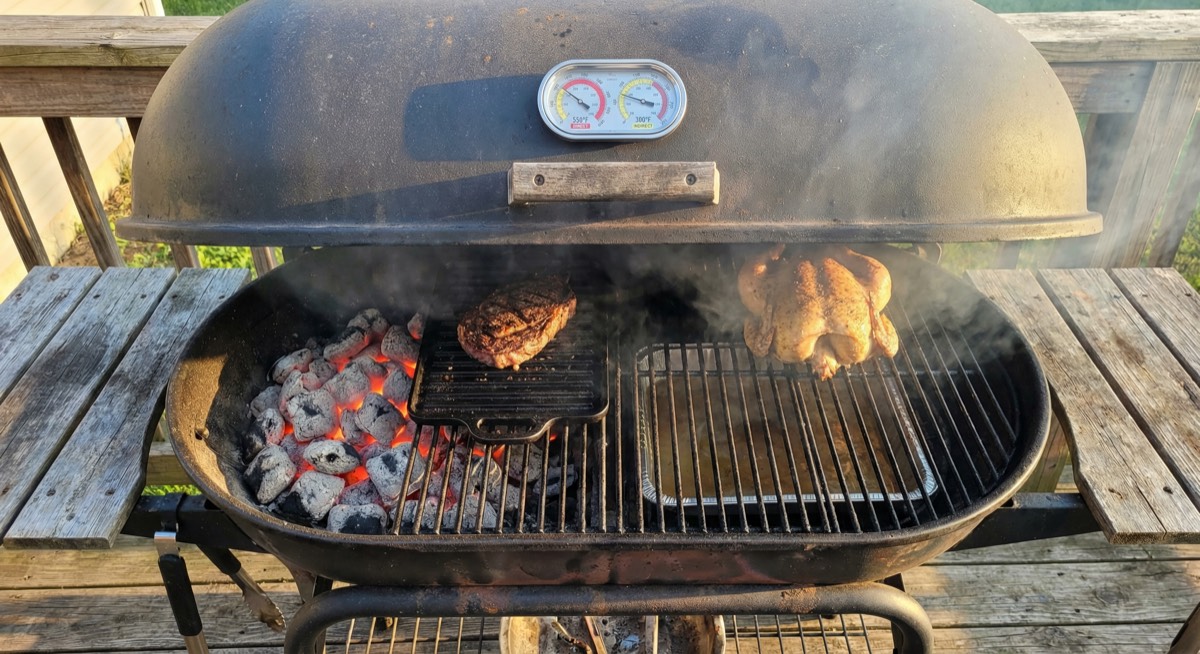
The most versatile grilling setup is the two-zone fire — direct heat on one side, no heat on the other. This gives you both cooking methods on a single grill, and it is the foundation of almost every advanced grilling technique.
Setting Up a Two-Zone Charcoal Fire
- Light a full chimney of charcoal until the top coals are ashed over (15–20 minutes)
- Pour all the coals onto one half of the charcoal grate, leaving the other half empty
- Replace the cooking grate and close the lid for 5 minutes to preheat
- You now have a hot zone (500–700°F directly over coals) and a cool zone (250–350°F on the empty side with the lid closed)
Setting Up a Two-Zone Gas Fire
- Turn one or two burners to high (or your desired heat level)
- Leave the remaining burners completely off
- Close the lid and preheat for 10–15 minutes
- The lit side is your direct zone; the unlit side is your indirect zone
Why Two Zones Change Everything
With a two-zone fire, you gain control over the biggest variable in grilling: time versus temperature. You can:
- Sear then move: Build a crust over direct heat, then slide to indirect heat to finish cooking gently without burning
- Cook then sear: The reverse sear — bring a thick steak up to temperature on the indirect side, then finish over the coals for a 60-second crust
- Manage flare-ups: When fat drips cause flames, move the food to the cool zone until the flare-up subsides, then return to direct heat
- Cook different items simultaneously: Sear steaks over direct heat while vegetables roast on the indirect side
- Hold finished food: Move items that are done to the cool zone to stay warm without overcooking
Heat Transfer Science: Radiation vs Convection vs Conduction
All three forms of heat transfer are present in every grilling scenario. What changes between direct and indirect is the ratio.
Direct Heat Breakdown
- Radiation: 60–75% — infrared energy from the hot coals or burner surfaces travels in straight lines to the food
- Conduction: 15–25% — where the food directly contacts the hot metal grate, conduction drives rapid local heating (this creates grill marks)
- Convection: 10–15% — rising hot air contributes some heat, especially with the lid open
Indirect Heat Breakdown (Lid Closed)
- Convection: 60–80% — circulating hot air is the dominant mechanism
- Radiation: 15–25% — the hot grill walls and lid radiate some energy inward
- Conduction: 5–10% — the grate is cooler on the indirect side, contributing less conductive heat
This shift in ratios explains why direct heat creates sear marks and crust (concentrated energy on contact points) while indirect heat cooks evenly (diffuse energy from all directions). It is the same reason a broiler browns the top of a casserole (radiant heat from above) while the oven setting cooks it through (convective heat from circulating air).
The Lid: Open vs Closed
The grill lid is the switch between direct-dominant and indirect-dominant cooking, even over the same heat source.
Lid open over direct heat: Pure direct grilling. Radiant and conductive heat dominate. Hot air escapes immediately instead of circulating. The underside of the food cooks while the top side stays relatively cool. This is ideal for quick searing where you want maximum surface heat without cooking the interior too fast.
Lid closed over direct heat: A hybrid. The food receives direct radiant heat from below AND convective heat from the trapped hot air. This cooks faster and more evenly than lid-open, but increases the risk of overcooking the exterior. Use this for items that need full cooking through — bone-in chicken pieces, thick pork chops — where you want both browning and interior doneness.
Lid closed over indirect heat: Pure indirect grilling. Convection dominates. The grill functions as an oven. This is the setup for smoking, roasting, and the low-heat phase of the reverse sear.
Common Mistakes with Direct and Indirect Heat
Mistake 1: Using Direct Heat for Everything
The most common beginner error. Bone-in chicken thighs, thick pork chops, and whole chickens placed over direct heat will char on the outside long before the interior reaches a safe temperature. If the food takes more than 8–10 minutes to cook through, it probably needs at least some indirect time.
Mistake 2: Never Using Direct Heat
The opposite error. Cooking everything on indirect produces food that is evenly cooked but lacks the crust, char, and Maillard flavors that make grilled food distinctive. Even low-and-slow items benefit from a brief direct-heat sear at the beginning or end.
Mistake 3: Opening the Lid Constantly on Indirect Cooks
Every time you open the lid, you dump all the accumulated hot air. The grill temperature can drop 50–100°F in seconds. On an indirect cook, this extends cooking time and disrupts the stable convective environment. Check your food by temperature (use a probe thermometer), not by looking.
Mistake 4: No Safety Zone
Even when cooking entirely over direct heat, always leave a section of the grill empty (or an unlit burner). This gives you a safe place to move food if flare-ups occur or if items finish cooking at different rates. A grill with wall-to-wall coals offers zero escape routes.
Temperature Profiles: What to Expect
Measured with a grate-level probe on a standard 22-inch kettle grill:
Full Charcoal Spread (Direct Everywhere)
- Grate temperature: 550–650°F
- Air temperature (lid closed, 6 inches above grate): 450–550°F
- No cool zone available
Two-Zone Setup (Half Coal, Half Empty)
- Direct zone grate temperature: 550–650°F
- Indirect zone grate temperature: 275–375°F (lid closed)
- Air temperature above indirect zone: 300–400°F
Low-and-Slow Indirect (Snake Method or Minion Method)
- Direct zone: minimal (just the burning coals, limited area)
- Indirect zone grate temperature: 225–275°F
- Stable for 4–8 hours with proper vent management
These numbers illustrate the range of cooking environments available on a single grill, depending solely on coal placement and vent control. The grill itself does not change — only the heat configuration.
Practical Applications
Thick Steak (Reverse Sear on the Grill)
Set up a two-zone fire. Place the steak on the indirect side, close the lid, and cook until the internal temperature reaches 115°F (for medium-rare). Move to the direct side and sear 60–90 seconds per side. This produces the most evenly cooked steak with a deep crust.
Bone-In Chicken Thighs
Start skin-side down over direct heat for 3–4 minutes to render fat and crisp the skin. Move to indirect heat, close the lid, and cook until the internal temperature reaches 175°F (thighs benefit from higher doneness to break down connective tissue). Total time: 25–35 minutes.
Baby Back Ribs
Entirely indirect heat at 250°F for 3–4 hours. The gentle convective heat slowly converts collagen to gelatin without drying out the meat. Apply sauce in the final 30 minutes, or finish with a 2-minute direct-heat sear to caramelize the glaze.
Whole Chicken
Indirect heat at 350°F, breast side up, until the thickest part of the thigh reads 165°F. Total time: 60–90 minutes depending on size. For crispy skin, move directly over coals for the final 5 minutes, rotating frequently. The indirect phase cooks the bird evenly; the direct finish delivers the skin texture.
Vegetables
Most vegetables benefit from direct heat — the high temperature caramelizes natural sugars quickly. Asparagus, zucchini, peppers, and corn all do well over direct heat for 3–8 minutes with frequent turning. Larger or denser vegetables (whole potatoes, beets, onion halves) benefit from starting on indirect heat to cook through, then finishing on direct to char.
The Bottom Line
Direct heat delivers intensity — crust, char, speed. Indirect heat delivers control — even cooking, moisture retention, patience. The two-zone fire gives you both, and learning to move food between zones based on what it needs in the moment is the single most valuable grilling skill you can develop.
Every technique on this site — the reverse sear, carryover cooking management, resting science — builds on this foundation. Master the zones and everything else follows.
Frequently Asked Questions
What is the difference between direct and indirect heat on a grill?
Direct heat means the food sits directly over the heat source (coals or burner), cooking primarily by infrared radiation at 500–700°F. Indirect heat means the food sits away from the heat source with the lid closed, cooking primarily by convection (hot air circulation) at 225–375°F. Direct heat sears and browns; indirect heat roasts and smokes.
How do you set up a two-zone fire?
On a charcoal grill, pour all lit coals onto one half of the charcoal grate, leaving the other half empty. On a gas grill, turn one or two burners to high and leave the remaining burners off. Close the lid to preheat. You now have a hot direct zone and a cooler indirect zone on the same grill.
Should the grill lid be open or closed?
Open the lid for quick direct-heat searing where you want maximum surface heat without overcooking the interior. Close the lid when you need convective heat to cook food through — especially for indirect cooking, thick cuts, or any cook longer than 10 minutes. Every lid opening drops the temperature 50–100°F.
When should I use indirect heat instead of direct?
Use indirect heat when the food takes more than 8–10 minutes to cook through: whole chickens, thick roasts, ribs, brisket, bone-in chicken pieces, or thick steaks during the low-heat phase of a reverse sear. Direct heat alone will burn the exterior before the interior reaches temperature on these items.
Can I use both direct and indirect heat on the same food?
Yes — this is the most versatile approach. Sear over direct heat for crust, then move to indirect to finish cooking gently (or vice versa for the reverse sear). Bone-in chicken, thick chops, and whole birds all benefit from combining both methods in the same cook.
More Expert Guides
Steak Doneness Temperature Guide: The Science of Every Level from Rare to Well Done
Every degree matters. This science-backed guide covers the exact internal temperatures for every steak doneness level, why each temperature produces a different texture, and how to nail your target every time.
14 min readResting Meat After Cooking: The Science of Why It Makes Every Steak Juicier
Resting meat after cooking is not optional — it is physics. Here is exactly what happens inside the steak during those crucial minutes and how long to rest every cut.
14 min readGrill vs Cast Iron for Steak: The Science of Which Method Wins
The grill vs cast iron debate has divided steak lovers for years. The answer depends on physics — specifically, how each method transfers heat and what that means for your crust and interior.