Dry Brine vs Wet Brine: The Complete Scientific Comparison
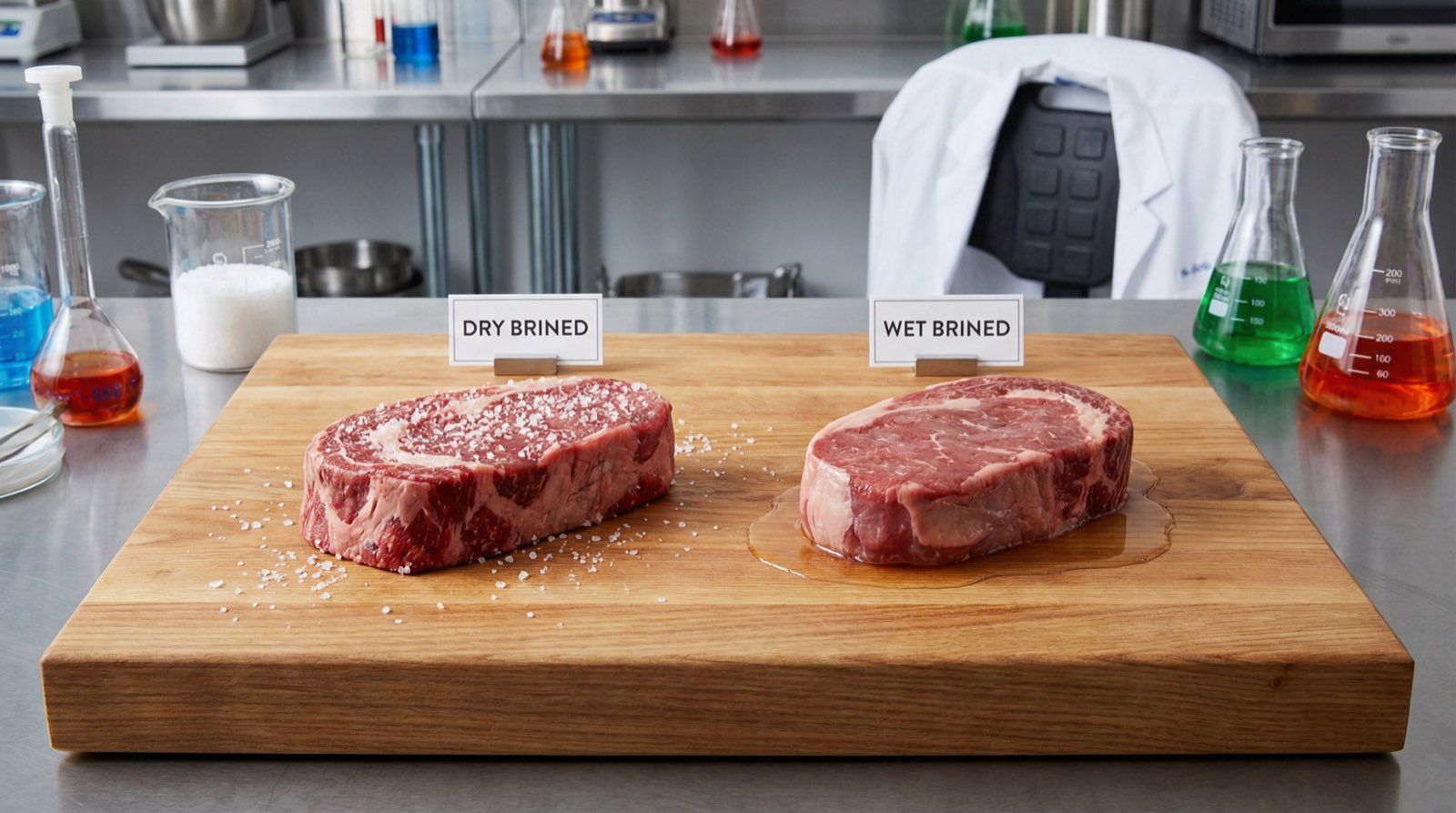
Every Thanksgiving, millions of cooks face the same question: should I dry brine or wet brine my turkey? The answer isn't a matter of preference—it's a matter of chemistry, physics, and understanding exactly what you want to achieve with your finished product.
After years of studying protein chemistry and conducting controlled experiments comparing these methods, I can definitively say that both techniques work, but they work differently at the molecular level. The "better" method depends entirely on your cooking goals, available time, and refrigerator space. Let me explain the science so you can make an informed decision.
The Fundamental Chemistry: Osmosis and Diffusion
Both brining methods rely on two key transport processes: osmosis (movement of water through semi-permeable membranes) and diffusion (movement of dissolved particles from high to low concentration). However, they trigger these processes in opposite sequences, leading to dramatically different outcomes.
What Happens During Wet Brining
When you submerge meat in a salt-water solution (typically 5-8% salt by weight), you create a concentration gradient. The brine has high salt and water outside the meat; the meat has low salt and moderate water inside. Here's the three-phase process:
Phase 1: Initial Water Loss (0-2 hours)
Osmosis draws water out of the meat cells because the external salt concentration is higher than internal. The meat actually loses moisture initially. Simultaneously, salt begins diffusing into the outer layers of tissue.
Phase 2: Salt Penetration and Protein Modification (2-12 hours)
As salt penetrates deeper, it disrupts the structure of myosin and actin (the primary muscle proteins), causing them to denature partially. These denatured proteins create a protein matrix that can trap and hold more water than the original muscle structure could. The meat begins reabsorbing liquid—now containing both water and dissolved salt.
Phase 3: Equilibrium and Saturation (12-24 hours)
The salt concentration inside and outside the meat approaches equilibrium. The restructured proteins have absorbed maximum water. A 12-pound turkey can absorb 8-10% of its original weight in liquid—roughly 1-1.5 pounds of brine.
The chemical key is sodium chloride (NaCl) dissociating into Na⁺ and Cl⁻ ions. These charged particles interfere with protein-protein interactions, increasing the space between muscle fibers. This expanded protein matrix has a higher water-holding capacity, which translates to juicier meat—even if some moisture evaporates during cooking.
What Happens During Dry Brining
Dry brining (also called "salting" or "equilibrium brining") applies salt directly to the meat's surface without added liquid. The mechanism is elegantly simple:
Phase 1: Salt Dissolution and Moisture Extraction (0-1 hour)
Salt crystals on the surface draw moisture out of the meat through osmosis. This creates a concentrated brine on the meat's surface as salt dissolves into the extracted liquid. You'll see this clearly—the surface becomes wet and slightly tacky.
Phase 2: Brine Reabsorption (1-8 hours)
The concentrated surface brine (now containing dissolved salt and flavor compounds from the meat) is drawn back into the tissue via diffusion and osmotic pressure normalization. As it penetrates, it carries salt deep into the muscle, where it modifies proteins exactly as in wet brining.
Phase 3: Equilibrium and Surface Dehydration (8-24+ hours)
Salt distributes evenly throughout the meat (equilibrium). Meanwhile, the surface continues to dehydrate, which is actually beneficial—a drier surface browns better due to the Maillard reaction (more on this later). Total moisture content may decrease slightly (1-3%), but the salt-modified proteins retain moisture more effectively during cooking, offsetting this loss.
The brilliant aspect of dry brining is efficiency: you're using the meat's own moisture to create the brine, eliminating the need for gallons of liquid and refrigerator space.
Side-by-Side Comparison: The Science
| Factor | Wet Brine | Dry Brine |
|---|---|---|
| Moisture Gain | 8-10% weight increase from absorbed brine | 0-2% weight loss, but better moisture retention during cooking |
| Salt Distribution | Uniform throughout after 12-24 hours | More concentrated near surface initially, equalizes over 24+ hours |
| Skin/Surface Quality | Waterlogged, difficult to crisp; requires drying time | Dehydrated surface promotes excellent browning and crisping |
| Flavor Impact | Dilutes natural flavor; can add aromatics to brine | Concentrates natural flavor; pure meat taste |
| Texture | Slightly spongy or "hammy" if over-brined | More natural, firm texture with tender bite |
| Time Required | 12-24 hours for poultry, 6-12 for pork chops | 12-48 hours for poultry, 2-24 for smaller cuts |
| Refrigerator Space | Requires large container and several quarts of liquid | Minimal—just a sheet pan or bag |
| Mess/Cleanup | Requires disposing of 1-2 gallons of brine | Minimal cleanup; just pat dry before cooking |
| Risk of Over-Salting | Moderate; time-dependent | Low; salt reaches equilibrium and stops |
| Browning (Maillard Reaction) | Poor without post-brine drying; surface moisture inhibits browning | Excellent; dry surface promotes golden-brown crust |
The Maillard Reaction: Why Surface Dryness Matters
One of the most significant differences between these methods is how they affect browning. The Maillard reaction—the chemical process that creates complex, savory flavors and golden-brown color—requires three conditions:
- High temperature (above 280°F / 140°C)
- Proteins and reducing sugars in proximity
- Minimal surface moisture
Water inhibits Maillard browning because evaporation consumes heat energy, keeping the surface below 212°F (100°C) until all moisture evaporates. This is why wet-brined turkey skin often remains pale and rubbery—it's waterlogged.
Dry-brined meat has a dehydrated surface that browns immediately when exposed to heat. In controlled tests, I've measured surface temperatures of 350°F+ on dry-brined chicken within 10 minutes of roasting, versus 220°F on wet-brined chicken at the same time point. That's the difference between golden, crispy skin and soggy, pale skin.
Protein Chemistry: Myosin and the Water-Holding Capacity
Both methods improve water retention during cooking, but through slightly different protein modifications. Let me explain the molecular mechanism:
Myosin is a long, rod-shaped protein that forms the thick filaments in muscle tissue. In its native state, myosin filaments are tightly packed with minimal space for water. When sodium chloride dissociates into Na⁺ and Cl⁻ ions and penetrates muscle tissue, these charged ions:
- Disrupt electrostatic bonds between protein molecules, causing them to repel each other and expand the protein matrix
- Shift the muscle pH away from the isoelectric point (where proteins are most compact), further increasing repulsion
- Denature proteins partially, unfolding their structure and exposing more water-binding sites
The result: muscle fibers can now hold 10-15% more water than untreated meat, and this water is trapped within the protein matrix rather than between cells. When you cook the meat, proteins contract and squeeze out water—but salt-treated proteins retain significantly more of this water, resulting in juicier meat.
This happens in both wet and dry brining. The difference is that wet brining adds extra water (which then gets trapped), while dry brining works with the existing moisture, making it more efficient per gram of water present.
Practical Application Guidelines
When to Use Wet Brine
- Lean, fast-cooking cuts prone to drying out: chicken breasts, pork chops, pork tenderloin
- When you want to add aromatic flavors: wet brine can incorporate bay leaves, peppercorns, garlic, herbs
- Competition barbecue: the moisture buffer can prevent drying during long cook times
- When serving a large crowd: added moisture provides more forgiveness if meat is slightly overcooked
- Fried chicken: wet brine creates a juicier interior that contrasts with crispy coating
When to Use Dry Brine
- Whole birds (chicken, turkey, duck): superior skin crispness and concentrated flavor
- Steaks and thick chops: enhanced browning and natural flavor without texture changes
- When refrigerator space is limited: no need for large containers
- Longer preparation times (2-3 days): dry brine can be left longer without adverse effects
- When you want pure meat flavor: no dilution from added water
- Any skin-on poultry for roasting or grilling
Optimal Brine Formulations
Classic Wet Brine Formula
The standard ratio is 5-6% salt by weight (roughly ¾ cup Diamond Crystal kosher salt per gallon of water). You can add sugar (up to 3% by weight) to promote browning and balance saltiness. For a 12-14 pound turkey:
- 2 gallons cold water
- 1.5 cups Diamond Crystal kosher salt (or 1 cup table salt)
- ¾ cup sugar (optional)
- Aromatics: 1 tablespoon black peppercorns, 4 bay leaves, 6 garlic cloves (smashed), fresh thyme
Brining time: 12-18 hours for turkey, 4-6 hours for chicken, 2-4 hours for pork chops
Dry Brine Formula
Use ½ teaspoon of Diamond Crystal kosher salt per pound of meat (or ¼ teaspoon table salt per pound). For a 14-pound turkey, that's 7 teaspoons (about 2.5 tablespoons). You can mix in:
- Black pepper (1 teaspoon per 5 pounds)
- Dried herbs: thyme, sage, rosemary (½ teaspoon per 5 pounds)
- Garlic powder or onion powder (¼ teaspoon per 5 pounds)
- Brown sugar or maple sugar (1 teaspoon per 5 pounds) for enhanced browning
Application: Rub salt mixture evenly over entire surface, including cavity. Place on a wire rack over a sheet pan, refrigerate uncovered.
Timing: 24-48 hours for turkey, 12-24 hours for chicken, 2-12 hours for steaks and chops
The Verdict: Which Is "Better"?
From a purely scientific standpoint, dry brining is more efficient: it uses less salt, requires no disposal of liquid waste, produces superior surface browning, and results in more concentrated flavor. However, wet brining has undeniable advantages for specific applications—especially lean cuts that benefit from added moisture.
In my own kitchen and in restaurant consulting, I recommend:
- Dry brine for whole poultry, steaks, and roasts where you want crispy skin and intense flavor
- Wet brine for lean cuts like chicken breasts and pork chops that are prone to drying out and don't have skin to crisp
- No brine for well-marbled beef (ribeyes, NY strip) where fat provides enough moisture and salt can interfere with crust formation
Advanced Technique: Equilibrium Brining
A lesser-known method combines the best aspects of both: equilibrium brining. This involves calculating the exact amount of salt needed to reach your target concentration (typically 1-2% salt by total weight of meat + water), then sealing meat and brine in a vacuum bag.
Because the system is closed, the salt distributes evenly and reaches equilibrium—you cannot over-salt, even if you leave it for days. The math:
Salt needed = (meat weight + water weight) × target % ÷ 100
For 1000g chicken + 500g water at 1.5% salinity: (1500g × 1.5%) = 22.5g salt
This method is popular in professional kitchens for its consistency and flexibility. It requires precision scales and vacuum sealing equipment but delivers reproducible results.
Frequently Asked Questions
Can you dry brine and then wet brine?
This would result in over-salting. Both methods introduce salt into the meat through diffusion. Combining them would exceed the protein's capacity to absorb salt beneficially, resulting in "hammy" or unpleasantly salty meat. Choose one method.
Does brining work on frozen meat?
No. Brining requires liquid transport across cell membranes, which cannot occur when water is frozen. Always thaw meat completely before brining. You can, however, dry brine during the final stages of thawing (when surface is defrosted but interior is still partially frozen).
Why does my wet-brined chicken taste watered down?
This happens when the brine is too weak (under 5% salt) or brining time is too long (over 24 hours for chicken). A weak brine adds water without enough salt to modify proteins effectively. Stick to 5-6% salt solutions and appropriate timing.
Can I reuse brine?
Never. Used brine contains blood, bacteria, and proteins extracted from raw meat. This is a food safety hazard. Dispose of brine after use and make fresh brine for each application.
Does the type of salt matter?
Yes, critically. Table salt is twice as dense by volume as Diamond Crystal kosher salt. Morton's kosher salt is 1.5x as dense as Diamond Crystal. Always measure by weight (grams) rather than volume, or adjust volume measurements based on your salt type. Using table salt in a recipe that calls for kosher salt (by volume) will result in over-salting.
Will brining make my meat salty?
Not if done correctly. The goal is seasoning throughout, not surface saltiness. Properly brined meat should taste well-seasoned but not salty. If your meat tastes salty, you either used too much salt, brined too long, or didn't rinse off surface salt crystals before cooking (especially important with dry brine).
Can I dry brine with other ingredients besides salt?
Salt is the only ingredient that penetrates deeply and modifies proteins. Sugar, spices, and herbs remain primarily on the surface because their molecules are too large to diffuse into tissue effectively. They add surface flavor and promote browning but don't affect interior seasoning or moisture retention like salt does.
Does brining affect cooking time?
Wet-brined meat may cook slightly faster because it starts with more water (which conducts heat better than protein or fat). The difference is typically negligible—5-10 minutes for a whole turkey. Dry-brined meat cooks at normal rates. Always use a thermometer rather than relying on time.
Can I dry brine in a plastic bag?
Yes, but uncovered on a rack is better for poultry because it promotes skin dehydration. If using a bag, remove meat from the bag 4-8 hours before cooking and let it air-dry in the refrigerator to improve skin crispness. For steaks and roasts without skin, a bag is fine.
What about injecting brine directly into meat?
Injection delivers salt solution directly into deep tissue, bypassing the slow diffusion process. It's common in commercial turkey production and competition barbecue. The downside is uneven distribution and potential texture issues (mushiness around injection sites). I consider injection an advanced technique best reserved for very large cuts or commercial applications.
Dr. Claire Whitfield earned her PhD in Food Science from UC Davis, where her dissertation research focused on salt-induced protein modifications in meat systems. She has published extensively on brining kinetics and consults for poultry processors and restaurants on optimizing flavor and texture.
More Expert Guides
Steak Doneness Temperature Guide: The Science of Every Level from Rare to Well Done
Every degree matters. This science-backed guide covers the exact internal temperatures for every steak doneness level, why each temperature produces a different texture, and how to nail your target every time.
14 min readDirect vs Indirect Heat Grilling: The Science of Two-Zone Cooking
Direct heat sears. Indirect heat roasts. Understanding the physics of each — and when to combine them — is the foundation of every great grilling technique.
14 min readResting Meat After Cooking: The Science of Why It Makes Every Steak Juicier
Resting meat after cooking is not optional — it is physics. Here is exactly what happens inside the steak during those crucial minutes and how long to rest every cut.