Dry Rub vs Marinade: The Science of Which Works Better (and When)
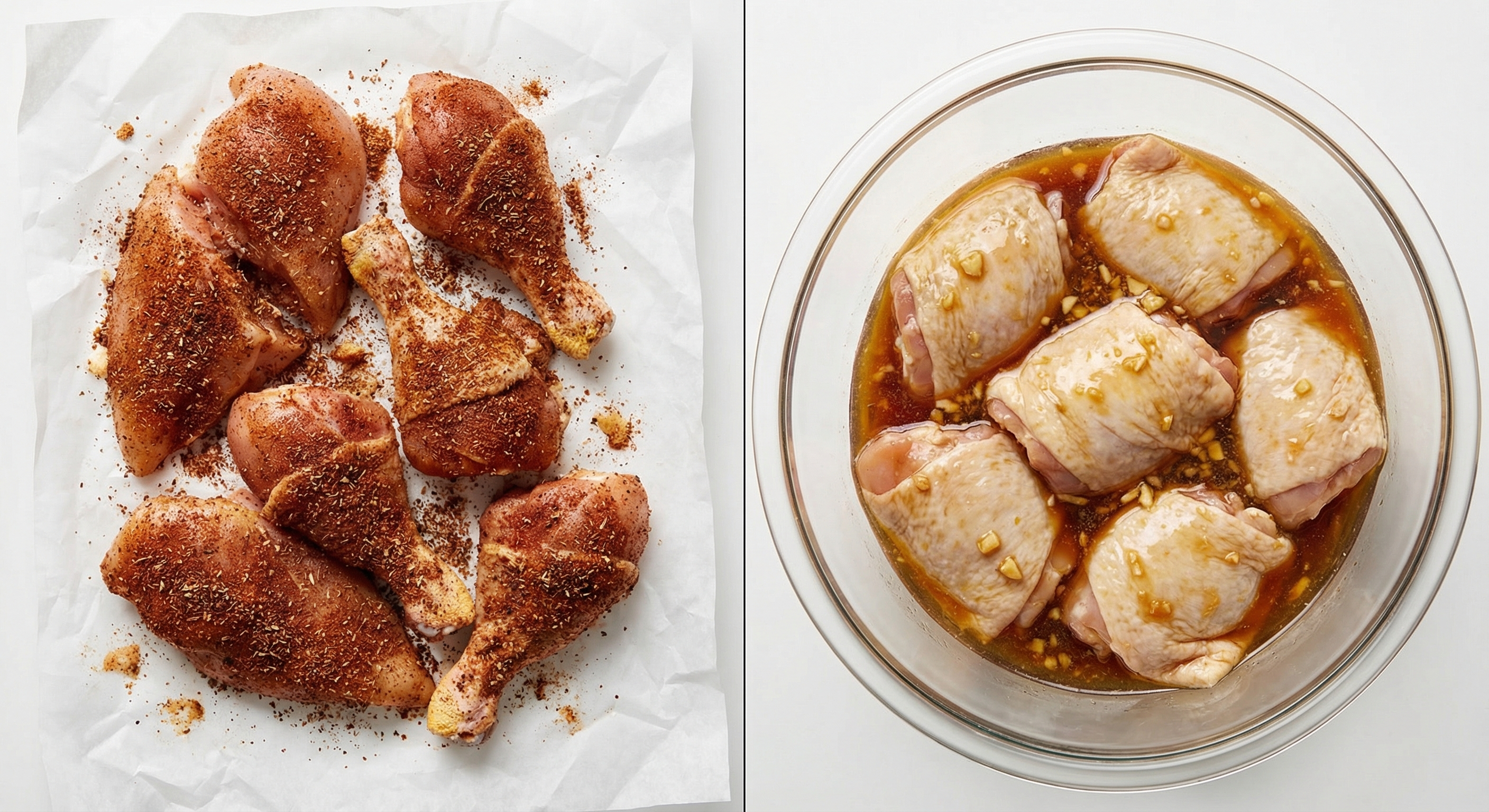
Dry Rub vs Marinade: The Science of Which Works Better (and When)
You stand at the counter with a pound of chicken thighs. To your left: a bowl of spices. To your right: a bottle of soy sauce, lemon juice, and garlic. Both promise flavor. Both claim to "tenderize." Both have passionate advocates who swear their method is superior.
The truth is more nuanced. Dry rubs and marinades alter meat chemistry through entirely different mechanisms — and neither is universally better. The question isn't "which is best?" It's "which is best for this cut, this cook, and this goal?"
What Is a Dry Rub?
A dry rub is a blend of dry spices, herbs, salt, and sometimes sugar applied directly to the surface of meat. No liquid. No oil (though some pitmasters apply a thin binder like mustard or oil first to help the rub adhere).
Common dry rub ingredients:
- Salt — seasoning, moisture extraction (osmosis), protein denaturation
- Sugar (brown, white, turbinado) — caramelization, bark formation, balances heat
- Paprika — color, mild flavor, bark
- Black pepper — heat, aromatics
- Chili powder, cayenne — heat
- Garlic powder, onion powder — umami, aromatics
- Cumin, coriander, mustard powder — regional flavor profiles
Dry rubs sit on the surface and penetrate shallowly (salt and small molecules go deeper; large spice particles stay on top). During cooking, the rub undergoes chemical transformations — the Maillard reaction, caramelization, and polymerization — forming a flavorful, textured crust called bark.
What Is a Marinade?
A marinade is a liquid mixture (typically acidic or enzymatic) that meat soaks in before cooking. Marinades contain:
- Acid — vinegar, citrus juice, wine, yogurt (lactic acid)
- Oil — carries fat-soluble flavor compounds, adds moisture
- Aromatics — garlic, ginger, herbs, spices
- Salt — seasoning, osmotic effects
- Enzymatic tenderizers (optional) — pineapple (bromelain), papaya (papain), ginger (zingibain)
Marinades penetrate deeper than rubs because they're liquid. The acid denatures surface proteins, the salt penetrates via osmosis, and aromatic compounds diffuse into the meat. But marinades also introduce moisture, which inhibits browning during cooking.
The Chemistry: How Each Works
Dry Rub: Surface Transformation via Dehydration and Maillard Reaction
Salt draws moisture out (osmosis). At the molecular level, salt dissolves into sodium and chloride ions, which create an osmotic gradient. Water migrates from inside the meat (low salt concentration) toward the surface (high salt concentration). Some of this moisture evaporates; some dissolves the salt and gets reabsorbed along with dissolved spices.
This dry-brining effect seasons the meat internally (not just the surface) and creates a drier surface conducive to browning. The dissolved salt also denatures surface proteins slightly, improving texture.
Sugar caramelizes and participates in Maillard reactions. At temperatures above 300°F, sugars break down into hundreds of flavor compounds (caramelization). Simultaneously, reducing sugars react with amino acids in the meat to form Maillard products — the brown, savory crust that defines barbecue bark.
Spices toast and release volatile oils. Heat activates aromatic compounds in spices (terpenes, phenols, ketones). Paprika develops a richer red hue. Black pepper releases piperine. Cumin releases cuminaldehyde. The longer the cook, the more these compounds develop.
Result: A dry, flavorful, textured crust (bark) with seasoning concentrated at the surface. Minimal internal flavor penetration beyond salt.
Marinade: Protein Denaturation and Flavor Diffusion
Acid denatures surface proteins. Acids (acetic acid from vinegar, citric acid from lemon, lactic acid from yogurt) lower the pH at the meat's surface. Proteins denature (unfold) when pH drops below their isoelectric point (~pH 5.5 for myosin). This unfolding creates a mushy, tender surface layer — which can be desirable in thin cuts but problematic in thick ones.
The acid effect is shallow. Even after 24 hours, acidic marinades penetrate only 2–3 millimeters into dense muscle tissue. This is why marinated chicken breasts often have a tender exterior but a firm interior.
Enzymatic marinades (pineapple, papaya, ginger) break peptide bonds. Proteolytic enzymes cleave the peptide bonds in collagen and myosin, physically degrading the protein structure. This is true tenderization — but it's aggressive. Over-marinating with enzymes can turn meat into mush. (Enzymes are deactivated by cooking, so the effect stops once heat hits ~140°F.)
Oil carries fat-soluble aromatics. Compounds like eugenol (cloves), cinnamaldehyde (cinnamon), and thymol (thyme) are fat-soluble. Oil in the marinade dissolves these compounds and carries them toward the meat's surface. However, oil itself doesn't penetrate muscle tissue — it coats the surface and gets washed away if you pat the meat dry before cooking.
Result: Tenderized surface layer, aromatic coating, and higher surface moisture (which inhibits browning unless you dry the meat before grilling).
Penetration Depth: How Far Does Flavor Go?
| Component | Dry Rub Penetration | Marinade Penetration |
|---|---|---|
| Salt (NaCl) | Deep — via osmosis, reaches center in 12–24 hours (depending on thickness) | Deep — same osmotic mechanism |
| Sugar | Shallow — stays mostly on surface | Shallow — 2–3 mm in 8–12 hours |
| Spices (large particles) | Surface only — particle size prevents penetration | Surface only (if particulate); some volatile oils penetrate shallowly if dissolved in oil |
| Acid | N/A | Shallow — 2–3 mm after 24 hours |
| Enzymes | N/A | Shallow — 3–5 mm, but effect is localized to protein structure |
| Aromatics (garlic, ginger) | Surface only (unless dissolved in moisture from salt) | Shallow — oil-soluble compounds coat surface; water-soluble ones penetrate slightly |
Key insight: Both methods primarily flavor the surface. Salt is the only component that penetrates deeply. If you want internal seasoning, you need salt (in either a rub or marinade) and time.
Moisture Retention: Dry Rub vs Marinade
This is where the science gets counterintuitive.
Dry Rub (with Salt): Retains More Moisture
A salt-based dry rub acts as a dry brine. Salt denatures proteins slightly, causing them to unwind and form a gel-like matrix that traps water. During cooking, this matrix holds moisture better than untreated meat.
Studies (notably by food scientist Harold McGee and America's Test Kitchen) show that dry-brined chicken retains 4–6% more moisture than unbrined chicken. This is because the denatured protein network prevents water from being squeezed out by muscle contraction during heating.
Marinade: Adds Surface Moisture But Doesn't Improve Retention
Marinades add liquid to the meat's surface, but they don't significantly improve moisture retention during cooking. The acidic environment can actually reduce moisture retention by over-denaturing proteins, which squeezes water out (like wringing a sponge).
Oil-based marinades coat the surface but don't penetrate muscle tissue. When you grill, much of that oil drips off or burns away.
Exception: Yogurt-based marinades (like tandoori chicken) provide both lactic acid (gentle denaturation) and fat, which can improve perceived juiciness by coating the mouth. But actual water retention is similar to unseasoned meat.
The verdict: For moisture retention, a dry rub with salt (applied 4–24 hours ahead) beats most marinades.
Bark Formation: Why Dry Rubs Win for Low-and-Slow
Bark — the dark, crusty, flavorful exterior on smoked brisket, ribs, or pork shoulder — is the holy grail of barbecue. Bark forms through:
- Maillard reactions (amino acids + reducing sugars at 300°F+)
- Caramelization (sugar breakdown at 320°F+)
- Polymerization (proteins and sugars cross-linking into complex, brown structures)
- Smoke deposition (phenols, carbonyls, and other smoke compounds adhering to sticky, tacky surfaces)
Dry rubs excel at bark formation because they create a dry, sticky surface rich in sugars and proteins. As the meat cooks, the surface dehydrates, concentrates the rub, and undergoes repeated cycles of moisture evaporation and reabsorption (especially during the stall). This builds layer upon layer of flavor and texture.
Marinades inhibit bark formation because they introduce too much moisture. Even if you pat the meat dry before cooking, residual liquid on the surface slows browning. The meat spends more time steaming (evaporating surface moisture) than browning. By the time the surface is dry enough to brown, the interior may be overcooked.
Result: If you want bark (brisket, ribs, pork shoulder), use a dry rub. If you're grilling thin cuts quickly (chicken thighs, skirt steak), marinades are fine.
Tenderizing: Does Either Actually Work?
Dry Rub: Minimal Tenderization
Salt in a dry rub provides some tenderization by denaturing proteins and creating a moisture-retaining matrix, but the effect is subtle. You're not breaking down collagen or physically degrading muscle fibers. The perceived tenderness comes mostly from moisture retention and seasoning (well-seasoned meat tastes more tender because the flavor distracts from texture).
Marinade (Acidic): Surface Tenderization Only
Acidic marinades tenderize the outer 2–3 millimeters of meat. Beyond that, the effect is negligible. For a 1-inch-thick chicken breast, that's about 20% of the total volume. The interior remains unchanged.
Over-marinating in acid can over-tenderize the surface, creating a mushy, mealy texture (think: ceviche, where acid "cooks" the fish by denaturing proteins so aggressively they turn opaque and firm-yet-mushy).
Marinade (Enzymatic): Real Tenderization, But High Risk
Enzymatic marinades (pineapple, papaya, kiwi, ginger) genuinely tenderize meat by cleaving peptide bonds in collagen and myosin. This is real structural degradation, not just surface denaturation.
But enzymes are aggressive. Marinating chicken in pineapple juice for 12 hours can turn the surface into paste. The sweet spot is 30 minutes to 2 hours for thin cuts. For thick cuts, enzymes still only penetrate shallowly, so you end up with a mushy exterior and a firm interior — not ideal.
Best tenderization method? Low-and-slow cooking (for collagen-rich cuts) or mechanical tenderization (Jaccard, pounding) for lean cuts. Marinades and rubs are flavoring methods, not tenderization methods.
Flavor Development: Complexity vs Concentration
Dry Rub: Concentrated, Developed Flavor
Because dry rubs stay on the surface and undergo heat transformation, they develop complex, concentrated flavors. The Maillard reaction creates hundreds of new compounds (pyrazines, furans, thiazoles) that weren't in the original spices. Sugar caramelizes into bittersweet, nutty notes. Smoke compounds adhere to the tacky rub, building layers of flavor.
A well-executed dry rub on a 12-hour brisket creates flavors that are literally impossible to achieve with a marinade.
Marinade: Fresh, Bright, Aromatic Flavor
Marinades deliver fresh, bright, aromatic flavors — citrus, ginger, garlic, herbs. These are the flavors you taste immediately upon biting into the meat. They don't develop during cooking (many volatile aromatics burn off at high heat). Instead, they provide a contrast to the rich, fatty interior.
Marinades are excellent for cuts that cook quickly and benefit from acidity to cut richness (e.g., fatty chicken thighs, lamb chops, skirt steak).
When to Use a Dry Rub
- Low-and-slow smoking — brisket, pork shoulder, ribs
- Thick cuts with long cook times — where bark and smoke penetration matter
- Cuts you want to dry-brine — chicken (whole or parts), turkey, pork chops
- High-heat searing — where you want rapid browning without surface moisture interference (ribeye, strip steak)
- Competition barbecue — judges score heavily on bark and smoke ring
Application timing: Apply 4–24 hours before cooking for dry-brining effect. For sugary rubs on high heat, apply just before cooking to prevent burning.
When to Use a Marinade
- Thin, quick-cooking cuts — chicken thighs, skirt steak, flank steak, shrimp
- Lean cuts that benefit from added fat/moisture perception — chicken breast, pork tenderloin
- Grilled vegetables — where acid, oil, and aromatics add flavor without the need for bark
- Ethnic cuisines where marinade is traditional — teriyaki (soy + mirin), tandoori (yogurt + spices), carne asada (citrus + chili)
- When you want bright, fresh flavors — citrus, herbs, ginger, garlic
Marinating time: 30 minutes to 4 hours for thin cuts. 8–24 hours for whole chickens or thick steaks. Avoid over-marinating in acidic mixtures (mushy texture).
Hybrid Approach: Dry Rub + Finishing Sauce
Many pitmasters use a dry rub during the cook, then apply sauce in the final 30 minutes (or serve it on the side). This combines the bark-building advantages of a dry rub with the bright, tangy flavors of a sauce.
Example: Memphis-style ribs use a dry rub throughout the cook. Kansas City-style ribs use a dry rub, then glaze with a tomato-based sauce in the last 20 minutes.
This hybrid approach avoids the pitfalls of marinades (too much surface moisture early in the cook) while still delivering sauce flavor at the end.
Common Myths Debunked
Myth: "Marinades penetrate deep into the meat."
False. Acidic and enzymatic marinades penetrate 2–3 millimeters. Only salt (and small water-soluble molecules) penetrates deeply via osmosis. Most marinade flavor stays on the surface.
Myth: "Oil in marinades keeps meat moist."
False. Oil doesn't penetrate muscle tissue. It coats the surface and drips off during grilling. It does help carry fat-soluble flavor compounds, but it doesn't improve internal moisture retention.
Myth: "Dry rubs make meat dry."
False. Salt-based dry rubs improve moisture retention via protein denaturation (dry-brining effect). The "dry" in "dry rub" refers to the lack of liquid in the rub, not the final texture of the meat.
Myth: "Acidic marinades tenderize tough cuts."
Misleading. Acid tenderizes only the outer few millimeters. For tough, collagen-rich cuts (brisket, chuck roast, pork shoulder), the only effective tenderization method is low-and-slow cooking to convert collagen to gelatin. Marinades won't fix a tough cut.
The Bottom Line: Choose Based on Cut and Cook Method
| Goal | Method | Why |
|---|---|---|
| Bark and smoke flavor (brisket, ribs, pork shoulder) | Dry rub | Low surface moisture, sugar for Maillard, long cook time for bark development |
| Quick-grilled thin cuts (chicken thighs, skirt steak) | Marinade | Bright flavors, surface tenderization, short cook time (bark not a priority) |
| Moisture retention | Dry rub (with salt) | Dry-brining effect improves water retention |
| Tenderizing tough cuts | Neither | Use low-and-slow cooking or mechanical tenderization instead |
| High-heat searing (steaks) | Dry rub or salt only | Dry surface = better crust. Marinade moisture interferes with browning |
| Ethnic/traditional flavors | Marinade | Teriyaki, tandoori, carne asada — marinades are part of the dish identity |
There is no universal winner. The science tells us that dry rubs excel at bark, moisture retention, and developed flavors for long cooks, while marinades excel at delivering fresh, aromatic flavors to thin cuts cooked quickly.
Understand the chemistry. Match the method to the cut and the cook. And when in doubt, remember: salt penetrates. Everything else is surface decoration.
Frequently Asked Questions
Do marinades actually tenderize meat?
Acidic marinades tenderize only the outer 2–3 millimeters of meat by denaturing surface proteins. Enzymatic marinades (pineapple, papaya) genuinely break down proteins but penetrate shallowly and can turn the surface mushy if overused. For tough, collagen-rich cuts, low-and-slow cooking is far more effective than marinating.
Which is better for chicken: dry rub or marinade?
For whole chickens or bone-in pieces cooked on a grill or smoker, use a dry rub applied 4–24 hours ahead (dry-brining effect improves moisture retention and creates crispy skin). For quick-grilled boneless thighs or breasts, marinades work well — especially yogurt-based or citrus-herb marinades that add bright flavors in 1–4 hours.
How deep does a dry rub penetrate?
Salt in a dry rub penetrates deeply via osmosis (can reach the center of a chicken breast in 12–24 hours). Sugar and spice particles stay mostly on the surface. Small aromatic molecules may penetrate shallowly if dissolved in moisture from the salt, but most dry rub flavor is concentrated at the surface.
Why does bark form better with dry rubs than marinades?
Bark forms through Maillard reactions, caramelization, and smoke deposition — all of which require a dry, sticky surface. Dry rubs create this environment by concentrating sugars and proteins on the meat. Marinades introduce too much surface moisture, which delays browning as the meat spends time steaming off liquid instead of developing a crust.
Can you use both a dry rub and a marinade?
Yes, but apply them sequentially: marinate first (1–4 hours), then pat dry and apply a dry rub before cooking. This gives you the aromatic infusion from the marinade and the bark-building advantage of the rub. Alternatively, use a dry rub during the cook and brush on sauce in the final 20–30 minutes (common for ribs).
Do oil-based marinades keep meat moist?
No. Oil does not penetrate muscle tissue — it coats the surface and drips off during grilling. It does help carry fat-soluble flavor compounds (garlic, herbs, spices), but it does not improve internal moisture retention. For moisture retention, use a salt-based dry rub (dry-brining effect) instead.
More Expert Guides
Grill Vent Management: The Science of Airflow and Temperature Control
Oxygen controls fire. Fire controls temperature. Vents control oxygen. Master your vents and you master your grill.
12 min readHow Often to Flip Steak: The Science of Multiple Flips vs Single Flip
The traditional advice to flip your steak only once is wrong. Science shows that flipping every 30 seconds produces better crust, more even doneness, and 30% faster cooking through improved heat transfer.
12 min readThe Science of Plancha Grilling: How High Heat and Flat Surfaces Create Superior Crust
Plancha grilling delivers more surface contact, higher heat, and better crust than traditional grates. Here is the science behind why flat-top cooking produces superior results.