Dry Brining vs Wet Brining: A Comparative Analysis
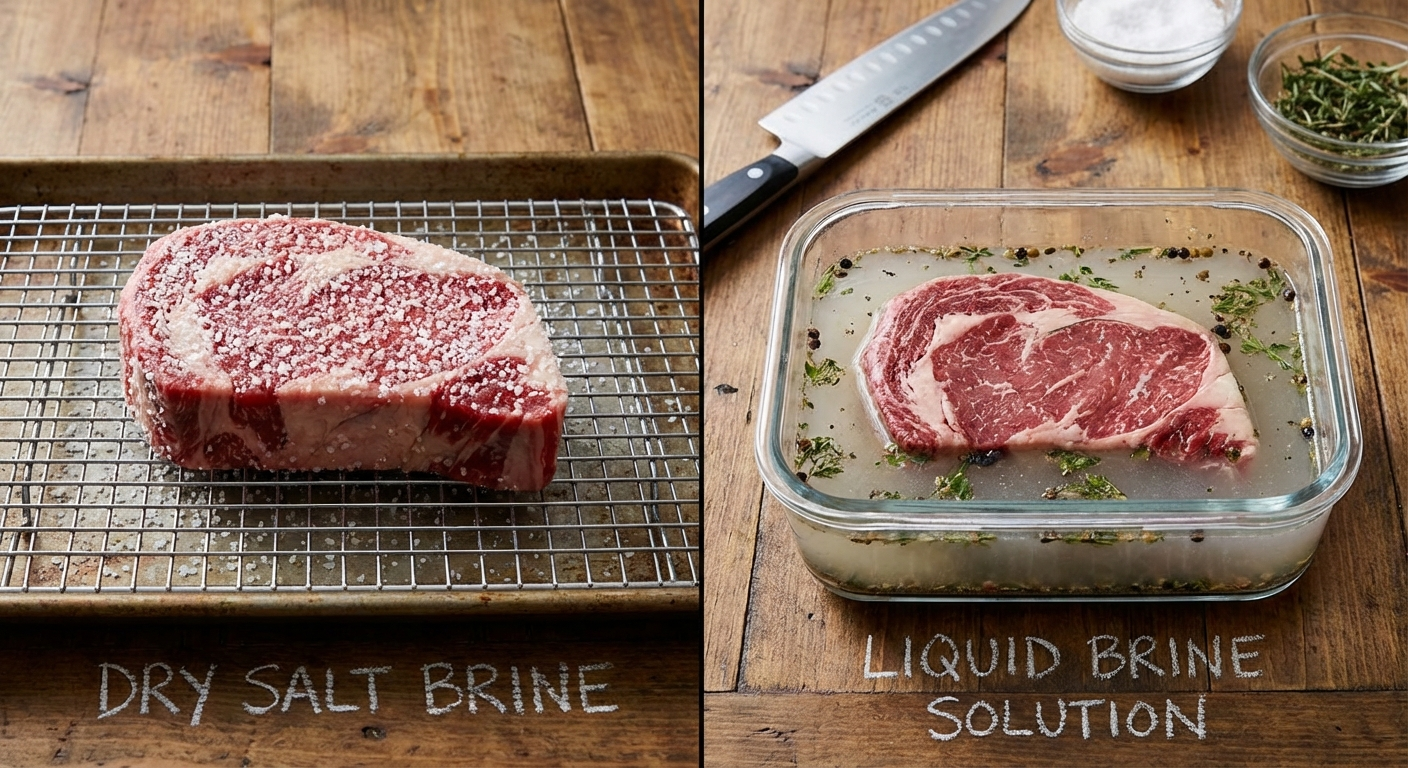
Seasoning a steak on the surface right before cooking tastes fine. But penetrating the interior with salt — and doing it in a way that improves texture, moisture retention, and crust development — requires advance preparation. The two primary methods are dry brining (salting and refrigerating) and wet brining (submerging in salt water). Both work. They use different physics, produce different results, and each has clear advantages.
Dry Brining: How It Works
Dry brining is simple: coat the steak generously with kosher salt (approximately 1/2 to 3/4 teaspoon per pound) and place it on a wire rack over a sheet pan, uncovered, in the refrigerator for 12–24 hours.
Phase 1: Osmotic Draw (0–30 minutes)
Salt on the surface creates a high-concentration zone. Osmosis pulls moisture from inside the steak to the surface to equalize the concentration gradient. You'll see beads of liquid forming on the surface within 15–20 minutes. This is normal — it looks like you're drying out the steak, but you're not.
Phase 2: Dissolution and Reabsorption (30 minutes – 4 hours)
The drawn-out moisture dissolves the surface salt, creating a concentrated brine on the meat's surface. This brine then reverses direction — it gets reabsorbed into the steak through a combination of osmosis (now the surface is saltier than the interior) and diffusion (salt ions migrate from high to low concentration). The salt penetrates roughly 1/8 to 1/4 inch in the first few hours.
Phase 3: Equilibrium and Drying (4–24 hours)
Over the next 12–20 hours, the salt continues to diffuse deeper into the meat. Simultaneously, the dry refrigerator air (typically 35–40% relative humidity) dehydrates the steak's surface. This surface drying is a critical advantage of dry brining — it means less moisture to evaporate during searing, resulting in faster, deeper Maillard browning.
What Salt Does Inside the Steak
Salt (sodium chloride) does more than add flavor. The chloride ions interact with muscle protein — specifically, they cause the myosin filaments to repel each other slightly, loosening the protein matrix. This loosened structure can hold more water. Studies (Offer & Knight, 1988) showed that salt-treated beef retained 5–10% more moisture during cooking compared to unsalted controls.
In practical terms: a dry-brined steak is more juicy, more evenly seasoned, and develops a better crust than one seasoned at the last minute. This technique is especially valuable with premium steaks from The Meatery, where proper seasoning lets the beef's natural quality shine.
Wet Brining: How It Works
Wet brining submerges the steak in a salt-water solution — typically 3–5% salt by weight (about 1 tablespoon of table salt per cup of water). The steak is fully submerged and refrigerated for 1–4 hours.
The Mechanism
Osmosis drives salt water into the meat. The external solution is saltier than the meat's intracellular fluid, so water + dissolved salt migrates inward. The steak absorbs the brine, increasing its weight by 5–15% depending on brine concentration and time.
The additional water dilutes the steak's natural flavor somewhat, but the salt improves moisture retention during cooking (the same myosin-repulsion mechanism as dry brining). Net result: a juicier steak that tastes slightly less "beefy" per bite due to the absorbed water.
Head-to-Head Comparison
| Factor | Dry Brine | Wet Brine |
|---|---|---|
| Flavor concentration | Preserved — no added water | Slightly diluted by absorbed water |
| Crust development | Excellent — surface dehydrates | Worse — surface is wet |
| Moisture retention during cooking | Good (+5–8%) | Better (+8–15%) |
| Seasoning depth | Good — 1/4 inch in 24 hours | Faster — salt penetrates with water |
| Effort | Minimal — salt and wait | More — need container, solution prep |
| Time required | 12–24 hours ideal | 1–4 hours sufficient |
| Best for | Steaks, roasts, any cut where crust matters | Lean cuts prone to drying, poultry |
My Recommendation for Steak
Dry brining is the clear winner for steak. The surface dehydration is a massive advantage for searing — you're starting the Maillard reaction from a dry surface, which means faster browning, deeper crust, and less gray band. The concentrated beef flavor (no added water) is another significant benefit.
Wet brining is more appropriate for lean proteins that tend toward dryness — chicken breast, pork loin, turkey. These cuts benefit more from the extra absorbed moisture because they lack the intramuscular fat that keeps a well-marbled steak juicy on its own.
The Dry Brine Protocol for Steak
- Season all surfaces with kosher salt — approximately 3/4 teaspoon per pound. Use Diamond Crystal kosher (or halve the amount for Morton's, which is denser).
- Place on a wire rack over a sheet pan (the rack allows air circulation on all sides).
- Refrigerate uncovered for 12–24 hours. Overnight is ideal.
- Before cooking: don't rinse, don't add more salt. Pat lightly with a paper towel if any surface moisture remains. Add pepper and cook using your method of choice.
If you only have 45 minutes, salt immediately and proceed — the initial osmotic draw and partial reabsorption still improve the steak compared to salting at the last second. The one time to avoid is the 5–30 minute window: the salt has drawn moisture to the surface but it hasn't been reabsorbed yet, leaving the surface wet and salty. Either salt immediately and cook, or salt and wait at least 45 minutes.
Frequently Asked Questions
How long should I dry brine a steak?
The ideal range is 12–24 hours uncovered in the fridge. This gives the salt enough time to fully dissolve, get reabsorbed, and penetrate 1/4 inch into the meat. The surface also dehydrates in the dry fridge air, which improves searing. If short on time, 45 minutes is the minimum useful duration.
Should I rinse the salt off after dry brining?
No. If you used the right amount of salt (3/4 teaspoon kosher salt per pound), there's nothing to rinse. The salt was drawn in and distributed throughout the meat. Rinsing adds surface moisture that hurts your sear. Just pat lightly with a paper towel and cook.
Why avoid salting 5–30 minutes before cooking?
In the 5–30 minute window, the salt has pulled moisture to the surface through osmosis, but that moisture hasn't been reabsorbed yet. You're left with a wet, salty surface that steams instead of searing. Either salt and cook immediately, or salt and wait at least 45 minutes for reabsorption to begin.
Is dry brining better than wet brining for steak?
For steak, yes. Dry brining concentrates flavor (no added water), dehydrates the surface for better Maillard browning, and still improves moisture retention by 5–8%. Wet brining adds moisture but dilutes beef flavor and leaves a wet surface that impedes searing. Wet brining is better suited for lean cuts like chicken breast.
More Expert Guides
Grill Vent Management: The Science of Airflow and Temperature Control
Oxygen controls fire. Fire controls temperature. Vents control oxygen. Master your vents and you master your grill.
12 min readHow Often to Flip Steak: The Science of Multiple Flips vs Single Flip
The traditional advice to flip your steak only once is wrong. Science shows that flipping every 30 seconds produces better crust, more even doneness, and 30% faster cooking through improved heat transfer.
12 min readThe Science of Plancha Grilling: How High Heat and Flat Surfaces Create Superior Crust
Plancha grilling delivers more surface contact, higher heat, and better crust than traditional grates. Here is the science behind why flat-top cooking produces superior results.