Grill Vent Management: The Science of Airflow and Temperature Control
Grill Vent Management: The Science of Airflow and Temperature Control
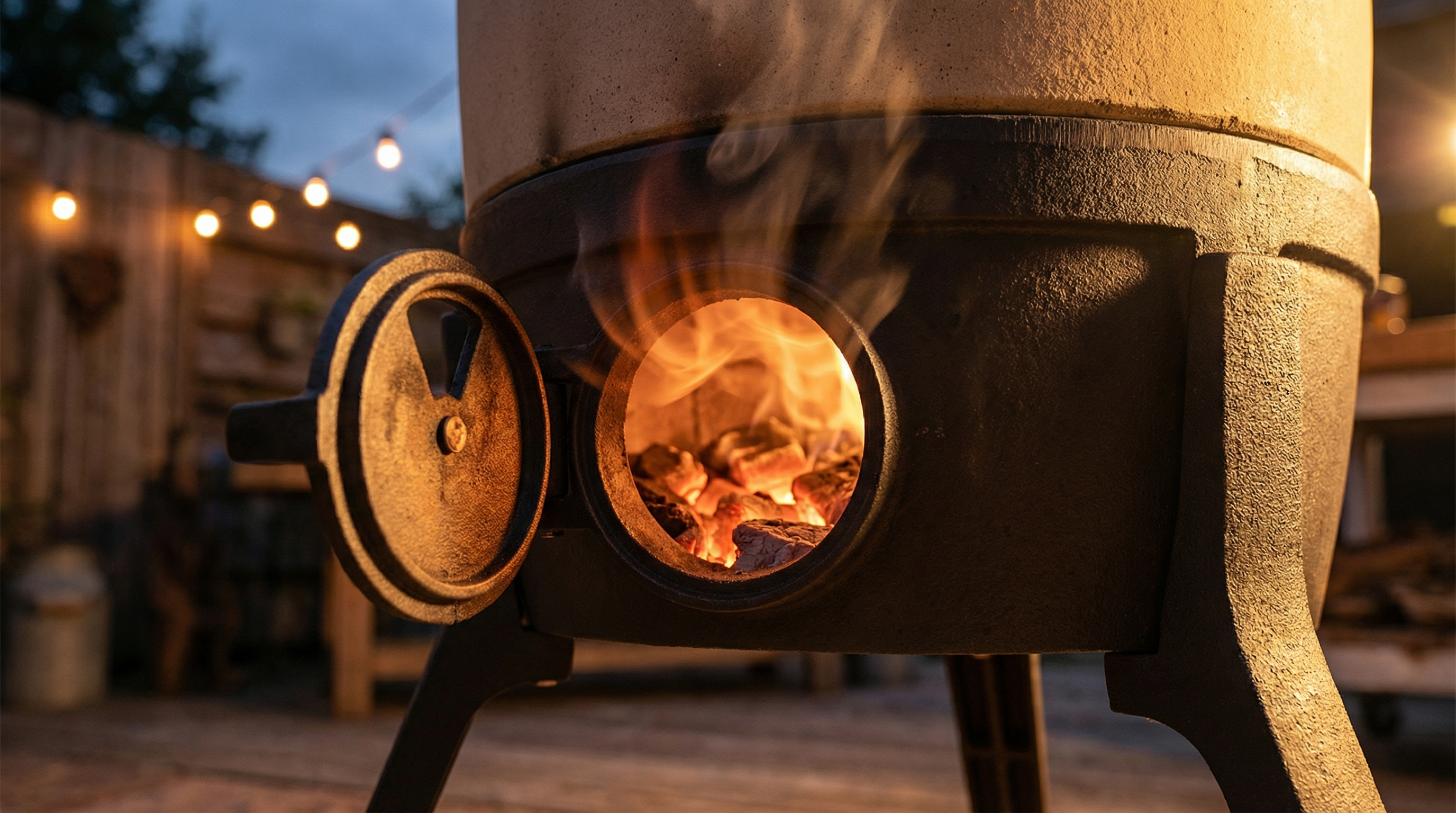
Most grillers treat vent adjustments like guesswork. They crack them open, crack them closed, and hope for the best. But airflow through a grill follows predictable physics — the same principles that power industrial furnaces, smokestacks, and rocket engines.
Once you understand the relationship between oxygen, combustion, and draft, vent management becomes precise. You stop chasing temperatures and start setting them.
Here is the science behind every vent on your grill, and how to use it like an engineer instead of a gambler.
The Combustion Triangle: Why Oxygen Matters
Fire requires three things: fuel (charcoal), heat (ignition), and oxygen. Remove any one and combustion stops. Your vents control the third variable.
Charcoal combustion is an exothermic oxidation reaction: carbon reacts with oxygen to produce carbon dioxide, heat, and light. The rate of this reaction — how fast the charcoal burns — is directly proportional to oxygen availability.
More oxygen means faster combustion, which means higher temperatures. Less oxygen means slower combustion and lower temperatures. That relationship is not linear, but it is predictable.
Peak Combustion Temperature
Charcoal can theoretically burn at temperatures exceeding 2,000°F in pure oxygen environments. In normal atmospheric conditions (21% oxygen), peak lump charcoal combustion temperatures reach approximately 1,200-1,400°F in the combustion zone directly above the coals.
But grilling temperatures rarely approach those peaks because:
- Distance from the coals reduces radiant heat intensity
- Metal grill grates absorb and distribute heat
- Airflow restrictions limit oxygen supply
- Incomplete combustion (producing CO instead of CO₂) reduces heat output
By controlling airflow, you control which of these factors dominates. That is what vent management is: choosing your limiting factor.
Bottom Vents: The Primary Throttle
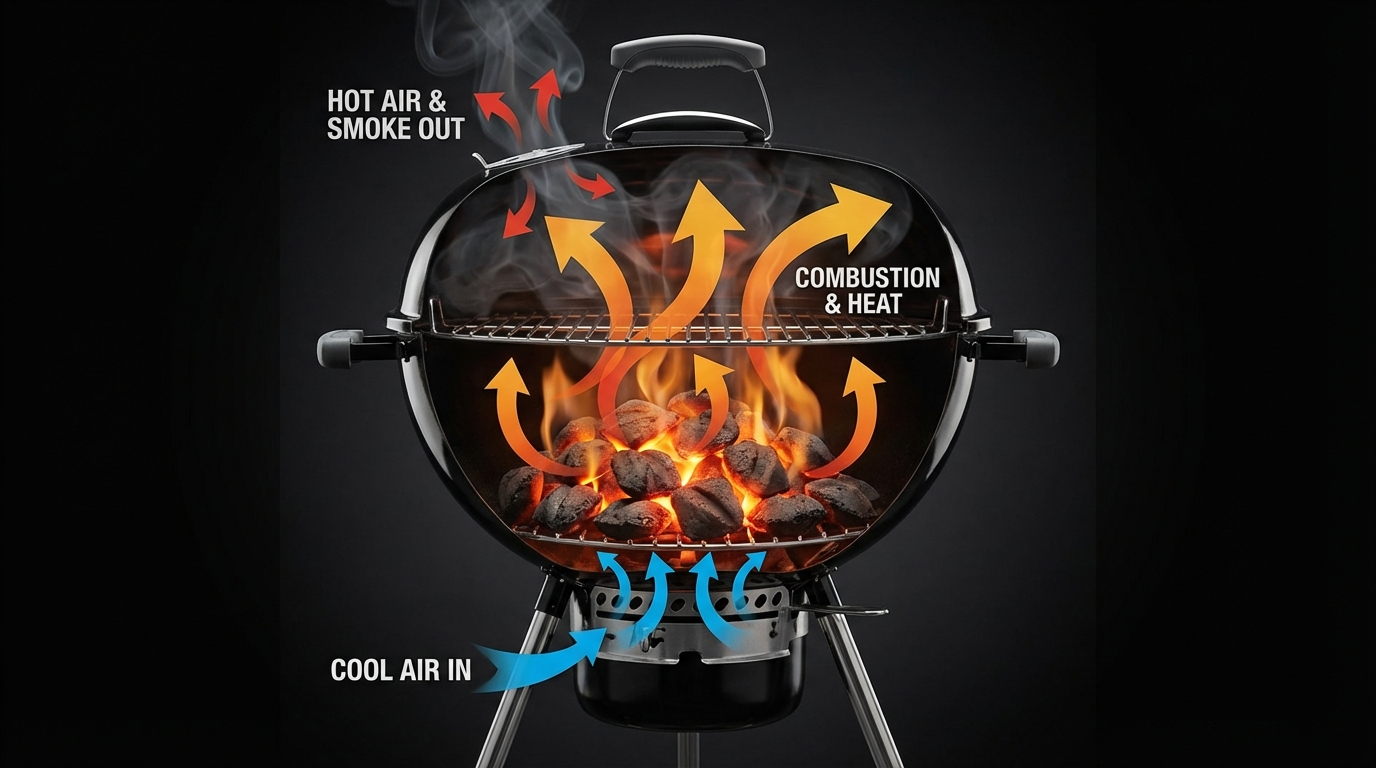
The bottom vent is your accelerator pedal. It controls fresh oxygen intake, which directly controls combustion rate.
How Bottom Vents Work
Air enters through the bottom vent, passes upward through the charcoal bed (the fuel source), and exits through the top vent. As air moves through the coals, oxygen reacts with carbon, releasing heat. The hotter the fire, the stronger the convective pull drawing fresh air upward.
This creates a self-reinforcing cycle: more oxygen → hotter fire → stronger draft → more oxygen pulled in. That is why fires can run away from you if vents are left fully open.
Bottom Vent Temperature Control
Adjusting the bottom vent changes oxygen supply, which changes burn rate, which changes temperature. Here is the practical mapping for a typical 18-22 inch charcoal grill:
- Fully open (100%): High heat (450-600°F+), direct grilling, searing steaks
- Half open (50%): Medium-high (350-450°F), direct grilling chicken, burgers
- Quarter open (25%): Low-and-slow range (225-275°F), smoking brisket, ribs
- Barely cracked (5-10%): Very low (180-225°F), cold smoking, holding temps
- Fully closed (0%): Fire will die within 5-15 minutes once oxygen is depleted
These ranges are starting points. Your actual temperatures will vary based on charcoal type, ambient temperature, wind, and grill design.
Bottom Vent Placement Matters
On kettle grills, bottom vents are located on the sides or bottom of the bowl. Their positioning creates directional airflow patterns through the charcoal bed.
On offset smokers, the firebox intake vent serves the same function. On kamado grills, a sliding or rotating bottom vent sits at the base of the ceramic shell.
Closer proximity between the vent and the coals means more direct oxygen delivery and faster response times. Grills with multiple bottom vents (like Weber kettles with three separate dampers) allow for more precise airflow control and zoning.
Top Vents: The Draft Governor
The top vent does not supply oxygen — it controls exhaust. But exhaust flow determines draft strength, which indirectly controls how much fresh air gets pulled through the bottom vents.
The Stack Effect
Hot air rises. Inside a closed grill, hot combustion gases accumulate near the top. When you open the top vent, those gases escape, creating negative pressure that pulls fresh air in through the bottom vent.
This is called the stack effect or chimney effect. The greater the temperature difference between inside and outside the grill, the stronger the draft. That is why grills are easier to control in cold weather — the temperature differential creates stronger natural convection.
Top Vent Temperature Control
Closing the top vent reduces exhaust flow, weakens the draft, and slows oxygen intake even if the bottom vent is open. Here is how top vent adjustments affect cooking:
- Fully open: Maximum draft, maximum airflow, fastest temperature rise
- Half open: Moderate draft, stable mid-range temps (250-350°F)
- Quarter open: Weak draft, low-and-slow smoking (200-250°F)
- Nearly closed: Minimal draft, fire risks suffocating, heavy smoke buildup
Important: Never fully close the top vent while cooking. Doing so traps combustion gases (including carbon monoxide), creates creosote buildup, and can smother your fire entirely.
Top Vent Positioning for Indirect Cooking
On kettle grills, the top vent is adjustable and rotates 360°. Position it opposite your coals for indirect cooking. This creates a horizontal airflow path: air enters through the bottom vent, passes across the cooking zone (not directly through it), and exits through the top vent.
That cross-flow pattern creates convective heat circulation without direct flame exposure — the basis of indirect grilling and smoking.
The Vent Relationship: Bottom + Top = Temperature
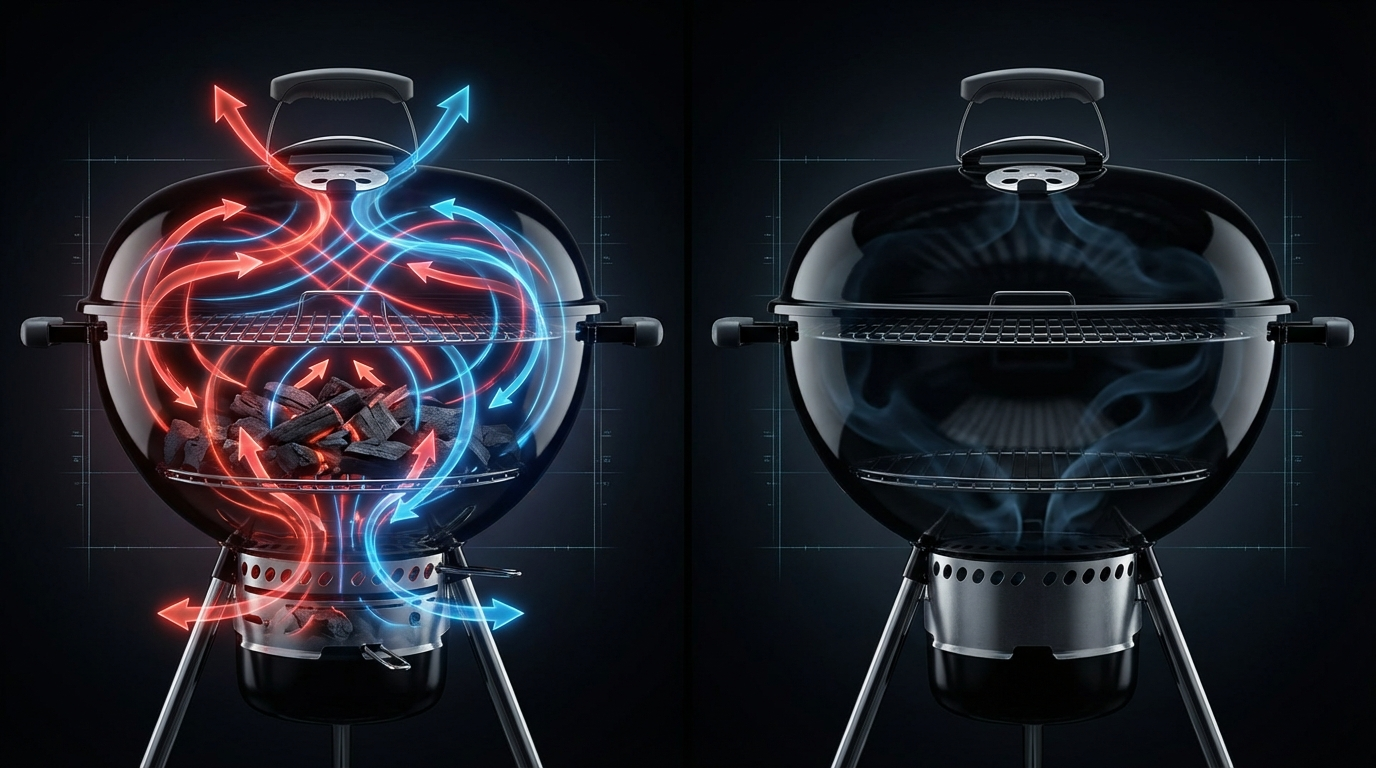
Temperature is not controlled by one vent alone. It is the product of both vents working together. Think of it like a river: the bottom vent is the water source, and the top vent is the dam controlling flow rate.
Common Vent Combinations
High Heat (Searing, Direct Grilling):
- Bottom vent: Fully open
- Top vent: Fully open
- Result: Maximum airflow, peak combustion, 500-700°F
Medium Heat (Burgers, Chicken Thighs):
- Bottom vent: Half to three-quarters open
- Top vent: Fully open
- Result: Moderate airflow, steady 350-450°F
Low-and-Slow (Brisket, Pork Shoulder):
- Bottom vent: Quarter open or less
- Top vent: Half open
- Result: Restricted airflow, slow burn, 225-275°F
Fire Shutdown:
- Bottom vent: Fully closed
- Top vent: Fully closed
- Result: Oxygen starvation, fire dies, coals can be reused next cook
Why Bottom Vent Adjustments Are More Responsive
Bottom vent changes affect temperature faster than top vent changes because they directly control oxygen supply to the combustion zone. Top vent changes affect draft strength, which influences oxygen intake indirectly.
In practice: Use the bottom vent for temperature adjustments. Use the top vent to fine-tune once you are close to your target temperature.
Kamado Grills: Precision Airflow in a Ceramic Shell
Kamado-style grills (Big Green Egg, Kamado Joe, Primo) use the same airflow principles but with tighter tolerances. Thick ceramic walls retain heat and create stable internal environments, making vent adjustments incredibly sensitive.
Kamado Bottom Vent: Micro-Adjustments
Kamado bottom vents are often dial-style or sliding mechanisms with fine adjustment increments. A 1/4-inch vent opening change can shift temperatures by 25-50°F.
For low-and-slow smoking on a kamado, you might set the bottom vent to barely cracked — sometimes as little as 1/8 inch open. That tiny airflow is enough to sustain combustion for 12+ hours.
Kamado Top Vent: The Daisy Wheel
Most kamados use a top vent cap with adjustable petals (called a daisy wheel). Each petal setting changes exhaust area and draft strength.
For smoking, a common setup is:
- Bottom vent: 1/4 inch open
- Top vent: 1-2 petals open
- Result: Rock-solid 225-250°F for hours
Kamados are so efficient that closing the top vent even slightly can drop temps by 50°F within minutes.
Offset Smokers: Firebox and Stack Control
Offset smokers separate the firebox (combustion chamber) from the cook chamber. Airflow follows a horizontal path: intake vent → firebox → cook chamber → exhaust stack.
Firebox Intake Vent (Bottom Vent Equivalent)
This vent controls oxygen supply to the fire. Opening it increases combustion rate and cook chamber temperature. Most offset smokers have a single large intake vent at the bottom or side of the firebox.
Exhaust Stack Damper (Top Vent Equivalent)
The stack damper controls draft and exhaust flow. On offsets, keep the stack damper at least half open during cooking to maintain airflow and prevent smoke stagnation.
Closing the stack too much creates "dirty smoke" — thick, white, acrid smoke from incomplete combustion. That smoke deposits bitter creosote on meat. Good smoke is thin, blue, and nearly invisible.
Offset Airflow Path
Heat and smoke enter the cook chamber near the firebox side, flow across the meat, and exit through the stack. This creates a temperature gradient: hotter near the firebox, cooler near the stack.
Reverse-flow offsets use a baffle plate to force smoke and heat to travel under the cook chamber before rising through the grate. This evens out the temperature gradient and reduces hot spots.
Environmental Factors That Affect Airflow
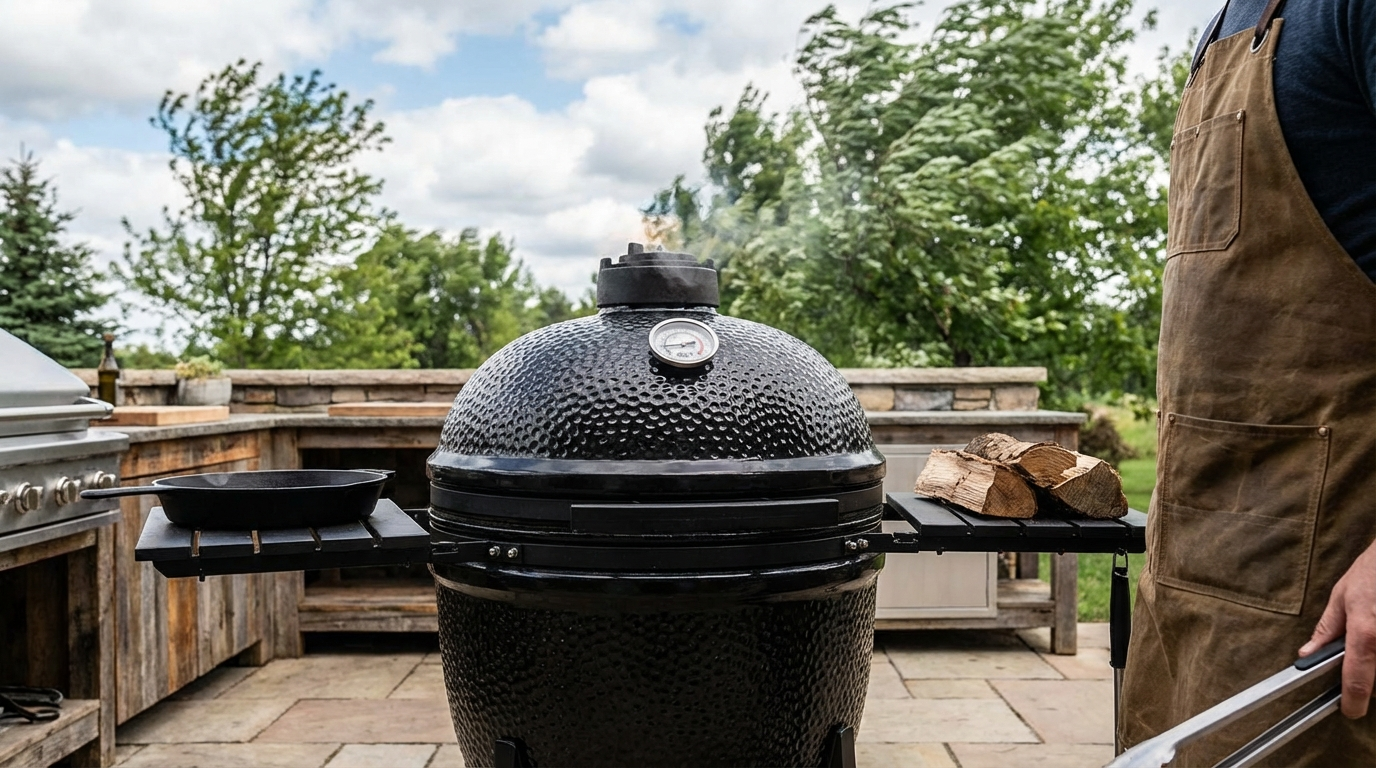
Vents do not operate in a vacuum. External conditions change how air moves through your grill.
Wind
Wind increases oxygen supply and accelerates combustion. Even light breezes can raise grill temperatures by 50-100°F if vents are open.
On windy days, close bottom vents more than usual to compensate. Position your grill so the wind does not blow directly into the intake vent if possible.
Ambient Temperature
Cold weather strengthens the stack effect (greater temperature differential = stronger draft). Hot weather weakens it. You may need wider vent openings in summer to achieve the same temperatures you get with narrower vents in winter.
Altitude
Higher altitudes mean lower atmospheric pressure and less oxygen per unit volume of air. Grills at 5,000+ feet may require wider vent openings to maintain the same combustion rates as sea-level grills.
Common Vent Management Mistakes
Closing the Top Vent to Lower Temperature
Closing the top vent restricts exhaust and weakens draft, but it also traps heat and smoke inside the grill. This can cause temperature spikes, bitter smoke flavor, and uneven combustion.
Instead: Lower temperature by closing the bottom vent first. Leave the top vent at least half open.
Opening Vents Too Wide During Startup
Fully open vents during charcoal lighting can cause temperatures to overshoot your target by 100-200°F. Charcoal takes time to stabilize, and wide-open vents create runaway combustion.
Instead: Light your coals with vents fully open, but once they are ashed over, close vents to your target position before adding food.
Ignoring Wind
Wind is an invisible vent. It can push extra oxygen into your grill even with vents closed. If your temps are running high despite narrow vents, wind is likely the culprit.
Instead: Shield your grill from wind or compensate by closing bottom vents more than usual.
Adjusting Both Vents Simultaneously
Changing both vents at once makes it impossible to know which adjustment caused the temperature change. This leads to overcorrection and temperature swings.
Instead: Adjust one vent at a time. Wait 5-10 minutes for temperature to stabilize before making another change.
Vent Settings for Common Cooking Styles
Direct Grilling (High Heat)
- Bottom vent: Fully open
- Top vent: Fully open
- Target temp: 450-600°F
- Use case: Steaks, burgers, chops, kebabs
Indirect Grilling (Medium Heat)
- Bottom vent: Half to three-quarters open
- Top vent: Fully open, positioned opposite coals
- Target temp: 325-375°F
- Use case: Whole chickens, thick pork chops, bone-in chicken
Low-and-Slow Smoking
- Bottom vent: Quarter open or less
- Top vent: Half open
- Target temp: 225-275°F
- Use case: Brisket, pork shoulder, ribs
Cold Smoking
- Bottom vent: Barely cracked (just enough to sustain smoke)
- Top vent: Fully open (to pull smoke through without heat buildup)
- Target temp: 70-90°F
- Use case: Cheese, salmon, jerky
Advanced Technique: Vent Pre-Positioning
Instead of lighting coals with vents fully open and then scrambling to close them, experienced grillers pre-set vents to the target cooking position before lighting.
Here is how it works:
- Set vents to the position you will need for your target temperature (e.g., bottom vent quarter-open, top vent half-open for 250°F)
- Light charcoal using a chimney starter or fire starter cubes
- Once coals are ashed over, add them to the grill (which already has vents set correctly)
- Grill temperature stabilizes at target within 15-20 minutes without overshoot
This technique prevents the common problem of temperatures spiking to 400°F+ during startup and requiring 30+ minutes to drop back down to smoking range.
Vent Maintenance: Airflow Depends on Cleanliness
Ash buildup blocks airflow. Even a thin layer of ash under the charcoal grate can restrict oxygen intake and make temperature control unpredictable.
Bottom Vent Cleaning
After every cook, clear ash from the bottom vent area. On kettle grills, use the ash sweep lever to push debris into the ash catcher. On kamados, vacuum out the bottom vent chamber.
Clogged bottom vents reduce maximum achievable temperature and slow temperature response times.
Top Vent Cleaning
Grease and creosote can gum up top vent dampers over time. Scrape off buildup periodically to ensure smooth operation and proper sealing.
The Bottom Line on Vent Management
Airflow is not magic. It is combustion science. Oxygen in, heat out. The vents are your control panel.
Bottom vent controls oxygen supply and combustion rate. Top vent controls draft and exhaust flow. Together, they determine temperature.
Master the relationship between those two variables, and you stop guessing. You set a temperature and hold it — not because you got lucky, but because you understand the physics.
That is the difference between someone who cooks on a grill and someone who controls one.
Dr. Claire Whitfield is a food scientist and grilling enthusiast focused on the chemistry and physics of outdoor cooking. She holds a PhD in thermal engineering and has spent a decade researching combustion dynamics in charcoal and wood-fired systems. Claire lives in Austin, Texas, where she teaches backyard pitmasters how to think like engineers.
More Expert Guides
How Often to Flip Steak: The Science of Multiple Flips vs Single Flip
The traditional advice to flip your steak only once is wrong. Science shows that flipping every 30 seconds produces better crust, more even doneness, and 30% faster cooking through improved heat transfer.
12 min readThe Science of Plancha Grilling: How High Heat and Flat Surfaces Create Superior Crust
Plancha grilling delivers more surface contact, higher heat, and better crust than traditional grates. Here is the science behind why flat-top cooking produces superior results.
14 min readWhen to Salt Steak: The Science of Timing, Osmosis, and Flavor Development
Salt your steak 40+ minutes before cooking, or salt it right before it hits the pan. Never salt it 3-40 minutes before. The difference is osmosis, diffusion, and water activity — and understanding the science turns every steak into a perfectly seasoned, deeply flavored piece of meat.