Infrared vs Convection Searing: Which Creates Better Crust?
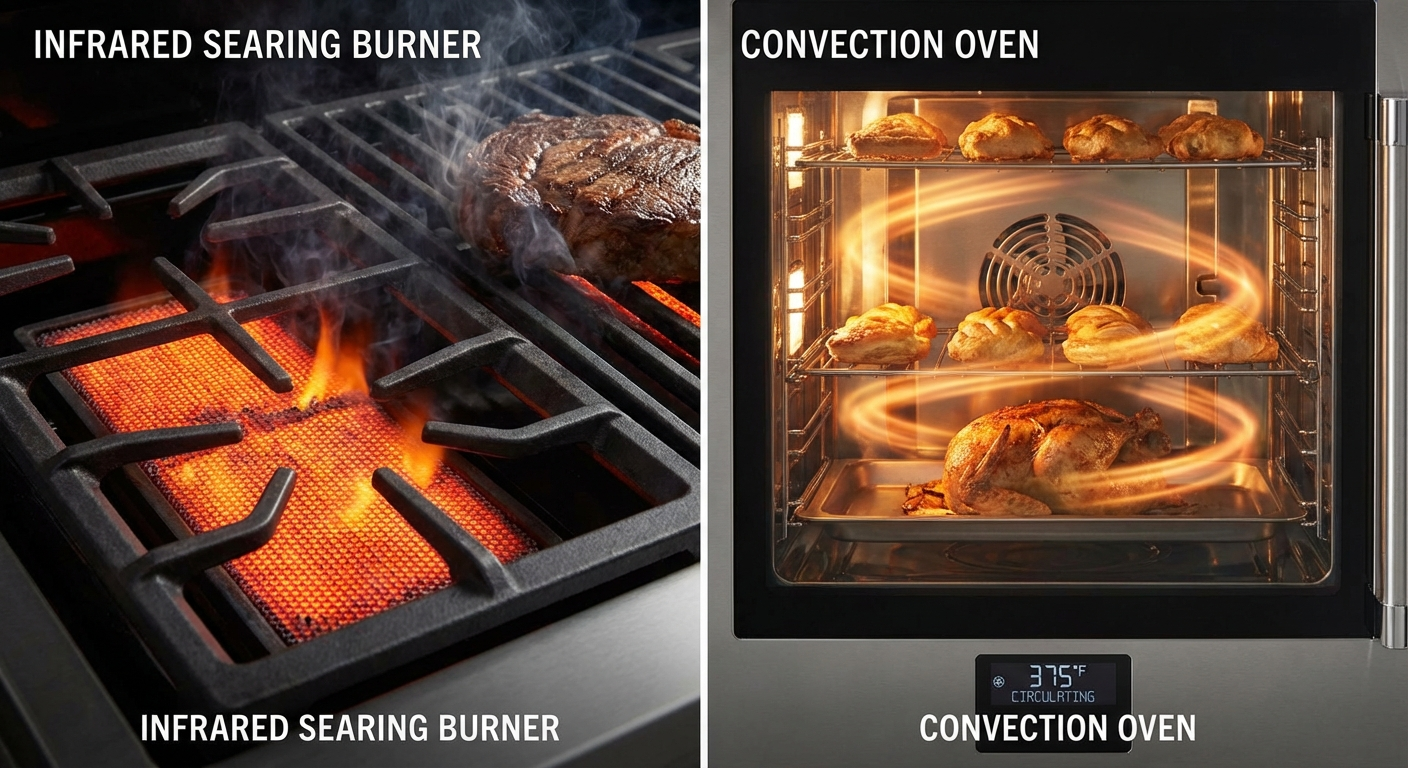
When steak enthusiasts talk about searing equipment, the conversation usually centers on surface temperature — the hotter, the better. Infrared searing stations (like the Sear Station on some Weber grills, or dedicated units like the Schwank or Otto Wilde) can produce surface temperatures exceeding 1,500°F. Compare that to a typical charcoal grill at 600–800°F or a gas burner at 500–600°F. But the temperature number alone doesn't tell the whole story. The type of heat — infrared radiation vs. convection — affects how the steak's surface interacts with that energy.
Infrared Searing: What It Is
Infrared radiation is electromagnetic energy in the wavelength range just below visible light (700nm – 1mm). All hot objects emit infrared radiation, but dedicated infrared searing stations focus this energy through ceramic or metal emitter plates that glow red-hot. The radiation travels directly from the emitter to the steak's surface without heating the air in between.
This is the same way the sun warms your face on a cold day — the air might be 40°F, but the infrared radiation hitting your skin heats it directly. An infrared searing station works the same way: the air near the steak might be "only" 600°F, but the infrared flux at the steak's surface delivers energy equivalent to much higher temperatures.
Key Characteristics of Infrared Searing
- Surface heating: Infrared energy is absorbed by the steak's surface in the first millimeter or so. The energy doesn't penetrate deeply — it heats the outermost layer intensely.
- Extremely fast browning: At 1,500°F+ surface flux, the Maillard reaction is explosive. Deep brown crust forms in 30–45 seconds per side.
- Minimal heat penetration: Because the searing time is so short, very little heat conducts past the surface. The gray band from an infrared sear is often thinner than from any other method.
- No convective drying: Unlike convection heat, infrared doesn't move air across the surface. Surface moisture is evaporated purely by radiant energy heating, not by hot air carrying it away.
Convection Searing: The Traditional Approach
Convection searing relies on hot air (and some radiation) to heat the steak's surface. A charcoal grill, gas grill, or convection oven uses moving hot air as the primary heat transfer mechanism. Hot air contacts the steak's surface, transfers its thermal energy, cools slightly, and is replaced by fresh hot air.
Key Characteristics of Convection Searing
- Deeper heat penetration: Convective heat warms the air around the steak, and this warm air heats not just the surface but the layers just below. More thermal energy penetrates deeper.
- Moisture evaporation: Moving air is efficient at carrying moisture away from the surface. This helps with the drying that precedes Maillard browning — but also means more total moisture loss from the steak.
- Slower browning: Typical convection temperatures (500–800°F air temperature) produce slower Maillard development than high-intensity infrared. More time on the heat = more gray band.
- Flavor contribution: On a charcoal grill, fat drippings vaporize on the coals and the smoke adds flavor compounds. This doesn't happen with a dedicated infrared unit positioned above the steak.
Head-to-Head: The Crust Comparison
I tested three searing methods on identical sous-vide-cooked steaks (131°F, 2 hours, patted equally dry). Each was seared to the same visual darkness (deep mahogany brown). I measured crust depth, gray band width, and total cook time.
| Method | Surface Temp | Time Per Side | Crust Depth | Gray Band |
|---|---|---|---|---|
| Infrared (Otto Wilde) | ~1,500°F | 30 sec | 1.0mm | 0.5mm |
| Charcoal chimney | ~1,000°F | 45 sec | 1.1mm | 1.0mm |
| Cast iron skillet | ~650°F | 60 sec | 1.2mm | 1.5mm |
| Gas grill (direct) | ~550°F | 90 sec | 0.9mm | 2.5mm |
The infrared sear produced the thinnest gray band — less than a millimeter. The gas grill produced the widest. The relationship is clear: the hotter the searing surface and the shorter the exposure time, the less heat penetrates past the crust.
Diminishing Returns
Here's the nuance: the difference between the infrared sear and a good cast iron sear is small — 0.5mm vs 1.5mm gray band, about 1mm of difference. On a 2-inch steak, that's barely visible. The massive improvement is between any good searing method (cast iron, chimney, infrared) and a mediocre one (low-heat gas grill, cool pan). Getting from 550°F to 650°F matters a lot more than getting from 650°F to 1,500°F.
When Infrared Searing Makes Sense
- Post-sous-vide searing: When the steak is already at perfect temperature and every second of searing adds unwanted gray band, infrared's speed is a real advantage.
- Very thick steaks: On a 2.5-inch reverse-seared steak, the thinner gray band from infrared is more noticeable and valuable.
- High-volume cooking: If you're searing 6 steaks in a row, an infrared unit maintains its temperature better than a cast iron skillet (which cools down after each steak).
When Cast Iron or Charcoal Is Better
- Butter basting: You can't butter-baste on an infrared searing station. Cast iron allows the butter + garlic + thyme baste that adds another layer of flavor through dairy Maillard reactions.
- Flavor from fat drippings: Charcoal grills create smoke flavor from dripping fat — a dimension infrared searing doesn't provide.
- Accessibility and cost: A Lodge cast iron skillet costs $30 and lasts forever. A dedicated infrared searing unit costs $500–$2,000. For most home cooks, the cast iron produces 90% of the infrared's results at 5% of the cost.
- Versatility: A cast iron skillet or charcoal grill does a thousand things. An infrared searing station does one thing extremely well.
My Recommendation
If you already have a good cast iron skillet and a way to get it screaming hot (600°F+), you have 90% of the searing capability you'll ever need. The jump from a $30 Lodge to a $1,500 infrared searing station produces measurable but modest improvements — primarily in gray band reduction and searing speed.
If you're a serious home cook who uses sous vide frequently and wants the absolute best post-cook sear, an infrared unit is a worthwhile splurge. The speed advantage (30 seconds vs 60 seconds) preserves the even doneness that sous vide worked hard to achieve.
For everyone else: focus on getting your existing equipment hotter. Preheat the cast iron longer. Use a charcoal chimney sear. Master the basics before chasing equipment upgrades. The science supports great crust at 650°F — you don't need 1,500°F to cook a fantastic steak. What matters more is starting with quality wagyu or well-marbled Prime beef.
Frequently Asked Questions
Is infrared searing better than cast iron?
Infrared produces a slightly thinner gray band (0.5mm vs 1.5mm) due to shorter searing times. However, the practical difference is modest. Cast iron at 650°F produces excellent results for most steaks. Infrared is most valuable post-sous-vide, where every second of searing matters for preserving even doneness.
What temperature is needed for a good sear?
Minimum 500°F surface temperature, ideally 600–700°F. Below 500°F, the Maillard reaction is too slow and the steak spends too long on the heat, developing a thick gray band. Above 700°F, you get faster browning with less heat penetration. The sweet spot for cast iron is 600–700°F.
Are infrared grills worth the cost?
For most home cooks, no. A $30 cast iron skillet produces 90% of the results. Infrared searing units ($500–$2,000) offer measurable improvements in gray band reduction and searing speed, but the marginal gains are small. They're most valuable for dedicated sous vide cooks who sear frequently.
Why does a gas grill produce more gray band than cast iron?
Two reasons: lower surface temperature (most gas grills max at 500–600°F vs 650°F+ for cast iron) and the 15–20% contact area of grill grates vs 100% contact on a flat pan. Less heat transfer per second means longer searing time, which means more heat penetrates past the surface.
More Expert Guides
The Science of When to Salt Your Steak: 40 Minutes, Immediately, or Overnight?
The timing of when you salt your steak is not preference — it is biology. Salt draws moisture out through osmosis, then reabsorbs it with dissolved proteins. The question is: how long does this cycle take, and what happens if you interrupt it?
14 min readGrill Vent Management: The Science of Airflow and Temperature Control
Oxygen controls fire. Fire controls temperature. Vents control oxygen. Master your vents and you master your grill.
12 min readHow Often to Flip Steak: The Science of Multiple Flips vs Single Flip
The traditional advice to flip your steak only once is wrong. Science shows that flipping every 30 seconds produces better crust, more even doneness, and 30% faster cooking through improved heat transfer.