The Maillard Reaction: Why Your Steak Browns (And How to Maximize It)
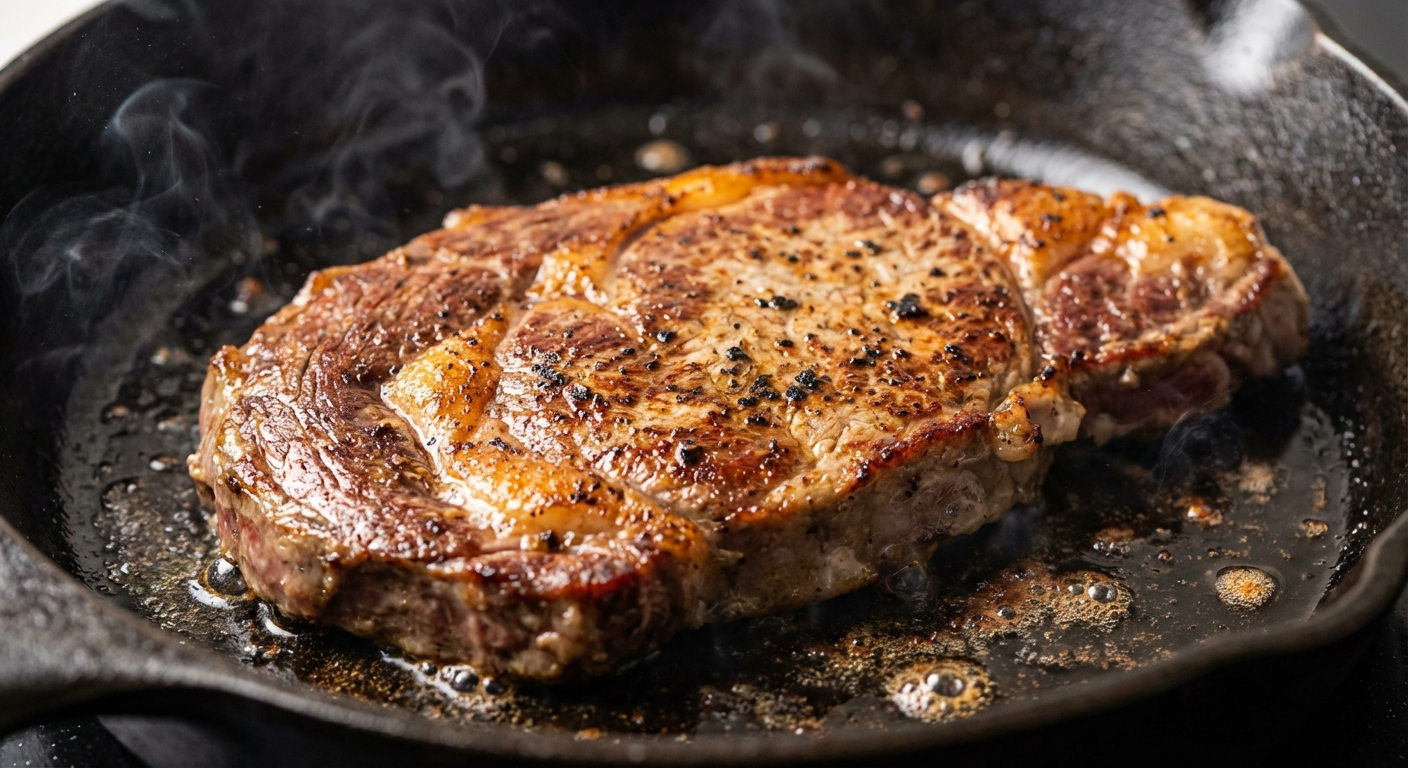
Every great steak has two components: the interior (controlled by temperature) and the crust (controlled by the Maillard reaction). You can nail the internal temperature perfectly and still end up with a mediocre steak if the crust isn't developed. The Maillard reaction is the chemistry that separates "cooked meat" from "that steak I can't stop thinking about."
Named after French chemist Louis-Camille Maillard, who first described it in 1912, the Maillard reaction is a cascade of chemical interactions between amino acids and reducing sugars that occurs at temperatures above approximately 280°F (140°C). It's not one reaction — it's hundreds of parallel reactions producing over 1,000 distinct flavor and aroma compounds.
The Chemistry (Simplified)
Here's what happens when your steak hits a screaming-hot pan:
Step 1: The initial reaction. An amino acid (from the steak's proteins) reacts with a reducing sugar (like glucose or ribose, present in small amounts in muscle tissue) to form an unstable compound called a glycosylamine. This happens above 280°F and requires very little moisture — water actually inhibits the reaction by keeping the surface temperature at 212°F.
Step 2: Amadori rearrangement. The glycosylamine rearranges into a more stable compound called an Amadori product. This is the first committed step — once you're here, the reaction proceeds downhill thermodynamically.
Step 3: The cascade. The Amadori products undergo a series of degradations, dehydrations, and recombinations that produce hundreds of different molecules: pyrazines (nutty, roasty flavors), furanones (caramel-like), thiophenes (meaty, savory), and melanoidins (the brown pigments that give the crust its color).
Think of it like a fireworks show. The initial reaction is lighting the fuse. The Amadori rearrangement is the rocket leaving the ground. The cascade is the explosion of colors — except the colors are flavor molecules.
Why Surface Moisture Is the Enemy
This is the single most important practical insight about the Maillard reaction: water prevents it from happening.
As long as there's liquid water on the steak's surface, the surface temperature is capped at 212°F (100°C) — the boiling point. The Maillard reaction doesn't begin in earnest until 280°F. That means you need to evaporate all the surface moisture before browning can start.
This is why a wet steak thrown into a warm pan produces that depressing sizzle followed by gray, steamed-looking meat. The pan's energy goes into boiling water instead of creating flavor chemistry. By the time the moisture evaporates, the interior is overcooked.
Practical Solutions for a Dry Surface
- Pat dry with paper towels — The minimum step. Blot both sides thoroughly right before the steak hits the pan. This removes free surface moisture.
- Dry brine overnight — Salt the steak and leave it uncovered on a wire rack in the fridge for 12–24 hours. The salt initially draws moisture to the surface through osmosis, then that moisture gets reabsorbed along with the salt. The surface dehydrates in the dry refrigerator air. This is the best method for maximizing crust development.
- Use the reverse sear — The 30–60 minutes in a low oven evaporates surface moisture before the sear phase. The pre-dried surface browns faster and more deeply.
- Avoid marinades with water — Wet marinades add surface moisture that must be evaporated. If you marinade, pat the steak very dry or use a paste-style rub instead.
Temperature and the Maillard Reaction
The reaction rate approximately doubles for every 18°F (10°C) increase in temperature — a principle from chemical kinetics called the Arrhenius equation. This means:
- At 300°F: Browning occurs, but slowly. You'll get a light crust after several minutes.
- At 450°F: The reaction rate is roughly 8x faster than at 300°F. Good crust in 1–2 minutes.
- At 600°F: The reaction is explosive. Deep brown crust in 45–60 seconds.
- Above 700°F: You're at the boundary between Maillard browning and pyrolysis (burning). Manage carefully.
This is why cast iron is so effective for searing. A properly preheated cast iron skillet can hold 600–700°F surface temperature, and its thermal mass means it doesn't cool down much when you add the steak. A thin stainless steel pan might start at 500°F but drop to 350°F the moment a cold steak contacts it — and that 150°F drop cuts the Maillard reaction rate by roughly 75%.
Maillard vs. Caramelization
People often confuse these two browning reactions. They're different processes:
Maillard reaction: Requires amino acids AND sugars. Produces savory, meaty, complex flavors. Occurs above 280°F. This is the dominant browning reaction on steak.
Caramelization: Involves only sugars (no amino acids). Produces sweet, nutty, butterscotch flavors. Occurs above 320°F for most sugars. Significant on foods with high sugar content (onions, bread), minor on steak.
On a steak, the Maillard reaction is responsible for 90%+ of the crust flavor. There's simply not enough free sugar on the meat surface for caramelization to play a major role. The exception is if you've applied a sugar-containing rub or glaze — then both reactions contribute.
Maximizing Crust: A Practical Checklist
- Dry the surface: Dry brine overnight, or at minimum, pat thoroughly with paper towels.
- Get the pan screaming hot: 600°F+ for cast iron. Preheat for 5+ minutes on maximum heat.
- Use the right oil: Avocado oil (smoke point 520°F) or refined safflower (510°F). Extra virgin olive oil (375°F smoke point) will burn and taste bitter before the Maillard reaction gets going.
- Don't crowd the pan: Multiple steaks cool the pan dramatically. One steak per pan, or use a very large skillet.
- Don't move the steak: Full contact with the hot surface = maximum heat transfer = fastest crust. Moving the steak breaks contact and slows the reaction.
- Consider butter basting: Adding butter in the final 15–20 seconds introduces milk solids (amino acids + lactose) that undergo their own Maillard reaction, adding complexity to the crust flavor.
- Add a pinch of baking soda: Controversial, but effective. A tiny amount of baking soda (1/4 teaspoon per steak, applied 15 minutes before cooking) raises the surface pH, which accelerates the Maillard reaction. Use sparingly — too much tastes soapy.
The Flavor Compounds: What You're Actually Tasting
Gas chromatography analysis of seared steak crust has identified over 1,000 volatile compounds. The major flavor contributors include:
- 2-acetyl-1-pyrroline: The compound responsible for "roasted" or "bready" aromas. Also found in basmati rice and popcorn.
- 4-hydroxy-2,5-dimethyl-3(2H)-furanone (HDMF): Caramel-like, sweet-savory. One of the most potent flavor compounds in cooked meat.
- 2-methyl-3-furanthiol: The "meaty" compound. Extraordinarily potent — detectable by the human nose at parts per trillion.
- Various pyrazines: Nutty, earthy, roasted notes. Concentration increases dramatically with searing temperature.
None of these compounds exist in raw meat. They're all created by the Maillard reaction during searing. When someone says a steak "tastes like steak," they're largely describing Maillard chemistry. The effect is particularly dramatic with heavily marbled cuts like American wagyu, where the fat provides additional substrates for these flavor reactions.
Frequently Asked Questions
At what temperature does the Maillard reaction start?
The Maillard reaction begins around 280°F (140°C) and accelerates rapidly with increasing temperature. The reaction rate roughly doubles every 18°F. Significant crust development requires surface temperatures of 450°F or above, which is why screaming-hot pans are essential for searing.
Why does my steak turn gray instead of brown?
Gray steak means the surface never got hot enough for the Maillard reaction. The most common cause is surface moisture — water caps the surface temp at 212°F, preventing the 280°F+ needed for browning. Pat your steak dry, preheat the pan to 600°F+, and don't crowd the pan.
Is the Maillard reaction the same as caramelization?
No. The Maillard reaction requires amino acids and sugars, producing savory, complex flavors. Caramelization involves only sugars, producing sweet/nutty flavors. On steak, the Maillard reaction dominates because there's very little free sugar on the surface. They're different chemical pathways.
Does searing "seal in juices"?
No — this is one of the most persistent myths in cooking. Harold McGee debunked it decades ago, and our lab data confirms it. Seared steaks actually lose slightly more moisture than unseared steaks at the same internal temperature, because the high heat drives more moisture from the surface layers. Searing creates flavor through the Maillard reaction. That's its purpose.
Can I get Maillard browning in a sous vide bag?
No. Sous vide cooking maxes out at 212°F (boiling water) and typically occurs at 130–140°F for steak. The Maillard reaction requires 280°F+. That's why every sous vide steak protocol includes a post-cook sear — the bag gives you perfect doneness, the sear gives you the crust.
More Expert Guides
Grill Vent Management: The Science of Airflow and Temperature Control
Oxygen controls fire. Fire controls temperature. Vents control oxygen. Master your vents and you master your grill.
12 min readHow Often to Flip Steak: The Science of Multiple Flips vs Single Flip
The traditional advice to flip your steak only once is wrong. Science shows that flipping every 30 seconds produces better crust, more even doneness, and 30% faster cooking through improved heat transfer.
12 min readThe Science of Plancha Grilling: How High Heat and Flat Surfaces Create Superior Crust
Plancha grilling delivers more surface contact, higher heat, and better crust than traditional grates. Here is the science behind why flat-top cooking produces superior results.