Pellet Grill vs Charcoal: The Science of Flavor, Heat, and Smoke
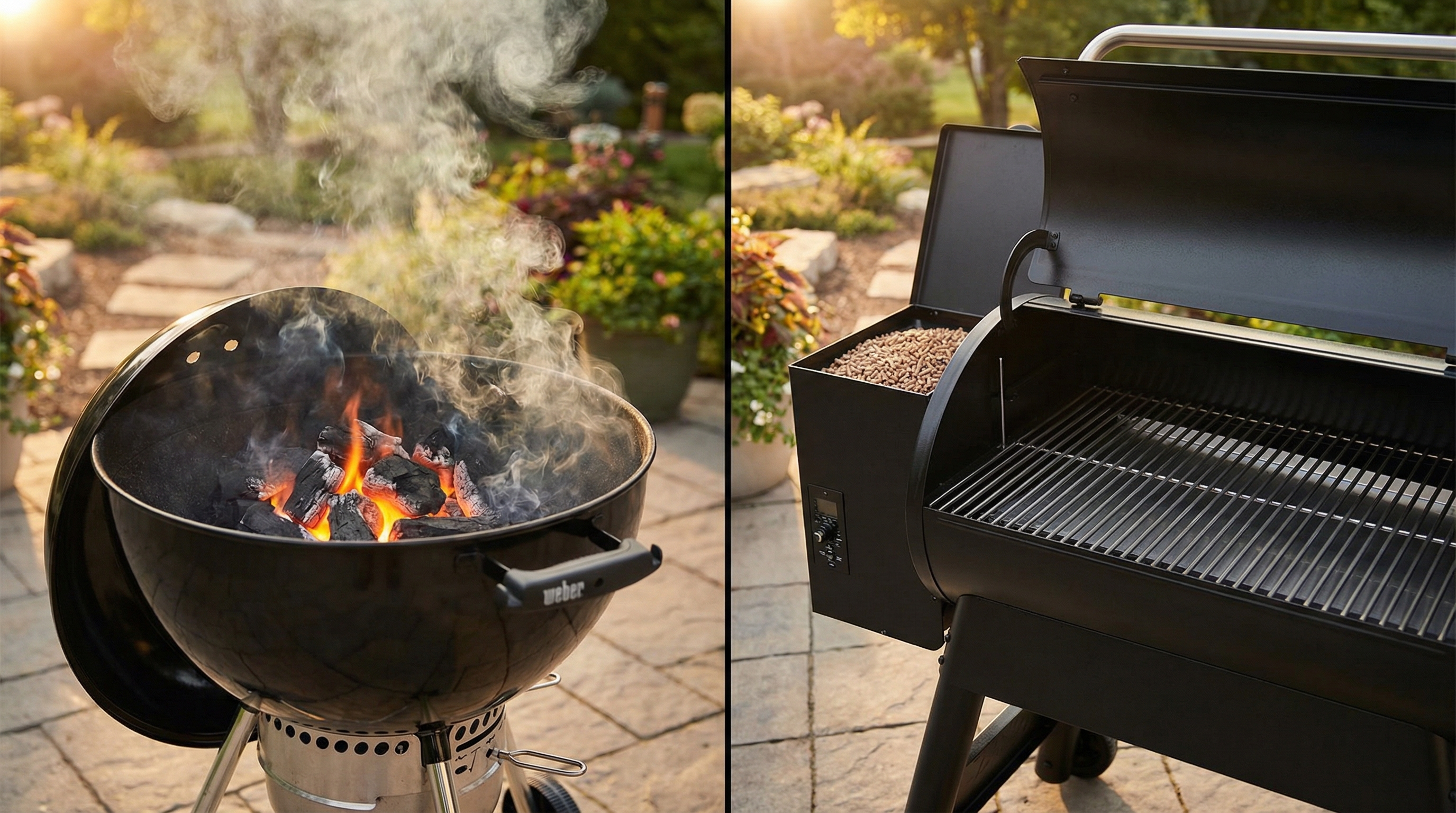
Pellet Grill vs Charcoal: The Science of Flavor, Heat, and Smoke
The pellet grill vs charcoal debate generates more heat in online forums than either fuel produces on a grate. Loyalists on both sides argue from experience, but the real differences come down to combustion chemistry, heat transfer physics, and smoke compound profiles. Understanding these mechanisms tells you exactly what each grill does well, where it falls short, and which one produces the flavors you are actually chasing.
This guide breaks down the science — no brand loyalty, no marketing claims, just thermodynamics and chemistry.
How Each Fuel Burns: Combustion Chemistry
Every grilling fuel is fundamentally the same thing: stored carbon and hydrogen that reacts with oxygen to release heat. The differences lie in composition, moisture content, and how the combustion process is managed.
Charcoal Combustion
Lump charcoal is wood that has been pyrolyzed — heated in the absence of oxygen until the volatile organic compounds (VOCs) burn off, leaving behind a carbon-rich solid. When you light lump charcoal, you are burning nearly pure carbon. The primary reaction is:
C + O₂ → CO₂ + heat (393.5 kJ/mol)
In oxygen-limited conditions (a closed grill with dampers partially shut), incomplete combustion produces carbon monoxide (CO), which contributes to smoke ring formation on meat. Lump charcoal burns at temperatures between 700°F and 1,200°F at the coal surface, with radiant heat reaching the cooking grate at 400–700°F depending on distance and airflow.
Briquettes are a different animal. They contain pulverized charcoal mixed with binders (starch, borax, limestone) and fillers. These additives affect burn temperature, ash production, and the chemical composition of the combustion gases. Briquettes burn more consistently but at slightly lower peak temperatures than lump, and the binders produce additional combustion byproducts that purists claim affect flavor.
Wood Pellet Combustion
Pellet grills burn compressed hardwood sawdust — small cylinders about 6mm in diameter and 25mm long. Unlike charcoal, pellets have not been pyrolyzed. They still contain the full spectrum of wood volatile compounds: lignin, hemicellulose, cellulose, and extractives (resins, tannins, oils).
When a pellet grill's auger feeds pellets into the firepot, combustion happens in stages:
- Drying (212°F) — Moisture evaporates. Pellets typically contain 5–8% moisture, much less than fresh wood (30–50%).
- Pyrolysis (400–600°F) — Volatile compounds break down and release as gases. This is where smoke flavor compounds are generated.
- Flaming combustion (600°F+) — Volatile gases ignite and burn. The firepot fan ensures oxygen supply.
- Char combustion (800°F+) — The remaining carbon char burns, similar to charcoal.
The critical difference: pellet combustion goes through all four stages in rapid succession because the fan-forced airflow and small pellet size accelerate the process. A charcoal fire, by contrast, has already completed stages 1–2 during manufacturing. This means pellet grills produce more volatile smoke compounds during normal operation than charcoal alone — but only during the pyrolysis phase, which is brief for each individual pellet.
Smoke Flavor: What You Actually Taste
Smoke flavor is not one thing. It is a complex mixture of hundreds of compounds, dominated by a few key players:
- Syringol and guaiacol — The two primary "smoky" flavor compounds, both derived from lignin pyrolysis. Syringol provides the smooth, sweet smokiness; guaiacol delivers the sharper, more pungent smoke character.
- Carbonyls (formaldehyde, acetaldehyde, furfural) — Contribute to color development and subtle flavor notes.
- Organic acids (acetic acid, formic acid) — Add tang and bite to smoked food.
- Phenols — A broad family of aromatic compounds that contribute depth and complexity. Different wood species produce different phenol profiles.
Charcoal Smoke Profile
Pure lump charcoal produces relatively little smoke flavor on its own because the volatile compounds were already driven off during manufacturing. The flavor that charcoal devotees love comes primarily from drippings vaporization: when meat fat and juices hit the hot coals, they flash-vaporize and undergo pyrolysis, creating a unique set of flavor compounds that rise back up and deposit on the food surface.
This drippings-vaporization flavor is distinctive and impossible to replicate in a pellet grill because the firepot is too small and too enclosed for significant drip contact. It includes compounds like 2,4-decadienal (a lipid oxidation product with a deep, fatty, grilled aroma) and various heterocyclic compounds formed when amino acids in the drippings hit extreme heat.
When you add wood chunks to charcoal, you get the best of both worlds: drippings vaporization plus genuine wood smoke from the smoldering chunks. This is why many competition pitmasters use charcoal as the heat source and wood chunks for smoke.
Pellet Grill Smoke Profile
Pellet grills generate smoke primarily from the pyrolysis stage of pellet combustion. Because the fan forces abundant oxygen into the firepot, pellets tend toward complete combustion — meaning most volatile compounds burn rather than depositing on food. This is why pellet grills produce "cleaner" or "lighter" smoke than a stick burner or a charcoal grill with wood chunks.
The smoke flavor from pellet grills is real but subtle. At low temperatures (180–250°F), the auger feeds pellets slowly, and smoldering conditions produce more visible smoke. At high temperatures (400°F+), pellets burn almost completely, producing minimal smoke flavor. This is the fundamental tradeoff: pellet grills produce the most smoke at the temperatures where smoke adhesion is also highest (low and slow), and the least smoke at searing temperatures where you would want char flavor.
Multiple blind taste tests — including a well-known 2019 study from Texas A&M's Meat Science section — have shown that experienced tasters can distinguish charcoal-grilled from pellet-grilled meat, with charcoal consistently rated higher for "grilled flavor intensity." However, the difference narrows significantly when both are used for low-and-slow smoking rather than high-heat grilling.
Heat Transfer: Radiant vs Convective
This is where physics drives the practical differences between the two platforms.
Charcoal: Radiant-Dominant
A charcoal fire transfers heat primarily through infrared radiation. Glowing coals emit electromagnetic radiation in the infrared spectrum, which travels in straight lines from the coal surface to the food surface. The intensity follows the inverse-square law — double the distance and you get one-quarter the heat.
Radiant heat is surface-intensive. It heats the side of the food facing the coals much faster than the opposite side. This creates steep temperature gradients, which is exactly what you want for searing: a deeply browned, Maillard-crusted exterior with a still-rare interior. A properly banked charcoal fire with the food 3–4 inches from the coals can deliver surface heat flux exceeding 50 kW/m² — comparable to a commercial salamander broiler.
The downside: radiant-dominant heat is inherently uneven. Hot spots form directly above coal concentrations, and areas without coals underneath receive much less energy. This is why two-zone setups matter on charcoal grills — you need the temperature differential.
Pellet Grills: Convection-Dominant
Pellet grills transfer heat primarily through forced convection. The fan blows heated air around the cooking chamber, enveloping food from all sides. This is functionally the same mechanism as a convection oven, just with the addition of combustion gases and trace smoke particles.
Convection heating is even and gentle. Every surface of the food receives roughly the same energy input, which means uniform doneness from edge to edge. For a pork butt or brisket, this is ideal — you get consistent results without needing to rotate or manage hot spots.
But convection is also slower at surface browning. The heat transfer coefficient for forced air convection at grilling temperatures is roughly 10–25 W/m²·K, compared to the effective radiant heat transfer coefficient of 50–100+ W/m²·K from a charcoal bed. This is why pellet grills struggle with searing. Even with the lid open and the firepot cranked to maximum, the radiant component from the small firepot cannot match a full bed of charcoal.
Some newer pellet grills include "direct flame" modes that open a slide plate over the firepot, exposing food to radiant heat. This helps, but the firepot surface area is still a fraction of a charcoal grill's coal bed, limiting total radiant output.
Temperature Control and Stability
Pellet Grills: Set-and-Forget Precision
The pellet grill's greatest engineering achievement is its PID controller (Proportional-Integral-Derivative). This algorithm reads the chamber temperature from a thermocouple, calculates the difference from the set point, and adjusts the auger feed rate and fan speed to minimize the error. Modern pellet grills hold temperatures within ±5–10°F of the set point under normal conditions.
This precision matters for long cooks. A 14-hour brisket cook at 250°F requires thousands of micro-adjustments to fuel and air. A PID controller makes these adjustments every few seconds, automatically. The cook sleeps; the controller does not.
Charcoal: Manual Mastery Required
Charcoal temperature control is accomplished through airflow management — adjusting intake and exhaust dampers to regulate the oxygen supply to the coals. More air means hotter fire, less air means cooler. In theory, this is simple. In practice, it demands attention and experience.
A well-tuned charcoal smoker (Weber Smokey Mountain, kamado-style cookers) can hold ±15–25°F for several hours, but it requires periodic checks and adjustments. Wind, ambient temperature changes, fuel depletion, and ash buildup all affect the burn rate. Kamado cookers, with their thick ceramic insulation and precise damper systems, come closest to pellet-grill stability — experienced kamado users routinely hold ±10°F.
The charcoal advantage is temperature range. A charcoal grill can operate from 200°F (heavily damped, minion method) to 800°F+ (wide open, all vents, fresh fuel). Most pellet grills top out at 450–500°F, and their low end is 160–180°F. Charcoal gives you the full spectrum; pellets give you precision within a narrower band.
Fuel Efficiency and Cost
A pellet grill burns approximately 1–3 pounds of pellets per hour, depending on the set temperature and ambient conditions. At an average cost of $0.80–$1.00 per pound for quality hardwood pellets, a 12-hour brisket cook costs roughly $15–$25 in fuel.
A charcoal smoker burning lump charcoal uses 2–5 pounds per hour for low-and-slow cooking. Quality lump runs $1.00–$1.50 per pound, putting a 12-hour cook at $24–$60+ in fuel. Briquettes are cheaper per pound but burn faster in weight terms, roughly evening out the cost.
Pellet grills are meaningfully more fuel-efficient because the PID controller optimizes combustion. A charcoal fire wastes heat through the exhaust and burns fuel even when you do not need maximum output. The pellet grill feeds only as much fuel as the temperature demands.
Smoke Ring Formation
The smoke ring requires nitric oxide (NO) gas to diffuse into the meat surface and bind with myoglobin before the protein denatures. Both charcoal and pellet grills produce NO as a combustion byproduct, but the conditions differ.
Charcoal fires, especially with restricted airflow, produce more NO and CO per unit of fuel because incomplete combustion is more prevalent. The larger coal bed also means a larger surface area of smoldering combustion, which favors NO production.
Pellet grills, with their fan-forced complete combustion, produce less NO per unit of fuel. However, pellet grills excel at maintaining low, stable temperatures for extended periods, giving whatever NO is present more time to diffuse into cold meat. The result: pellet grills can produce respectable smoke rings, but they are typically thinner (2–4mm) compared to charcoal or stick-burner rings (5–8mm).
For maximum smoke ring depth, charcoal with wood chunks in a slightly oxygen-starved environment remains the gold standard.
Moisture Retention and Bark Development
Pellet grills operate as enclosed convection systems with relatively high humidity — the combustion gases contain water vapor, and the sealed chamber traps it. This higher humidity environment slows surface dehydration, which means:
- More moisture retention in the finished product. Pellet-smoked briskets and pulled pork are often juicier than charcoal-smoked equivalents cooked to the same internal temperature.
- Softer bark. The Maillard reaction and sugar caramelization that create bark require surface dehydration. The humid pellet grill environment slows bark formation, often producing a "softer" or "tackier" bark compared to the dry, crunchy bark from a well-managed offset smoker or kamado.
Charcoal smokers, especially offset designs with a separate firebox, create a drier cooking environment because the combustion air flows through the chamber and exits through the stack, carrying moisture with it. This promotes faster surface drying and crispier bark, but also means slightly more moisture loss from the meat overall.
The ideal depends on what you value: if bark texture is paramount, charcoal wins. If you prioritize juicy, tender results with less babysitting, the pellet grill's humid environment is an advantage.
Searing Capability
High-heat searing requires intense radiant heat at the food surface. As discussed in the heat transfer section, charcoal excels here. A full chimney of lit lump charcoal, spread across the grate with the food positioned 2–3 inches above, delivers the kind of surface heat that creates a deep Maillard crust in 60–90 seconds per side.
Standard pellet grills cannot match this. Even at maximum temperature (450–500°F), the convective heat delivery is too gentle for a true restaurant-quality sear. You will get browning, but it takes longer and produces a thinner, less complex crust.
Workarounds exist: some pellet grills have cast iron sear stations, GrillGrates aftermarket accessories that concentrate heat, or direct-flame access plates. These help bridge the gap but do not fully close it. If searing is critical to your cooking style, charcoal or a dedicated searing setup alongside the pellet grill is the honest answer.
Convenience and Learning Curve
This is where the comparison shifts from pure science to practical reality:
- Pellet grill startup: Fill hopper, set temperature, press ignite. Cooking temperature reached in 10–15 minutes. No skill required.
- Charcoal startup: Fill chimney, light newspaper or fire starters, wait 15–20 minutes for coals to ash over, dump and arrange coals, adjust vents, wait for temperature to stabilize. Skill required: moderate.
- Pellet grill maintenance during cook: Check pellet hopper level occasionally. That is it.
- Charcoal maintenance during cook: Monitor temperature, adjust vents, add fuel every 1–3 hours, manage ash buildup. Skill required: moderate to high for long cooks.
The pellet grill is objectively easier. This is not a weakness — it is an engineering solution to a real problem. Not everyone wants to learn charcoal fire management, and not every cook justifies the attention it demands. A Wednesday night dinner of chicken thighs benefits from the pellet grill's simplicity. A Saturday competition brisket might justify the charcoal ritual.
When Each Grill Wins: Science-Based Recommendations
Choose a Pellet Grill When:
- Low-and-slow is your primary cooking method — The PID controller and convection heating produce consistent, juicy results with minimal effort.
- You want predictable results — Temperature stability means repeatable cooks every time.
- Cooking for crowds — Set it and tend to your guests instead of the fire.
- Cold weather grilling — The insulated design and automatic fuel management handle temperature swings better than charcoal in wind and cold.
Choose Charcoal When:
- High-heat searing is essential — Nothing matches the radiant output of a full charcoal bed for steaks and burgers.
- Maximum smoke flavor matters — Charcoal plus wood chunks produces the deepest, most complex smoke profile.
- You want the full temperature range — From 200°F smoking to 800°F+ searing on one platform.
- You enjoy the process — Fire management is part of the craft for many grillers, and charcoal delivers that experience.
The Hybrid Approach
Many serious outdoor cooks own both. The pellet grill handles the weeknight dinners, overnight briskets, and any cook where consistency matters more than peak flavor. The charcoal grill comes out for steaks, burgers, and weekend cookouts where the ritual and flavor are part of the experience. This is not a compromise — it is using the right tool for each job, informed by the science of how each one works.
Final Thoughts
The pellet grill vs charcoal question does not have a single right answer because the two platforms optimize for different things. Pellet grills optimize for consistency, convenience, and gentle convection cooking. Charcoal optimizes for flavor intensity, searing power, and cooking versatility. The science makes both positions defensible.
What matters is understanding why each grill performs the way it does, so you can make informed decisions about which one to fire up for each cook. That is what separates a good griller from someone just following instructions.
Frequently Asked Questions
Do pellet grills produce real smoke flavor?
Yes. Pellet grills produce genuine smoke from wood pyrolysis, primarily syringol and guaiacol — the same compounds found in any wood smoke. However, the fan-forced combustion means most volatiles burn completely, so the smoke flavor is lighter and cleaner than charcoal with wood chunks. The difference is most noticeable at high temperatures; at low-and-slow temps (225–250°F), pellet grills produce meaningful smoke.
Can you sear on a pellet grill?
Standard pellet grills reach 450–500°F, which produces some browning but not the intense Maillard crust that charcoal or cast iron delivers. The issue is heat transfer mode: pellet grills rely on convection, which is gentler than the radiant heat from charcoal. Direct-flame access plates and GrillGrates help but do not fully match a charcoal sear.
Which produces a better smoke ring — pellet or charcoal?
Charcoal typically produces thicker smoke rings (5–8mm) because incomplete combustion generates more nitric oxide and carbon monoxide. Pellet grills produce thinner rings (2–4mm) due to their efficient, fan-forced combustion. Both form genuine smoke rings through the same nitrosylmyoglobin chemistry.
Are pellet grills more expensive to run than charcoal?
No — pellet grills are actually more fuel-efficient. A 12-hour cook costs roughly $15–25 in pellets vs $24–60+ in lump charcoal. The PID controller feeds only as much fuel as needed, while charcoal burns continuously regardless of heat demand.
Is food from a pellet grill healthier than charcoal-grilled food?
Pellet grills produce fewer polycyclic aromatic hydrocarbons (PAHs) and heterocyclic amines (HCAs) because there is less direct flame contact with food and less drippings vaporization. Both cooking methods are safe in normal use, but the cleaner combustion of pellet grills does produce fewer combustion byproducts on the food surface.
More Expert Guides
Steak Doneness Temperature Guide: The Science of Every Level from Rare to Well Done
Every degree matters. This science-backed guide covers the exact internal temperatures for every steak doneness level, why each temperature produces a different texture, and how to nail your target every time.
14 min readDirect vs Indirect Heat Grilling: The Science of Two-Zone Cooking
Direct heat sears. Indirect heat roasts. Understanding the physics of each — and when to combine them — is the foundation of every great grilling technique.
14 min readResting Meat After Cooking: The Science of Why It Makes Every Steak Juicier
Resting meat after cooking is not optional — it is physics. Here is exactly what happens inside the steak during those crucial minutes and how long to rest every cut.