Resting Meat After Cooking: The Science of Why It Makes Every Steak Juicier
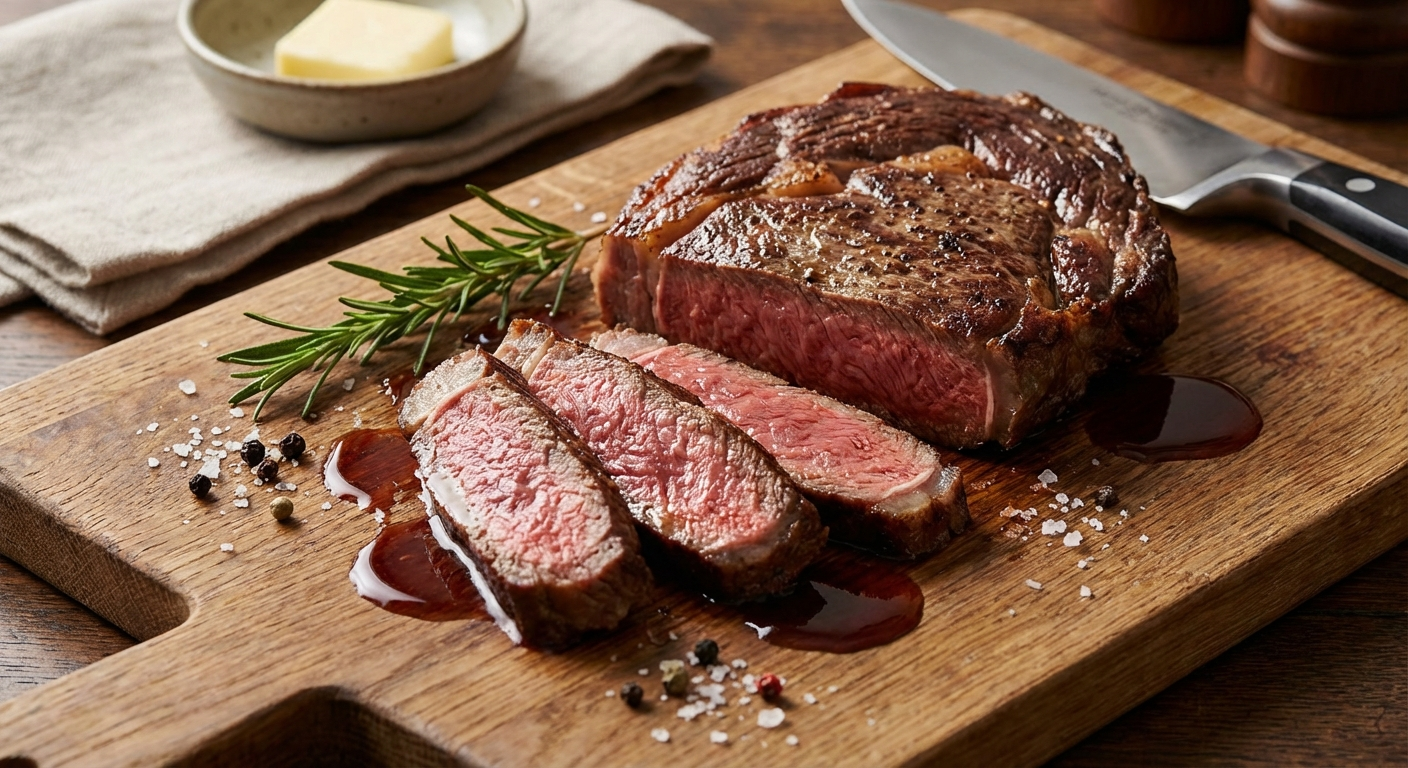
Resting Meat After Cooking: The Science of Why It Makes Every Steak Juicier
You have spent forty-five minutes perfecting the reverse sear. The crust is deep mahogany, the internal temp reads exactly 131°F. And now comes the hardest part of cooking a steak — doing nothing.
Resting meat after cooking is one of the most frequently given pieces of cooking advice, and one of the least understood. Most people know they should rest their steak, but few understand why it works at a molecular level. The science is straightforward once you see it, and understanding it helps you make better decisions about timing, tenting, and how long to wait.
What Happens Inside a Steak During Cooking
To understand resting, you first need to understand what heat does to muscle fibers.
Raw steak is roughly 75% water by weight. That water is held in three places: inside muscle fibers (the majority), between muscle fibers, and loosely bound to proteins. When you apply heat, two things happen simultaneously:
- Proteins denature and contract. As muscle proteins (primarily myosin above 120°F and actin above 140°F) denature, the protein strands tighten and shorten — like wringing a wet towel. This contraction physically squeezes water out of the muscle fibers.
- Water migrates toward the center. The outer layers of the steak, being hotter, contract first and most aggressively. This pushes moisture inward toward the cooler center, creating an uneven distribution — the center is engorged with liquid while the outer layers are relatively dry.
If you cut into the steak immediately after cooking, that pressurized moisture in the center has nowhere to go but out — flooding the cutting board in a pool of flavorful juice that should have been in your mouth.
The Physics of Resting
Temperature Equalization
When you remove a steak from heat, the thermal gradient between the hot exterior and cooler interior begins to equalize. Heat flows from hot regions to cool regions (second law of thermodynamics), so the outer layers cool while the center continues to warm slightly — this is carryover cooking.
As the outer layers cool, their contracted muscle fibers relax partially. Protein denaturation is irreversible — you cannot uncook meat — but the physical tension in the fibers eases as temperature drops. Think of it like a rubber band stretched tight: it cannot return to its original shape once deformed, but when you release some tension, it stops pulling as hard.
This relaxation allows the outer fibers to reabsorb some of the moisture that was squeezed toward the center during cooking. The water redistributes more evenly throughout the steak, from the pressurized center back toward the now-relaxed edges.
The Viscosity Factor
There is a second mechanism that matters: as the steak cools slightly, the gelatin from dissolved collagen and the rendered fat within the meat begin to thicken. At cooking temperatures, these are thin liquids that flow easily. As temperature drops toward 120–140°F during rest, they become more viscous — stickier, slower to flow.
When you cut into a well-rested steak, the juices are thicker and cling to the meat instead of running out. The steak appears and tastes juicier not just because more moisture stays inside, but because the moisture that does emerge coats your palate more effectively.
The Evidence: How Much Juice Do You Actually Save?
Multiple studies have quantified the difference. In research published in the Journal of Food Science, steaks cut immediately after cooking lost approximately 22% of their total weight as juice on the plate. Identical steaks rested for 5–7 minutes lost only 12–15%. That is a 30–40% reduction in juice loss — a difference you can see and taste.
The original work by food scientist Harold McGee and subsequent controlled studies by researchers at Texas A&M's meat science department confirmed the pattern across multiple cuts: resting consistently reduces cutting losses by one-third or more.
For a 16-ounce ribeye, the difference between resting and not resting is roughly 1 to 1.5 ounces of juice — about two tablespoons. That may not sound like much, but it is the difference between a steak that tastes succulent and one that tastes merely good. Every bite carries more moisture, more dissolved flavor compounds, more of the experience you cooked for.
How Long to Rest: The Practical Guide
There is no universal resting time because the optimal duration depends on the steak's thickness, cooking method, and how steep the thermal gradient is. Here is a research-based framework:
Thin Steaks (under 1 inch)
Rest 3–5 minutes. Thin steaks have a shallow thermal gradient — the center-to-edge temperature difference is small. Redistribution happens quickly. Resting too long means a cold steak, which is worse than a slightly juicier one.
Standard Steaks (1–1.5 inches)
Rest 5–7 minutes. This is the sweet spot for most home-cooked steaks. Five minutes provides the majority of the redistribution benefit. Beyond 7 minutes, you hit diminishing returns and the steak cools below ideal serving temperature.
Thick Steaks (1.5–2.5 inches)
Rest 7–10 minutes. Thick steaks from methods like the reverse sear have a more moderate thermal gradient to begin with, so they need less resting time than you might expect. The exception is traditionally seared thick steaks (hot sear followed by oven), which have a steeper gradient and benefit from the full 10 minutes.
Roasts and Large Cuts (3+ pounds)
Rest 15–20 minutes, loosely tented. Prime rib, whole tenderloin, and similar large cuts have significant thermal mass and steep internal gradients. They need more time for heat to equalize. Carryover cooking in these cuts can raise the center temperature by 10–15°F, so pull them earlier than you think.
The Reverse Sear Exception
If you use the reverse sear method, your resting protocol changes. Because the reverse sear uses low, even heat to bring the entire steak to near-target temperature before searing, the thermal gradient is already shallow when the steak comes off heat. The center and edges are much closer in temperature than with traditional methods.
This means:
- Less moisture has been driven to the center (the driving force — the temperature differential — was weaker)
- Less redistribution is needed
- A 5-minute rest is sufficient even for thick steaks
- Some reverse-sear advocates argue you can serve immediately after the sear with minimal penalty
In practice, I still recommend a 5-minute rest for reverse-seared steaks. The sear phase creates a localized hot zone on the surface that benefits from brief equalization, even if the gradient is less extreme.
To Tent or Not to Tent
The foil tent debate generates surprisingly strong opinions. Here is what the science says:
Tenting with foil:
- Pro: Slows heat loss, keeping the steak warmer longer. Important in cold environments or for large cuts with long rest times.
- Con: Traps steam, which can soften the crust. If you spent effort building Maillard crust, steam is the enemy.
Resting uncovered:
- Pro: Preserves crust texture completely. Surface stays dry.
- Con: The steak cools faster, which can be an issue for thin cuts in cold rooms.
My recommendation: For steaks, do not tent. The crust is too valuable to sacrifice. For large roasts (prime rib, whole tenderloin), tent loosely — the longer rest time means significant heat loss without some insulation, and the crust on a roast is less of a defining feature.
The Wire Rack Trick
Rest your steak on a wire rack set over a plate or cutting board. This prevents the bottom surface from sitting in a pool of juice, which softens the crust and creates a soggy underside. The wire rack allows air circulation on all sides, preserving the crust uniformly.
Carryover Cooking: The Resting Side Effect
Resting and carryover cooking are inseparable. While the steak rests, the center temperature continues to rise as heat flows inward from the hotter exterior. The amount of carryover depends on:
- Cooking method: High-heat methods (direct grilling, pan searing) create steep gradients and more carryover (5–10°F). Low-heat methods (reverse sear, sous vide) create shallow gradients and less carryover (2–5°F).
- Thickness: Thicker cuts have more thermal mass at higher temperatures in the outer layers, producing more carryover.
- Resting environment: Tenting increases carryover by slowing surface cooling. Open-air resting reduces it.
For a detailed carryover reference including pull temperatures for every doneness level, see our carryover cooking chart.
What About Resting in a Warm Oven?
Some restaurant kitchens rest steaks in a low oven (140–170°F) to keep them warm for service. This is a practical solution for professional settings where timing multiple dishes is critical, but it is not ideal for crust preservation or moisture redistribution.
Holding meat at temperature keeps the proteins contracted. They never get the chance to relax as they would during open-air cooling. Moisture redistribution still occurs to some degree (the gradient equalizes), but the relaxation benefit is reduced. The steak stays warm but may not be as juicy as one rested at room temperature.
For home cooking, skip the warm oven. Rest at room temperature and eat within 5–7 minutes of pulling from heat.
Resting Different Cuts
Ribeye
Ribeyes have significant intramuscular fat that stays liquid at serving temperature. Rest 5–7 minutes. The melted fat acts as a built-in moisture buffer, making ribeyes more forgiving than leaner cuts. American Wagyu ribeyes with their extreme marbling are especially forgiving — the fat keeps the steak tasting juicy even with imperfect resting.
NY Strip
Strips are leaner than ribeyes with a distinct fat cap on one side. Rest 5–7 minutes. Pay attention to the fat cap side — if it is not fully rendered, consider searing it briefly on edge before resting.
Filet Mignon
Filets are the leanest common steak cut. With minimal intramuscular fat to buffer moisture loss, resting is critical. Rest 5 minutes minimum. Do not skip this step with filet — the difference in juiciness is more noticeable than with fattier cuts.
Tri-Tip and Flank Steak
These thinner, wider cuts have shallow thermal gradients and rest quickly. Three to five minutes is sufficient. Slice against the grain immediately after resting — these cuts tighten as they cool, so do not let them sit too long.
Brisket and Pork Shoulder
Large barbecue cuts benefit from extended resting — 30 minutes to 2 hours, held in an insulated cooler (the "faux cambro" technique). These cuts are cooked to 195–205°F internally, and the gelatin from dissolved collagen needs time to redistribute and set slightly. A well-rested brisket slices cleaner and tastes more succulent than one cut immediately.
Common Myths About Resting Meat
Myth: Resting "seals in juices"
Nothing seals in juices. Not searing, not resting, not wishing. Resting allows the pressurized moisture inside the steak to redistribute more evenly so less floods out when you cut. The total moisture content of the steak is the same whether you rest or not — it is the distribution that changes.
Myth: You should rest meat for as long as you cooked it
This is excessive for steaks. A steak cooked for 45 minutes does not need a 45-minute rest. The redistribution process reaches 90% completion within 5–7 minutes for most steaks. After that, you are just eating a cold steak.
Myth: Resting on a cold plate is fine
A cold plate or cutting board acts as a heat sink, rapidly cooling the bottom surface. This can create a cold, soggy underside. Use a warm plate, a wooden cutting board (wood is a poor heat conductor, which is good here), or a wire rack.
Myth: If your steak is cooked perfectly, you do not need to rest
Even a perfectly cooked steak has a thermal gradient and uneven moisture distribution. The only exception is sous vide, where the temperature is mathematically uniform — and even then, the sear phase creates a surface gradient that benefits from a brief rest.
The Bottom Line
Resting meat after cooking is not a nice-to-have. It is the final step that determines whether all your earlier effort — selecting the right cut, seasoning properly, nailing the temperature — actually translates to the eating experience.
Five to seven minutes. Uncovered. On a wire rack. That is all it takes to transform a good steak into a great one.
Frequently Asked Questions
How long should you rest a steak after cooking?
For standard steaks (1–1.5 inches), rest 5–7 minutes uncovered at room temperature. Thin steaks (under 1 inch) need only 3–5 minutes. Thick steaks (1.5–2.5 inches) benefit from 7–10 minutes. Large roasts need 15–20 minutes loosely tented with foil.
Why does resting meat make it juicier?
During cooking, heat contracts muscle proteins, squeezing moisture toward the cooler center. Resting allows the outer fibers to relax partially and reabsorb some of that moisture. Studies show resting reduces juice loss on the cutting board by 30–40% compared to cutting immediately.
Should you cover steak with foil while resting?
For steaks, do not tent with foil — the trapped steam softens the crust you worked to build. For large roasts with rest times over 15 minutes, a loose foil tent slows heat loss without completely destroying the surface. Rest steaks uncovered on a wire rack for best results.
Does resting steak make it cold?
A 5–7 minute rest drops the surface temperature of a steak by roughly 15–25°F, but the center temperature actually rises slightly due to carryover cooking. The steak remains well above comfortable eating temperature (120°F+). If temperature is a concern, use a warm plate for serving.
Do you need to rest a reverse seared steak?
Yes, but for a shorter time. The reverse sear produces a shallower thermal gradient, so less moisture redistribution is needed. A 5-minute rest is sufficient even for thick reverse-seared steaks, compared to 7–10 minutes for traditionally seared thick cuts.
What happens if you cut steak without resting?
Cutting immediately releases a flood of juice onto the cutting board — up to 22% of the steak's weight. Resting reduces this to 12–15%. The difference is about 1–1.5 ounces for a 16-ounce steak, which significantly affects perceived juiciness and flavor in every bite.
More Expert Guides
Grill Vent Management: The Science of Airflow and Temperature Control
Oxygen controls fire. Fire controls temperature. Vents control oxygen. Master your vents and you master your grill.
12 min readHow Often to Flip Steak: The Science of Multiple Flips vs Single Flip
The traditional advice to flip your steak only once is wrong. Science shows that flipping every 30 seconds produces better crust, more even doneness, and 30% faster cooking through improved heat transfer.
12 min readThe Science of Plancha Grilling: How High Heat and Flat Surfaces Create Superior Crust
Plancha grilling delivers more surface contact, higher heat, and better crust than traditional grates. Here is the science behind why flat-top cooking produces superior results.