When to Salt Steak: The Science of Timing, Osmosis, and Flavor Development
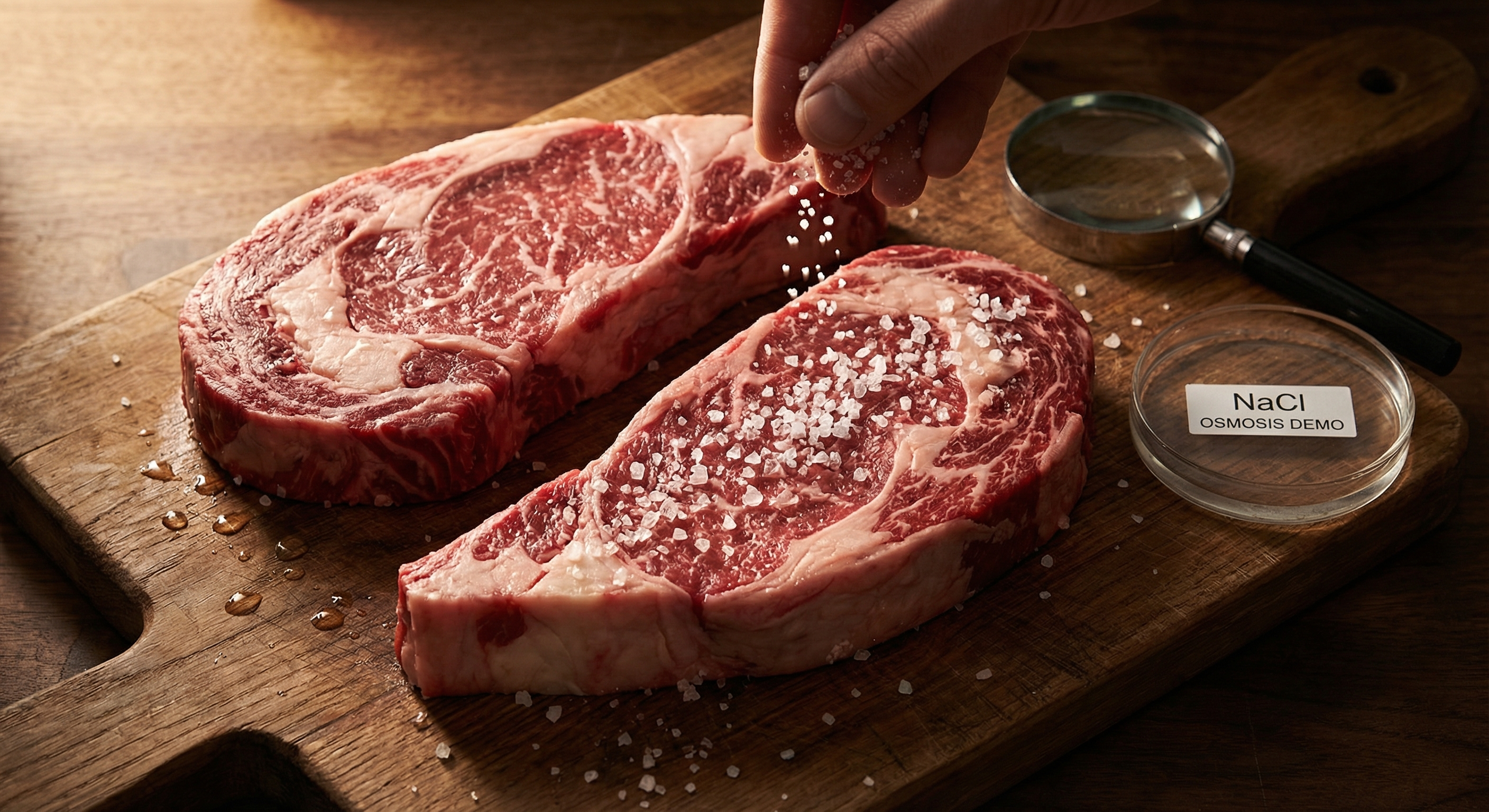
When to Salt Steak: The Science of Timing, Osmosis, and Flavor Development
You've heard it a thousand times: "Always salt your steak." But when you salt it changes everything. Salt it at the wrong moment, and you'll pull moisture out of the meat, leaving it sitting in a puddle of its own juices while the surface stays wet and refuses to brown. Salt it at the right moment, and the same moisture migrates back into the muscle fibers, dissolves proteins, and creates a deeply seasoned, tender, perfectly browned crust.
The difference is osmosis, diffusion, and water activity — three forces that most recipes ignore but every great steakhouse chef understands instinctively.
The Three Salt Timing Windows
There are three scientifically sound times to salt a steak:
- 40+ minutes before cooking (optimal: 1–24 hours) — allows full osmosis and reabsorption cycle
- Immediately before cooking (less than 3 minutes) — salt adheres without triggering moisture extraction
- Never between 3 and 40 minutes before cooking — the "danger zone" where surface moisture pools without reabsorption
The science behind each window explains why timing matters as much as the salt itself.
The Science: Osmosis, Diffusion, and the Salt Cycle
Phase 1: Osmosis Draws Moisture Out (0–10 Minutes)
When salt crystals land on the surface of raw meat, they encounter a thin layer of surface moisture — water, myoglobin, and dissolved proteins. The salt crystals dissolve into this moisture, forming a concentrated brine.
This brine is now much more concentrated (higher solute concentration) than the liquid inside the muscle cells. Water naturally moves from areas of low solute concentration (inside the cells) to areas of high solute concentration (the surface brine) to equalize the imbalance. This movement of water through a semi-permeable membrane (the cell walls) is osmosis.
Result: moisture is drawn out of the meat and pools on the surface. If you salt a steak and let it sit for 5–10 minutes, you'll see visible beads of liquid forming on top. This is osmosis at work.
At this stage, the surface is wet. Wet surfaces do not brown well because the water must evaporate before the Maillard reaction can begin. If you cook a steak during this phase, you get steaming instead of searing.
Phase 2: Reabsorption and Diffusion (10–40 Minutes)
After about 10 minutes, the salt has fully dissolved and the brine on the surface is now isotonic (equal concentration) with the interior of the meat. Osmotic pressure equalizes. The moisture that was pulled out begins reabsorbing back into the muscle fibers through diffusion — the passive movement of molecules from areas of high concentration to low concentration.
But now the brine carries dissolved salt with it. As the salty moisture reabsorbs, it penetrates deeper into the meat, seasoning not just the surface but the interior. Salt ions diffuse along concentration gradients, spreading evenly through the muscle tissue.
Simultaneously, salt disrupts protein structures. Myosin (a muscle protein) begins to dissolve slightly, forming a sticky protein gel. This gel traps moisture, creating a more cohesive, tender texture and helping the surface dry out so it can brown properly.
At 40 minutes, the surface has mostly dried. The salt has penetrated 3–6 mm into the meat (depending on thickness and salt grain size). The proteins have begun restructuring. The steak is now optimally seasoned and ready for a perfect sear.
Phase 3: Full Equilibration (1–24 Hours)
If you salt a steak and refrigerate it uncovered for 1–24 hours, you allow full diffusion equilibration. The salt penetrates evenly throughout the entire thickness of the steak. The surface dries completely due to evaporation in the refrigerator's low-humidity environment. Proteins denature further, and myosin forms a tacky, gel-like coating on the surface that promotes browning.
This is the technique behind dry-brining (also called dry-aging lite or overnight salting). Steakhouses use this method because it produces:
- Deeper seasoning: Salt has 12–24 hours to diffuse through the meat.
- Drier surface: Less moisture to evaporate during searing means faster, more aggressive browning.
- Tenderization: Salt breaks down some muscle protein structure, improving texture.
- Better crust: The sticky protein gel formed by dissolved myosin caramelizes beautifully during high-heat searing.
Why the 3–40 Minute Window Is Bad
If you salt a steak 3–40 minutes before cooking, you catch it in the worst phase: osmosis has pulled moisture to the surface, but there hasn't been enough time for reabsorption and diffusion. The surface is wet. When you place a wet steak in a hot pan, the water must evaporate before browning can occur. This wastes time, lowers the pan temperature, and produces steaming instead of searing.
You end up with:
- Gray, steamed exterior instead of a brown crust
- Wasted heat energy evaporating surface moisture instead of browning proteins
- Uneven seasoning — the salt hasn't penetrated, so the exterior is salty but the interior is bland
Avoid this window at all costs. If you're 5 minutes from cooking and realize you forgot to salt, either salt it immediately (less than 3 minutes before cooking) or wait until after the sear and season the cooked steak.
The Two Proven Methods
Method 1: Salt 40+ Minutes to 24 Hours Before (Dry-Brining)
How: Generously season both sides of the steak with coarse kosher salt or sea salt (about 1% of the steak's weight in salt — roughly 3/4 teaspoon per pound). Place the steak on a wire rack over a plate or sheet pan. Refrigerate uncovered for 1–24 hours.
Why it works:
- Osmosis pulls moisture out (10–15 minutes).
- Diffusion pulls the salty brine back in, seasoning the interior (40+ minutes).
- Surface dries in the refrigerator's low-humidity air, creating ideal conditions for browning.
- Proteins denature and form a sticky gel that enhances crust formation.
Best for: Thick steaks (1.5–2 inches), special occasions, steakhouse-quality results. The longer the better — 12–24 hours produces noticeably superior flavor and texture compared to 1–2 hours.
Science detail: Salt diffuses at approximately 1 mm per hour in muscle tissue at refrigerator temperature (35–40°F). A 1.5-inch (38 mm) steak requires roughly 19 hours for salt to reach the center. Even if you only have 1–2 hours, the first 6–10 mm will be well-seasoned, which covers the outer third of most steaks.
Method 2: Salt Immediately Before Cooking (Last-Second Seasoning)
How: Remove the steak from the refrigerator 30–60 minutes before cooking to bring it closer to room temperature (this improves even cooking, unrelated to salting). Pat the surface completely dry with paper towels. Season generously with coarse salt and freshly ground black pepper. Immediately place in a preheated skillet or on a hot grill — within 3 minutes of salting.
Why it works: Osmosis requires time (5–10 minutes minimum) to pull significant moisture to the surface. If you salt and cook within 3 minutes, osmosis hasn't had time to draw moisture out. The salt adheres to the dry surface, and the steak sears immediately without interference from surface moisture.
Best for: Thin steaks (under 1 inch), weeknight cooking, minimal planning. Also the preferred method for competition steak cooks who want absolute control over browning timing.
Trade-off: The salt doesn't penetrate. It seasons the surface only. The interior of the steak will be less salty than a dry-brined steak. Some diners prefer this because it creates a flavor gradient — salty crust, pure beef flavor in the center. Others find it unbalanced.
Salt Grain Size Matters
The size of the salt crystals affects dissolution rate and diffusion speed:
- Fine table salt: Dissolves almost instantly. Penetrates quickly. Risk of over-salting because it's easy to apply too much by volume (table salt is denser than kosher salt). Use 1/2 teaspoon per pound.
- Kosher salt (Diamond Crystal or Morton): Larger crystals dissolve in 2–5 minutes. Standard choice for dry-brining. Diamond Crystal is less dense than Morton — use 3/4 tsp Diamond Crystal vs. 1/2 tsp Morton per pound.
- Coarse sea salt or flake salt (Maldon): Large, irregular crystals dissolve slowly (5–10 minutes). Best for finishing (sprinkling on cooked steak) rather than pre-salting. Beautiful texture, satisfying crunch, but inefficient for penetration.
For dry-brining, kosher salt is the gold standard. For last-second seasoning, any salt works as long as you adjust the volume for density.
Does Salt "Draw Out Moisture" and Dry the Steak?
Short answer: No. This is the most common salting myth.
Yes, osmosis draws moisture to the surface initially (phase 1). But that moisture reabsorbs (phase 2) along with the dissolved salt. The net result is that the steak retains the same total amount of moisture — but that moisture is now seasoned and redistributed.
In fact, salted steaks often lose less moisture during cooking than unsalted steaks. Harold McGee (author of On Food and Cooking) tested this: steaks salted 1 hour before cooking lost 1–2% less weight during cooking compared to unsalted steaks. The reason is that dissolved salt denatures proteins, which form a gel matrix that traps water molecules. This gel prevents moisture from escaping as easily during the high heat of searing.
Surface drying (from refrigerator evaporation during overnight dry-brining) is beneficial, not harmful. A dry surface browns faster and better. The interior remains fully hydrated.
The Role of Temperature and Resting
Bringing a steak to room temperature before cooking is about even cooking, not salting. A fridge-cold steak (35–40°F) has a steep temperature gradient from surface to center. When you sear it, the exterior overcooks before the center reaches your target doneness.
A steak rested at room temperature for 30–60 minutes warms to 55–65°F, reducing the gradient. This allows more even doneness from edge to center.
However: salting happens independently of temperature. You can salt a steak while it's cold and let it rest for 40 minutes as it comes to room temp. Or salt it 24 hours ahead while refrigerated. The osmosis-diffusion cycle works at any temperature — it's just slightly faster at room temperature than refrigerated (but the difference is negligible for 1–24 hour dry-brining).
What About Other Seasonings?
Salt penetrates because it's a small ion (Na⁺ and Cl⁻). Black pepper, garlic powder, herbs, and other seasonings are much larger molecules and do not diffuse into muscle tissue. They remain on the surface.
This is why professional steak cooks apply salt early but save black pepper, garlic, and other aromatics for immediately before cooking. Pepper can burn during high-heat searing, especially if it sits on the surface for hours. Garlic powder can turn bitter if exposed to long dry-brining periods.
Best practice:
- Salt the steak 1–24 hours ahead (or immediately before cooking).
- Apply black pepper, garlic, onion powder, or other seasonings in the last 3 minutes before cooking.
- Finish with flaky sea salt and fresh herbs after cooking.
Salt and the Maillard Reaction
Salt does not directly participate in the Maillard reaction (the browning of proteins and sugars at high heat), but it supports it in two ways:
- Protein denaturation: Salt breaks down muscle proteins into smaller peptides and amino acids, which are more reactive in Maillard browning. This is why dry-brined steaks often develop a darker, richer crust.
- Surface drying: By pulling moisture out temporarily and allowing it to evaporate in the refrigerator, salt creates a drier surface. Dry surfaces reach higher temperatures faster because there's no evaporative cooling. Higher surface temperature = more aggressive Maillard browning.
Dry-Brining vs. Wet-Brining
Wet-brining (submerging meat in a saltwater solution) works for poultry and pork, but it's a terrible idea for steak. Here's why:
- Dilution: Wet-brining adds 10–15% water weight to the meat. Steaks are prized for concentrated beef flavor; diluting them with water is counterproductive.
- Texture degradation: Excess water disrupts the muscle fiber structure, making the texture spongy instead of firm.
- No surface drying: Wet-brined meat emerges from the brine soaking wet. You must thoroughly dry it before cooking, which wastes time.
Dry-brining (salting without liquid) gives you all the benefits of seasoning penetration and protein denaturation without the downsides of added water. Stick to dry-brining for steaks.
How Much Salt?
The standard ratio for dry-brining is 1% of the meat's weight in salt (by weight, not volume). For a 1-pound (454g) steak:
- By weight: 4.5 grams of salt (about 3/4 teaspoon Diamond Crystal kosher salt or 1/2 teaspoon Morton kosher salt)
- Visual guide: A generous pinch per side, evenly distributed
If you don't have a scale, the "generous but not excessive" eyeball method works: you should see visible salt coverage, but not a thick crust. The salt should look like a light snowfall, not a blizzard.
For last-second seasoning (method 2), you can use slightly more salt because it's staying on the surface and won't penetrate. Some will fall off during searing. Season boldly.
Practical Timeline Comparison
| Method | Timing | Seasoning Depth | Surface Moisture | Crust Quality | Best Use Case |
|---|---|---|---|---|---|
| Dry-brine 24 hours | Salt 24 hrs ahead | Full penetration | Completely dry | Exceptional | Thick steaks, special dinners |
| Dry-brine 1–2 hours | Salt 1–2 hrs ahead | Outer 6–10 mm | Mostly dry | Excellent | Weeknight planning |
| Dry-brine 40 min | Salt 40 min ahead | Outer 2–4 mm | Mostly dry | Very good | Minimal planning |
| Last-second | Salt <3 min before | Surface only | Dry (if patted) | Very good | No planning, thin steaks |
| 3–40 min (AVOID) | Salt 5–30 min ahead | Surface only | Wet | Poor | Never do this |
Real-World Test: Head-to-Head Comparison
Cook's Illustrated (now America's Test Kitchen) ran a controlled experiment testing four salt timing methods on identical ribeye steaks:
- Salted immediately before cooking
- Salted 10 minutes before cooking
- Salted 40 minutes before cooking
- Salted 24 hours before cooking (refrigerated uncovered)
Results:
- #1 (immediate): Good browning, surface seasoning only, slight flavor gradient. Judges rated it 7.5/10.
- #2 (10 minutes): Poorest browning due to surface moisture. Steaming instead of searing. Judges rated it 5/10.
- #3 (40 minutes): Good browning, better seasoning penetration than immediate. Judges rated it 8/10.
- #4 (24 hours): Best browning, deepest seasoning, most tender texture. Judges rated it 9.5/10.
- Do not salt before freezing. Salt draws moisture to the surface, which freezes into ice crystals. These crystals damage cell structure and cause excessive moisture loss during thawing.
- Salt immediately before searing. The frozen surface is dry and extremely cold, which prevents osmosis from occurring during the brief searing phase.
The 24-hour dry-brine was the unanimous winner. The 10-minute steak (caught in the osmotic "danger zone") was the clear loser.
Special Case: Frozen Steaks
If you're cooking from frozen (using the reverse-frozen sear method where you sear a frozen steak then finish in the oven), salt timing is different:
The Bottom Line
Salt your steak at least 40 minutes before cooking — ideally 1–24 hours ahead for thick cuts. Or salt it immediately before cooking if you forgot to plan ahead. Never salt it 3–40 minutes before cooking.
The science is simple: osmosis pulls moisture out, diffusion pulls it back in with dissolved salt. Give the cycle time to complete, and you'll end up with a deeply seasoned, perfectly browned, restaurant-quality steak every time.
And if someone tells you that salting "draws out the juices" and dries the meat, you can explain the actual physics: osmosis, diffusion, protein denaturation, and moisture retention. Science beats myth every time.
Frequently Asked Questions
When is the best time to salt a steak?
The best time is 40 minutes to 24 hours before cooking (dry-brining). This allows osmosis to draw moisture out, then diffusion to pull it back in along with dissolved salt, seasoning the interior. The surface also dries, improving browning. If you forgot, salt immediately before cooking (less than 3 minutes before). Never salt 3-40 minutes before cooking — that's when surface moisture pools without reabsorbing.
Does salting steak ahead of time make it dry?
No. While osmosis initially draws moisture to the surface (5-10 minutes), that moisture reabsorbs within 40 minutes through diffusion, carrying dissolved salt into the meat. The total moisture content stays the same. In fact, salted steaks often lose less moisture during cooking because salt-denatured proteins form a gel that traps water.
What is dry-brining and how does it work?
Dry-brining is salting meat 1-24 hours ahead and refrigerating it uncovered. Salt dissolves in surface moisture, diffuses into the meat (seasoning the interior), and denatures muscle proteins (improving tenderness). The refrigerator air dries the surface, creating ideal conditions for a dark, crispy crust during searing. It's the technique steakhouses use for perfect seasoning and browning.
Why shouldn't you salt steak 10-30 minutes before cooking?
Salting 3-40 minutes before cooking catches the steak in the worst phase: osmosis has pulled moisture to the surface, but there hasn't been time for reabsorption. The wet surface must evaporate before browning can occur, causing steaming instead of searing. You get a gray exterior, wasted heat, and uneven seasoning. Always salt 40+ minutes ahead or immediately before cooking.
How much salt should you use on a steak?
For dry-brining, use 1% of the steak's weight in salt (about 3/4 teaspoon Diamond Crystal kosher salt per pound, or 1/2 teaspoon Morton kosher salt per pound). Visually, it should look like a light, even coating — not a thick crust. For last-second seasoning, you can use slightly more since it stays on the surface and some will fall off during cooking.
Can you salt a steak the night before?
Yes — this is ideal. Salting 12-24 hours ahead (refrigerated uncovered) allows full diffusion of salt through the entire thickness of the steak, complete surface drying for superior browning, and maximum protein denaturation for tenderness. This method produces steakhouse-quality results and is the preferred technique for thick cuts (1.5-2 inches).
More Expert Guides
Grill Vent Management: The Science of Airflow and Temperature Control
Oxygen controls fire. Fire controls temperature. Vents control oxygen. Master your vents and you master your grill.
12 min readHow Often to Flip Steak: The Science of Multiple Flips vs Single Flip
The traditional advice to flip your steak only once is wrong. Science shows that flipping every 30 seconds produces better crust, more even doneness, and 30% faster cooking through improved heat transfer.
12 min readThe Science of Plancha Grilling: How High Heat and Flat Surfaces Create Superior Crust
Plancha grilling delivers more surface contact, higher heat, and better crust than traditional grates. Here is the science behind why flat-top cooking produces superior results.