Smoke Ring Science: Why BBQ Meat Turns Pink and How to Get a Better One
Smoke Ring Science: Why BBQ Meat Turns Pink and How to Get a Better One
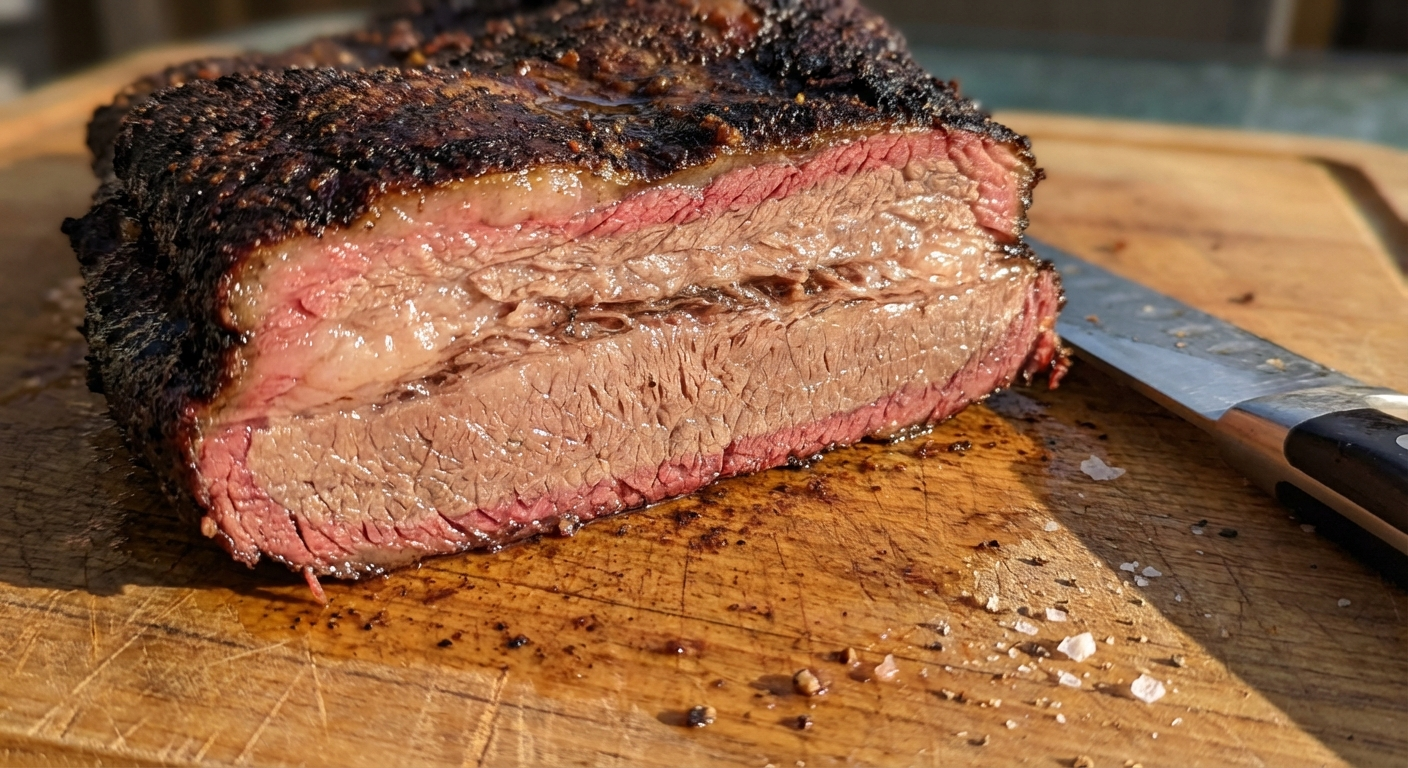
Slice into a perfectly smoked brisket and you will see it immediately — a vivid pink band just beneath the bark, stretching 3 to 8 millimeters deep. This is the smoke ring, and for generations of pitmasters, it has been the visual signature of authentic low-and-slow barbecue.
But the smoke ring is not actually caused by smoke penetrating the meat. It is the result of a gas-phase chemical reaction between combustion byproducts and the proteins in muscle tissue. Understanding this chemistry does not diminish the craft. It makes you a better pitmaster.
The Chemistry: Nitric Oxide and Myoglobin
Meat gets its red color from myoglobin, an oxygen-carrying protein found in muscle fibers. Myoglobin is not hemoglobin — it stays in muscle tissue, while hemoglobin travels in the blood. Fresh meat is purplish-red because myoglobin's iron atom is in a reduced (ferrous, Fe²⁺) state, bound to nothing but water. Expose it to oxygen and it becomes bright cherry red (oxymyoglobin). Cook it above 140°F and the protein denatures, the iron oxidizes to Fe³⁺, and the meat turns gray-brown. That is normal cooked meat.
The smoke ring breaks this pattern. When wood, charcoal, or pellets burn, they produce nitric oxide (NO) and carbon monoxide (CO) as combustion gases. These small, reactive molecules dissolve into the moist surface of the meat and diffuse inward.
Nitric oxide binds to myoglobin's iron center far more tightly than oxygen does. The resulting molecule — nitrosylmyoglobin — is remarkably heat-stable. Even when you cook the brisket to 203°F internally, the myoglobin in the smoke ring stays pink because the NO-iron bond resists the thermal denaturation that turns the rest of the meat gray.
This is the exact same chemistry used in commercial cured meats. Ham, bacon, and hot dogs get their pink color from sodium nitrite, which converts to nitric oxide in the meat. The smoke ring is, in essence, a natural curing reaction happening at the surface of your barbecue.
Why Carbon Monoxide Matters Too
Carbon monoxide (CO) also binds to myoglobin, creating carboxymyoglobin, which is bright red and heat-stable. While NO is the primary driver of the smoke ring, CO contributes, especially in the earliest stages of the cook when surface temperatures are still low and CO diffusion is fastest.
This dual mechanism explains why different fuel sources produce different ring qualities. Hardwood logs generate more NO and CO than gas burners. Charcoal produces substantial CO. Electric smokers produce very little of either, which is why they rarely create a visible smoke ring without intervention.
The Physics: Why the Ring Has a Boundary
If NO and CO can diffuse into meat, why does the pink stop after a few millimeters? The answer is a race between two processes: gas diffusion inward and thermal denaturation outward.
As the cook progresses, heat moves from the surface toward the center. Once any layer of meat exceeds roughly 140°F, the myoglobin in that layer denatures and can no longer bind NO. Meanwhile, NO is diffusing inward from the surface, trying to reach fresh myoglobin before the heat wave destroys it.
The smoke ring boundary is the exact depth where the heat front "catches up" to the NO diffusion front. Everything shallower than that boundary was reached by NO while the myoglobin was still intact. Everything deeper was cooked before NO could arrive.
This is why starting with cold meat produces a thicker smoke ring. A refrigerator-cold brisket (38°F) gives the NO more time to penetrate before the surface layers hit 140°F. A room-temperature brisket starts with less thermal runway, and the ring will be shallower.
Proven Techniques to Maximize the Smoke Ring
1. Start with Cold Meat
Take the brisket directly from the refrigerator to the smoker. Do not temper. The colder the meat surface, the longer NO has to diffuse before myoglobin denatures. This single change can double ring depth from 3mm to 6-8mm.
2. Keep the Surface Moist
NO dissolves into water before it can reach the myoglobin. A dry surface slows absorption. Spritzing with water, apple cider vinegar, or broth during the first 2-3 hours keeps the surface wet and maximizes gas uptake. A water pan in the smoker chamber also raises humidity and aids this process.
3. Use Wood or Charcoal as Your Primary Fuel
Hardwood splits and lump charcoal generate the most NO and CO. Offset smokers and charcoal-fired bullet smokers naturally produce thick smoke rings. Gas and electric smokers produce far less NO — adding a charcoal tray or smoke tube to these units helps compensate.
4. Manage Your Fire for Clean Smoke
Thin blue smoke contains NO. Thick white smoke contains primarily particulates and creosote precursors that deposit bitter compounds on the surface but do not aid the ring. A clean-burning fire at 225-275°F with adequate airflow produces the ideal combustion gases for ring development.
5. Apply Rubs After Salting, Not Instead of It
Salt on the surface draws moisture outward via osmosis, creating a thin brine layer. This wet layer is ideal for dissolving NO. Apply salt (or a salt-heavy rub) the night before, then add additional spices before the cook. A dry, crusty rub applied right before cooking can actually slow gas absorption.
6. Low and Slow Wins the Ring Race
Cooking at 225°F rather than 300°F slows the rate at which the heat front advances into the meat. This gives NO more time to diffuse deeper. Higher-temperature cooks will still produce a ring, but it will be noticeably thinner.
The Smoke Ring Myth: Does It Mean Better Barbecue?
Competition judges know — or should know — that the smoke ring is not a reliable indicator of flavor. You can fake a smoke ring by applying curing salt (sodium nitrite) to the surface. You can also produce deeply flavorful barbecue in an electric smoker with no visible ring at all.
The Kansas City Barbeque Society (KCBS) officially ruled years ago that the smoke ring should not factor into scoring. The reason is simple: the ring is a surface chemistry phenomenon. Smoke flavor comes from entirely different compounds — phenols, guaiacol, syringol — that adhere to the surface and permeate the bark.
That said, a good smoke ring is a sign that you managed your fire, temperature, and humidity well. It correlates with good barbecue because the same conditions that produce a ring (clean combustion, low temperature, moist surface) also produce great flavor. It is an indicator, not a cause.
Fuel Source Comparison: Smoke Ring Potential
Not all heat sources are equal when it comes to NO production:
- Hardwood logs (oak, hickory, mesquite): Highest NO output. Thick rings with minimal effort. The gold standard for offset smokers.
- Lump charcoal: High CO, moderate NO. Produces reliable rings, especially when supplemented with wood chunks.
- Charcoal briquettes: Moderate NO and CO. The binders and additives alter combustion chemistry slightly, but rings are still achievable.
- Wood pellets: Moderate NO. Pellet grills compress sawdust with heat, and the controlled burn produces a consistent but thinner ring compared to stick-burning.
- Propane gas: Very low NO. Natural gas combustion is clean — too clean for ring formation. Adding a smoke tube with pellets or chips is essential.
- Electric: Virtually zero NO or CO. The heating element produces no combustion gases. Wood chips in a tray add some, but rings are typically faint.
Common Smoke Ring Questions
Can you get a smoke ring on chicken or pork?
Yes. Any meat with myoglobin will develop a smoke ring. Pork shoulder and ribs show it clearly. Chicken has much less myoglobin (especially breast meat), so the ring is faint and harder to see, but it is there.
Does wrapping in foil (the Texas crutch) stop ring development?
Effectively, yes. Once you wrap, the meat is sealed away from combustion gases. However, by the time most pitmasters wrap (around 160-170°F internal), the ring has already formed. The myoglobin at the surface has long since locked in its NO bond, and the heat front has advanced past the ring boundary.
Does the ring keep growing throughout the cook?
No. Ring development is essentially complete within the first 2-3 hours. After that, the surface myoglobin is fully denatured and cannot bind additional NO. The ring boundary is fixed once the local temperature exceeds 140°F.
Is the smoke ring safe to eat?
Absolutely. Nitrosylmyoglobin is the same compound found in every piece of cured deli meat. The quantities formed during smoking are far lower than in commercial curing. There is no safety concern.
Frequently Asked Questions
What causes the smoke ring in BBQ meat?
The smoke ring is caused by nitric oxide (NO) and carbon monoxide (CO) from combustion gases binding to myoglobin in the meat. This creates nitrosylmyoglobin, a heat-stable pink compound that resists the thermal denaturation that turns the rest of the meat gray-brown during cooking.
How do you get a thicker smoke ring?
Start with cold meat straight from the refrigerator, keep the surface moist with spritzing, use wood or charcoal fuel, cook low and slow at 225°F, and maintain clean thin blue smoke. These techniques maximize nitric oxide diffusion before heat denatures the surface myoglobin.
Does the smoke ring mean the meat is undercooked?
No. The pink color in a smoke ring is caused by a chemical reaction between nitric oxide and myoglobin, not by undercooking. The meat in the smoke ring zone has reached full cooking temperature — the pink color persists because nitrosylmyoglobin is heat-stable up to well beyond safe cooking temperatures.
Can electric smokers produce a smoke ring?
Electric smokers produce very little nitric oxide or carbon monoxide because the heating element does not combust fuel. Adding a charcoal smoke tube or wood chip tray helps, but the ring will typically be thinner than what a charcoal or wood-burning smoker produces.
When does the smoke ring stop forming?
The smoke ring stops forming within the first 2-3 hours of cooking. Once the surface layers of meat exceed 140°F, the myoglobin denatures and can no longer bind nitric oxide, fixing the ring boundary at its final depth.
More Expert Guides
Steak Doneness Temperature Guide: The Science of Every Level from Rare to Well Done
Every degree matters. This science-backed guide covers the exact internal temperatures for every steak doneness level, why each temperature produces a different texture, and how to nail your target every time.
14 min readDirect vs Indirect Heat Grilling: The Science of Two-Zone Cooking
Direct heat sears. Indirect heat roasts. Understanding the physics of each — and when to combine them — is the foundation of every great grilling technique.
14 min readResting Meat After Cooking: The Science of Why It Makes Every Steak Juicier
Resting meat after cooking is not optional — it is physics. Here is exactly what happens inside the steak during those crucial minutes and how long to rest every cut.