Sous Vide Steak: Precision Cooking From Lab to Kitchen
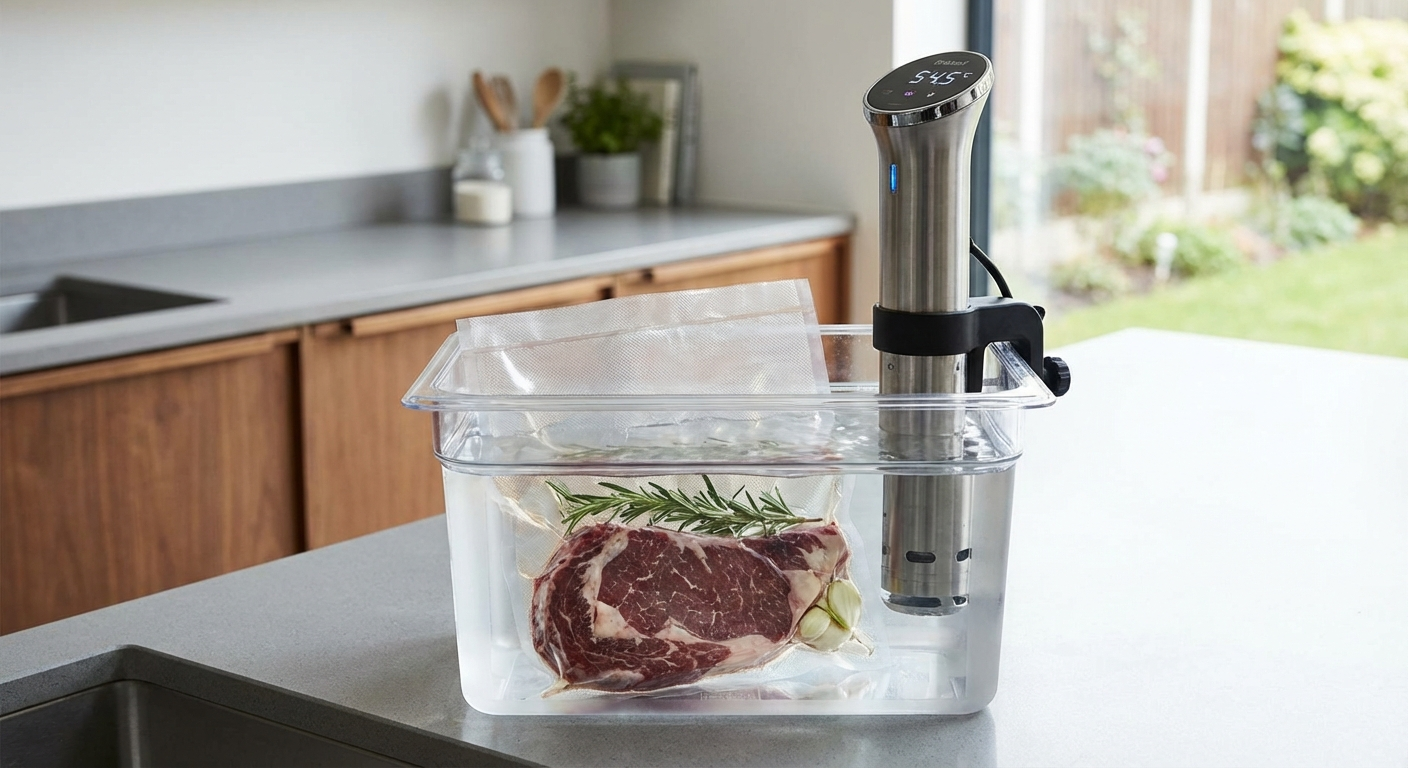
Sous vide cooking is, fundamentally, a method of achieving thermal equilibrium between a water bath and a piece of protein. The water bath holds a precise temperature — 131°F, say — and the steak gradually reaches that same temperature throughout. No thermal gradient. No guesswork. The steak literally cannot overcook past the bath temperature, no matter how long you leave it (within reason).
I first encountered sous vide in a USDA lab in 2008, where we were studying pathogen lethality at various time-temperature combinations. The equipment was industrial — massive circulating water baths and vacuum sealers that cost more than my car. Today, you can buy a home immersion circulator for $100 that holds temperature within 0.1°F. The democratization of precision cooking technology is one of the best things to happen to home cooks in the past 20 years.
How Sous Vide Works
The concept is simple: seal food in a plastic bag, remove the air, and submerge it in a water bath held at your target temperature. Water is roughly 25 times more efficient at transferring heat than air (the thermal conductivity of water is 0.6 W/m·K vs. 0.025 W/m·K for air), so the steak heats up relatively quickly and evenly.
The key insight is that the bath temperature IS the final food temperature. In an oven set to 250°F, the steak's center will eventually reach 250°F if left long enough (though you'd never do that). In a 131°F water bath, the steak's center asymptotically approaches 131°F — and can never exceed it. This is the fundamental safety net of sous vide: overcooking requires actively raising the bath temperature.
Time vs. Temperature: Both Matter
Temperature controls doneness (myoglobin denaturation, texture). Time controls tenderness beyond temperature's effect. A steak at 131°F for 1 hour has a different texture than the same steak at 131°F for 4 hours. The longer cook allows more collagen breakdown and enzyme activity. For most steaks, 1–2 hours is optimal. Beyond 4 hours, the texture can become mushy as the protein matrix breaks down excessively.
Recommended Temperatures and Times
| Doneness | Bath Temperature | Time Range | Notes |
|---|---|---|---|
| Rare | 120–125°F | 1–2 hours | Very soft. Below pasteurization temps — use within 2 hours. |
| Medium-Rare | 129–134°F | 1–3 hours | The most popular target. 131°F is my default. |
| Medium | 138–145°F | 1–3 hours | Firmer, less juice. Good for fattier cuts where fat renders more at higher temps. |
| Medium-Well | 148–155°F | 1–2 hours | Significant moisture loss. Shorter cook prevents mushiness. |
For a standard 1.5-inch steak, 1.5 to 2 hours at temperature is sufficient to reach equilibrium and achieve the desired texture. Thicker cuts (2+ inches) may need 2–3 hours to fully equilibrate.
The Sear: Solving the Crust Problem
Sous vide's weakness is the crust. The steak comes out of the bag perfectly cooked inside but with a pale, wet, boiled-looking surface. The Maillard reaction requires 280°F+ — and the bath maxes out at your target temp. You need a post-cook sear.
The Surface Moisture Challenge
This is where sous vide has a disadvantage compared to the reverse sear. The bag environment is humid — the steak sits in its own juices. When you open the bag, the surface is wet. That moisture must evaporate (boiling off at 212°F) before the surface temperature can climb to the 280°F+ needed for browning.
Every second spent evaporating moisture is a second where heat is penetrating deeper into the steak, creating a thin gray band of overcooked meat just below the surface. The goal is to minimize this time.
Best Searing Methods for Sous Vide Steak
- Scorching-hot cast iron: Preheat for 5+ minutes on maximum heat. Pat the steak extremely dry, oil the steak (not the pan), and sear 45–60 seconds per side. This is the most practical method for most home cooks.
- Charcoal chimney sear: Light a full chimney of charcoal and place a grill grate directly on top. The direct exposure to burning charcoal produces surface temperatures above 1,000°F. Sear for 30–45 seconds per side. Incredibly effective crust in minimal time.
- Torch searing: A Bernzomatic TS8000 (MAPP gas) or similar torch can produce 3,000°F+ flame temperature. Sweep the flame across the surface evenly. Takes 60–90 seconds per side. Some people detect a "torch taste" — I don't find it significant if you keep the flame moving.
- Deep frying: Yes, seriously. 30 seconds in 450°F oil produces an extraordinary crust with minimal heat penetration. Tallow or beef fat is traditional. This is over-the-top for weeknight cooking, but the results are remarkable.
The Dry-Before-Sear Protocol
After removing the steak from the bag:
- Pat thoroughly with paper towels — multiple passes.
- Optional: place on a wire rack in front of a fan for 5–10 minutes. This accelerates surface evaporation.
- Season with salt if you didn't salt before bagging. Add pepper now (not before — black pepper burns at 350°F and can taste bitter after searing).
- Sear immediately on the hottest surface available.
Sous Vide vs. Reverse Sear
I'm asked this constantly. Here's my honest comparison:
Sous vide wins on: Temperature precision (within 0.1°F vs. oven variability of ±15°F), foolproof timing (can't overcook if you forget it for an extra hour), and consistency (identical results every time).
Reverse sear wins on: Crust quality (pre-dried surface browns faster with less gray band), simplicity (no bags, circulators, or water baths), and what I'd call "steak feel" — the sizzle, the smoke, the experience of cooking over real heat.
For a 1.5-inch USDA Choice ribeye on a Tuesday night, I use the reverse sear. For a 2.5-inch dry-aged Prime NY strip or a premium A5 wagyu steak for a special occasion, I use sous vide because the temperature precision is more valuable with expensive protein.
Safety Considerations
At typical steak temperatures (125–135°F), you're below the traditional pasteurization temperature of 165°F. However, pasteurization is a function of both temperature AND time. At 131°F, Salmonella is reduced to safe levels after approximately 2 hours of exposure (per the USDA-FSIS time-temperature tables). At 140°F, pasteurization takes about 12 minutes.
For steaks cooked under 2 hours at 130–135°F, the interior is technically unpasteurized — the same safety consideration as any medium-rare steak. Since the interior of whole-muscle cuts is essentially sterile (bacteria live on the surface), this is safe for healthy adults. The post-cook sear kills surface bacteria effectively.
For immunocompromised individuals or if the steak has been mechanically tenderized (blade-tenderized or needle-injected, which can push surface bacteria into the interior), sous vide at 131°F for a minimum of 2.5 hours ensures pasteurization of the interior.
Frequently Asked Questions
What is the best sous vide temperature for steak?
131°F produces what most people consider the ideal medium-rare: warm red center, tender texture, maximum juiciness. The 129–134°F range gives you medium-rare with varying degrees of tenderness. Fattier cuts like ribeye can benefit from slightly higher temperatures (133–135°F) to render more intramuscular fat.
How long should I sous vide a steak?
For a 1 to 1.5-inch steak, 1.5 to 2 hours is sufficient for the center to reach equilibrium. For 2-inch cuts, allow 2 to 3 hours. Going beyond 4 hours at typical steak temperatures can result in a mushy, overly soft texture as the protein matrix breaks down excessively.
Can I leave a steak in the sous vide too long?
Yes. While you can't overcook the temperature (it matches the bath), extended time breaks down the protein structure. After 4+ hours at 131°F, most steaks develop an unpleasant mushy texture. One to three hours is the sweet spot for standard cuts.
Why is my sous vide steak missing a good crust?
The steak exits the bag wet, and moisture prevents the Maillard reaction (which needs 280°F+). Pat the steak extremely dry — multiple passes with paper towels. Then sear in a screaming-hot (600°F+) cast iron for 45–60 seconds per side. The drier the surface, the faster and deeper the crust develops.
Is sous vide steak safe at medium-rare temperatures?
For whole-muscle cuts cooked by healthy adults, yes. Bacteria exist on the surface (killed by searing), not the interior. The USDA's 145°F recommendation includes a wide safety margin. At 131°F for 2+ hours, the interior is also pasteurized per USDA time-temperature tables. Immunocompromised individuals should follow the 145°F guideline.
More Expert Guides
Grill Vent Management: The Science of Airflow and Temperature Control
Oxygen controls fire. Fire controls temperature. Vents control oxygen. Master your vents and you master your grill.
12 min readHow Often to Flip Steak: The Science of Multiple Flips vs Single Flip
The traditional advice to flip your steak only once is wrong. Science shows that flipping every 30 seconds produces better crust, more even doneness, and 30% faster cooking through improved heat transfer.
12 min readThe Science of Plancha Grilling: How High Heat and Flat Surfaces Create Superior Crust
Plancha grilling delivers more surface contact, higher heat, and better crust than traditional grates. Here is the science behind why flat-top cooking produces superior results.