Steak Doneness Temperature Guide: The Science of Every Level from Rare to Well Done
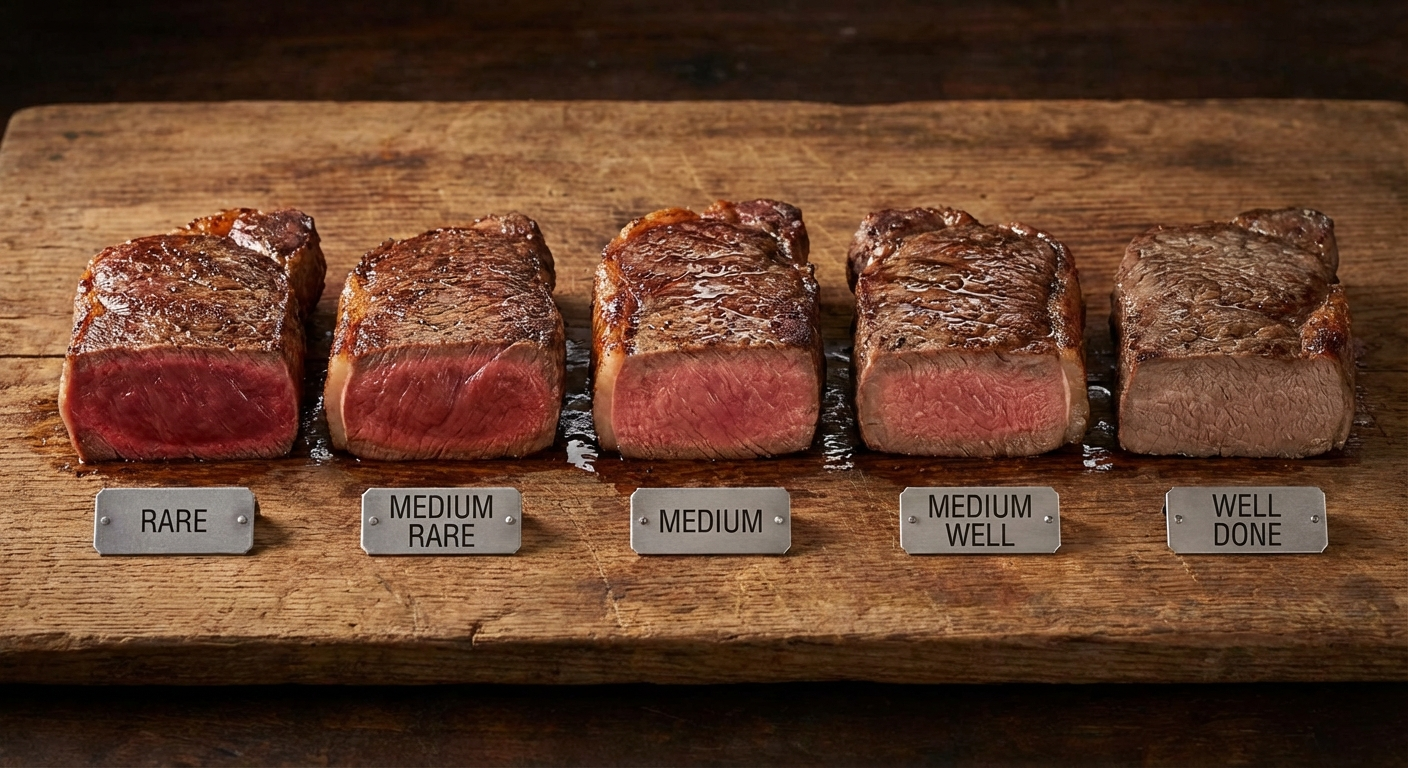
Steak Doneness Temperature Guide: The Science of Every Level from Rare to Well Done
Steak doneness is not a matter of opinion. It is a matter of protein chemistry. Every level — from rare to well done — corresponds to a specific internal temperature range that triggers predictable changes in the meat's proteins, fats, and moisture content. Understanding these changes means you never have to guess again.
This guide covers the exact temperatures for each doneness level, the science behind why each one looks, feels, and tastes different, and the practical adjustments (including carryover cooking) that ensure you hit your target every time.
Why Temperature Is the Only Reliable Doneness Indicator
Before diving into specific temperatures, it is worth understanding why a thermometer is the only tool that works consistently. The common alternatives — the hand test, touch test, visual inspection, and timing charts — all fail because they cannot account for the variables that actually determine doneness:
- Starting temperature — a steak straight from the refrigerator at 38°F cooks differently than one tempered to 65°F
- Thickness variation — even steaks sold as "1 inch" vary by a quarter inch or more, which changes cooking time dramatically
- Fat content and marbling — intramuscular fat insulates the meat and slows heat penetration
- Bone presence — bone conducts heat differently than muscle tissue
- Grill temperature fluctuations — charcoal beds cool over time, gas burners cycle, and wind affects everything
An instant-read thermometer bypasses all of these variables. It measures the one thing that actually determines doneness: the internal temperature of the meat at its geometric center.
The Protein Science Behind Doneness
What happens inside a steak as temperature rises is a sequence of protein denaturation events — each protein unfolds and restructures at a specific temperature threshold. These events determine the color, texture, and juiciness of the finished steak.
Myosin Denaturation: 104–122°F (40–50°C)
Myosin is the primary contractile protein in muscle fibers. As internal temperature crosses 104°F, myosin begins to denature — its molecular structure unfolds and the protein coagulates. This is the transition that turns raw meat from soft and slippery to firm and opaque.
Between 104°F and 122°F, myosin denaturation is partial. The meat firms slightly but retains its deep red color because myoglobin — the pigment protein — has not yet denatured. This is the rare zone: structurally changed enough to eat safely (for whole-muscle cuts), but still dominated by the texture of minimally cooked protein.
Collagen Contraction: 140–160°F (60–71°C)
Collagen, the connective tissue protein that forms sheaths around muscle fibers and bundles, begins to contract significantly above 140°F. This contraction squeezes moisture out of the muscle fibers — the primary mechanism of moisture loss in cooked steak. The more collagen contracts, the more juice is expelled.
This is why the difference between medium and well done is so dramatic in terms of juiciness. The jump from 145°F to 160°F crosses a collagen contraction threshold that forces out a disproportionate amount of liquid.
Myoglobin Denaturation: 140–170°F (60–77°C)
Myoglobin is responsible for the color of meat. In its native state, it appears purplish-red (in vacuum-packed meat) or bright red (when exposed to oxygen as oxymyoglobin). As temperature rises:
- Below 140°F — myoglobin remains largely intact, producing a red or pink interior
- 140–150°F — partial denaturation creates a pink color
- 150–160°F — most myoglobin has denatured, producing a tan or gray-brown color
- Above 160°F — complete denaturation, fully gray-brown throughout
This is why color correlates with doneness — but imperfectly. Factors like pH, the presence of nitrites (from dry brining with certain salts), and whether meat was previously frozen can all shift the temperature at which myoglobin denatures. Temperature remains more reliable than color.
The Complete Steak Doneness Temperature Chart
The temperatures below represent the final resting temperature — the temperature you want the steak to reach after carryover cooking. Pull temperatures (when to remove from heat) are listed separately because carryover varies by cooking method and steak thickness.
Blue Rare: 115°F (46°C)
Blue rare steak has a seared exterior with an interior that is barely warmed above body temperature. The center is deep purple-red, cool to the touch, and has the soft, almost gelatinous texture of raw meat with only the outermost layer showing signs of myosin denaturation.
Pull temperature: 110°F for thick steaks off a hot grill (5°F carryover). For reverse sear, pull at 105°F from the oven, then sear — the sear adds approximately 5–10°F.
Best cuts: High-quality tenderloin (filet mignon), high-grade wagyu ribeye. Blue rare only works with cuts that are naturally tender — without significant collagen content that requires higher temperatures to become palatable.
Rare: 120–125°F (49–52°C)
A rare steak has a cool-to-warm red center with a thin band of pink transitioning to the seared exterior. Myosin denaturation is underway but incomplete — the meat is soft and yields easily to pressure. The texture is notably juicy because collagen has barely begun to contract, so almost no moisture has been mechanically expelled.
Pull temperature: 115–118°F for direct grilling (carryover of 5–7°F on a thick steak). For reverse sear, pull from the oven at 110–113°F before the final sear.
Moisture loss: Approximately 15–18% of starting weight, almost entirely from surface evaporation during searing rather than internal moisture expulsion.
Medium Rare: 130–135°F (54–57°C)
Medium rare is the most widely recommended doneness for premium steaks, and for good reason rooted in protein chemistry. At this temperature range:
- Myosin is substantially denatured — the meat has a satisfying firmness and chew
- Myoglobin is still largely intact — the center is warm and red-pink
- Collagen contraction is minimal — moisture loss is moderate (18–22%)
- Intramuscular fat has begun to soften and render — enhancing juiciness and flavor
This is the sweet spot where the meat has developed texture and flavor from cooking but has not yet crossed the thresholds that cause significant moisture loss or color change.
Pull temperature: 125–128°F for direct high-heat grilling. For reverse sear, pull from oven at 120–123°F before the finishing sear. For sous vide, set the water bath to 131°F for a consistent edge-to-edge medium rare.
Medium: 140–145°F (60–63°C)
At medium, the steak transitions from red to pink throughout the center. Myoglobin denaturation is accelerating rapidly in this range, and the color shifts from the warm red of medium rare to a definitive pink. Collagen contraction increases noticeably — moisture loss climbs to 22–27%.
The texture is firmer, with more resistance to the bite. Fat rendering is more complete, which can actually make well-marbled cuts like ribeye taste richer at medium than at rare — the fat has had time to melt and distribute flavor through the meat.
Pull temperature: 133–138°F for direct grilling. The higher internal temperature means more thermal energy stored in the steak, so carryover is typically 5–8°F.
Note on ribeye: Many experienced grillmasters prefer ribeye at medium rather than medium rare specifically because of fat rendering. The generous intramuscular fat in a ribeye needs temperatures above 130°F to fully soften. A medium rare ribeye can have pockets of firm, unrendered fat that detract from the eating experience.
Medium Well: 150–155°F (66–68°C)
Medium well marks the transition past the critical collagen contraction threshold. The center shows only a slight hint of pink — more blush than color — and the texture is notably firm. Moisture loss accelerates sharply in this range (27–33%) as collagen squeezes the muscle fibers.
Pull temperature: 143–148°F for direct grilling.
The key science here is nonlinear moisture loss. Between 140°F and 155°F, collagen contraction follows a steep curve. A steak at 140°F retains significantly more moisture than one at 155°F — the 15-degree difference has a much larger impact on juiciness than the same 15-degree difference between 125°F and 140°F.
Well Done: 160°F+ (71°C+)
At 160°F and above, myoglobin denaturation is complete — the interior is uniformly gray-brown with no pink. Collagen has contracted fully in its initial phase, and moisture loss reaches 33–40% or more. The texture is firm to stiff, and the dominant flavor shifts from the juicy, iron-rich taste of myoglobin to the Maillard-driven flavors of the seared exterior.
Pull temperature: 153–155°F for direct grilling. Despite the high target, avoid pulling above 155°F — carryover will bring it to well done, and overshooting past 165°F pushes moisture loss above 40%.
If cooking well done by request, consider methods that minimize moisture loss: lower cooking temperatures (indirect heat or reverse sear) reach 160°F more gently than direct high heat. Brining or marinating beforehand can also offset some moisture loss by increasing the meat's starting water content.
Carryover Cooking: The Pull Temperature Adjustment
Carryover cooking is the continued rise in internal temperature after the steak is removed from the heat source. It occurs because the steak's exterior is significantly hotter than its center — thermal energy continues flowing inward even after the external heat source is removed.
The amount of carryover depends on several factors:
- Steak thickness — thicker steaks store more thermal energy in the outer layers, producing greater carryover (up to 10–15°F for a 2-inch steak from a hot grill)
- Cooking method heat intensity — a steak pulled from a 700°F grill has a larger thermal gradient (and more carryover) than one pulled from a 225°F smoker
- Resting method — resting on a warm plate retains more heat than resting on a cool wire rack
For a detailed breakdown, see our carryover cooking temperature chart. As a general rule:
- Hot and fast grilling: subtract 5–8°F from your target for pull temperature
- Reverse sear (oven phase): subtract 10–15°F (the final sear adds significant energy)
- Sous vide: zero carryover from the water bath (but add 3–5°F if finishing with a sear)
Thermometer Technique: Where and How to Measure
The accuracy of your temperature reading depends entirely on probe placement. The goal is to measure the thermal center — the coldest point in the steak, which is always the last to reach target temperature.
Probe Placement
Insert the thermometer probe into the thickest part of the steak, approaching from the side rather than the top. The probe tip should reach the geometric center of the steak's cross-section. For bone-in cuts, keep the probe away from the bone — bone conducts heat faster than muscle and will give a falsely high reading.
For uneven-thickness steaks (like a T-bone with tenderloin and strip sections), measure the thickest portion — the thin section will be at a higher doneness than the thick section regardless of technique.
Thermometer Types
- Instant-read thermocouple (Thermapen, etc.) — fastest response time (1–2 seconds), most accurate, ideal for spot-checking during cooking
- Leave-in probe thermometer — inserted before cooking and monitored remotely, eliminates the need to open the grill lid, ideal for indirect cooking and reverse sear
- Infrared thermometer — measures surface temperature only, useful for checking grill grate temperature but cannot measure internal doneness
How Cooking Method Affects Doneness Consistency
The same target temperature produces different eating experiences depending on how you reached it. This is because cooking method determines the doneness gradient — the variation in temperature from edge to center.
Direct High-Heat Grilling
A steak cooked entirely over direct high heat develops a steep thermal gradient. The outer quarter-inch may be well done (160°F+), transitioning through medium and medium rare to reach a rare center. The result is a narrow band of perfectly cooked meat at your target doneness, with significant overcooked edges.
Reverse Sear
The reverse sear method produces the most even doneness from edge to edge. By first bringing the steak to target temperature in a low oven (225–275°F) or the indirect zone of a grill, the gentle heat creates a shallow thermal gradient. The center and the edges are within a few degrees of each other. The final high-heat sear adds crust without significantly deepening the overcooked layer.
Sous Vide
Sous vide achieves mathematically perfect edge-to-edge doneness because the water bath temperature equals the target internal temperature. Given enough time, every point in the steak equilibrates to the same temperature. The result is uniform color and texture throughout — a 131°F sous vide steak is medium rare from edge to edge, with zero gradient. A brief post-sear adds the essential crust.
Common Doneness Mistakes and the Science Behind Them
Mistake: Cutting to Check Doneness
Slicing into a steak to check the color releases juices and creates an unsightly gash that continues to leak during service. More importantly, the color you see immediately after cutting is unreliable — myoglobin reacts with oxygen on the newly exposed surface, and the color shifts within seconds. A thermometer is faster, more accurate, and does not damage the steak.
Mistake: Using Time as a Proxy
Cooking charts that specify "4 minutes per side for medium rare" fail because they cannot account for steak thickness, starting temperature, grill temperature, altitude (which affects boiling points and atmospheric pressure), or even the moisture content of the specific cut. Time is a rough guide at best. Temperature is the only endpoint that works.
Mistake: Not Resting
Skipping the rest means two problems. First, you miss the carryover cooking — your steak may be underdone at the center. Second, the steep thermal gradient means that juices are concentrated in the center (driven inward by the contracting collagen on the exterior). Resting allows the thermal gradient to equalize and the collagen to relax slightly, redistributing moisture more evenly. Five minutes is the minimum for a standard steak; thick cuts benefit from 8–10 minutes.
Mistake: Ignoring Cut-Specific Preferences
Not all cuts taste best at the same doneness. Fat content, collagen content, and fiber structure all influence the ideal target:
- Tenderloin (filet mignon): Best at rare to medium rare (120–135°F). Low fat content means there is no benefit from higher temperatures for fat rendering, and the delicate texture is lost above medium.
- Ribeye: Often best at medium rare to medium (130–145°F). The generous marbling needs heat to render fully and coat the muscle fibers.
- Strip (New York strip): Medium rare (130–135°F) is the sweet spot. Moderate fat content renders well at this range, and the firmer texture benefits from not being overcooked.
- Flat iron: Medium rare to medium (130–140°F). The central connective tissue seam softens more at slightly higher temperatures.
- Skirt and flank steak: Medium rare (130–135°F) maximum — these thin, heavily grained cuts become tough quickly above medium. Slice against the grain after resting.
Frequently Asked Questions
Frequently Asked Questions
What is the best internal temperature for a medium rare steak?
The ideal final internal temperature for medium rare steak is 130–135°F (54–57°C). Pull the steak from heat at 125–128°F to account for carryover cooking. At this range, myosin is denatured for satisfying texture, intramuscular fat has begun rendering, and myoglobin is still intact for a warm red-pink center.
How much does steak temperature rise after removing from the grill?
Carryover cooking typically raises internal temperature by 5–8°F for steaks cooked over direct high heat, and 10–15°F for thick steaks pulled from a reverse sear oven before a finishing sear. The exact amount depends on steak thickness, cooking temperature, and resting method.
Is the hand touch test accurate for steak doneness?
The hand touch test is unreliable because it cannot account for steak thickness, starting temperature, fat content, or cooking method variations. An instant-read thermometer provides accurate, repeatable results regardless of these variables. The touch test may work as a rough approximation for experienced cooks with consistent cuts, but it is not a substitute for actual temperature measurement.
What temperature should I pull steak off the grill for medium?
For a medium steak (final target 140–145°F), pull from direct high heat at 133–138°F. The stored thermal energy in the outer layers will continue heating the center by approximately 5–8°F during a 5-minute rest. For reverse sear, pull from the oven at 125–130°F before the finishing sear.
Why does my steak look pink even though I cooked it to well done temperature?
Persistent pinkness in well-done steak can be caused by several factors unrelated to doneness: high pH meat (from certain breeds or stress at slaughter), the presence of nitrites or nitrates (from some salts or curing agents), or carbon monoxide exposure during packaging. If your thermometer confirmed 160°F+ at the center, the steak is fully cooked regardless of residual color.
What is the minimum safe temperature for steak?
For whole-muscle cuts like steak, the USDA recommends 145°F with a 3-minute rest. However, harmful bacteria exist only on the surface of intact steaks — they cannot penetrate whole muscle. A proper sear kills surface bacteria, which is why rare and medium rare steaks (120–135°F internal) are considered safe by food scientists when the exterior has been adequately seared. Ground beef is different — bacteria are distributed throughout and should reach 160°F.
More Expert Guides
Direct vs Indirect Heat Grilling: The Science of Two-Zone Cooking
Direct heat sears. Indirect heat roasts. Understanding the physics of each — and when to combine them — is the foundation of every great grilling technique.
14 min readResting Meat After Cooking: The Science of Why It Makes Every Steak Juicier
Resting meat after cooking is not optional — it is physics. Here is exactly what happens inside the steak during those crucial minutes and how long to rest every cut.
14 min readGrill vs Cast Iron for Steak: The Science of Which Method Wins
The grill vs cast iron debate has divided steak lovers for years. The answer depends on physics — specifically, how each method transfers heat and what that means for your crust and interior.