Steak Doneness Temperatures: The Definitive Reference
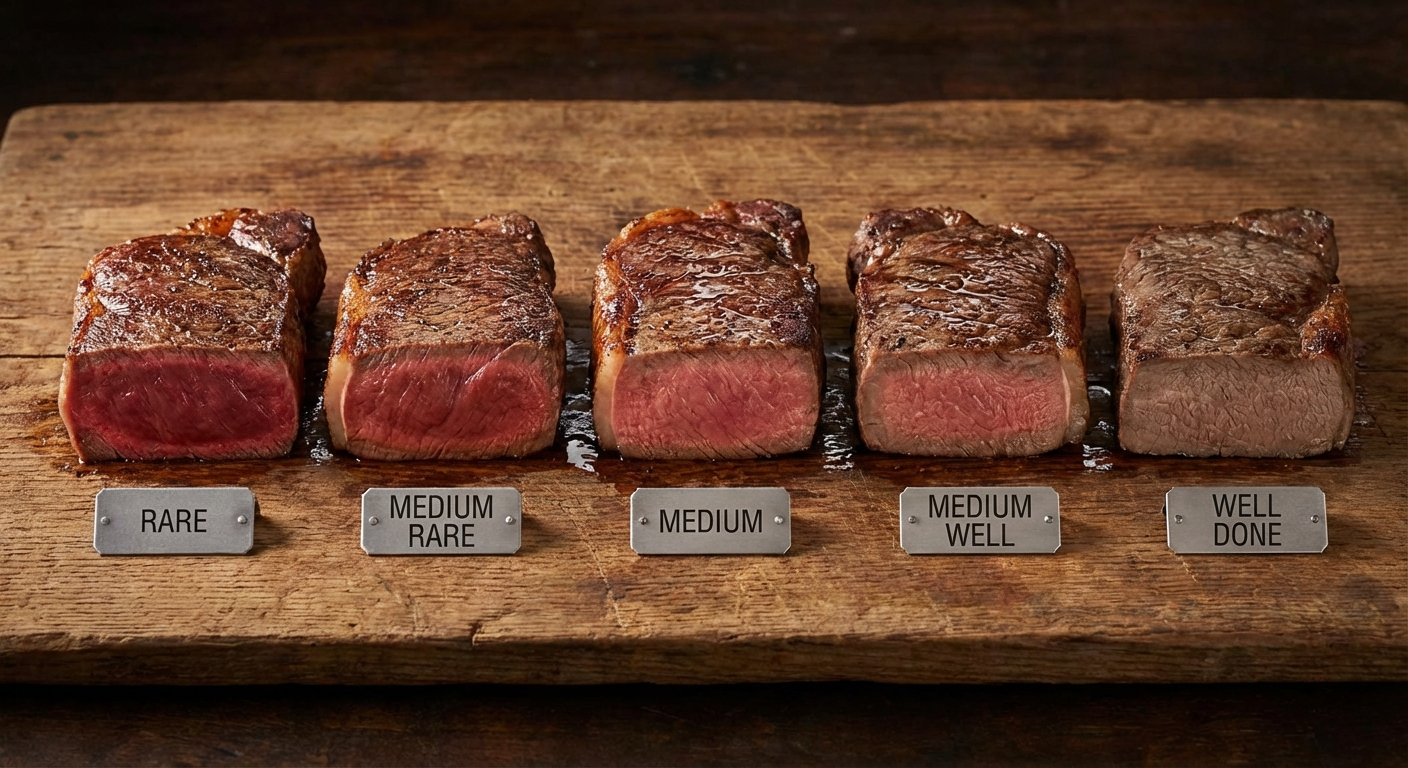
If I could change one thing about how people cook steak, it would be this: stop thinking about doneness as a category and start thinking about it as a temperature. "Medium-rare" is not one fixed state — it's a range of temperatures, each producing a slightly different texture, juiciness, and color. When you understand what's happening at the molecular level at each degree, you gain precise control over your results.
I've spent over a decade measuring these temperatures in controlled lab settings. The numbers I'm sharing here aren't approximations from a cookbook — they're derived from research on myoglobin denaturation, collagen behavior, and moisture retention across hundreds of samples.
The Complete Doneness Temperature Chart
| Doneness | Final Temp (center) | Pull Temp (before rest) | Visual | Texture |
|---|---|---|---|---|
| Blue/Very Rare | 115–120°F | 110–115°F | Cool, deep red/purple | Very soft, almost raw feel |
| Rare | 120–125°F | 115–120°F | Cool red center | Soft, slight resistance |
| Medium-Rare | 129–134°F | 123–128°F | Warm red to pink-red | Tender, yielding, juicy |
| Medium | 138–145°F | 132–139°F | Warm pink center | Firmer, still juicy |
| Medium-Well | 148–155°F | 142–149°F | Slight pink, mostly gray | Firm, less juice |
| Well Done | 160°F+ | 154°F+ | Gray-brown throughout | Dry, very firm |
A note on these numbers: the "pull temp" assumes 5–7°F of carryover cooking during rest. If you're using the reverse sear method with a hot sear phase, account for the sear adding 10–15°F and adjust your pull temp from the oven accordingly.
What Happens Inside the Steak at Each Temperature
100–120°F: Myoglobin Begins to Shift
Myoglobin is the protein that gives raw meat its red-purple color. At room temperature, myoglobin holds onto iron and oxygen in a configuration that appears deep red. As temperature rises past 100°F, the protein begins to denature — its three-dimensional structure unfolds slightly, altering how it interacts with light. The color shifts from purple-red to brighter red.
At this stage, very little structural change has occurred in the muscle fibers. The steak feels raw — because structurally, it mostly is. Fans of blue-rare steak eat at this temperature range. The texture is extremely soft, almost gelatinous.
120–130°F: The Sweet Spot Begins
Between 120°F and 130°F, the muscle protein myosin begins to denature and coagulate. Myosin is the motor protein responsible for muscle contraction, and when it coagulates, the texture shifts from raw-soft to tender-firm. This is the "just right" zone — enough protein structure change to feel like cooked meat, but not so much that moisture gets squeezed out.
At 131°F — the temperature I consider the center of the medium-rare sweet spot — about 50% of the myosin has denatured. The meat is warm, the color is a vibrant pink-red, and the texture is tender with a clean, yielding bite. Moisture retention at this temperature is near maximum for cooked steak.
Research published in Meat Science (Tornberg, 2005) showed that cooking losses (moisture expelled from the protein matrix) are minimal below 131°F — roughly 15–18% of starting weight. Above 140°F, those losses increase rapidly.
135–145°F: Medium Territory
At 140°F, a second major protein — actin — begins to denature. Actin denaturation is the turning point. Once actin coagulates, the muscle fibers contract significantly, squeezing out moisture like wringing a sponge. Cooking losses jump from 18% to 25–30% in this range.
The color shifts from red-pink to pink to pale pink as myoglobin continues denaturing. The texture becomes noticeably firmer. A steak at 142°F still has good flavor (fat rendering is excellent at this temp), but the juiciness is measurably reduced compared to 131°F.
150–160°F: The Squeeze Zone
Collagen begins to denature and contract around 150°F. In cuts with significant connective tissue (like brisket or chuck), this contraction is desirable because continued cooking converts collagen to gelatin. In a steak — which has relatively little collagen — it means the last remaining structural proteins are tightening, expelling even more moisture.
Cooking losses at 155°F approach 30–35%. The color is gray-brown with perhaps a trace of pink. The steak will be firm and dry by comparison to lower temperatures.
160°F+: Well Done
At 160°F, virtually all myoglobin has denatured (the meat is gray-brown throughout), actin contraction is essentially complete, and moisture losses exceed 35%. This is the USDA's recommended minimum internal temperature for ground beef — a safety target for meat that may have surface bacteria mixed throughout. For whole-muscle steaks where bacteria exist only on the surface (killed during searing), 160°F is unnecessary from a safety perspective.
Why "Medium-Rare" Isn't One Temperature
Medium-rare spans roughly 129–134°F, and there's a real difference between the low and high ends. At 129°F, the center is redder, softer, and more reminiscent of rare. At 134°F, you're approaching the upper boundary — pinker, slightly firmer, closer to medium. I find 131°F to be the ideal center point, but your preference matters more than my data.
Restaurant kitchens typically target 130–132°F for medium-rare orders. If you've ever had a steakhouse steak that seemed perfect, chances are the center read somewhere in that range. For best results, start with quality beef — Japanese A5 wagyu or USDA Prime makes a noticeable difference at these precise temperatures.
The USDA Safety Question
The USDA recommends cooking all beef steaks to a minimum of 145°F with a 3-minute rest. This is a food safety guideline, not a quality recommendation. For whole-muscle cuts (steaks), harmful bacteria like E. coli and Salmonella exist only on the exterior surface — and a proper sear kills them at temperatures well above 300°F.
The 145°F guideline makes sense for immunocompromised individuals, pregnant women, young children, and elderly adults. For healthy adults eating whole-muscle steaks with properly seared surfaces, the risk at 131°F is extremely low. I eat my steaks at 131°F. I feed them to my family at 131°F. But make your own informed decision.
How to Measure Temperature Accurately
Probe Placement
Insert the thermometer probe into the geometric center of the thickest part of the steak. Not the top, not near a bone, not at the edge. The geometric center is the coldest point — it's the temperature that defines your doneness.
For bone-in steaks, the bone conducts heat differently than meat. Insert the probe from the side, away from the bone, into the center of the thickest meat section. The bone side will typically be 5–8°F warmer than the center of the meat.
Instant-Read vs. Leave-In Probes
I recommend both. Use a leave-in probe (like ThermoWorks Smoke) during the reverse sear oven phase to monitor without opening the door. Use an instant-read (ThermoWorks Thermapen) for final verification after the sear and rest. The two together give you complete temperature awareness throughout the cook.
Account for Thermal Lag
When you insert a probe into a hot steak, the reading continues climbing for several seconds before stabilizing. Wait for the number to settle — usually 3–5 seconds with a fast-response thermometer, up to 15 seconds with a cheap one. A Thermapen stabilizes in under 2 seconds, which is one reason professionals prefer it.
Frequently Asked Questions
What is the exact temperature for medium-rare steak?
Medium-rare spans 129–134°F at the geometric center. The sweet spot is 131°F — at this temperature, about 50% of myosin has denatured, giving tender texture with maximum juiciness. Restaurant kitchens typically target 130–132°F.
Why does the USDA recommend 145°F for steak?
The 145°F recommendation is a food safety guideline with a built-in safety margin. For whole-muscle cuts like steak, bacteria exist only on the exterior surface and are killed during searing at 300°F+. The interior of an intact steak is essentially sterile. The 145°F target is important for immunocompromised individuals but is not a quality recommendation.
How much does temperature rise during resting?
For a conventionally cooked steak, carryover cooking raises the internal temperature 5–10°F during rest. For a reverse-seared steak (where the temperature is more uniform), carryover is smaller — typically 3–5°F. Thicker steaks and higher-heat cooking methods produce more carryover.
At what temperature does steak become dry?
Moisture loss increases sharply above 140°F when the protein actin begins denaturing and contracting. Below 131°F, cooking losses are typically 15–18% of starting weight. At 155°F, losses approach 30–35%. The 140°F mark is where most people notice a significant drop in perceived juiciness.
Is the finger-poke test for doneness accurate?
No. The finger-poke test (comparing steak firmness to the fleshy part of your palm) is unreliable because steak firmness varies with cut, thickness, marbling grade, aging method, and starting temperature. A thermometer removes all guesswork. Professional kitchens use thermometers — the finger test is a parlor trick, not a measurement tool.
More Expert Guides
Grill Vent Management: The Science of Airflow and Temperature Control
Oxygen controls fire. Fire controls temperature. Vents control oxygen. Master your vents and you master your grill.
12 min readHow Often to Flip Steak: The Science of Multiple Flips vs Single Flip
The traditional advice to flip your steak only once is wrong. Science shows that flipping every 30 seconds produces better crust, more even doneness, and 30% faster cooking through improved heat transfer.
12 min readThe Science of Plancha Grilling: How High Heat and Flat Surfaces Create Superior Crust
Plancha grilling delivers more surface contact, higher heat, and better crust than traditional grates. Here is the science behind why flat-top cooking produces superior results.