The Texas Crutch: Why Wrapping Brisket in Foil or Butcher Paper Works
The Texas Crutch: Why Wrapping Brisket in Foil or Butcher Paper Works
Your brisket has been in the smoker for six hours. The bark looks perfect — deep mahogany, almost black at the edges. But the internal temperature has been stuck at 155°F for the last ninety minutes and shows no sign of moving.
You have three options. Wait it out (potentially adding 3–5 more hours to your cook). Crank the heat (and risk drying out the exterior). Or wrap the brisket and push through the stall in half the time.
That third option is the Texas Crutch — and understanding the thermodynamics behind it will make you a better pitmaster whether you choose to wrap or not.
What Is the Texas Crutch?
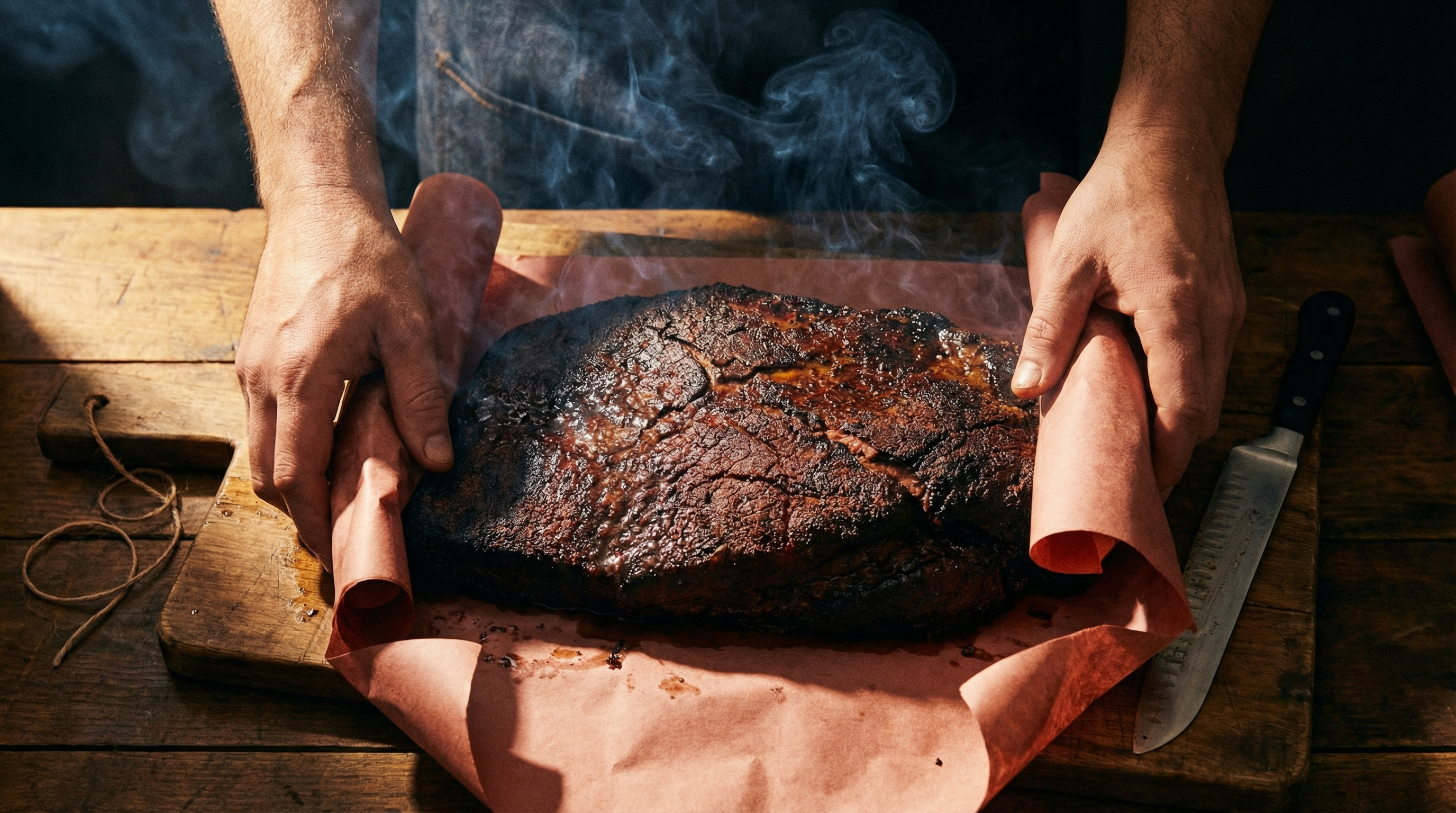
The Texas Crutch is the practice of wrapping a large cut of meat — typically brisket, pork butt, or beef ribs — in aluminum foil or butcher paper partway through a low-and-slow smoke. The wrap is applied during the stall, the temperature plateau that occurs between 150°F and 170°F when evaporative cooling on the meat's surface matches the heat input from the smoker.
The name carries a hint of derision. In traditional Texas BBQ culture, "real" pitmasters cook unwrapped, managing time and fire until the brisket breaks through the stall on its own. The wrap was seen as a shortcut — a crutch. But competitive BBQ changed the math. When cook windows are tight and judges reward tenderness, wrapping became standard practice. Today, most championship briskets are wrapped in butcher paper.
The technique works because wrapping fundamentally changes the heat transfer dynamics on the meat's surface. To understand why, you need to understand the stall itself.
The Physics of the Stall
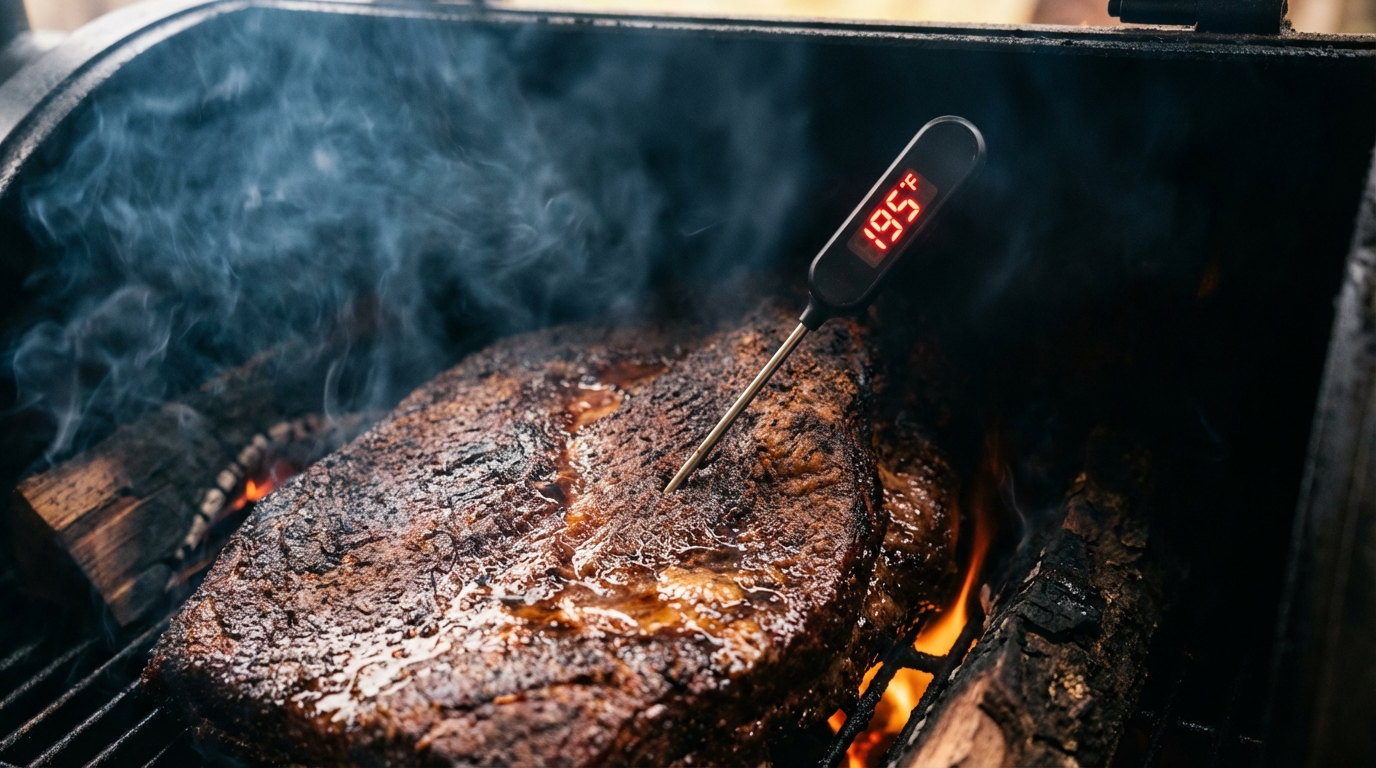
When meat cooks in a smoker, moisture from inside the muscle migrates to the surface and evaporates. This evaporation absorbs energy — the same principle that makes sweat cool your skin. At low smoker temperatures (225–275°F), the rate of evaporative cooling eventually equals the rate of heat absorption. The internal temperature flatlines.
Dr. Greg Blonder at genuineideas.com demonstrated this conclusively with controlled experiments. He showed that a wet clay ball exhibits the exact same stall behavior as a brisket — proving that the stall is purely a function of evaporative cooling, not collagen breakdown or any other meat-specific process.
The stall ends naturally when the surface dries out enough that evaporation can no longer keep pace with heat input. But this can take 2–6 hours on a large brisket, depending on humidity, airflow, and surface area.
Wrapping short-circuits this process by eliminating or drastically reducing evaporation.
How Foil Wrapping Works
Aluminum foil is a near-perfect vapor barrier. When you wrap a brisket tightly in two layers of heavy-duty foil, you create a sealed environment where:
- Evaporation stops almost completely. Moisture that reaches the surface has nowhere to go. It condenses on the inside of the foil and returns to the meat as liquid. With no evaporative cooling, the internal temperature begins climbing again immediately.
- The meat braises in its own juices. Rendered fat and meat juices pool at the bottom of the foil packet. The brisket is now partially submerged in hot liquid, adding conductive heat transfer to the equation.
- Thermal efficiency increases dramatically. The foil reflects radiant heat back toward the meat and eliminates convective heat loss from the surface. Every BTU from the smoker goes into raising the meat's temperature.
The result: internal temperature starts climbing at roughly 1°F per 3–5 minutes instead of being stalled. A brisket wrapped in foil at 165°F can reach 203°F (the typical probe-tender target) in 2–3 hours. Unwrapped, the same brisket might take 5–7 hours from the same starting point.
The Trade-Off: Bark
Foil wrapping produces exceptionally tender brisket. But the bark — that prized, crunchy, smoke-flavored crust — takes a hit. Inside the foil, the bark sits in a hot, humid environment. Moisture softens the Maillard reaction products and dissolved bark compounds. When you unwrap a foil-wrapped brisket, the bark is often soft, sometimes almost paste-like.
Some pitmasters unwrap the brisket for the last 30–60 minutes to re-firm the bark. This helps, but the bark will never match an unwrapped cook. The texture difference is fundamental — the bark's structure has already been partially dissolved by steam and liquid.
How Butcher Paper Wrapping Works
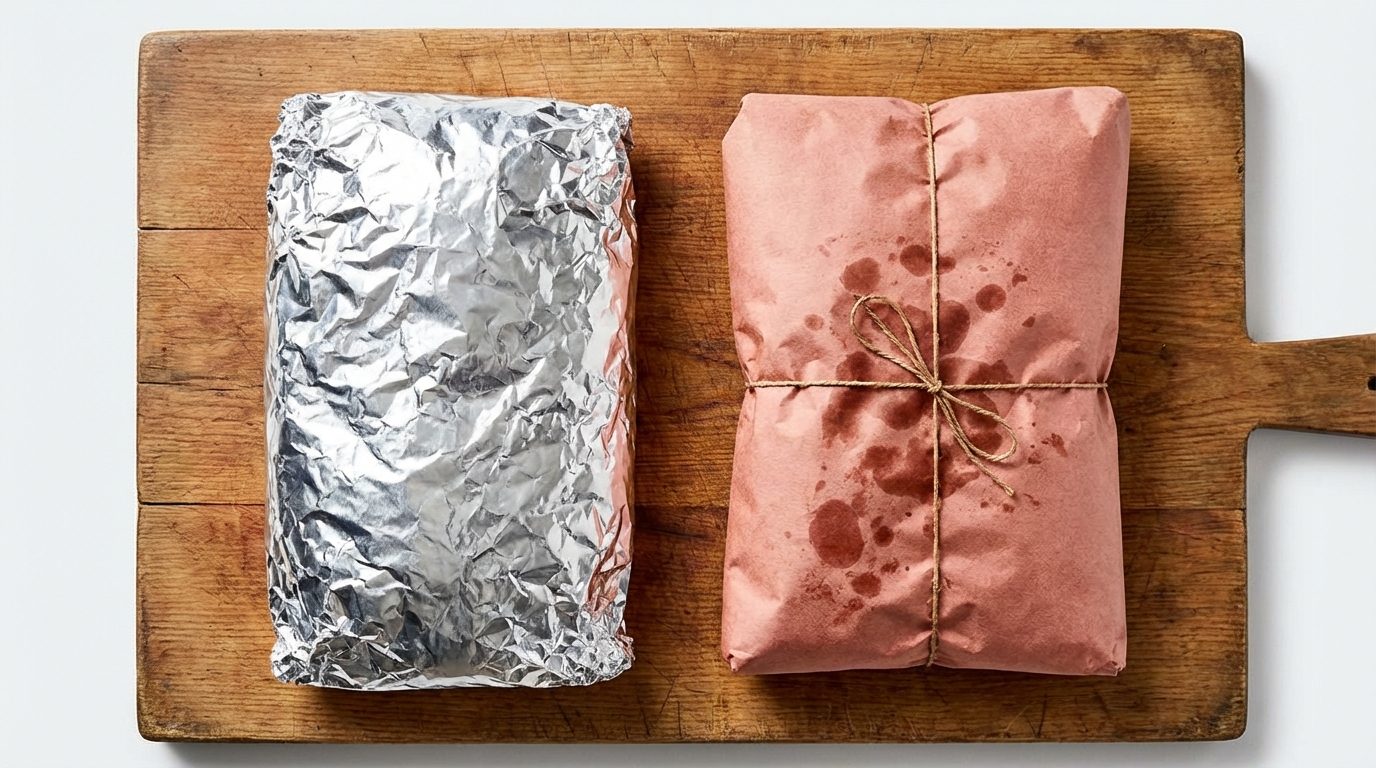
Pink (peach) butcher paper — specifically unwaxed, uncoated kraft paper — is semi-permeable. It allows some water vapor to pass through while still trapping a significant amount of heat and moisture. This gives it a unique position between fully wrapped and fully unwrapped cooking.
When you wrap in butcher paper:
- Evaporation is reduced but not eliminated. Some moisture passes through the paper, so evaporative cooling continues at a lower rate. The stall shortens but doesn't vanish entirely. Expect the brisket to still plateau briefly, but at a higher temperature and for a shorter duration.
- The bark stays drier. Because vapor can escape, the bark surface never fully saturates. The Maillard compounds remain intact. When you unwrap, the bark is firm, tacky, and crunchy — close to what an unwrapped cook produces.
- Smoke penetration stops. The paper blocks smoke particles from reaching the meat, just like foil does. However, by the time most pitmasters wrap (165°F+), the meat has already absorbed the majority of its smoke flavor. The smoke ring — caused by nitric oxide reacting with myoglobin — is fully set by 140°F.
- Rendered fat is absorbed by the paper. Unlike foil, butcher paper wicks away some of the rendered fat. The brisket doesn't braise. This produces a cleaner, more focused beef flavor compared to foil's richer, more pot-roast-like profile.
The result: cook time is reduced by 1–3 hours (less than foil), but bark quality is vastly superior. This is why butcher paper became the default choice in competition BBQ, where bark appearance and texture are judged alongside tenderness and flavor.
When to Wrap: Temperature vs Visual Cues
The most common advice is to wrap at an internal temperature of 165°F. This is a reasonable starting point, but temperature alone is not the best indicator. Here is what actually matters:
- Bark color and set. The bark should be deep mahogany to dark brown. It should feel firm and dry to the touch — a light press with a gloved finger should not leave an indent or feel tacky. If the bark is still light brown and soft, the Maillard reaction hasn't finished. Wrapping too early locks in an underdeveloped bark that cannot improve further.
- Temperature plateau duration. Wait until the stall has been in effect for at least 30 minutes. If the temperature is still climbing steadily at 165°F, there is no stall to push through and wrapping provides minimal benefit while reducing bark quality.
- Surface moisture. Look at the brisket surface. During the stall, it will appear wet and glistening as moisture evaporates actively. The best time to wrap is when the surface starts to look matte and dry — this indicates the evaporative cooling rate is already declining, and wrapping will accelerate the endpoint.
For most full-packer briskets (12–18 lbs) smoked at 225–250°F, the wrap point falls between 155°F and 170°F internal temperature, typically 5–7 hours into the cook.
The Unwrapped Option: Naked Brisket
Some pitmasters never wrap. The argument is straightforward: wrapping is a compromise. Unwrapped brisket develops the best bark, absorbs smoke for the longest period, and produces the most authentic flavor profile. The only cost is time.
An unwrapped brisket at 225°F may take 14–18 hours from start to probe-tender. At 275°F, the stall shortens significantly (higher heat input overcomes evaporative cooling faster), and total cook time drops to 10–14 hours. Running a "hot and fast" cook at 300°F+ can deliver excellent unwrapped brisket in 8–10 hours, though the margin for error shrinks considerably.
The science supports both approaches. Wrapping trades bark quality and cook time against each other. Unwrapped cooking maximizes bark but demands patience, fuel, and consistent fire management over a longer window. Neither is objectively superior — it depends on your priorities, your timeline, and your equipment.
Foil vs Butcher Paper vs Unwrapped: Side-by-Side
Here is how the three approaches compare on the metrics that matter:
- Cook time (14 lb brisket at 250°F): Foil wrap — 10–12 hours total. Butcher paper — 12–14 hours. Unwrapped — 14–18 hours.
- Bark quality: Foil — soft, often mushy. Butcher paper — firm, tacky, crunchy. Unwrapped — crunchiest, darkest, most developed.
- Tenderness: Foil — most tender, almost braised texture. Butcher paper — tender with more structure. Unwrapped — least tender unless cook time is extended.
- Moisture retention: Foil — highest (sealed environment). Butcher paper — moderate (some vapor escapes). Unwrapped — lowest (full evaporation).
- Smoke flavor: All three are similar if wrapped at 165°F+. Smoke absorption is minimal after the wrap point regardless of method.
- Juiciness at slicing: Foil — very juicy, can be overly wet. Butcher paper — juicy with clean mouthfeel. Unwrapped — drier if overcooked, excellent if pulled at the right time.
Common Mistakes When Using the Texas Crutch
Wrapping seems simple — fold meat in paper, put it back in the smoker. But several common errors produce mediocre results:
- Wrapping too early. This is the most frequent mistake. If you wrap before the bark has fully set, you lock in a soft, pale exterior that never develops proper Maillard flavors. Wait until the bark passes the touch test.
- Using waxed or coated butcher paper. Only unwaxed, uncoated pink kraft paper works correctly. Waxed paper melts at smoker temperatures. Parchment paper is heat-safe but does not breathe the same way. White butcher paper often has a polyethylene coating that blocks vapor transfer. Look for "peach paper" or "pink butcher paper" specifically rated for smoking.
- Wrapping too loosely. Air gaps between the meat and the wrap reduce the effectiveness of the technique. The wrap should be snug — not crushing the bark, but making full contact with the meat surface. Two overlapping sheets of butcher paper, folded tightly at the seams, work best.
- Opening the wrap to check temperature. Every time you unwrap to probe, you release trapped heat and moisture. Use a leave-in thermometer probe threaded through the wrap before sealing. If you must probe manually, be quick and re-seal immediately.
- Not resting after the cook. Wrapped brisket should rest — still in its wrap — for at least 1 hour, ideally 2–4 hours in a cooler (no ice) or a holding oven at 150°F. Resting allows the collagen-gelatin matrix to firm up and juices to redistribute. Cutting immediately after cooking releases moisture that would otherwise stay in the meat.
The Science of Rest After Wrapping
Resting is not optional — it is the final phase of cooking. When you pull a wrapped brisket at 203°F, the thermal gradient between the exterior (which may be 210°F+) and the deep center creates internal heat flow. Carryover cooking continues for 20–30 minutes.
But the real benefit of resting is not temperature. It is gelatin behavior. During the cook, collagen in the connective tissue converts to gelatin starting around 160°F. This gelatin is liquid while hot. As the brisket rests and the internal temperature drops to 145–155°F, the gelatin begins to set — transitioning from liquid to a soft, jiggly solid. This gelled collagen is what gives properly rested brisket its characteristic moist, tender texture that holds together when sliced.
If you slice at 203°F, the gelatin is liquid. It runs out as juice, leaving the meat drier and less cohesive. Resting for 2+ hours allows the gelatin to partially set while the meat remains warm enough to serve. This is why competition briskets rest in insulated cambros for hours before turn-in.
The wrap helps during rest because it prevents surface evaporation. An unwrapped brisket resting on a cutting board loses moisture from the surface continuously. A wrapped brisket retains that moisture in the packet, where it can be reabsorbed or served alongside the sliced meat.
Which Method Should You Use?
Match the method to your priorities:
- Choose foil if time is your constraint. Foil is the fastest path to tender brisket. It is forgiving of temperature swings and smoker inconsistencies. If you need dinner by 6 PM and started late, foil is the practical choice.
- Choose butcher paper if you want the best balance of bark, tenderness, and cook time. This is the default recommendation for most home cooks smoking brisket. The bark quality is excellent, the tenderness is competition-worthy, and the time savings over unwrapped is meaningful.
- Choose unwrapped if bark is your top priority and you have the time and fuel. Unwrapped brisket at 275°F is a strong middle ground — faster than 225°F unwrapped, with outstanding bark development. This method rewards experience and consistent fire management.
There is no wrong answer. The Texas Crutch is a tool — use it when the physics support your goals, skip it when they do not. Understanding why it works matters more than following a rigid rule about whether to wrap.
Frequently Asked Questions
What is the Texas Crutch in BBQ?
The Texas Crutch is a technique where you wrap a large cut of meat — usually brisket or pork butt — in aluminum foil or butcher paper during the smoking process. Wrapping traps heat and moisture, pushing the internal temperature through the stall (the 150–170°F plateau) much faster than cooking unwrapped.
Should I use foil or butcher paper for the Texas Crutch?
Foil produces faster cook times and more tender (almost braised) results, but softens the bark. Butcher paper is semi-permeable — it retains enough moisture to push through the stall while allowing some vapor to escape, preserving a firmer, drier bark. Most competition pitmasters prefer butcher paper for brisket.
At what temperature should I wrap my brisket?
Wrap when the internal temperature hits 150–170°F and the temperature has stalled for at least 30–60 minutes. Many pitmasters wrap at 165°F. The key visual cue is bark color — wrap when the bark is deep mahogany and set to the touch.
Does the Texas Crutch ruin the bark?
Foil wrapping can soften bark significantly because no moisture escapes. Butcher paper preserves bark much better because its porous structure lets some steam vent while still trapping enough heat to overcome the stall. Unwrapped cooking produces the crunchiest bark but takes significantly longer.
How much time does the Texas Crutch save?
Wrapping in foil can cut 2–4 hours off a full brisket cook. Butcher paper typically saves 1–3 hours. The exact time depends on the size of the cut, smoker temperature, and how deep into the stall the meat was when wrapped.
More Expert Guides
Steak Doneness Temperature Guide: The Science of Every Level from Rare to Well Done
Every degree matters. This science-backed guide covers the exact internal temperatures for every steak doneness level, why each temperature produces a different texture, and how to nail your target every time.
14 min readDirect vs Indirect Heat Grilling: The Science of Two-Zone Cooking
Direct heat sears. Indirect heat roasts. Understanding the physics of each — and when to combine them — is the foundation of every great grilling technique.
14 min readResting Meat After Cooking: The Science of Why It Makes Every Steak Juicier
Resting meat after cooking is not optional — it is physics. Here is exactly what happens inside the steak during those crucial minutes and how long to rest every cut.