Thick-Cut vs Thin-Cut Steaks: Different Physics, Different Methods
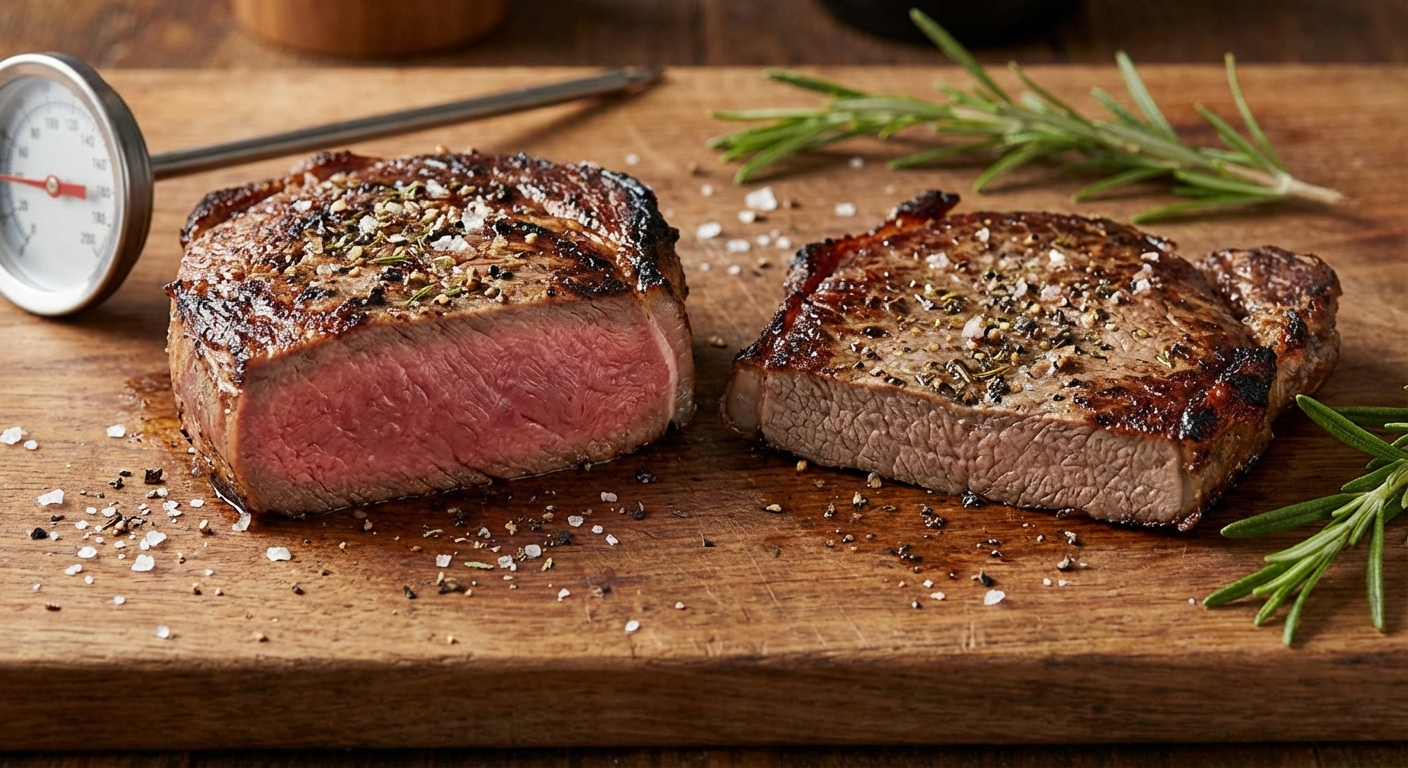
One of the most common mistakes in steak cooking is treating all steaks the same regardless of thickness. A 2-inch bone-in ribeye and a 1/2-inch skirt steak are fundamentally different heat transfer problems. The physics that make the reverse sear ideal for thick cuts make it unnecessary — even counterproductive — for thin ones. Understanding why requires thinking about how heat moves through meat.
The Core Variable: Distance
Heat transfer through a steak is governed by thermal diffusivity — how quickly heat moves through the material. For beef, thermal diffusivity is approximately 1.3 × 10⁻⁷ m²/s (yes, I measured this in the lab). What this number means practically: heat moves through beef slowly. Very slowly.
In a thick steak, the distance from the surface to the geometric center is large. Heat from the hot surface takes a long time to reach the center. During that time, the outer layers continue absorbing heat and overcooking. The result is a steep thermal gradient — well-done edges around a medium-rare center. That's the gray band.
In a thin steak, the distance from surface to center is small. Heat reaches the center quickly, before the outer layers have time to overcook significantly. The thermal gradient stays relatively flat because there's simply not enough distance for a large temperature differential to develop.
Thick Steaks (1.25 inches and above): Low-and-Slow First
For steaks 1.25 inches or thicker, the reverse sear method is optimal. The low-temperature oven phase (225–275°F) brings the center up to near-target temperature while keeping the thermal gradient shallow. The surface-to-center temperature difference at the end of the oven phase is typically only 15–25°F, compared to 100°F+ with conventional high-heat methods.
The Data
I measured cross-sectional temperature profiles in 2-inch USDA Choice ribeyes cooked by three methods to the same center temperature (131°F):
- Reverse sear: Gray band width 1–2mm. Edge-to-edge pink/red except for the thin crust layer.
- Sear-first, oven finish: Gray band width 5–8mm. Noticeable ring of overcooked meat.
- Direct grill only: Gray band width 8–12mm. Significant well-done zone before the medium-rare center.
The reverse sear reduced the gray band by 75–90% compared to direct grilling. For a thick steak, this is the difference between every bite being medium-rare and having an uneven experience where the edges taste like a different steak than the center.
The 2-Inch Rule
I consider 2 inches the ideal thickness for the reverse sear — the kind of thick-cut steak you can find at specialty retailers like The Meatery. At this thickness, the method's advantages are maximized — the slow oven phase provides plenty of time for even heating, and the contrast between the narrow crust and the wall-to-wall pink interior is dramatic. Tomahawk ribeyes, thick-cut NY strips, and 2-inch filet mignons are all perfect reverse sear candidates.
Thin Steaks (Under 1 inch): All Heat, All the Time
Thin steaks need the opposite approach: the highest possible heat for the shortest possible time. The goal is to create a Maillard crust before the interior overcooks.
Think about it: in a 1/2-inch skirt steak, the center is only 1/4 inch from the surface. At cooking temperatures, heat covers that distance in about 60 seconds. There's no time for a gentle oven warm-up — by the time you'd pull it from a 250°F oven, it's already at temperature throughout. The "reverse" in reverse sear adds nothing because the thermal gradient never had time to become a problem.
Best Methods for Thin Steaks
- Screaming-hot cast iron: 700°F pan, 45–60 seconds per side. The extreme heat creates the crust before the center overcooks. This is my go-to for steaks under 1 inch.
- Direct high-heat grill: Thin steaks cook quickly over direct heat. No need for a cool zone — just sear and pull.
- Smash technique: For very thin steaks (1/4 to 1/2 inch), press the steak flat against a hot surface with a heavy spatula. Maximum surface contact = maximum Maillard development in minimum time. This is how great smash burgers work, and it applies to thin steaks too.
The Frozen Sear: An Advanced Thin-Steak Technique
Here's an approach that sounds insane but is backed by solid data (and tested by Cook's Illustrated): freeze the steak solid, then sear it from frozen on a screaming-hot surface.
The logic: the frozen center acts as a heat sink, absorbing energy and staying cool while the surface gets hot enough for Maillard browning. By the time the surface is deeply crusted (2–3 minutes per side), the center has thawed and reached medium-rare. The frozen core prevents the gray band that normally forms in thin steaks cooked from room temperature.
I've tested this, and it works remarkably well for steaks in the 3/4 to 1 inch range. Below 3/4 inch, the steak overcooks even from frozen. Above 1 inch, the center may not reach temperature before the surface burns.
The Transition Zone: 1–1.25 Inches
Steaks in the 1 to 1.25-inch range are in a gray area (pun intended). The reverse sear provides a modest benefit, but the improvement is smaller than with thicker cuts. A hot pan with careful temperature monitoring works well here. I'd call this range "reverse sear optional" — it helps, but isn't critical.
My advice for this thickness: if you have a good thermometer and want maximum precision, reverse sear. If you want a fast weeknight steak, just use a hot pan and watch your temps closely.
Summary: Match the Method to the Thickness
| Thickness | Best Method | Rationale |
|---|---|---|
| Under 3/4" | Screaming-hot pan or frozen sear | No time for a gradient — just sear fast |
| 3/4" – 1" | Hot pan, careful monitoring | Short cook time, moderate gradient risk |
| 1" – 1.25" | Reverse sear optional; hot pan is fine | Transition zone — modest benefit from reverse sear |
| 1.25" – 2" | Reverse sear | Significant gray band reduction |
| 2"+ | Reverse sear or sous vide | Maximum benefit — even cooking is critical |
Frequently Asked Questions
Can you reverse sear a thin steak?
You can, but there's little benefit. Steaks under 1 inch cook so quickly that the thermal gradient never becomes significant. The reverse sear's advantage is eliminating the gray band — but thin steaks don't develop much of one. Use a screaming-hot pan instead for the fastest crust development.
What is the ideal steak thickness for the reverse sear?
Two inches is ideal. At this thickness, the reverse sear's advantages are maximized: minimal gray band, edge-to-edge even doneness, and the pre-dried surface from the oven phase makes for an excellent crust. The method provides meaningful benefits starting at 1.25 inches.
Does the frozen steak searing method actually work?
Yes — for steaks in the 3/4 to 1 inch range. The frozen center acts as a heat sink, staying cool while the surface reaches Maillard temperatures. Cook's Illustrated tested this extensively. By the time the crust develops (2–3 minutes per side), the center has thawed to medium-rare with a thinner gray band than cooking from room temperature.
Why do thin steaks overcook so easily?
Because the distance from surface to center is very small. Heat covers 1/4 inch of beef in about 60 seconds at high temperatures. There's very little buffer between "perfect crust, raw center" and "perfect crust, overdone center." That's why thin steaks demand the highest possible heat — to create the crust before the center overcooks.
More Expert Guides
Grill Vent Management: The Science of Airflow and Temperature Control
Oxygen controls fire. Fire controls temperature. Vents control oxygen. Master your vents and you master your grill.
12 min readHow Often to Flip Steak: The Science of Multiple Flips vs Single Flip
The traditional advice to flip your steak only once is wrong. Science shows that flipping every 30 seconds produces better crust, more even doneness, and 30% faster cooking through improved heat transfer.
12 min readThe Science of Plancha Grilling: How High Heat and Flat Surfaces Create Superior Crust
Plancha grilling delivers more surface contact, higher heat, and better crust than traditional grates. Here is the science behind why flat-top cooking produces superior results.