When to Salt Steak: The Science of Timing, Osmosis, and Perfect Seasoning
When to Salt Steak: The Science of Timing, Osmosis, and Perfect Seasoning
There is a 30-minute window where salting your steak actively makes it worse. Most people salt their steak right in that window.
The question of when to salt steak has generated more contradictory advice than almost any other cooking topic. Some chefs say salt immediately before cooking. Others say salt overnight. Some say never salt raw meat at all. They cannot all be right — and the science tells us exactly who is wrong and why.
The answer comes down to osmosis, protein chemistry, and time. Once you understand what salt actually does to meat at the molecular level, the timing debate resolves itself completely.
What Salt Does to Meat: The Three Phases
When salt touches raw steak, it triggers a predictable sequence of events. This sequence happens every single time, and understanding it is the key to perfect seasoning.
Phase 1: Surface Dissolution (0-3 Minutes)
Salt crystals dissolve in the surface moisture of the steak, creating a concentrated brine layer on the meat surface. At this point, nothing has happened inside the meat. The salt is sitting on top, dissolved in the steak's own moisture. If you cook right now — within the first three minutes of salting — the salt is still essentially on the surface. It will season the crust but will not have penetrated meaningfully into the interior.
Phase 2: Osmotic Extraction (3-30 Minutes)
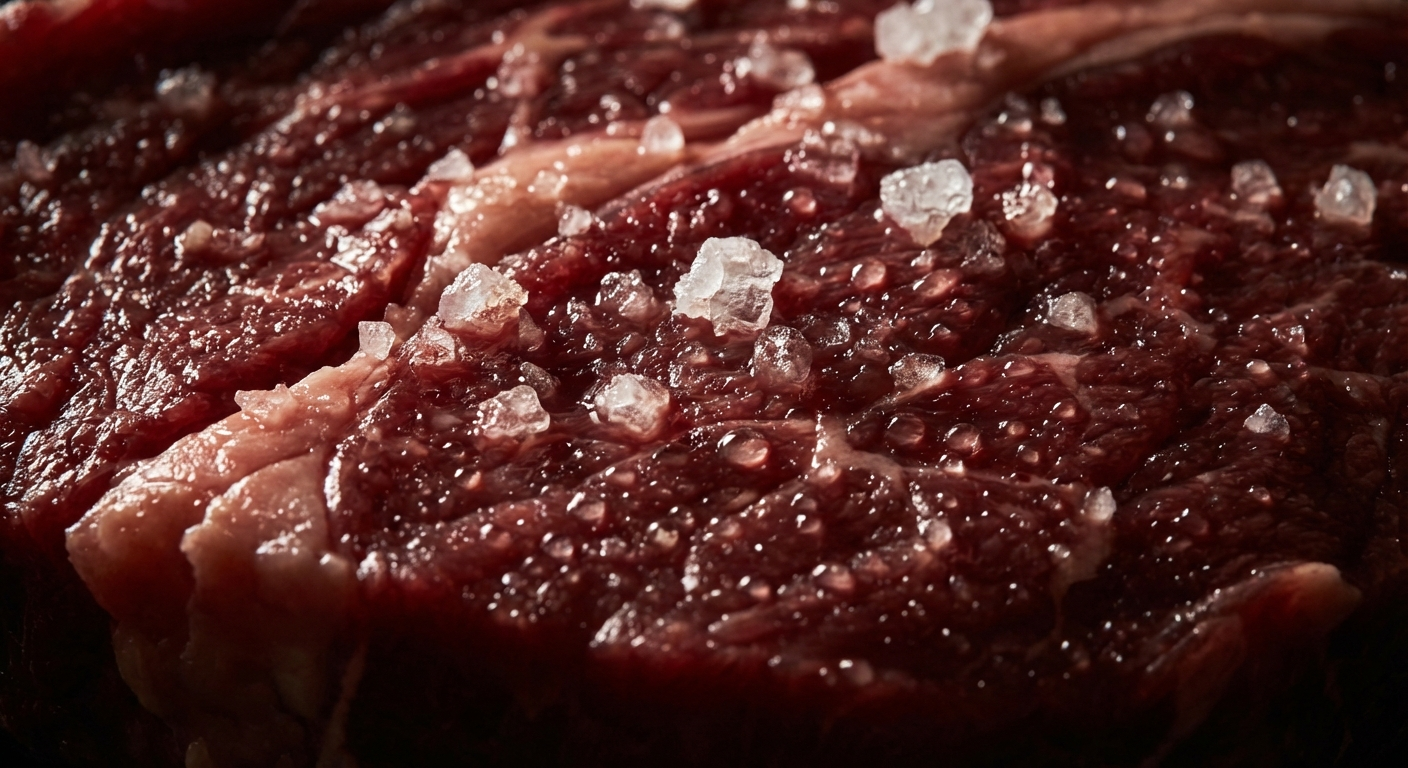
This is the danger zone. Osmosis kicks in — the high salt concentration on the surface draws moisture out of the meat cells. You will physically see this happen: beads of liquid appear on the steak surface within 5-10 minutes.
At this stage, the steak is actively losing moisture. The salt has not yet had time to break down muscle proteins and create pathways for reabsorption. If you cook the steak now, two bad things happen:
- The surface is wet, which prevents proper Maillard browning and crust formation
- The interior has lost moisture that has not been reabsorbed, resulting in a drier finished steak
This is why the advice "salt your steak 15-20 minutes before cooking" is the worst possible timing. You are cooking at peak moisture loss with a wet surface. It is the absolute worst of both worlds.
Phase 3: Reabsorption and Penetration (40+ Minutes)
Here is where the magic happens. Given enough time, the salt begins to break down muscle protein structures through a process called protein denaturation. The dissolved proteins create channels that allow the salty liquid on the surface to be drawn back into the meat.
The extracted moisture — now seasoned with dissolved salt — gets reabsorbed into the steak. The meat actually takes back its own liquid, but now that liquid is seasoned. The result is a steak that is seasoned throughout its interior, not just on the surface.
By 40-60 minutes, the surface has dried significantly (the liquid has been reabsorbed), and the interior salt concentration has increased meaningfully. By 24 hours, the salt has penetrated deeply and the surface is noticeably dry — ideal conditions for aggressive searing.
The Two Safe Windows: Immediately or 40+ Minutes
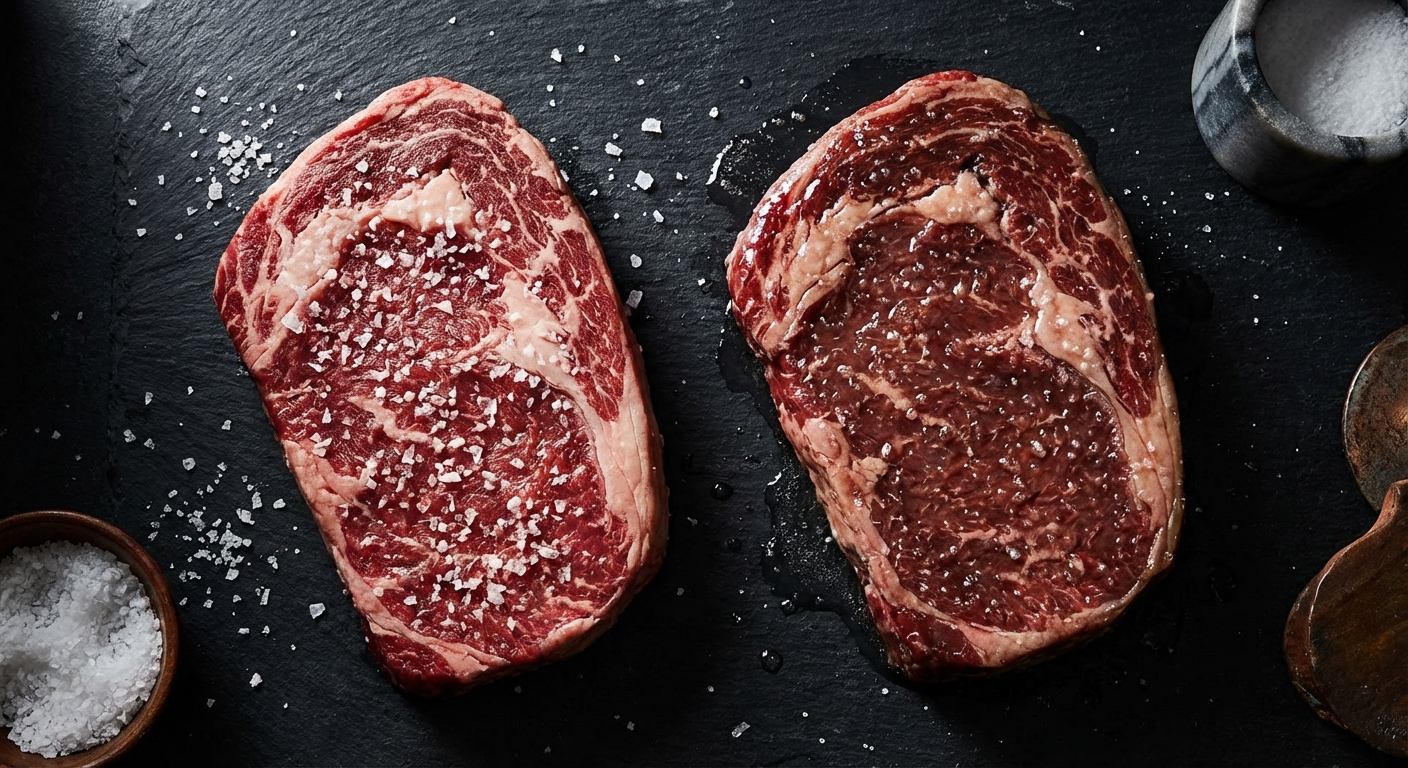
Based on the three-phase process above, there are exactly two good strategies:
Strategy 1: Salt Right Before Cooking (0-3 Minutes)
If you do not have time, just salt the steak immediately before it hits the grill. The salt dissolves in surface moisture, you get good surface seasoning, and osmosis has not had time to extract significant moisture. The steak surface stays relatively dry, which means good sear potential.
Best for: Weeknight dinners, situations where you did not plan ahead, thin steaks that cook quickly.
Limitation: Seasoning stays surface-level only. The interior of the steak will be under-seasoned compared to a longer salt.
Strategy 2: Salt 40 Minutes to 24 Hours Before (The Dry Brine)
This is the superior method by every measurable metric. Salt the steak generously, place it uncovered on a wire rack in the refrigerator, and wait at minimum 40 minutes. Overnight is ideal.
What happens:
- Moisture extracts, dissolves the salt, then gets reabsorbed carrying salt into the interior
- The surface dries out in the refrigerator air, creating ideal conditions for Maillard browning
- Salt-denatured proteins on the surface create a more effective crust
- Interior seasoning is far more uniform
Best for: Any steak you can plan ahead for. Thick cuts (1.5 inches+) benefit the most because the salt has further to penetrate.
Sweet spot: 1-2 hours gives you excellent results without requiring overnight planning. For thick ribeyes and strips, 4-8 hours is even better.
The Osmosis Science in Detail
Osmosis is the movement of water across a semi-permeable membrane from an area of low solute concentration to high solute concentration. Meat cell walls act as those semi-permeable membranes.
When you apply salt to the steak surface, you create a zone of extremely high sodium chloride concentration outside the cells. The water inside the cells — which has much lower salt concentration — moves outward through the cell membranes to try to equalize the concentration. This is passive transport; it requires no energy and cannot be stopped once the gradient exists.
The result: water leaves the cells and pools on the surface. This is not "juice" in the way people think of it — it is mostly water with dissolved myoglobin (the red protein), some dissolved minerals, and small amounts of dissolved amino acids.
Over time, the salt concentration gradient decreases as salt moves inward through protein diffusion and as the extracted liquid is reabsorbed. The system moves toward equilibrium — roughly equal salt concentration inside and outside the cells. This takes time, which is why the minimum window is 40 minutes for a standard 1-inch steak.
How Much Salt to Use
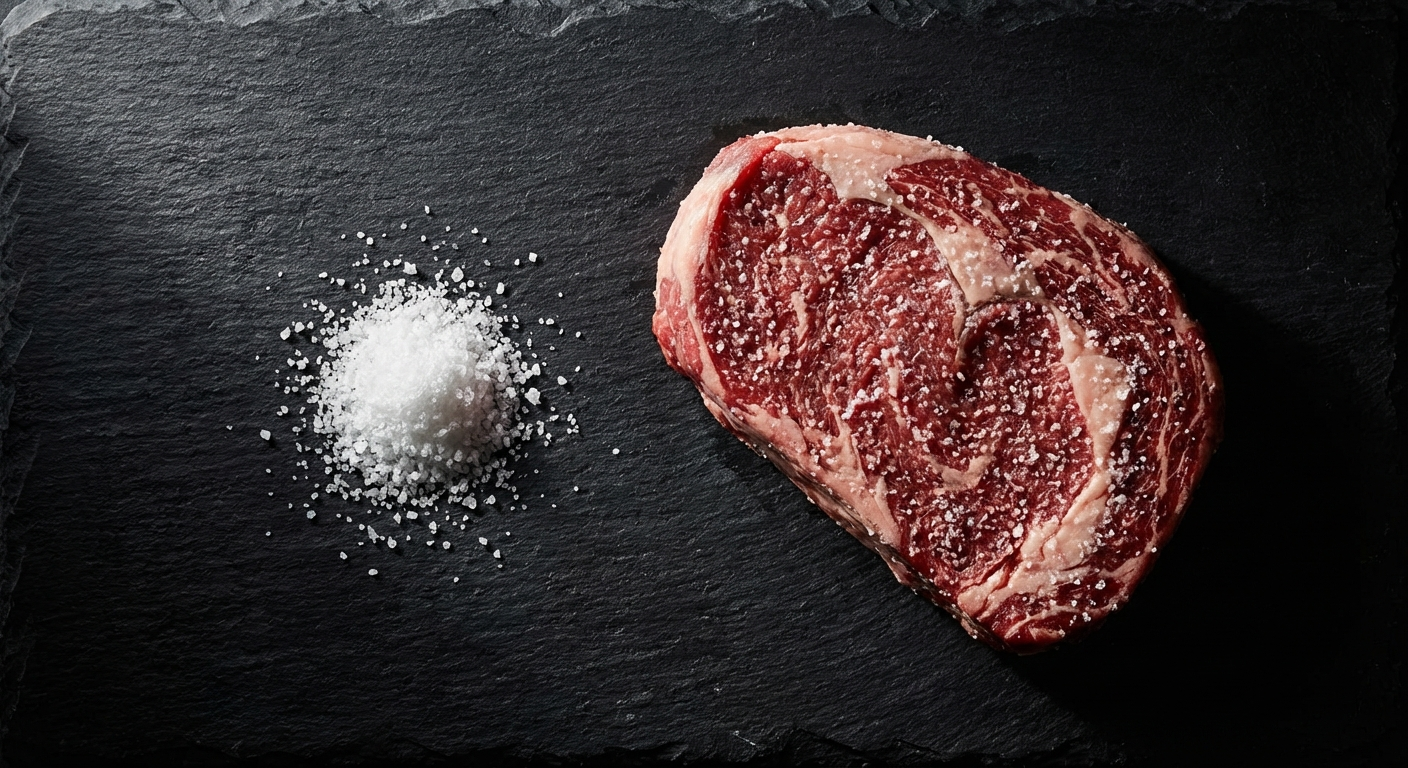
The amount matters as much as the timing. Too little salt and the osmotic effect is minimal — you get surface seasoning only. Too much and the exterior becomes unpleasantly salty even after reabsorption.
The standard ratio: 3/4 teaspoon of kosher salt per pound of meat. This works for Diamond Crystal kosher salt. If you are using Morton's kosher salt (which has smaller, denser crystals), use about half as much — roughly 1/2 teaspoon per pound.
Table salt: Do not use table salt for dry brining. The fine grains dissolve too quickly, create an immediately intense osmotic gradient, and distribute unevenly. Coarse kosher salt dissolves gradually and distributes more uniformly across the surface.
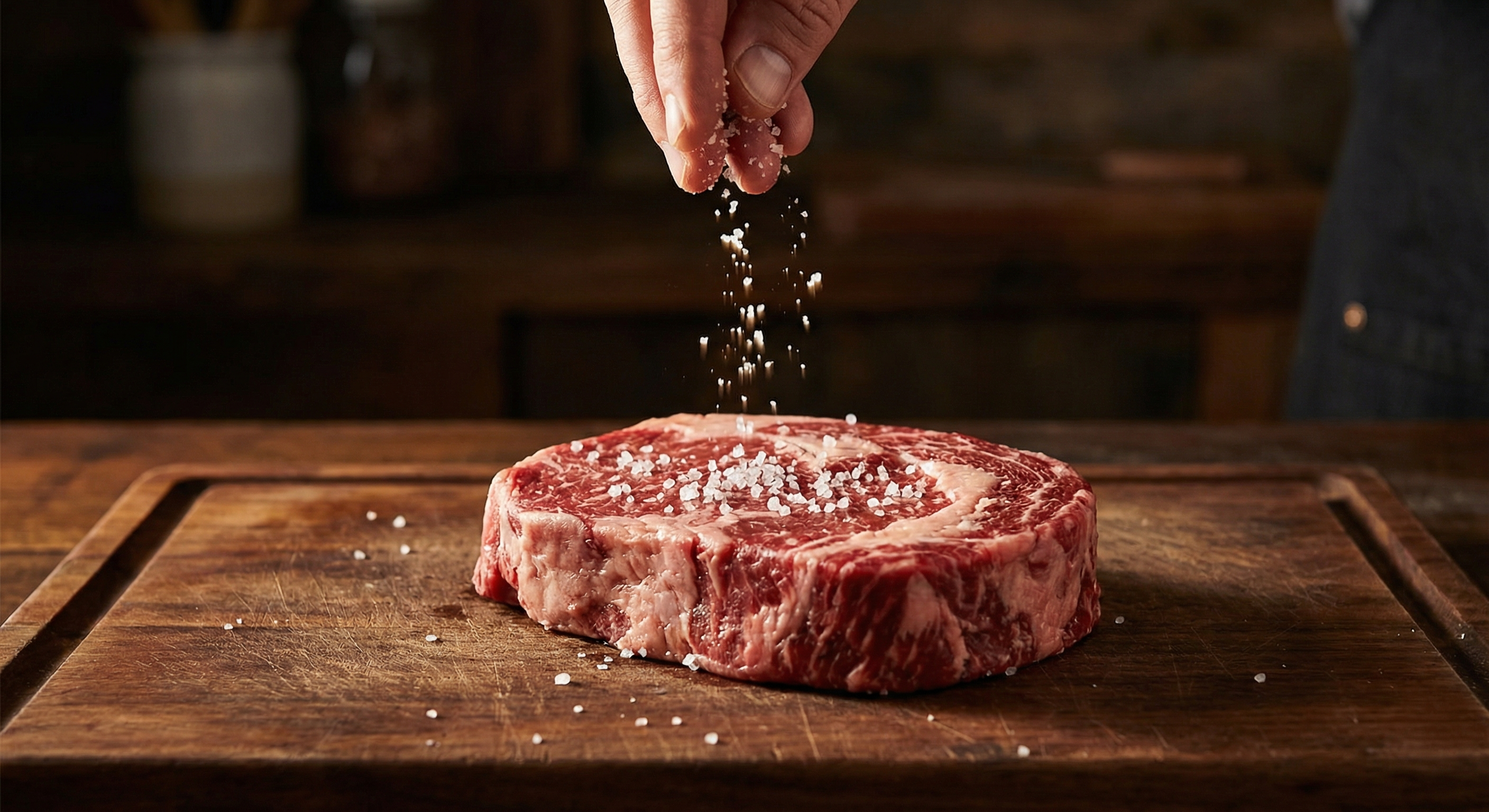
Application method: Hold your hand 10-12 inches above the steak and let the salt fall like snow. This distributes the crystals evenly instead of creating concentrated patches. Season all sides, including the edges — those get seared too.
Does Salt Make Steak Tougher or More Tender?
Salt makes steak more tender — but only with sufficient time.
Sodium chloride partially denatures muscle proteins, particularly myosin. Denatured myosin loses some of its ability to contract when heated. Since toughness in cooked meat is largely caused by muscle fiber contraction during cooking, pre-denaturing those proteins with salt results in less contraction and a more tender finished steak.
This tenderizing effect requires time — at least 40 minutes, with increasing benefit up to about 24 hours. A steak salted for 5 minutes gets zero tenderizing benefit. A steak salted overnight is measurably more tender than an unsalted control.
There is a limit, though. Salting beyond 48 hours starts to create a cured texture — firmer, denser, almost ham-like on the surface. For a fresh-tasting steak, stay under 24 hours. The 1-2 hour range gives you meaningful tenderization without any textural compromise.
The Wet Surface Problem: Why Moisture Kills Your Sear
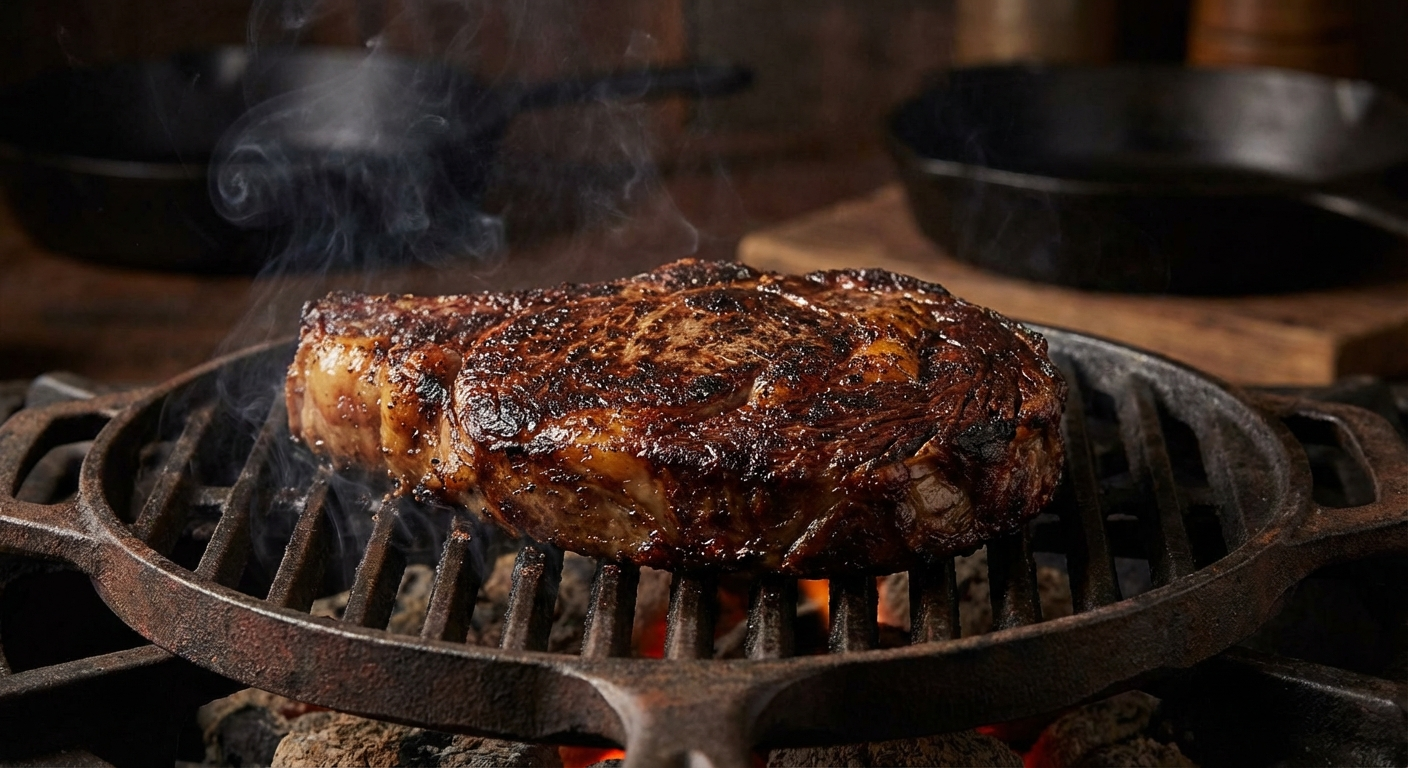
The Maillard reaction — the browning that creates flavor-packed crust — requires surface temperatures above 280°F. Water boils at 212°F. As long as there is liquid water on the steak surface, the temperature at that point cannot exceed 212°F. The energy goes into evaporating water instead of browning meat.
This is why a wet-surfaced steak (one salted 10-20 minutes ago) sears poorly. The grill's energy is spent boiling off surface moisture instead of triggering the Maillard reaction. You get gray, steamed meat instead of a dark, crispy crust.
A properly dry-brined steak (salted 1+ hours, uncovered on a rack) has a noticeably dry, slightly tacky surface. When this hits a screaming-hot grill grate, the Maillard reaction begins almost immediately because there is no water barrier to overcome. The crust forms faster, which means less time on direct heat, which means a thinner band of overcooked meat below the surface.
Even if you salt immediately before cooking (Strategy 1), pat the steak aggressively dry with paper towels. Remove as much surface moisture as possible. Every drop of water you remove is energy that goes toward browning instead of evaporation.
Salt Type Matters More Than You Think
Not all salt seasons equally because not all salt has the same crystal structure:
- Diamond Crystal kosher salt: Large, hollow, pyramid-shaped flakes. Dissolves gradually. Easy to pinch and distribute. This is the gold standard for dry brining and general steak seasoning. 1 tablespoon weighs about 10 grams.
- Morton's kosher salt: Flat, dense, compact flakes. Dissolves faster than Diamond Crystal. Significantly saltier by volume — 1 tablespoon weighs about 15 grams. If a recipe says "kosher salt" without specifying, it almost always means Diamond Crystal.
- Table salt: Tiny, dense, uniform cubes. Contains anti-caking agents. Extremely salty by volume — 1 tablespoon weighs about 18 grams. Dissolves almost instantly on meat, creating intense localized brine. Not recommended for dry brining.
- Flaky finishing salts (Maldon, fleur de sel): Use after cooking, not before. Their texture and crunch is the point — dissolving them on raw meat wastes their best quality and their premium price.
The volume-to-weight ratio difference between salt types is dramatic. If you switch from Diamond Crystal to Morton's without adjusting, you are using 50% more salt by weight. This is a common source of oversalting.
Thickness Changes the Timeline
Salt penetration speed is a function of diffusion through protein, and that rate is relatively constant regardless of how much salt you apply. What changes is the distance the salt needs to travel:
- 3/4 inch steak: 40-60 minutes for meaningful penetration
- 1 inch steak: 1-2 hours for good interior seasoning
- 1.5 inch steak: 2-4 hours for even seasoning throughout
- 2+ inch steak: 4-8 hours, or overnight for best results
For extremely thick cuts like a tomahawk or a 2.5-inch porterhouse, overnight salting is not just nice to have — it is essential. A 40-minute salt on a 2-inch steak will season the outer 1/4 inch nicely but leave the center completely unseasoned. You will taste the difference.
Frequently Asked Questions
Frequently Asked Questions
When is the best time to salt a steak before grilling?
Either immediately before cooking (within 3 minutes) or at least 40 minutes before. The worst time is 10-30 minutes before, when osmosis has drawn moisture to the surface but reabsorption has not yet occurred. For the best results, salt 1-2 hours ahead or overnight.
Why does my steak get wet after I salt it?
That is osmosis at work. The high salt concentration on the surface draws water out of the meat cells through their semi-permeable membranes. This moisture will be reabsorbed if you wait 40+ minutes, carrying the salt back into the interior. If you cook during peak moisture extraction (10-30 minutes), you get a wet surface that prevents proper searing.
Does salting steak make it dry?
Only if you cook it during the wrong window. Salting for 10-30 minutes and then cooking can result in a drier steak because moisture has been extracted but not reabsorbed. Salting for 40+ minutes actually improves moisture retention because denatured proteins hold water more effectively during cooking.
What kind of salt is best for seasoning steak?
Diamond Crystal kosher salt is the gold standard for steak seasoning and dry brining. Its large, hollow flakes dissolve gradually and distribute evenly. Morton kosher salt works but is about 50% saltier by volume, so use less. Avoid table salt for pre-salting — its fine crystals dissolve too fast and create uneven seasoning.
How much salt should I use per pound of steak?
About 3/4 teaspoon of Diamond Crystal kosher salt per pound of meat, applied evenly on all sides. For Morton kosher salt, use roughly 1/2 teaspoon per pound. Hold your hand 10-12 inches above the steak and let the salt fall like snow for even distribution.
Can you salt a steak too far in advance?
Yes. Beyond 48 hours, the surface can develop a cured, ham-like texture. For fresh-tasting steak, keep the salting window under 24 hours. The sweet spot for most steaks is 1-2 hours, with thick cuts (2+ inches) benefiting from 4-8 hours or overnight.
More Expert Guides
Steak Doneness Temperature Guide: The Science of Every Level from Rare to Well Done
Every degree matters. This science-backed guide covers the exact internal temperatures for every steak doneness level, why each temperature produces a different texture, and how to nail your target every time.
14 min readDirect vs Indirect Heat Grilling: The Science of Two-Zone Cooking
Direct heat sears. Indirect heat roasts. Understanding the physics of each — and when to combine them — is the foundation of every great grilling technique.
14 min readResting Meat After Cooking: The Science of Why It Makes Every Steak Juicier
Resting meat after cooking is not optional — it is physics. Here is exactly what happens inside the steak during those crucial minutes and how long to rest every cut.