Brisket Flat vs Point: Anatomy, Flavor Differences, and How to Cook Each Cut
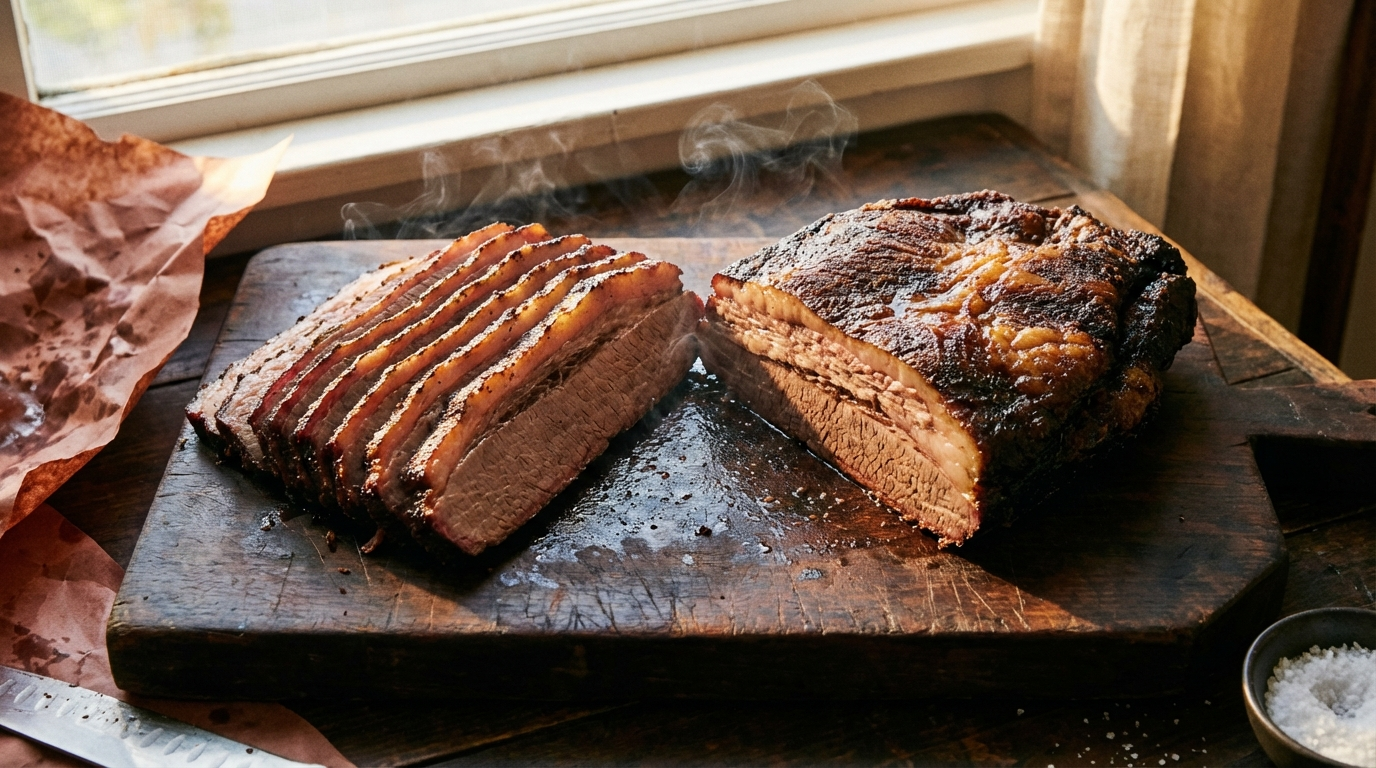
Brisket Flat vs Point: Anatomy, Flavor Differences, and How to Cook Each Cut
Walk up to any barbecue counter in Texas and you'll hear the question: "Lean or moist?" That single choice — lean from the flat, moist from the point — represents the fundamental divide inside every whole packer brisket. These two muscles sit on top of each other, connected by a seam of fat, yet they behave like completely different cuts of meat when exposed to heat and smoke.
Understanding the science behind these differences doesn't just make you a better pitmaster. It explains why the flat dries out when the point is perfect, why burnt ends exist, and why competition teams separate these muscles before the final cook.
Brisket Anatomy: Two Muscles, One Cut
A whole packer brisket (NAMP 120) comes from the lower chest of the steer, between the front legs. It's a heavily worked muscle group that supports roughly 60% of the animal's body weight during movement. This constant use creates dense muscle fibers and extensive connective tissue — the raw materials that make brisket both challenging and rewarding to cook.
The packer contains two overlapping muscles:
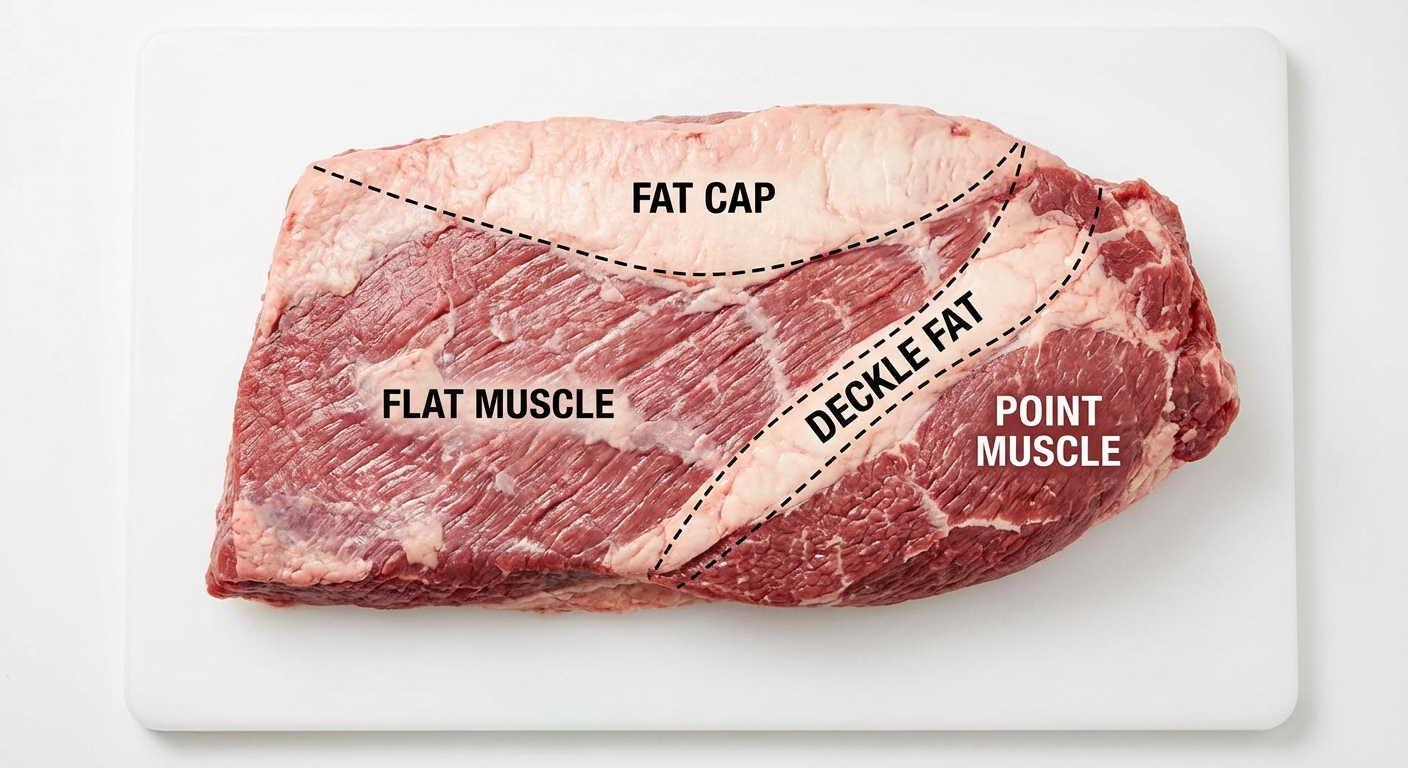
The Flat (Pectoralis Profundus)
The flat — also called the "first cut" or "deep pectoral" — is the larger, leaner muscle that forms the bottom of the brisket. It's relatively uniform in thickness (usually 1 to 2 inches), rectangular in shape, and covered by a fat cap on one side.
- Weight: 6–10 pounds (roughly 60–65% of a whole packer)
- Intramuscular fat: Low to moderate — typically 5–8% by weight
- Connective tissue: Moderate collagen content in organized parallel sheets
- Grain direction: Runs lengthwise, uniform and easy to identify
- Fiber density: Tightly packed, long parallel fibers
The flat is what most people picture when they think of sliced brisket. Its uniform shape makes it ideal for neat, even slices. The challenge: its leanness means it's less forgiving of overcooking.
The Point (Pectoralis Superficialis)
The point — also called the "second cut," "deckle," or "superficial pectoral" — sits on top of the flat, offset toward the thicker end. It's irregularly shaped, thicker, and significantly fattier than the flat.
- Weight: 4–8 pounds (roughly 35–40% of a whole packer)
- Intramuscular fat: High — typically 15–25% by weight
- Connective tissue: Dense, irregular collagen network throughout the muscle
- Grain direction: Runs perpendicular to the flat's grain — this matters when slicing
- Fiber density: Looser, with more fat marbled between fiber bundles
The point is where burnt ends come from. Its high fat content and dense connective tissue make it almost impossible to dry out, and when cooked properly, it delivers the rich, unctuous texture that brisket lovers crave.
The Deckle Fat Seam
Between the flat and point lies a thick layer of intermuscular fat called the deckle (or "fat seam"). This layer is typically 1/4 to 1/2 inch thick and serves as a natural boundary between the two muscles. During cooking, this fat renders partially, basting the surrounding meat. However, it never fully renders — which is why some pitmasters separate the muscles before or during the cook.
The Science: Why They Cook Differently
Fat Content and Thermal Insulation
Fat is a thermal insulator. It conducts heat roughly 3 times slower than lean muscle tissue. The point's high intramuscular fat content means heat penetrates it more slowly, but it also means the point retains moisture far better as temperatures rise.
When lean muscle fibers contract during cooking (beginning around 140°F and accelerating above 160°F), they squeeze out moisture. In the flat, with its lower fat content, this moisture loss is significant. In the point, the abundant fat melts and fills the spaces between contracting fibers, keeping the meat moist and succulent even at high internal temperatures.
This is why the flat can be perfectly done at 195°F while the point needs 200–210°F to fully render its fat and break down its collagen. Cook both muscles to the same temperature, and one will be suboptimal.
Collagen Content and Breakdown
Both muscles contain significant collagen (Type I and Type III), but the distribution differs:
- The flat has collagen organized in parallel sheets (perimysium and epimysium) surrounding the muscle fiber bundles. This collagen begins converting to gelatin at around 160°F and is largely converted by 195–200°F.
- The point has a denser, more irregular collagen network. The connective tissue weaves through the muscle in multiple directions, requiring more time and higher temperatures to fully convert. Peak conversion occurs between 200–210°F.
Collagen-to-gelatin conversion is both temperature-dependent and time-dependent. At 180°F, conversion happens slowly. At 200°F, it accelerates dramatically. This is why low-and-slow cooking works for brisket — it gives the collagen enough time at the critical temperature range to convert without the muscle fibers contracting so violently that they expel all their moisture.
The Stall Affects Them Differently
During the BBQ stall, evaporative cooling creates a temperature plateau. Because the point has more surface moisture (from rendering fat) and greater mass, it often stalls longer than the flat. In a whole packer, this means the flat may exit the stall and begin climbing in temperature while the point is still plateaued — creating an uneven cook if you're not monitoring both muscles.
Temperature Targets: Flat vs Point
| Parameter | Flat | Point |
|---|---|---|
| Target internal temp | 195–203°F | 200–210°F |
| Ideal probe feel | Slides in like warm butter | Almost no resistance |
| Stall range | 150–170°F | 150–175°F (often longer) |
| Rest time | 1–2 hours minimum | 1–2 hours minimum |
| Carryover rise | 3–8°F | 5–10°F (more thermal mass) |
The "probe tender" test matters more than any specific number. Insert a thermometer probe or skewer into the thickest part of each muscle. When it slides in with almost no resistance — like pushing into room-temperature butter — that section is done. The flat typically reaches this point at a lower temperature than the point.
Cooking Methods: Whole Packer vs Separated
Cooking as a Whole Packer
Most backyard pitmasters cook the brisket whole. The advantage: the point's fat bastes the flat during cooking, and the deckle seam provides insulation. The disadvantage: the flat and point finish at different times.
Strategies for even cooking:
- Position the point toward the heat source. Since the point can handle higher temperatures and longer cooking, orient it toward the hotter side of your smoker.
- Monitor both muscles. Place one probe in the thickest part of the flat and another in the center of the point. Don't rely on a single reading.
- Wrap when the flat is done. If the flat reaches probe-tender before the point, wrap the entire brisket in butcher paper or foil to protect the flat while the point finishes.
- Rest fat-side up. During the rest period, position the brisket so the point (and its rendered fat) sits above the flat, allowing gravity to redistribute moisture downward.
Separating Before Cooking
Competition teams and experienced pitmasters often separate the flat and point before cooking. This allows independent temperature control and optimized cook times for each muscle.
To separate:
- Place the brisket fat-cap down on a cutting board
- Locate the fat seam between the flat and point — it's visible as a thick white line running roughly two-thirds of the way across the brisket
- Using a sharp boning knife, follow the fat seam, cutting through the deckle to separate the muscles
- Trim excess fat from both pieces (leave 1/4 inch on the flat's fat cap)
Cook times when separated:
- Flat: 8–12 hours at 225–250°F (smaller and leaner, finishes faster)
- Point: 10–14 hours at 225–250°F (fattier, needs more time for full rendering)
Best Uses for Each Cut
The Flat: Sliced Brisket
The flat is the slicing muscle. Its uniform shape and consistent grain direction produce clean, even slices that hold together on a plate. This is what you get when you order "lean" at a barbecue joint.
- Slice against the grain — the grain runs lengthwise, so cut perpendicular to the long axis
- Pencil-thick slices (~1/4 inch) are traditional
- The bend test: Pick up a slice from one end. It should bend and nearly break under its own weight — not stiff (undercooked) and not falling apart (overcooked)
The Point: Burnt Ends and Chopped Brisket
The point is the flavor muscle. Its high fat content and irregular shape make it ideal for:
- Burnt ends: Cube the smoked point into 1-inch pieces, toss with sauce or rub, and return to the smoker at 275°F for 1–2 hours until caramelized and jiggly. The point's fat keeps each cube moist while the exterior develops a crispy, lacquered bark.
- Chopped brisket: The point's irregular grain makes it difficult to slice cleanly, but perfect for chopping. The higher fat content ensures chopped brisket stays moist.
- Moist slices: When you order "moist" or "fatty" at a barbecue joint, you're getting point slices. They're messier but intensely flavorful.
Buying Guide: Flat Only vs Whole Packer
Grocery stores often sell flats separately, trimmed of the point. While convenient, a standalone flat has disadvantages:
- No insulation from the point: The flat cooks faster and dries out more easily without the point sitting on top
- Less forgiving: A separated flat leaves almost zero margin for overcooking
- Higher price per pound: Flats are typically $1–3/lb more than whole packers because of the trimming labor and the perception of being the "premium" cut
A whole packer (typically 12–18 pounds untrimmed) is the better value and the better cook. The point's fat provides natural insurance against the flat drying out. Buy the whole brisket, learn to manage both muscles, and you'll produce better barbecue.
What Grade to Buy
USDA grading matters more for the flat than the point:
- Choice: Adequate marbling in both muscles. The flat will be noticeably leaner than Prime. Good for beginners — it's more forgiving of minor timing errors because there's less fat to render.
- Prime: Higher intramuscular fat in both muscles. The flat benefits significantly from the extra marbling — it's more forgiving and produces a juicier result. The point, already well-marbled, shows less dramatic improvement.
- Wagyu/American Wagyu: Extreme marbling throughout. The flat approaches the fat content of a standard point. Both muscles become incredibly forgiving but cook differently than standard beef — lower temperatures (225°F max) prevent the excessive fat from rendering too quickly.
Common Mistakes
1. Pulling Based on a Single Thermometer
If you place your only probe in the point, the flat will be overcooked and dry by the time the point reaches temperature. If you probe only the flat, the point will be undercooked and chewy. Always monitor both.
2. Slicing the Whole Brisket in One Direction
The flat and point have grain running in different directions — roughly perpendicular to each other. If you slice the entire brisket in one direction, you'll be slicing with the grain on one muscle, resulting in chewy, stringy meat. Separate the muscles at the fat seam before slicing, and cut each one against its own grain.
3. Trimming All the Fat
Some pitmasters over-trim the fat cap and deckle seam, removing the brisket's natural basting system. Leave at least 1/4 inch of fat cap on the flat and don't fully remove the deckle between the muscles. This fat renders during cooking and keeps both muscles moist.
4. Not Resting Long Enough
Brisket needs a minimum 1-hour rest, and 2–4 hours in a cooler (faux cambro) is even better. During rest, the muscle fibers relax and reabsorb some of the moisture that was driven toward the edges during cooking. The collagen-derived gelatin also sets slightly, improving the texture of each slice. Cutting too early means juices pool on the cutting board instead of staying in the meat.
The Bottom Line
The flat and point are two fundamentally different muscles that happen to share the same primal cut. The flat is lean, uniform, and built for clean slices. The point is fatty, irregular, and built for maximum flavor. Understanding their distinct properties — fat content, collagen structure, grain direction, and optimal temperatures — transforms brisket from a gamble into a predictable craft.
Cook to probe tenderness, not just temperature. Monitor both muscles independently. Slice each one against its own grain. And if you're buying for the first time, buy the whole packer — you'll get better results and learn more about what makes brisket the king of barbecue.
Frequently Asked Questions
What is the difference between brisket flat and point?
The flat (pectoralis profundus) is the larger, leaner muscle that forms the bottom of the brisket — ideal for slicing. The point (pectoralis superficialis) sits on top, is fattier with more marbling and connective tissue, and is best for burnt ends and chopped brisket. They have different grain directions and reach optimal tenderness at different temperatures.
Which is better, brisket flat or point?
Neither is objectively better — they serve different purposes. The flat produces clean, lean slices with a traditional brisket look. The point delivers richer, fattier bites and is the source of burnt ends. Most barbecue joints serve both as "lean" (flat) and "moist" (point).
Can you cook a brisket flat by itself?
Yes, but it requires more care. Without the point's fat providing insulation and moisture, a standalone flat is less forgiving. Cook at 225-250°F, wrap in butcher paper when it hits 165°F, and pull at 195-200°F when probe-tender. Monitor closely — a flat-only cook has less margin for error.
What temperature should I cook brisket flat vs point?
Cook both at the same smoker temperature (225-275°F), but they reach tenderness at different internal temperatures. The flat is typically probe-tender at 195-203°F, while the fattier point needs 200-210°F to fully render its fat and break down its denser collagen network.
Why is the brisket point more tender than the flat?
The point has 2-3 times more intramuscular fat than the flat. When this fat renders during cooking, it fills the spaces between contracting muscle fibers, keeping the meat moist. The point also has more collagen, which converts to gelatin and adds a rich, unctuous texture.
More Expert Guides
Steak Doneness Temperature Guide: The Science of Every Level from Rare to Well Done
Every degree matters. This science-backed guide covers the exact internal temperatures for every steak doneness level, why each temperature produces a different texture, and how to nail your target every time.
14 min readDirect vs Indirect Heat Grilling: The Science of Two-Zone Cooking
Direct heat sears. Indirect heat roasts. Understanding the physics of each — and when to combine them — is the foundation of every great grilling technique.
14 min readResting Meat After Cooking: The Science of Why It Makes Every Steak Juicier
Resting meat after cooking is not optional — it is physics. Here is exactly what happens inside the steak during those crucial minutes and how long to rest every cut.