Collagen Breakdown in BBQ: The Science of Tender, Melt-in-Your-Mouth Meat
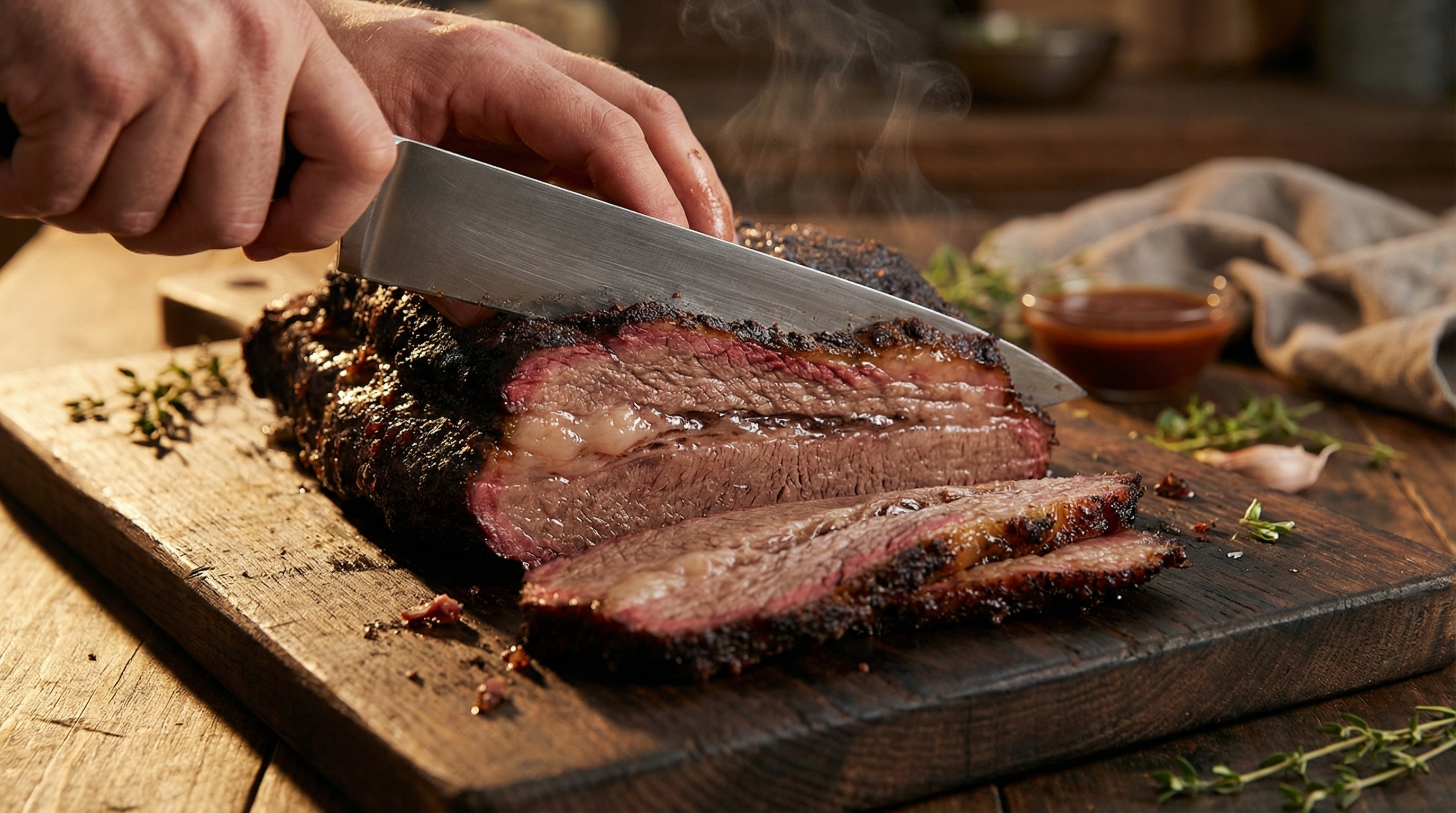
Every pitmaster knows the rule: tough cuts need low-and-slow cooking. But few understand why at a molecular level. The answer is collagen — the most abundant protein in mammals, and the single factor that determines whether a cut of meat is meltingly tender or chewy and tough.
Collagen is a structural protein. It forms the connective tissue that holds muscle fibers together — the silvery-white membranes, tendons, and sheaths you see running through a raw brisket or pork shoulder. In muscles that work hard during the animal's life (legs, shoulders, chest), collagen content is high. In muscles that do little work (tenderloin), collagen is minimal.
The magic of BBQ is that collagen, when exposed to the right combination of heat and time, converts into gelatin — a soft, silky protein that coats muscle fibers and creates that unmistakable melt-in-your-mouth texture. Understanding this conversion is the key to mastering low-and-slow cooking.
What Is Collagen? The Molecular Structure
Collagen is a triple-helix protein — three polypeptide chains wound tightly around each other like a braided rope. This structure is extraordinarily strong. Gram for gram, collagen fibers have tensile strength comparable to steel wire. That strength is why raw brisket is so tough — you are literally trying to chew through biological cables.
The triple helix is stabilized by hydrogen bonds between the three chains. These bonds are the key to everything that follows, because heat disrupts them. When you apply sustained heat to collagen, the hydrogen bonds break one by one. The tightly wound triple helix unravels into three individual gelatin strands. This is the collagen-to-gelatin conversion — and it is the entire reason low-and-slow BBQ exists.
There are actually over 25 types of collagen in the body, but the one that matters most for cooking is Type I collagen — the primary structural collagen in tendons, ligaments, and the connective tissue sheaths (perimysium and epimysium) surrounding muscle fiber bundles. Type I is the most heat-resistant, which is why converting it requires patience.
The Temperature Threshold: When Collagen Starts Breaking Down
Collagen denaturation — the unraveling of the triple helix — begins around 150°F (65°C). But "begins" is the operative word. At 150°F, the conversion is extremely slow. Only the most thermally vulnerable bonds are breaking. At this rate, you would need days to fully convert the collagen in a brisket.
The conversion rate increases with temperature:
- 150–160°F: Collagen begins to denature. Conversion rate is very slow. Connective tissue starts to soften but remains largely intact.
- 160–180°F: The critical zone. Collagen conversion accelerates significantly. This is also where the BBQ stall occurs — the meat's internal temperature plateaus as moisture evaporates from the surface, fighting against the heat. Patience here is rewarded.
- 180–205°F: Rapid gelatin conversion. Collagen sheaths dissolve into gelatin that lubricates and coats the muscle fibers. This is the target zone for pulled pork, brisket, and ribs.
- Above 210°F: Gelatin itself begins to break down further, and muscle fibers dry out excessively. The meat can become mushy or crumbly rather than tender.
The sweet spot for most BBQ is an internal temperature of 195–205°F, held long enough for the collagen in the thickest sections to fully convert. This is why pitmasters probe for tenderness ("probe tender") rather than relying solely on temperature — different parts of the meat have different collagen densities and convert at different rates.
Time vs. Temperature: The Conversion Trade-Off
Here is the critical insight that separates good BBQ from great BBQ: collagen conversion is a function of both temperature and time. You can convert collagen at lower temperatures if you give it more time, or at higher temperatures with less time. But the quality of the result differs dramatically.
Low Temperature, Long Time (The BBQ Method)
Cooking at 225–275°F (smoker temperature) means the meat's internal temperature rises slowly. It spends hours in the 160–200°F zone where collagen is actively converting. This extended conversion period produces several benefits:
- More complete conversion: Even deeply embedded collagen has time to denature and gelatinize.
- Better moisture retention: Lower cooking temperatures mean less aggressive muscle fiber contraction. The fibers squeeze out moisture more gently, and the gelatin produced by collagen conversion coats them, trapping moisture.
- Superior texture: Gelatin produced slowly has a silkier, more viscous quality. It coats every fiber evenly.
- Smoke absorption: The longer cooking time allows more wood smoke compounds to penetrate the meat surface, building a deeper smoke ring and more complex flavor.
High Temperature, Short Time (Braising)
Braising (300–350°F oven with liquid) converts collagen faster because the internal temperature rises more quickly. A braised brisket can be tender in 3–4 hours instead of 12–16. The trade-offs:
- Less even conversion: Outer sections may over-convert while inner sections are still tough.
- More moisture loss: Higher cooking temperatures cause more aggressive muscle fiber contraction, squeezing out more liquid.
- No smoke flavor: Braising occurs in a sealed environment, eliminating the smoke absorption that defines BBQ.
Both methods produce tender meat. But the low-and-slow BBQ approach produces meat that is both tender and juicy — because it gives collagen enough time to convert into gelatin that compensates for the moisture lost from muscle fiber contraction.
The BBQ Stall: Collagen's Connection to the Plateau
If you have ever smoked a brisket, you know the stall — that infuriating period when the internal temperature hovers around 150–170°F for hours despite the smoker running at 250°F. The stall is caused by evaporative cooling (moisture on the meat's surface evaporates, absorbing heat energy the way sweat cools your body).
But here is the often-overlooked connection: the stall temperature range overlaps almost exactly with the collagen conversion zone. While you are waiting impatiently for the temperature to climb, collagen is actively converting to gelatin throughout the meat. The stall is not wasted time — it is some of the most productive time in the entire cook.
This is why wrapping a brisket in foil or butcher paper (the "Texas crutch") to push through the stall faster can sometimes produce slightly less tender results. Yes, wrapping speeds past the stall by trapping moisture and preventing evaporative cooling. But it also reduces the time spent in the collagen conversion zone. The meat reaches 203°F faster, but some collagen may not have had enough time to fully gelatinize.
The best pitmasters understand this trade-off. Some wrap late (after the stall has done its work for 2–3 hours) to get the benefits of extended collagen conversion AND faster finishing. Others don't wrap at all, accepting a longer cook in exchange for more thorough collagen breakdown and a firmer bark.
Collagen Content by Cut: Why Some Cuts Need Low-and-Slow
Not all cuts contain enough collagen to benefit from low-and-slow cooking. Understanding collagen distribution helps you choose the right method for every cut.
High-Collagen Cuts (Low-and-Slow Required)
- Brisket (pectorals): Extremely high collagen content, especially in the point (deckle). Needs 12–18 hours at 225–250°F. Target internal temp: 200–205°F, probe tender.
- Pork shoulder / Boston butt: Dense collagen network throughout. Pull at 195–205°F for shredding. Typically 8–14 hours at 225–250°F.
- Beef short ribs: Thick layers of connective tissue between the meat and bone. 6–8 hours at 250–275°F, target 200–205°F internal.
- Pork ribs (spare and baby back): Collagen in the intercostal membranes and rib surface. 5–7 hours at 225–250°F until the meat pulls back from the bone 1/4 inch.
- Chuck roast: Heavy collagen content. Excellent for smoking or braising. 8–12 hours at 250°F.
- Beef cheeks: Extremely collagen-rich from constant chewing. Some of the most gelatin-rich meat when properly cooked. 6–10 hours at 250°F.
Low-Collagen Cuts (High Heat Is Fine)
- Tenderloin / filet mignon: Almost no collagen. Already tender. Cook hot and fast — reverse sear or direct grill.
- Ribeye: Moderate fat, low collagen. Sear over high heat. Extended cooking makes it dry, not more tender.
- NY strip: Similar to ribeye — cook to temperature, not to tenderness.
- Pork tenderloin: Virtually no connective tissue. Cook to 140–145°F and serve.
The rule of thumb: if a cut comes from a hard-working muscle (legs, shoulders, chest), it is loaded with collagen and needs low-and-slow. If it comes from a less-used muscle (along the spine), it has little collagen and should be cooked hot and fast to a target temperature. For premium steaks, American wagyu from The Meatery delivers exceptional tenderness in low-collagen cuts that only need proper searing.
The Role of Gelatin: What Happens After Collagen Breaks Down
When collagen converts to gelatin, the gelatin doesn't just disappear — it becomes a critical component of the eating experience. Gelatin is what makes properly smoked brisket feel moist even though significant water has been lost during cooking.
Here is why: gelatin is a hydrocolloid. It absorbs and retains water, forming a viscous, slippery coating on muscle fibers. Even though the muscle fibers themselves have contracted and expelled moisture during the long cook, the gelatin produced from collagen conversion coats those fibers and provides a sensation of juiciness.
This is the same gelatin that makes bone broth gelatinous when chilled. It is the same substance used in commercial gelatin desserts (Jell-O). In BBQ, it is produced in situ — created right where it is needed, coating the muscle fibers that have been dried by hours of heat.
You can test this yourself: take two slices of smoked brisket — one from a properly cooked portion (203°F, probe tender) and one from an undercooked section (185°F, still some resistance). Both have lost similar amounts of water. But the properly cooked slice tastes dramatically juicier because the gelatin is there, providing lubrication and mouthfeel that water alone cannot.
Practical Application: Controlling Collagen Conversion
1. Cook to Probe Tenderness, Not Just Temperature
A brisket at 203°F internal might be probe tender or might still have resistance. Temperature is a guideline, but the actual test is inserting a thermometer probe or skewer into the thickest part. It should slide in with the resistance of warm butter. If there is any catching or toughness, the collagen in that area has not fully converted.
2. Respect the Stall
The 150–170°F stall is collagen's conversion factory. Do not panic. If you choose to wrap, wait until the bark is set and the stall has been working for at least 2 hours. This gives the collagen conversion a meaningful head start before you accelerate the cook.
3. Rest After Cooking
Resting a brisket or pork shoulder for 1–4 hours after cooking (wrapped in butcher paper, in a cooler) allows the gelatin to cool slightly and thicken. This thicker gelatin is more effective at coating muscle fibers and retaining moisture when sliced. Cutting a brisket immediately after cooking — when the gelatin is fully liquid — results in that gelatin running out onto the cutting board instead of staying in the meat.
A resting period of 1 hour minimum is recommended. Many competition pitmasters rest for 2–4 hours. The brisket holds temperature safely above 140°F for hours when properly wrapped and insulated. This extended rest is where good brisket becomes great brisket.
4. Slice Against the Grain
Even with fully converted collagen, slicing with the grain creates long, intact muscle fibers that are chewy. Slicing against the grain cuts those fibers short, making each bite more tender. In brisket, the grain direction changes between the flat and the point — learn to identify the fiber direction before you start cutting.
Common Mistakes in Collagen-Rich Cooks
- Cooking too hot: Running the smoker above 300°F rushes through the collagen conversion zone. The exterior overcooks and dries out before the interior collagen has time to convert. Keep your smoker at 225–275°F for the most forgiving results.
- Pulling too early: An internal temperature of 190°F might seem "close enough" to 203°F, but those last 13 degrees represent the final push of collagen conversion. The difference in tenderness between 190°F and 203°F is enormous — often the difference between sliceable-but-chewy and fall-apart tender.
- Skipping the rest: Cutting a brisket without resting allows liquid gelatin to pour out. That gelatin is carrying flavor and providing the mouthfeel of juiciness. A minimum 1-hour rest lets it thicken enough to stay in the meat.
- Using the wrong cut: Applying low-and-slow to a low-collagen cut like tenderloin or ribeye doesn't make it more tender — it makes it dry. Low-and-slow works because it converts collagen. No collagen = no benefit.
- Not enough time in the stall: Aggressive wrapping to push through the stall at 155°F may shortchange collagen conversion. If you wrap, wrap after 165°F or when the bark is set.
The Bottom Line
Collagen is the reason BBQ exists as a distinct cooking tradition. Without collagen, there would be no need for 12-hour cooks, no stall to push through, no probe-tender test, no resting period. Every step in the BBQ process is designed around one goal: converting tough collagen into silky gelatin.
Understanding the science does not replace experience at the smoker. But it gives you a framework for making decisions: when to wrap, when to pull, how long to rest, and what to do when things do not go according to plan. The collagen-to-gelatin conversion is the beating heart of low-and-slow cooking — respect it, and it rewards you with the most tender, flavorful meat you have ever eaten.
Frequently Asked Questions
At what temperature does collagen break down in meat?
Collagen denaturation begins around 150°F (65°C) but is very slow at that temperature. Significant conversion to gelatin occurs between 160–205°F, with the optimal BBQ target being 195–205°F internal temperature. The conversion rate increases with both temperature and time — low-and-slow cooking at 225–275°F gives collagen the extended time it needs to fully gelatinize.
Why does brisket need to cook for so long?
Brisket is one of the most collagen-rich cuts on the animal. The pectoral muscles work constantly during the animal's life, building dense connective tissue. Converting all that collagen to gelatin requires sustained heat (195–205°F internal) for many hours. At a smoker temperature of 225–250°F, this process takes 12–18 hours depending on the brisket's size and collagen density.
What is the difference between collagen and gelatin?
Collagen is a tough, structural triple-helix protein that holds muscle fibers together. It is chewy and unpleasant to eat. Gelatin is collagen that has been denatured by heat — the triple helix unravels into soft, silky strands that coat muscle fibers and create a moist, tender mouthfeel. The collagen-to-gelatin conversion is the fundamental chemical reaction in BBQ.
Does wrapping brisket affect collagen breakdown?
Wrapping (the Texas crutch) pushes past the BBQ stall faster by trapping moisture and preventing evaporative cooling. However, it reduces the time spent in the 160–180°F zone where collagen conversion is most active. Wrapping after the stall has worked for 2–3 hours, or after 165°F, gives collagen conversion a meaningful head start while still shortening the total cook time.
How do I know when collagen has fully broken down?
The probe tender test is the gold standard. Insert a thermometer probe or bamboo skewer into the thickest part of the meat — it should slide in with the resistance of warm butter. Temperature alone is not reliable; a brisket at 203°F may be probe tender or may still have pockets of unconverted collagen. Probe in multiple spots to confirm even tenderness.
Can you convert collagen at high temperatures quickly?
Yes — braising at 300–350°F converts collagen faster than smoking at 225°F. But higher temperatures cause more aggressive muscle fiber contraction, resulting in drier meat. Low-and-slow cooking produces both tender AND juicy results because the gelatin produced during the longer conversion process compensates for moisture lost from the fibers.
More Expert Guides
Steak Doneness Temperature Guide: The Science of Every Level from Rare to Well Done
Every degree matters. This science-backed guide covers the exact internal temperatures for every steak doneness level, why each temperature produces a different texture, and how to nail your target every time.
14 min readDirect vs Indirect Heat Grilling: The Science of Two-Zone Cooking
Direct heat sears. Indirect heat roasts. Understanding the physics of each — and when to combine them — is the foundation of every great grilling technique.
14 min readResting Meat After Cooking: The Science of Why It Makes Every Steak Juicier
Resting meat after cooking is not optional — it is physics. Here is exactly what happens inside the steak during those crucial minutes and how long to rest every cut.