Grill vs Cast Iron for Steak: The Science of Which Method Wins
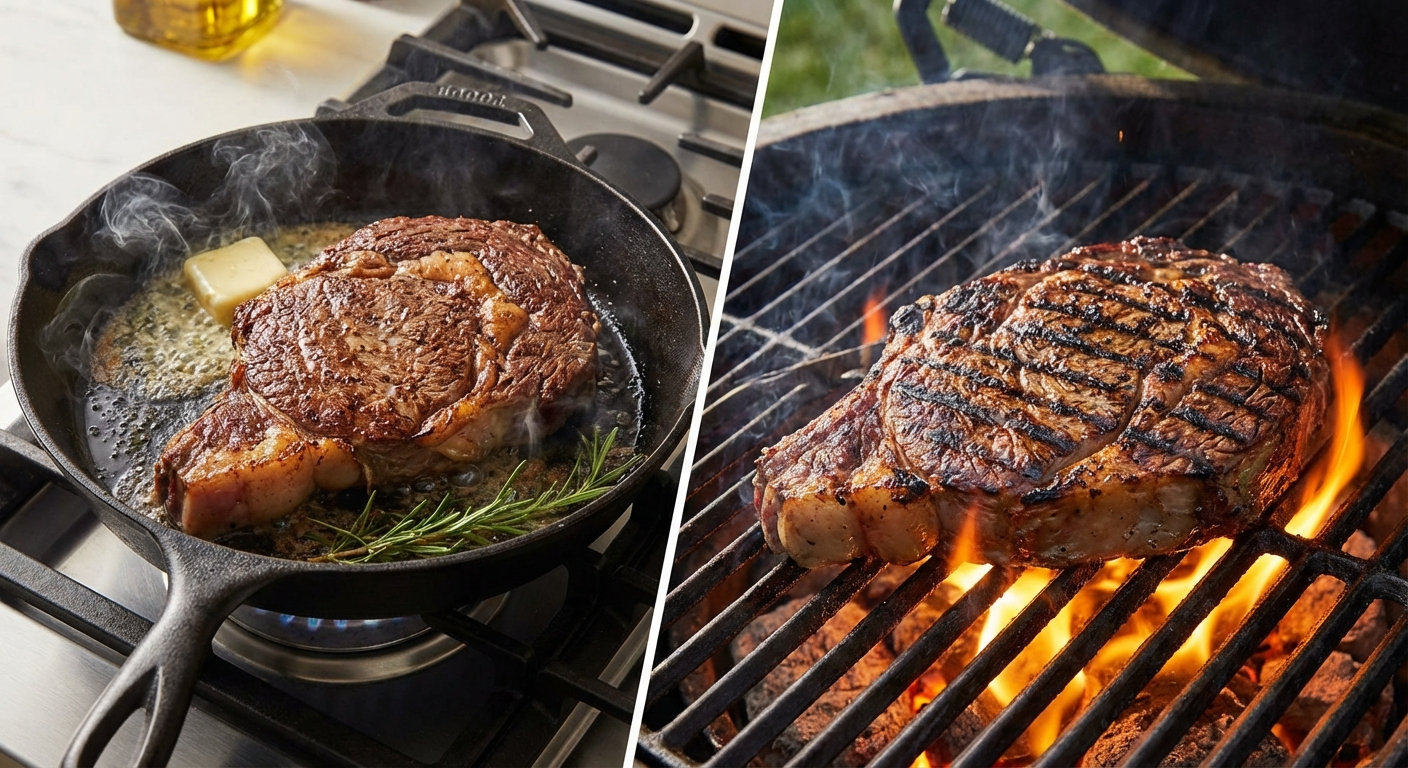
Grill vs Cast Iron for Steak: The Science of Which Method Wins
Ask any group of steak enthusiasts whether grill or cast iron produces a better steak, and you will start an argument that lasts all evening. Both sides have passionate defenders. Both sides are partially right.
The real answer is not about preference — it is about physics. The grill and the cast iron skillet transfer heat to your steak through fundamentally different mechanisms, and those mechanisms produce measurably different results in crust development, interior doneness, flavor complexity, and moisture retention. Understanding the science lets you choose the right tool for the result you want.
The Three Modes of Heat Transfer
Every cooking method uses some combination of conduction, convection, and radiation. The ratio between these three determines what happens to your steak.
Cast Iron: Conduction Dominant
When a steak sits on a cast iron skillet, heat transfers primarily through conduction — direct contact between two solid surfaces. The pan's metal molecules vibrate against the steak's surface molecules, transferring thermal energy at the point of contact.
Cast iron's advantage is its thermal mass. A 12-inch cast iron skillet weighs 8 pounds and stores enormous amounts of heat energy. When a cold steak hits the surface, the pan's temperature drops — but because of all that stored energy, it recovers quickly. The surface temperature stays high enough for continuous Maillard browning without the stalling that lighter pans experience.
The critical factor: conduction requires contact. Every square millimeter of steak touching the pan is browning. Every gap — every tiny air pocket between the meat and the metal — is not. A flat cast iron surface can contact nearly 100% of the steak's bottom face. This is why cast iron produces the most uniform, edge-to-edge crust of any cooking method.
Grill: Radiation and Convection Dominant
A grill transfers heat through a combination of radiation (infrared energy from the hot coals or burners) and convection (hot air moving around the meat). The grill grates add a small amount of conduction, but only at the narrow strips where metal meets meat — typically 15-20% of the steak's surface area.
This changes the physics dramatically. Radiation heats the entire exposed surface evenly, but at lower intensity than direct conduction. The grate marks get the most intense heat (conduction from the metal), while the spaces between grates receive only radiation and convection. The result is the characteristic crosshatch sear pattern — beautiful, but not a continuous crust.
Crust Formation: Cast Iron Wins on Coverage
The Maillard reaction — the chemical browning that creates steak flavor — happens at the surface. More browned surface area means more flavor compounds. This is simple arithmetic.
A cast iron skillet browns 90-100% of the steak's contact face. A grill grate browns 15-20% through conduction, with the remaining surface receiving gentler radiant heat that produces lighter browning. If you measure total Maillard reaction products (melanoidins and volatile aromatics), cast iron wins by a significant margin.
This is why steakhouse kitchens overwhelmingly use flat cooking surfaces — flat-top griddles, cast iron, or broilers with intense overhead radiation. They are optimizing for maximum crust, because crust is where steak flavor lives.
The Exception: Grill Marks Are Not Just Cosmetic
The concentrated heat at grill grate contact points produces deeper localized browning than the uniform browning on cast iron. Those dark grill marks contain a higher concentration of Maillard products per square millimeter. Some people perceive this as a more intense, slightly charred flavor that they associate specifically with grilled steak. It is a different flavor profile — not less flavor, but differently distributed flavor.
Smoke and Flavor: The Grill's Advantage
Here is where the grill pulls ahead. When fat and juices drip from the steak onto hot coals, burner covers, or flavorizer bars, they vaporize instantly. These vaporized compounds rise back up and deposit on the steak's surface. This process — called flavor vaporization and re-deposition — adds a layer of smoky, complex flavor that cast iron cannot replicate.
The compounds deposited include:
- Guaiacol and syringol — smoky, aromatic phenols from wood combustion (charcoal grills)
- Vaporized fat compounds — when beef fat hits 500°F+ surfaces, it breaks down into volatile fatty acids and aldehydes that smell intensely beefy
- Pyrazines and furans — formed when dripped juices undergo their own Maillard reaction on the hot surfaces below
A cast iron steak tastes like perfectly seared beef. A grilled steak tastes like perfectly seared beef plus smoke, vaporized fat, and the complex aromatics of an open fire. For many people, that additional layer of flavor is what makes grilled steak irreplaceable.
Temperature Control: Cast Iron Wins on Precision
A cast iron skillet on a stovetop gives you precise, adjustable heat. You can preheat to exactly the temperature you want, monitor it with an infrared thermometer, and adjust the burner in real time. The reverse sear method — oven to 115°F, then a 60-second cast iron sear — is arguably the most precise steak-cooking technique ever developed.
A grill is inherently less precise. Charcoal grills have hot spots and cool spots. Gas grills vary across the cooking surface. Wind affects temperature. Opening the lid drops it 50-100°F instantly. You can manage these variables with experience, but the grill will never match the stovetop's precision.
For thick steaks where hitting an exact internal temperature matters, cast iron (especially with the reverse sear) gives you the tightest control. For thinner steaks or casual cooking where a few degrees either way does not matter, the grill's imprecision is irrelevant.
The Moisture Question
Cast iron cooking keeps the steak in constant contact with its own rendered fat and juices. Those liquids pool around the steak, creating a shallow-fry effect that aids browning but can also steam the surface if the pan is not hot enough.
Grill cooking allows fat and juices to drip away through the grates. The steak loses more total moisture, but the surface stays drier — which can actually help crust formation because a dry surface reaches Maillard temperatures faster than a wet one.
Research on cooking losses shows that grilled steaks lose 2-4% more total weight than pan-seared steaks cooked to the same internal temperature. The difference is small but measurable. Whether this matters depends on the cut — a well-marbled American Wagyu ribeye has fat to spare, while a lean filet mignon benefits from retaining every drop of moisture.
Head-to-Head: When to Use Each Method
Choose Cast Iron When:
- You want maximum crust. No method produces more uniform browning. Period.
- You are cooking thick steaks (1.5 inches+). The reverse sear with a cast iron finish is the gold standard for edge-to-edge precision.
- You want to butter-baste. Adding butter, garlic, and thyme to a cast iron skillet in the final 30 seconds creates a self-basting effect impossible on a grill.
- Weather is bad. Cast iron works year-round, indoors, regardless of conditions.
- You are cooking lean cuts. Filet mignon, eye of round, or other low-fat cuts benefit from cooking in their own rendered fat rather than losing it through grill grates.
Choose the Grill When:
- You want smoke flavor. Cast iron cannot replicate the flavor of vaporized fat hitting hot coals and rising back onto the steak.
- You are cooking fatty cuts. Ribeyes and bone-in steaks with generous marbling benefit from fat rendering away through the grates rather than pooling.
- You want grill marks. Presentation matters, and the crosshatch pattern is iconic.
- You are cooking for a crowd. A grill handles 6-8 steaks at once. A cast iron skillet handles 1-2.
- You want the outdoor cooking experience. Sometimes the ritual of grilling — the fire, the smoke, the tending — is part of the meal.
The Best of Both Worlds: Hybrid Methods
The smartest approach borrows from both methods.
Grill-to-Cast-Iron Finish
Cook the steak over indirect heat on the grill (225-275°F) to build smoke flavor and bring the interior up slowly. When it hits 10-15°F below your target, move it to a screaming-hot cast iron skillet (preheated on the grill's hottest burner or on the stovetop) for a 60-second sear per side. You get the grill's smoke and the cast iron's crust.
Cast-Iron-to-Grill Finish
Reverse the sequence. Sear the steak in cast iron first for maximum crust, then transfer to the grill's indirect zone to finish cooking gently. The steak absorbs a hint of smoke during the finishing phase. Less common, but effective for steaks that need both a hard sear and a longer, gentler cook.
Cast Iron on the Grill
Place a cast iron skillet directly on the grill grates over high heat. The grill preheats the pan to temperatures that exceed most home stovetops — 700°F+ is achievable. You get the full-contact sear of cast iron with the superior heat output of an outdoor grill. This is my personal favorite method for a single steak when I want the absolute best crust.
What the Data Shows
In controlled comparisons of 1.5-inch USDA Choice ribeyes cooked to 131°F internal, here is what the numbers reveal:
- Crust coverage: Cast iron 92%, grill grates 18%, grill with pressing 25%
- Total cooking loss: Cast iron 18.2%, grill 21.6%
- Surface browning depth: Cast iron 0.8mm uniform, grill marks 1.2mm at contact / 0.3mm between
- Internal temperature uniformity: Cast iron ±2°F edge to center, grill ±5°F edge to center
- Flavor preference (blind tasting, n=24): Cast iron 42%, grill 46%, no preference 12%
The data confirms what experience suggests: cast iron produces better crust and more precise cooking. The grill produces more complex flavor from smoke and vaporization. In blind tastings, the two methods are statistically tied in overall preference — people who value crust lean cast iron, and people who value smoky complexity lean grill.
Practical Tips for Each Method
Cast Iron Best Practices
- Preheat for 5+ minutes over the highest heat your stove produces. The pan should be above 500°F before the steak goes in.
- Use minimal oil. A thin film of high-smoke-point oil (avocado, refined safflower) prevents sticking. Too much oil creates a barrier that reduces contact.
- Do not move the steak for the first 60-90 seconds. Let the crust form before you flip.
- Press gently. Contrary to myth, gentle pressing improves contact and crust formation. It does not squeeze out juices.
- Ventilate. Cast iron searing produces significant smoke. Turn on the range hood or open a window.
Grill Best Practices
- Set up two zones. Direct heat for searing, indirect for finishing. This is non-negotiable for steaks thicker than 1 inch.
- Preheat with the lid closed for at least 15 minutes. Grill grates need time to absorb and store heat.
- Clean and oil the grates. A clean grate prevents sticking and ensures consistent grill marks. Oil a folded paper towel with tongs and wipe the grates just before cooking.
- Leave the lid open during searing. You want direct radiant heat, not convective oven heat. Close the lid only during indirect cooking.
- Minimize flipping. One flip for searing (2-3 minutes per side over direct heat). More flips reduce grill mark definition and crust formation.
The Bottom Line
Cast iron delivers the best crust. The grill delivers the best flavor complexity. Neither is objectively superior — they are tools optimized for different outcomes.
If you own both, use both. Sear a filet mignon in cast iron for wall-to-wall crust. Grill a thick ribeye over charcoal for smoke and fire. And for the absolute best steak of your life, put a cast iron skillet on your grill, preheat it until it glows, and get the best of everything in one cook.
The physics do not care about your loyalty to one method. They care about contact, temperature, and time. Master those three variables with either tool, and every steak will be exceptional.
Frequently Asked Questions
Is cast iron or grill better for steak?
Neither is objectively better — they excel at different things. Cast iron produces a more uniform crust (90-100% surface browning vs 15-20% on grill grates) and offers more precise temperature control. The grill adds smoke flavor and complex aromatics from vaporized fat dripping onto hot surfaces. In blind taste tests, preference is roughly split 50/50.
Why do steakhouses use cast iron instead of grills?
Steakhouses prioritize maximum crust formation, which is where the most intense steak flavor lives. Cast iron and flat-top griddles contact nearly 100% of the steak surface, producing uniform Maillard browning. They also offer consistent, repeatable results — critical in a restaurant serving hundreds of steaks per night.
Can you get grill flavor from cast iron?
Not fully. The smoky, complex flavor from grilling comes from fat and juices vaporizing on hot coals or burner covers and re-depositing on the steak. Cast iron does not replicate this process. You can add a small amount of liquid smoke or smoked salt, but it is not the same as the hundreds of flavor compounds generated by actual fire and vaporization.
Should I use cast iron on my grill?
Yes — this is an excellent hybrid method. A cast iron skillet on a grill preheats to 700°F+, often exceeding what home stovetops can achieve. You get the full-contact sear of cast iron with superior heat output. This is particularly effective for the reverse sear method: cook the steak over indirect grill heat for smoke flavor, then finish in the cast iron for maximum crust.
Does pressing a steak in cast iron squeeze out juices?
No, this is a persistent myth. Gentle pressing improves contact between the steak and the pan, which increases crust formation without measurably affecting moisture retention. The pressure required to actually squeeze moisture from muscle fibers is far greater than what you would apply with a spatula. Press gently and you will get a better sear.
What is the best steak cut for grilling vs cast iron?
Fatty, well-marbled cuts like ribeye work well on the grill — the fat renders and drips away rather than pooling. Leaner cuts like filet mignon benefit from cast iron, where they cook in their own rendered fat. For thick cuts (1.5 inches+), the reverse sear with a cast iron finish gives the best combination of even cooking and crust.
More Expert Guides
Steak Doneness Temperature Guide: The Science of Every Level from Rare to Well Done
Every degree matters. This science-backed guide covers the exact internal temperatures for every steak doneness level, why each temperature produces a different texture, and how to nail your target every time.
14 min readDirect vs Indirect Heat Grilling: The Science of Two-Zone Cooking
Direct heat sears. Indirect heat roasts. Understanding the physics of each — and when to combine them — is the foundation of every great grilling technique.
14 min readResting Meat After Cooking: The Science of Why It Makes Every Steak Juicier
Resting meat after cooking is not optional — it is physics. Here is exactly what happens inside the steak during those crucial minutes and how long to rest every cut.