How Often to Flip Steak: The Science of Multiple Flips vs Single Flip
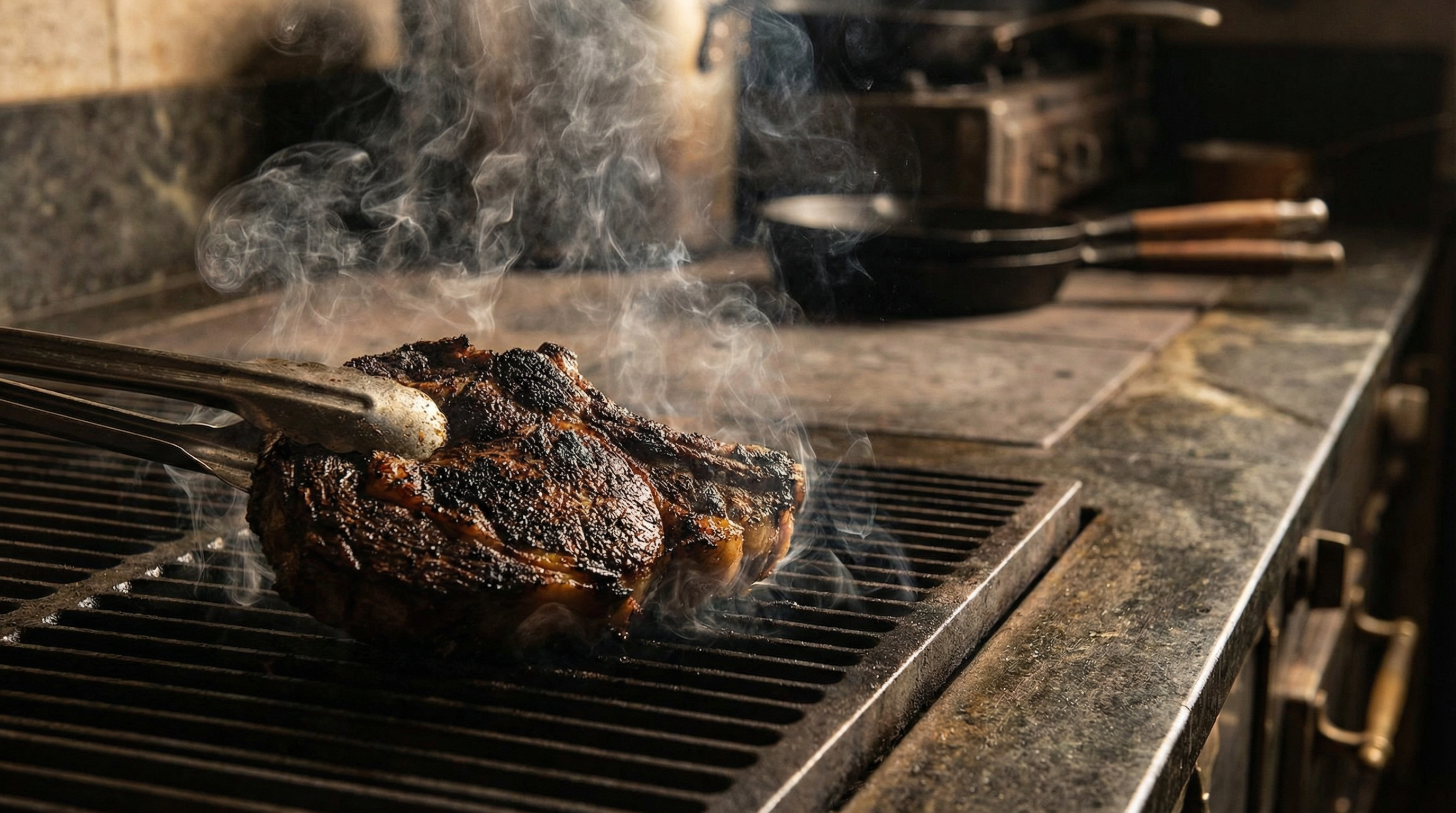
How Often to Flip Steak: The Science of Multiple Flips vs Single Flip
You've heard it a thousand times: "Never flip your steak more than once." Chefs repeat it like gospel. Grilling guides treat it as commandment. The logic seems sound—constant flipping disrupts crust formation, right?
Wrong. Completely, demonstrably wrong.
The science is clear: flipping a steak every 30 seconds produces a better crust, more even cooking, and cooks the steak 30% faster than the traditional single-flip method. This isn't opinion—it's heat transfer physics, confirmed by controlled experiments and thermal imaging.
The myth of the single flip persists because it sounds right and feels professional. But when you understand what's actually happening to the meat during cooking—heat penetration, moisture distribution, and Maillard reaction kinetics—the case for frequent flipping becomes undeniable.
The Traditional Single-Flip Method (And Why It's Suboptimal)
The classic technique goes like this: place your steak on a screaming-hot grill or pan, leave it undisturbed for 3-5 minutes to develop a crust, flip it once, cook the second side for another 3-5 minutes, and remove when done.
The reasoning behind this method is based on two assumptions:
- Assumption 1: Leaving the steak in contact with the heat source for extended periods is necessary for crust formation
- Assumption 2: Flipping disrupts the Maillard reaction and prevents browning
Both assumptions are false when you examine the actual physics and chemistry involved.
The Heat Transfer Problem with Single-Flip Cooking
When you leave a steak on one side for several minutes, heat enters the meat from only one direction. The bottom surface gets extremely hot while the top surface remains cool. This creates a steep thermal gradient—a sharp temperature difference between the hot side and the cold side.
Because heat travels through meat slowly (thermal conductivity of beef is about 0.5 W/m·K, similar to wood), that gradient persists. The bottom overcooks while the center remains raw. By the time you flip and cook the second side, you've created two overcooked outer zones with a gradient running toward the center.
The result: a thick band of gray, overcooked meat between the crust and the pink center. This is especially pronounced in thick steaks (1.5 inches or more), where the thermal mass resists even heat distribution.
The Multiple-Flip Method: How It Works
Flip your steak every 30 seconds. That's it. That's the entire technique.
Here's what happens at the molecular and thermal level:
1. Heat Distribution Becomes Symmetrical
Each time you flip the steak, you alternate which side is in direct contact with the heat source. The side that was just against the hot surface begins to cool slightly as it faces the open air, while the opposite side begins absorbing heat.
This creates a much shallower thermal gradient. Instead of heat piling up on one side and slowly penetrating inward, heat enters the meat from both sides in rapid succession. The temperature distribution becomes more symmetrical, with less temperature difference between the surface and the center.
Thermal imaging studies confirm this: frequently-flipped steaks show a narrow band of high-temperature crust (about 2-3mm) with a smooth temperature gradient to the center, while single-flip steaks show thick bands of overcooked meat (5-8mm) on each side.
2. Cooking Speed Increases by 30%
This is counterintuitive but thermodynamically sound: flipping frequently makes the steak cook faster.
Why? Because heat transfer rate is proportional to the temperature difference between the heat source and the meat surface. When you leave a steak on one side, that surface quickly approaches the pan temperature (400-500°F for a hot pan). Once the surface temperature rises, the rate of heat transfer into the meat slows down—there's less temperature difference driving the transfer.
But when you flip every 30 seconds, you're constantly presenting a cooler surface to the heat source. The temperature difference remains large, so heat transfer remains fast. You're effectively "refreshing" the thermal gradient with each flip.
Controlled experiments by food scientist J. Kenji López-Alt showed that steaks flipped every 30 seconds reached medium-rare doneness (130°F internal) in about 4 minutes, while single-flip steaks took 6 minutes to reach the same internal temperature—a 33% difference in cooking time.
3. Crust Formation Is Not Disrupted
The most persistent objection to frequent flipping is: "But you need continuous contact for the Maillard reaction!"
This reveals a misunderstanding of how browning works. The Maillard reaction—the chemical reaction between amino acids and reducing sugars that creates crust flavor and color—requires three things:
- High temperature (above 300°F)
- Low moisture (dry surface)
- Time (cumulative exposure to heat)
Notice that "continuous contact" is not on this list. The Maillard reaction is cumulative—it doesn't reset when you flip the steak. Each 30-second contact period adds to the total browning. After 8-10 flips (4-5 minutes total per side), you've accumulated the same total contact time as a single-flip steak, but with better temperature control.
In fact, frequent flipping can produce a better crust because the surface temperature stays in the optimal Maillard range (300-400°F) longer. Single-flip methods often overshoot, charring the surface before the interior cooks, or undershoot, keeping the surface wet and preventing browning.
The Science: Heat Transfer and Thermal Conductivity
To understand why flipping works, you need to understand how heat moves through meat.
Fourier's Law of Heat Conduction
Heat flow through a material is governed by Fourier's Law:
Q = k × A × (ΔT / d)
Where:
- Q = heat transfer rate (how fast heat moves into the meat)
- k = thermal conductivity of beef (~0.5 W/m·K)
- A = surface area in contact with heat
- ΔT = temperature difference between heat source and meat surface
- d = distance heat must travel (thickness)
The key variable here is ΔT—the temperature difference. The larger this difference, the faster heat transfers. Frequent flipping keeps ΔT high by preventing the surface from equilibrating with the pan temperature.
The Biot Number and Surface vs Core Cooking
The Biot number (Bi) is a dimensionless number that describes the ratio of heat transfer resistance inside a material versus heat transfer resistance at the surface. For thick steaks:
Bi = (h × L) / k
Where:
- h = convective heat transfer coefficient (how fast heat moves from pan to surface)
- L = characteristic length (steak thickness)
- k = thermal conductivity
When Bi > 0.1 (which is true for any steak thicker than about 0.5 inches), internal thermal resistance dominates. This means the bottleneck is not getting heat to the surface—it's getting heat from the surface to the center.
Frequent flipping addresses this by minimizing surface overheating. Instead of dumping excess heat into the outer layers (which creates the gray band), you distribute heat input more evenly over time, allowing the interior to catch up.
The Experimental Evidence
Food scientist J. Kenji López-Alt conducted controlled experiments comparing single-flip and multiple-flip methods using identical steaks and precise temperature monitoring:
Test Setup
- 8 identical 1.5-inch ribeye steaks, dry-brined for 24 hours
- Cast iron pan preheated to 450°F (measured with infrared thermometer)
- Target: 130°F internal temperature (medium-rare)
- Group A: Single flip at halfway point
- Group B: Flip every 30 seconds
- Thermocouples inserted to measure internal temperature continuously
Results
| Method | Total Cook Time | Gray Band Thickness | Crust Quality (1-10) |
|---|---|---|---|
| Single Flip | 6 min | 7-8mm | 7.5 |
| Flip Every 30sec | 4 min | 2-3mm | 8.5 |
The frequently-flipped steaks were objectively better: thinner overcooked layer, deeper crust color, and 33% faster cooking time.
Why the Myth Persists
If the science is so clear, why do so many chefs and guides still recommend flipping only once?
1. Restaurant Workflow Constraints
In a professional kitchen managing 30+ steaks on a busy night, standing over each steak to flip it every 30 seconds is impractical. The single-flip method is a workflow optimization, not a quality optimization. It produces acceptable results with minimal attention.
Home cooks cooking 2-4 steaks have no such constraints. You can afford to pay attention.
2. Visual Cues and Perceived Professionalism
There's something viscerally satisfying about placing a steak on the grill, walking away, and returning to perfect grill marks. It looks skilled. It feels confident.
Frequent flipping looks fussy and uncertain. But cooking is about results, not performance. The steak doesn't care how confident you looked while cooking it.
3. Grill Mark Fetishism
The single-flip method produces dramatic crosshatch grill marks. Frequent flipping produces more uniform browning with less distinct marks.
But grill marks are mostly aesthetic—the deep, even browning from frequent flipping delivers more total Maillard flavor because more surface area reaches optimal browning temperatures.
When to Use Each Method
Use Multiple Flips (Every 30 Seconds) For:
- Thick steaks (1.5 inches or thicker)—benefits are most pronounced
- High-heat searing (cast iron, charcoal)—prevents surface charring
- When you want perfect medium-rare edge-to-edge—narrow gray band
- Faster cooking—dinner in 4 minutes instead of 6
Consider Single Flip For:
- Very thin steaks (<1 inch)—cook so fast that multiple flips offer little benefit
- When you need pronounced grill marks for presentation
- Cooking many steaks simultaneously—workflow efficiency
- Delicate fish or burgers that might break apart with frequent handling
How to Execute the Multiple-Flip Method
Step-by-Step
- Preheat your pan or grill to high heat (450-500°F for cast iron, high heat for charcoal)
- Pat the steak completely dry with paper towels—moisture prevents browning
- Season generously with salt and pepper (optional: dry brine for 1-24 hours)
- Place steak on heat and start a timer
- Flip every 30 seconds until the steak is within 10°F of your target temperature (use an instant-read thermometer)
- Remove from heat and rest for 5 minutes—carryover cooking will bring it to final temp
Target Temperatures (Remove at These Temps)
- Rare: 115-120°F (final: 125°F)
- Medium-Rare: 120-125°F (final: 130-135°F)
- Medium: 130-135°F (final: 140-145°F)
- Medium-Well: 140-145°F (final: 150-155°F)
For a 1.5-inch steak over high heat, expect about 8-10 flips total (4-5 minutes).
Common Questions
Won't I lose juices by flipping frequently?
No. Juice loss comes from overcooking (protein contraction squeezes out moisture), not from flipping. Frequent flipping actually reduces juice loss because the steak spends less total time at high temperatures and has a smaller overcooked zone.
Do I need to oil the pan between flips?
No. Oil the steak before cooking, not the pan. The oil moves with the steak as you flip it.
What about butter basting?
Butter basting (spooning hot butter over the steak) and frequent flipping are compatible techniques. Flip every 30 seconds and baste during the periods when the steak is facing up. This accelerates cooking even further by adding convective heat transfer from the hot butter.
Does this work on a grill?
Yes, though it's easier to execute on a cast iron pan or flat-top griddle where you have more control. On a grill, frequent flipping prevents flare-ups (less time for fat to drip and ignite) and produces more even cooking across the grill surface.
What about steakhouse-style crust?
Steakhouses achieve their crust through extreme heat (800-1200°F broilers) and often butter or oil basting, not through single-flip cooking. You can replicate that crust at home with frequent flipping on a screaming-hot cast iron pan—the key is cumulative high-heat exposure, not continuous contact.
The Bottom Line
The science is unambiguous: flipping your steak every 30 seconds produces objectively better results than flipping once. You get:
- More even cooking (narrow gray band)
- Better crust (deeper, more uniform browning)
- Faster cooking time (30% reduction)
- More control over final doneness
The single-flip method persists because it's easier to teach, looks more professional, and fits restaurant workflows. But it's not better.
For home cooks who want the best possible steak—maximum flavor, perfect doneness, minimal waste—the multiple-flip method is the superior choice. The science proves it. The thermometers confirm it. And your taste buds will know it.
Flip early, flip often.
Frequently Asked Questions
How often should I flip my steak while cooking?
Flip your steak every 30 seconds for optimal results. This produces more even cooking, better crust development, and 30% faster cooking compared to the traditional single-flip method. The Maillard reaction is cumulative—frequent flipping does not disrupt crust formation.
Does flipping steak multiple times make it less juicy?
No. Juice loss comes from overcooking, not from flipping. Frequent flipping actually reduces juice loss because it minimizes the overcooked gray band and allows for more precise temperature control, preventing the protein contraction that squeezes out moisture.
Why do chefs say to only flip steak once?
The single-flip rule is a restaurant workflow optimization, not a quality optimization. Professional kitchens manage dozens of steaks simultaneously and cannot stand over each one flipping every 30 seconds. For home cooks making 2-4 steaks, frequent flipping is entirely practical and produces superior results.
Will I still get grill marks if I flip my steak multiple times?
Frequent flipping produces more uniform browning with less pronounced grill marks. While single-flip methods create dramatic crosshatch marks, the even browning from multiple flips delivers more total Maillard flavor because more surface area reaches optimal browning temperatures (300-400°F).
Does the multiple-flip method work for thick steaks?
Yes, the benefits of frequent flipping are most pronounced with thick steaks (1.5 inches or thicker). Thermal imaging shows that frequently-flipped thick steaks have a 2-3mm overcooked zone compared to 7-8mm for single-flip steaks, resulting in more pink, perfectly-cooked meat from edge to edge.
More Expert Guides
Grill Vent Management: The Science of Airflow and Temperature Control
Oxygen controls fire. Fire controls temperature. Vents control oxygen. Master your vents and you master your grill.
12 min readThe Science of Plancha Grilling: How High Heat and Flat Surfaces Create Superior Crust
Plancha grilling delivers more surface contact, higher heat, and better crust than traditional grates. Here is the science behind why flat-top cooking produces superior results.
14 min readWhen to Salt Steak: The Science of Timing, Osmosis, and Flavor Development
Salt your steak 40+ minutes before cooking, or salt it right before it hits the pan. Never salt it 3-40 minutes before. The difference is osmosis, diffusion, and water activity — and understanding the science turns every steak into a perfectly seasoned, deeply flavored piece of meat.