Carryover Cooking: Why Your Meat Keeps Cooking After You Remove It from Heat
Carryover Cooking: Why Your Meat Keeps Cooking After You Remove It from Heat
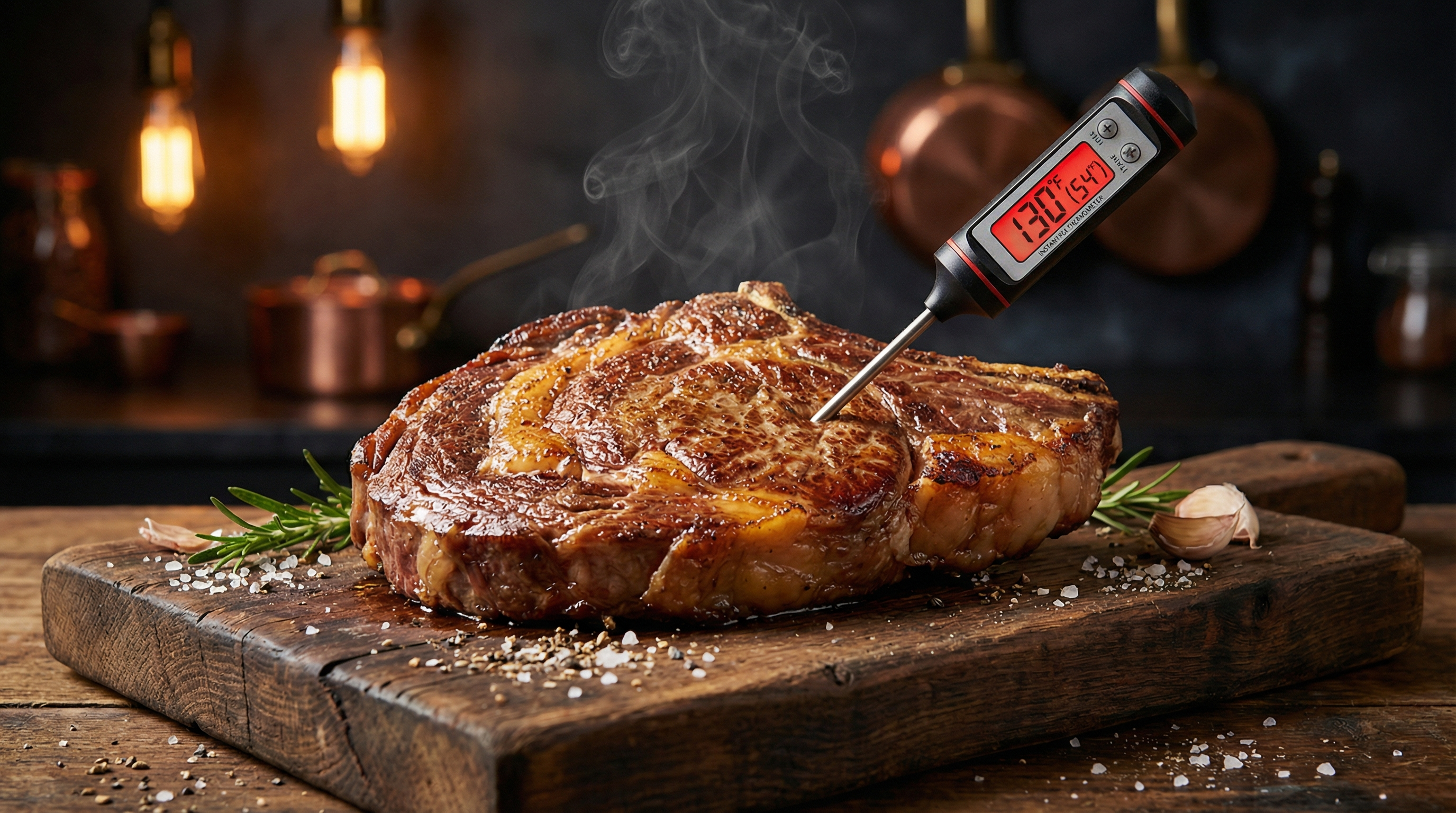
You pull a beautiful ribeye off the grill at exactly 130°F. Ten minutes later, you slice into it and the thermometer reads 143°F. That's medium — not the medium-rare you planned. The steak kept cooking on the cutting board, and nobody warned you how much.
This is carryover cooking, and misunderstanding it is the single most common reason home cooks overshoot their target doneness. Once you understand the thermal physics behind it, you'll never overcook a steak again.
What Is Carryover Cooking?
Carryover cooking is the continued rise in a food's internal temperature after it has been removed from the heat source. It's not residual heat from the air around the steak or from the cutting board. It's thermal energy that was already stored inside the meat — specifically in the hotter outer layers — flowing inward toward the cooler center.
Think of it this way: when you cook a steak, the outside gets much hotter than the inside. A seared steak's outer 5mm might be 350°F while the geometric center is 125°F. That's a 225-degree temperature difference within a few centimeters of meat. When you remove the steak from heat, that energy doesn't vanish. It follows the second law of thermodynamics: heat flows from hot regions to cold regions until equilibrium is reached.
The center temperature rises. The outer temperature falls. They meet somewhere in the middle. For a typical steak, this process takes 5–10 minutes and can raise the center temperature by 5–15°F depending on cooking method, thickness, and how aggressively you seared.
The Physics: Fourier's Law in Action
Carryover cooking is governed by Fourier's law of heat conduction, which states that the rate of heat transfer through a material is proportional to the temperature gradient — the steepness of the temperature difference between adjacent layers.
The steeper the gradient, the faster heat flows. A steak pulled from a 700°F cast iron skillet has a much steeper gradient than one pulled from a 250°F oven. That's why cooking method has such a dramatic effect on carryover magnitude.
The relevant equation is:
q = -k × (dT/dx)
Where q is the heat flux, k is the thermal conductivity of beef (approximately 0.5 W/m·K), and dT/dx is the temperature gradient. You don't need to calculate this — but understanding the principle tells you everything: steeper gradient = more carryover.
How Much Carryover to Expect by Cooking Method
I've measured carryover across hundreds of steaks using calibrated thermocouple probes placed at the geometric center. Here are the ranges you can rely on:
| Cooking Method | Typical Carryover | Why |
|---|---|---|
| Direct high-heat grilling (600°F+) | 8–15°F | Extremely hot outer layers create steep gradient |
| Traditional sear-first, oven finish | 5–10°F | Hot sear + moderate oven builds significant stored energy |
| Reverse sear (low oven + sear) | 3–5°F | Gentle oven phase creates shallow gradient; brief sear adds modest energy |
| Sous vide + sear | 2–4°F | Nearly uniform internal temp; only the sear contributes gradient |
| Large roast (prime rib, whole turkey) | 10–25°F | Enormous thermal mass stores massive energy reserves |
| Smoked brisket (low and slow) | 5–10°F | Moderate gradient despite long cook; large mass amplifies effect |
The pattern is clear: higher cooking temperatures and larger cuts produce more carryover. A thin steak reverse-seared with a brief sear might carryover only 3°F. A 12-pound prime rib pulled from a 350°F oven can climb 20°F or more during a 20-minute rest.
How Thickness Affects Carryover
Thickness is the second-most important variable after cooking method. A thicker steak contains more total thermal energy and has a longer distance for heat to travel from the outer layers to the center.
My measurements across different thicknesses (all cooked by direct grilling to 125°F center temp):
| Steak Thickness | Carryover (Direct Grill) | Peak Time After Removal |
|---|---|---|
| 3/4 inch | 3–5°F | 2–3 minutes |
| 1 inch | 5–8°F | 3–4 minutes |
| 1.5 inches | 8–12°F | 4–6 minutes |
| 2 inches | 10–15°F | 5–8 minutes |
| 2.5 inches (tomahawk) | 12–18°F | 6–10 minutes |
Notice the peak time column — thicker steaks take longer to reach their maximum carryover temperature. A 2-inch ribeye might not hit its peak until 7 minutes after removal. Patience during the rest isn't optional; it's physics.
Carryover Cooking by Protein Type
Different proteins have different thermal properties, and the size of the cut matters enormously. Here's what to expect beyond steak:
Beef Roasts
A standing rib roast (prime rib) is the poster child for dramatic carryover. The large thermal mass stores enormous energy. Pull a 7-pound prime rib from a 325°F oven at 120°F internal, and it will peak at 135–140°F during a 20-minute rest. That's 15–20°F of carryover — enough to jump two entire doneness levels if you're not accounting for it.
Rule for beef roasts: Pull 15–20°F below your target final temperature. For medium-rare prime rib (130–135°F final), pull at 115°F.
Pork
Pork chops (1–1.5 inches) behave similarly to beef steaks — expect 5–10°F of carryover. The USDA now recommends 145°F final temp for whole-muscle pork with a 3-minute rest. Pull your pork chops at 135–140°F.
Pork tenderloin, being cylindrical with a small diameter, has moderate carryover of 5–8°F. Pork shoulder and other large roasts follow the big-roast rules — 10–15°F carryover.
Poultry
A whole chicken or turkey has dramatic carryover in the breast (the thickest part). A whole roast chicken pulled at 155°F breast temp will typically reach 165°F during a 15-minute rest. The thighs, being smaller, carryover less.
Important: For food safety, poultry must reach 165°F at the thickest point of the breast. But you don't need to cook it to 165°F — you can pull at 155°F and let carryover finish the job. The meat is pasteurized at 165°F instantaneously, but also at 155°F if held for 50 seconds (per USDA time-temperature tables). Carryover provides that hold time naturally.
Fish
Fish fillets are thin and delicate, with minimal carryover — typically 2–5°F. Because fish overcooks quickly and the margin between perfect and dry is narrow (especially for salmon, which many people prefer at 120–125°F), even small carryover matters. Pull salmon fillets 3–5°F below your target.
The Pull Temperature Equation
Here's the formula for calculating your pull temperature:
Pull Temperature = Target Final Temp − Expected Carryover
For a 1.5-inch ribeye grilled over direct heat, targeting 131°F (medium-rare):
Pull at 131 − 10 = 121°F
For the same steak using the reverse sear method, where carryover includes both the sear addition and post-sear rest:
Pull from oven at 115°F → Sear adds ~12°F → Rest adds ~4°F → Final: ~131°F
The reverse sear makes the math more complex because you have two heat additions (sear + carryover), but the total is predictable with practice.
Comprehensive Pull Temperature Chart
These pull temperatures account for carryover from the most common method for each category:
| Cut | Target Final Temp | Pull Temp (Grill) | Pull Temp (Reverse Sear) |
|---|---|---|---|
| Steak — Rare | 120–125°F | 112–117°F | 105°F from oven |
| Steak — Medium-Rare | 130–135°F | 120–125°F | 115°F from oven |
| Steak — Medium | 140–145°F | 130–135°F | 125°F from oven |
| Prime Rib — Medium-Rare | 130–135°F | — | 115°F from oven |
| Pork Chop | 145°F | 135–138°F | 130°F from oven |
| Chicken Breast | 165°F | 155–158°F | — |
| Salmon Fillet | 125°F | 120°F | — |
For premium American wagyu steaks with high intramuscular fat, the fat acts as both insulator and thermal reservoir. Expect 1–2°F more carryover than lean cuts of the same thickness — the rendered fat retains heat slightly longer than lean muscle.
Why the Reverse Sear Minimizes Carryover
The reverse sear method produces the least carryover of any conventional cooking method (excluding sous vide), and the reason is pure physics.
During the low-oven phase (225–275°F), the entire steak slowly equilibrates toward the oven temperature. By the time you pull it, the outer layers might be 130°F and the center might be 115°F — a gradient of only 15°F. Compare that to a direct-grilled steak where the outer layers hit 300°F+ while the center is at 125°F — a gradient of 175°F.
Less stored energy in the outer layers means less energy flowing inward after removal. The brief 45–60 second sear adds some energy to the surface, but it doesn't have time to penetrate deeply. The result: highly predictable, minimal carryover that gives you precise control over your final temperature.
This is why the reverse sear has become the method of choice for precision-focused home cooks and for anyone cooking expensive cuts where overshooting by even 5°F means the difference between a $50 perfect steak and a $50 overcooked one.
Monitoring Carryover in Real Time
The best way to understand carryover is to watch it happen. Use a leave-in probe thermometer (ThermoWorks Smoke, Signals, or similar) during both cooking and resting.
After you pull the steak from heat, leave the probe inserted and observe:
- Minutes 0–2: Temperature rises quickly as heat flows from the hot outer layers inward
- Minutes 2–5: Rise slows as the gradient flattens
- Minutes 5–8: Temperature peaks and begins a slow decline as heat dissipates to the air
The peak reading is your actual final doneness temperature. Once you've observed this pattern a few times with your preferred cooking method, you'll internalize exactly when to pull for your target.
Factors That Increase Carryover
Understanding what amplifies carryover helps you adjust your pull temperature for any situation:
- Higher cooking temperature: A 700°F sear stores more surface energy than a 500°F sear
- Thicker cut: More thermal mass = more stored energy = higher carryover
- Bone-in cuts: Bone conducts heat differently than muscle and can act as a thermal reservoir, adding 1–2°F of additional carryover
- Higher fat content: Intramuscular fat retains heat slightly longer than lean muscle
- Foil tenting: Wrapping in foil traps heat and slows surface cooling, increasing carryover by 2–5°F
- Resting on a hot surface: A preheated plate or warm cutting board slows cooling from the bottom
Factors That Decrease Carryover
- Low cooking temperature: Reverse sear and sous vide minimize the gradient
- Thin cuts: Less mass = less stored energy = lower carryover
- Cool resting surface: A room-temperature wire rack allows maximum air circulation
- No foil tent: Open air allows the surface to cool, pulling heat outward
- Fan or cool environment: Increased airflow accelerates surface cooling
Emergency Moves: When You Overshoot
If you realize your steak is already at or above your target temp when you pull it, you need to stop carryover as quickly as possible:
- Transfer to a cool wire rack immediately — maximize air exposure on all sides
- Move to a cooler area — away from the hot grill or stove
- Do NOT tent with foil — this traps heat and makes the problem worse
- Last resort: brief ice bath — submerge the steak in ice water for 2–3 seconds. This kills the carryover dead. Not ideal for crust texture, but it saves the interior doneness
The Relationship Between Resting and Carryover
Resting meat and carryover cooking are two sides of the same coin. The rest period exists primarily to let juices redistribute — but carryover is happening simultaneously during that rest.
This is actually a feature, not a bug. The rest period serves double duty: moisture redistributes while the center reaches its final temperature. The key is knowing this happens so you pull early enough. If you pull at the right temperature and rest for the right duration, you get both optimal juice retention AND perfect doneness. Pull too late, and the rest period pushes you past your target.
Common Carryover Mistakes
Mistake #1: Pulling at the Target Temperature
This is the big one. If you want 131°F medium-rare, pulling at 131°F guarantees you'll overshoot. By 5–15°F depending on your method. Pull early.
Mistake #2: Ignoring the Cooking Method Variable
Not all carryover is equal. Reverse sear carryover (3–5°F) and direct grill carryover (8–15°F) are completely different numbers. Applying a generic "pull 5°F early" rule works for some methods and fails for others.
Mistake #3: Cutting Too Soon
If you slice before the carryover peak (usually 4–8 minutes post-removal), you get two problems: the juice pours out (it hasn't redistributed yet), and the center temperature continues climbing in the sliced pieces less predictably. Let the physics finish before you cut.
Mistake #4: Tenting Everything in Foil
Foil trapping is appropriate for large roasts where you want to maintain serving temperature during a long rest. For steaks, foil increases carryover and softens the Maillard crust you worked hard to build. Leave steaks uncovered during rest.
The Bottom Line
Carryover cooking is simple thermodynamics: hot outer layers transfer energy to the cooler center after you remove meat from heat. The magnitude depends on your cooking method, the meat's thickness, and how you rest it. Account for it by pulling early — and you'll hit your target doneness with scientific precision every time.
The single best investment for mastering carryover? A good instant-read thermometer and the habit of checking every steak 5 minutes before you think it's done. The physics will do the rest.
Frequently Asked Questions
What is carryover cooking?
Carryover cooking is the continued rise in internal temperature after meat is removed from the heat source. It occurs because the hotter outer layers of the meat transfer stored thermal energy inward toward the cooler center. Depending on the cooking method and thickness, carryover can raise the center temperature by 3–15°F in steaks and up to 25°F in large roasts.
How many degrees does carryover cooking add?
It depends on cooking method and thickness. Direct grilling adds 8–15°F, traditional sear-and-oven adds 5–10°F, reverse sear adds 3–5°F, and sous vide adds 2–4°F. Thicker cuts and higher cooking temperatures produce more carryover. A 2-inch steak off a hot grill can climb 12–15°F.
When should I pull my steak off the grill for medium-rare?
For direct grilling a 1.5-inch steak targeting 131°F medium-rare, pull at 120–123°F. For reverse sear, pull from the oven at 115°F (the sear will add ~12°F, and rest carryover adds ~4°F). Always subtract your expected carryover from your target final temperature.
Does carryover cooking happen with all meats?
Yes — carryover occurs in any protein cooked with heat. The magnitude varies: large roasts (prime rib, turkey) can carryover 15–25°F, steaks 5–15°F, pork chops 5–10°F, and thin fish fillets only 2–5°F. Thicker cuts with more thermal mass always produce more carryover.
How do I stop carryover cooking if my steak is too hot?
Transfer immediately to a cool wire rack for maximum air circulation. Do not tent with foil, which traps heat. Move away from hot surfaces. In emergencies, a 2–3 second ice water dip stops carryover instantly — it compromises crust texture but saves the interior doneness.
Does the reverse sear have less carryover than grilling?
Yes — significantly less. The reverse sear creates a shallow thermal gradient (only 15–20°F between outer layers and center) compared to direct grilling (100–200°F gradient). Less stored energy in the outer layers means less heat flows inward after removal. Reverse sear carryover is typically 3–5°F versus 8–15°F for direct grilling.
More Expert Guides
Steak Doneness Temperature Guide: The Science of Every Level from Rare to Well Done
Every degree matters. This science-backed guide covers the exact internal temperatures for every steak doneness level, why each temperature produces a different texture, and how to nail your target every time.
14 min readDirect vs Indirect Heat Grilling: The Science of Two-Zone Cooking
Direct heat sears. Indirect heat roasts. Understanding the physics of each — and when to combine them — is the foundation of every great grilling technique.
14 min readResting Meat After Cooking: The Science of Why It Makes Every Steak Juicier
Resting meat after cooking is not optional — it is physics. Here is exactly what happens inside the steak during those crucial minutes and how long to rest every cut.