Water Pan in a Smoker: The Science of Humidity, Heat Regulation & Better BBQ
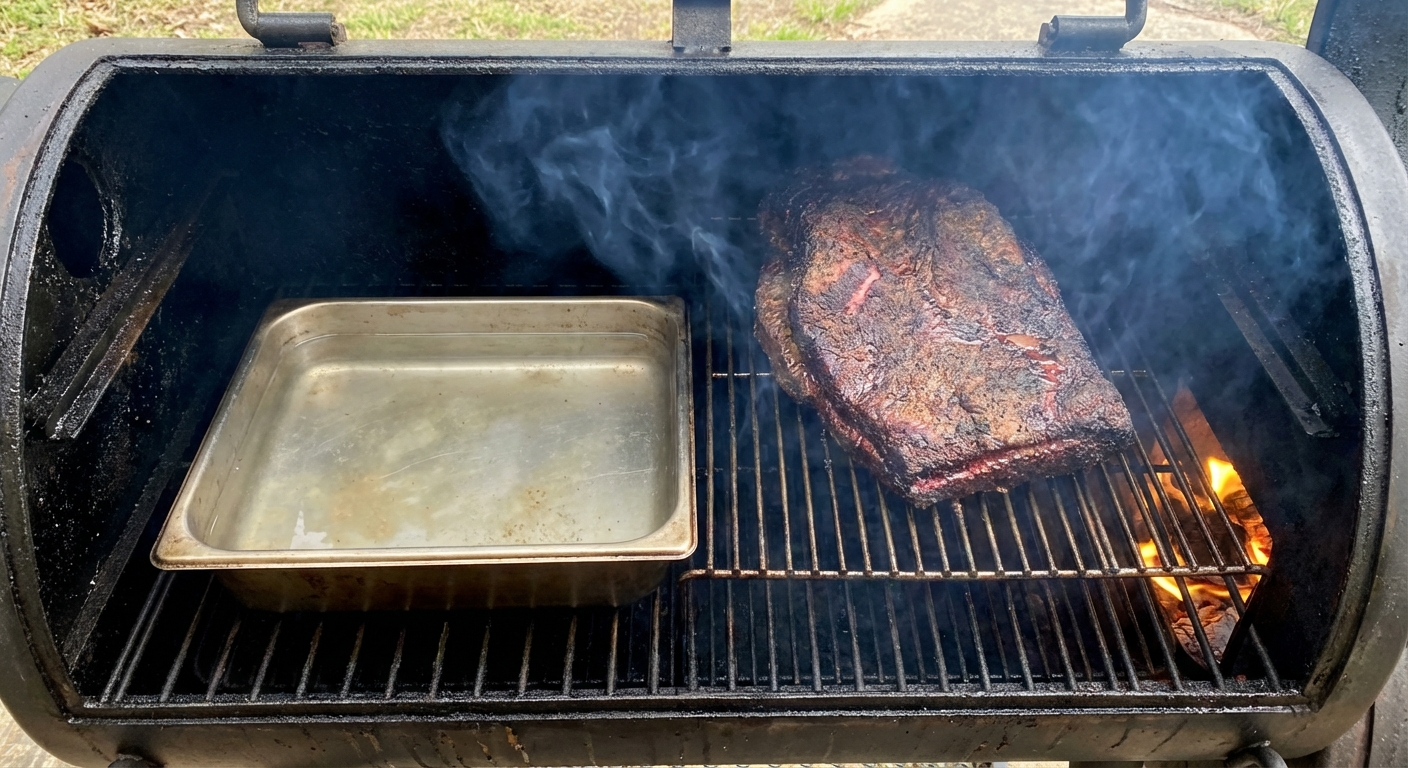
Water Pan in a Smoker: The Science of Humidity, Heat Regulation & Better BBQ
Every serious smoker — Weber Smokey Mountain, offset, kamado, pellet — either ships with a water pan or has owners arguing about whether to add one. The advice is everywhere: fill the water pan for better barbecue. But almost nobody explains why it works, and without understanding the physics, you cannot make smart decisions about when to use one, when to skip it, and what to put in it.
The water pan is not a humidifier. It is a thermal battery, an evaporative cooler, and a smoke-adhesion optimizer rolled into one cheap aluminum pan. Here is the science behind all three roles.
Role 1: Evaporative Cooling and Temperature Stability
This is the most important function of a water pan, and it has nothing to do with moisture in your meat.
Water has an extraordinarily high specific heat capacity — 4.18 joules per gram per degree Celsius, roughly four times that of air and ten times that of steel. It takes a tremendous amount of energy to change the temperature of water. When you place a pan of water inside a smoker, you are adding a massive thermal buffer that resists temperature swings.
But the real magic is phase change. Water boils at 212°F at sea level, and it cannot exceed that temperature as long as liquid water remains in the pan. The energy that would normally push your smoker hotter instead gets absorbed as latent heat of vaporization — 2,260 joules per gram, an enormous amount of energy consumed without any temperature increase.
This creates a natural temperature ceiling. If your fire flares and dumps extra heat into the cook chamber, the water pan absorbs that energy by evaporating faster rather than letting the air temperature spike. The result is a smoker that holds 225–250°F far more consistently than one without a water pan.
The Numbers
A typical water pan holds 2–4 liters. Evaporating one liter of water absorbs approximately 2.26 megajoules of energy — enough to heat 10 kilograms of steel by over 500°F. That is an enormous thermal buffer sitting quietly in your smoker, smoothing out every fire fluctuation, every gust of wind, every time you open the lid.
Without a water pan, your smoker temperature might swing 30–50°F between air vent adjustments. With one, those swings typically narrow to 10–15°F. For low-and-slow cooks where consistency matters more than peak temperature, this stability is transformative.
Role 2: Humidity and Smoke Adhesion
Smoke does not just float around and hope to land on your meat. Smoke adhesion is a surface chemistry problem, and moisture is the key variable.
Wood smoke contains hundreds of volatile compounds, but the flavor-relevant ones fall into two groups: water-soluble compounds (like syringol and guaiacol, responsible for smoky aroma) and fat-soluble compounds (like various phenols). The water-soluble compounds — which contribute the majority of perceived smoke flavor — need a wet surface to adhere to.
During the early hours of a cook, the meat surface is moist from its own juices and any applied rub. Smoke compounds dissolve into this moisture layer and are absorbed into the meat. As the cook progresses and the surface dries, smoke adhesion drops dramatically. This is why most smoke flavor is deposited in the first 2–3 hours, regardless of total cook time.
A water pan extends this adhesion window. By maintaining higher humidity inside the smoker (typically 60–80% relative humidity versus 20–40% without), the meat surface stays moist longer. The smoke ring — formed by nitrogen dioxide dissolving into surface moisture and reacting with myoglobin — also benefits directly from this extended moist phase.
The Stall Connection
Higher humidity also affects the BBQ stall. The stall occurs when evaporative cooling from the meat surface balances the heat input from the smoker, creating a temperature plateau. In a humid environment, evaporation slows down (less vapor pressure differential between the wet meat surface and the surrounding air), which means the stall is less severe and shorter.
This is a double-edged sword. A shorter stall means faster cooking, but it also means less time for collagen to break down at the plateau temperature. For brisket, where collagen conversion to gelatin is critical, a slightly longer stall at 160–170°F can actually improve the final texture. Some competition pitmasters deliberately lower humidity during the stall phase to extend it.
Role 3: Radiant Heat Shield
In vertical smokers like the Weber Smokey Mountain, the water pan sits directly between the fire and the meat. This positioning creates a radiant heat shield — the water pan intercepts direct infrared radiation from the coals and converts it into gentler convective heat.
Without this shield, the bottom of your brisket or pork shoulder receives intense direct radiant heat that can overcook the underside while the top stays underdone. The water pan eliminates hot spots by absorbing radiant energy and re-emitting it as uniform, lower-intensity thermal radiation in all directions.
This shielding effect is why many experienced WSM users report that their cooks are more even when the water pan is full versus empty. Even if you use sand or foil-wrapped bricks instead of water (a common modification), you still get the radiant shielding benefit — though you lose the evaporative cooling and humidity effects.
When to Use a Water Pan
Always Use One For:
- Low-and-slow cooks (225–250°F): Temperature stability is critical, and the extended cook time means the humidity benefits compound over hours.
- Brisket: The combination of stable temps, better smoke adhesion, and radiant shielding makes a measurable difference in bark quality and moisture retention.
- Pork shoulder and ribs: Same logic as brisket. The 3-2-1 method for ribs benefits from the first phase having higher humidity for smoke deposition.
- Vertical smokers: The radiant heat shield function is essential in these designs. Running a WSM without a water pan requires significant fire management skill.
Consider Skipping For:
- Hot-and-fast cooks (300–350°F): The evaporative cooling ceiling at 212°F fights you when you want higher chamber temps. The water pan absorbs energy you need for the cook.
- Poultry: Crispy skin requires a dry environment. High humidity softens skin and prevents rendering. Cook chicken and turkey without a water pan, or use it empty as a drip tray only.
- Short cooks under 2 hours: The thermal stabilization benefits do not have time to matter much, and you can manage temperature manually for short sessions.
Water vs Sand vs Empty Pan: The Debate
This argument has raged in BBQ forums for decades. Here is what the physics says about each option:
Water
Provides all three benefits: evaporative cooling (temperature ceiling), humidity for smoke adhesion, and radiant heat shielding. Requires refilling on long cooks as water evaporates — typically 1–2 liters every 4–5 hours at 225°F. Opening the smoker to refill causes temperature drops.
Sand (Foil-Wrapped)
Provides thermal mass for temperature stability and radiant heat shielding, but no evaporative cooling and no humidity boost. Sand has a specific heat of about 0.84 J/g/°C — one-fifth that of water — so it stabilizes temperature less effectively per unit mass. However, sand does not evaporate, so it requires zero maintenance during long cooks.
Sand also heats above 212°F, which means it can radiate heat at higher temperatures than water can. For cooks targeting 275–300°F, sand may actually help maintain temperature better than water, which is actively fighting to keep things below 212°F.
Empty Pan (Foil-Lined)
Acts as a drip tray and partial radiant shield only. No thermal mass, no humidity, no evaporative cooling. This works for hot-and-fast cooks, poultry, or situations where you want maximum heat transfer to the meat. Line it with foil for easy cleanup and to catch drippings for gravy.
The Verdict
For most low-and-slow barbecue at 225–250°F, water wins. The evaporative cooling provides unmatched temperature stability, and the humidity benefits are real and measurable in smoke flavor and bark development. Use sand for hot-and-fast or when you cannot babysit refills. Use an empty pan for poultry and short cooks.
What Temperature Does the Water Pan Actually Reach?
This is where most explanations get sloppy. The water in the pan does not boil vigorously at smoker temperatures. At 225–250°F ambient air temperature, the water surface temperature reaches approximately 190–200°F — below boiling but well into active evaporation range.
Water does not need to boil to evaporate. Evaporation occurs at any temperature when the vapor pressure of the water exceeds the partial pressure of water vapor in the surrounding air. At 190°F, evaporation is rapid and steady, producing a constant stream of water vapor without the turbulent bubbling of a full boil.
If your fire runs hot and pushes chamber temps above 275°F for extended periods, the water will reach a full boil. This actually provides even stronger temperature regulation — the phase change absorbs enormous amounts of energy — but it also depletes your water supply much faster. Check levels every 2 hours at higher temperatures.
Hot Water vs Cold Water: Does It Matter?
Start with hot water. Always.
Adding cold water to a hot smoker is thermodynamically wasteful. The fire must first heat the water from cold to operating temperature (190–200°F) before the evaporative cooling benefit kicks in. With 2 liters of cold tap water (roughly 60°F), that means the fire must contribute approximately 1.1 megajoules just to heat the water — energy that extends your startup time by 15–30 minutes.
Start with boiling or near-boiling water from a kettle. The pan reaches operating temperature almost immediately, and your smoker stabilizes faster. This is especially important for offset smokers where fire management during startup is already demanding.
Altitude Considerations
If you smoke at elevation, the boiling point of water drops — approximately 1.8°F per 1,000 feet of altitude. At 5,000 feet (Denver, Salt Lake City), water boils at roughly 203°F instead of 212°F. At 7,000 feet, it is about 199°F.
This means your evaporative cooling ceiling is lower at altitude. A water pan at 5,000 feet caps your effective heat buffer at 203°F instead of 212°F. In practice, this rarely causes problems for low-and-slow cooking, but it is worth knowing if you find your smoker running slightly cooler than expected at elevation with a full water pan.
Placement and Pan Selection
Vertical Smokers (WSM, Pit Barrel)
The water pan belongs between the fire and the cooking grates. Most vertical smokers have a dedicated mounting point for this. Fill to about 75% capacity — water expands slightly when heated, and you do not want overflow dripping onto your coals.
Offset Smokers
Place the water pan in the cook chamber near the firebox end, where temperatures are highest. This is where the evaporative cooling effect provides the most benefit, moderating the hot spot that offsets are notorious for. The humidity produced travels with the airflow across the rest of the chamber.
Kamado Grills
Place the water pan on the heat deflector plate. Kamado grills are already excellent at heat retention due to their ceramic walls, so the water pan's temperature stabilization effect is less dramatic — but the humidity and smoke adhesion benefits still apply.
Pellet Grills
Most pellet grills have a built-in drip tray and heat deflector that serves some of the water pan's shielding function. Adding a separate water pan on the cooking grate provides humidity benefits but sacrifices cooking space. Many pellet grill users skip the water pan entirely and rely on the PID controller for temperature stability. This is valid — the controller handles the thermal regulation role, though you lose the humidity benefit.
Pan Material
Disposable aluminum pans work fine and offer easy cleanup. Stainless steel pans are reusable and conduct heat slightly better. Cast iron pans add thermal mass but are overkill — the water itself provides all the thermal mass you need. Avoid non-stick coatings, which can degrade at prolonged smoker temperatures.
Common Water Pan Mistakes
Adding Flavoring to the Water
Beer, apple juice, wine, herbs — people add all sorts of things to the water pan hoping to infuse flavor into the meat. The science says this is almost entirely placebo.
For a flavor compound to reach the meat, it must first evaporate from the water, travel through the air, and then deposit on the meat surface. The volatile compounds that can do this (mostly alcohols and simple aromatic molecules) are present in such dilute concentrations in the humid air that their contribution to flavor is unmeasurable against the overwhelming flavor of wood smoke and the meat itself.
If you want apple flavor, spritz the meat directly with apple juice. If you want beer flavor, drink the beer. Do not waste it in the water pan.
Letting the Pan Run Dry
When the water evaporates completely, you lose all three benefits simultaneously: temperature stability drops, humidity crashes, and the pan stops absorbing radiant heat effectively. On a long brisket cook, a dry pan can cause a sudden 20–30°F temperature spike that is hard to recover from without choking the fire.
Check water levels at the midpoint of your estimated cook time. If you are doing a 12-hour brisket at 225°F, check at the 6-hour mark and refill with hot water as needed.
Overfilling
An overfilled pan risks spillover onto your coals or heating element, which can extinguish the fire, create acrid steam, or cause dangerous flare-ups when the water hits hot grease. Fill to 75% capacity and leave room for thermal expansion.
The Bottom Line
A water pan is not optional equipment for low-and-slow barbecue — it is a thermodynamic tool that solves three problems simultaneously. It smooths temperature swings through evaporative cooling, extends smoke adhesion through humidity, and shields your meat from harsh radiant heat.
Fill it with hot water, place it between your fire and your meat, and let physics do the work. Your brisket, ribs, and pork shoulder will be more consistent, more flavorful, and easier to manage from start to finish.
Frequently Asked Questions
What does a water pan do in a smoker?
A water pan serves three functions: it stabilizes temperature through evaporative cooling (water absorbs enormous energy without rising above 212°F), increases humidity for better smoke adhesion to the meat surface, and acts as a radiant heat shield between the fire and food to prevent hot spots and uneven cooking.
Should I use hot or cold water in my smoker water pan?
Always start with hot or boiling water. Cold water forces the fire to spend energy heating the water before the evaporative cooling benefit begins, extending startup time by 15–30 minutes. Boiling water from a kettle lets the pan reach operating temperature almost immediately.
Can I use sand instead of water in my smoker?
Yes. Foil-wrapped sand provides thermal mass for temperature stability and radiant heat shielding, but no evaporative cooling or humidity. Sand works better for hot-and-fast cooks (275–350°F) since water actively fights higher temperatures. For low-and-slow at 225–250°F, water is superior.
Does adding beer or juice to the water pan add flavor?
Not in any measurable way. Flavor compounds must evaporate from the water, travel through the air, and deposit on the meat — the concentrations reaching the meat are negligible compared to wood smoke and seasoning. For fruit or beer flavor, spritz the meat directly instead.
Do I need a water pan in a pellet grill?
It is optional. Pellet grills have PID controllers that handle temperature stability (the water pan's main role) and built-in heat deflectors for radiant shielding. Adding a water pan provides humidity benefits for smoke adhesion but sacrifices cooking space. Many pellet grill users skip it with good results.
How often should I refill the water pan during a long cook?
At 225°F, a typical 2–4 liter pan lasts 4–5 hours before needing a refill. Check at the midpoint of your estimated cook time. At higher temperatures (275°F+), check every 2 hours. Always refill with hot water to avoid temperature drops in the cook chamber.
More Expert Guides
The Science of Perfect Grilled Chicken Breast: Why Yours Keeps Drying Out
Chicken breast is the most overcooked protein in America. The science of why it dries out — and exactly how to prevent it — comes down to protein denaturation, moisture retention, and thermal management.
14 min readLow and Slow vs Hot and Fast BBQ: The Science of When Each Method Wins
Two schools of barbecue. One cooks brisket at 225°F for 14 hours. The other cranks to 325°F and finishes in 6. Both produce championship-caliber results — but the physics behind each method are completely different.
13 min readThe Science of Spatchcock Chicken on the Grill: Why Flattening Produces Better Results
Removing the backbone and flattening a whole chicken isn’t just a shortcut — it’s an engineering solution to poultry’s biggest thermal problem. Here’s the science behind why spatchcocking delivers crispier skin and juicier meat every time.