The Science of Kamado Grills: Why Ceramic Cookers Outperform Metal
The Science of Kamado Grills: Why Ceramic Cookers Outperform Metal
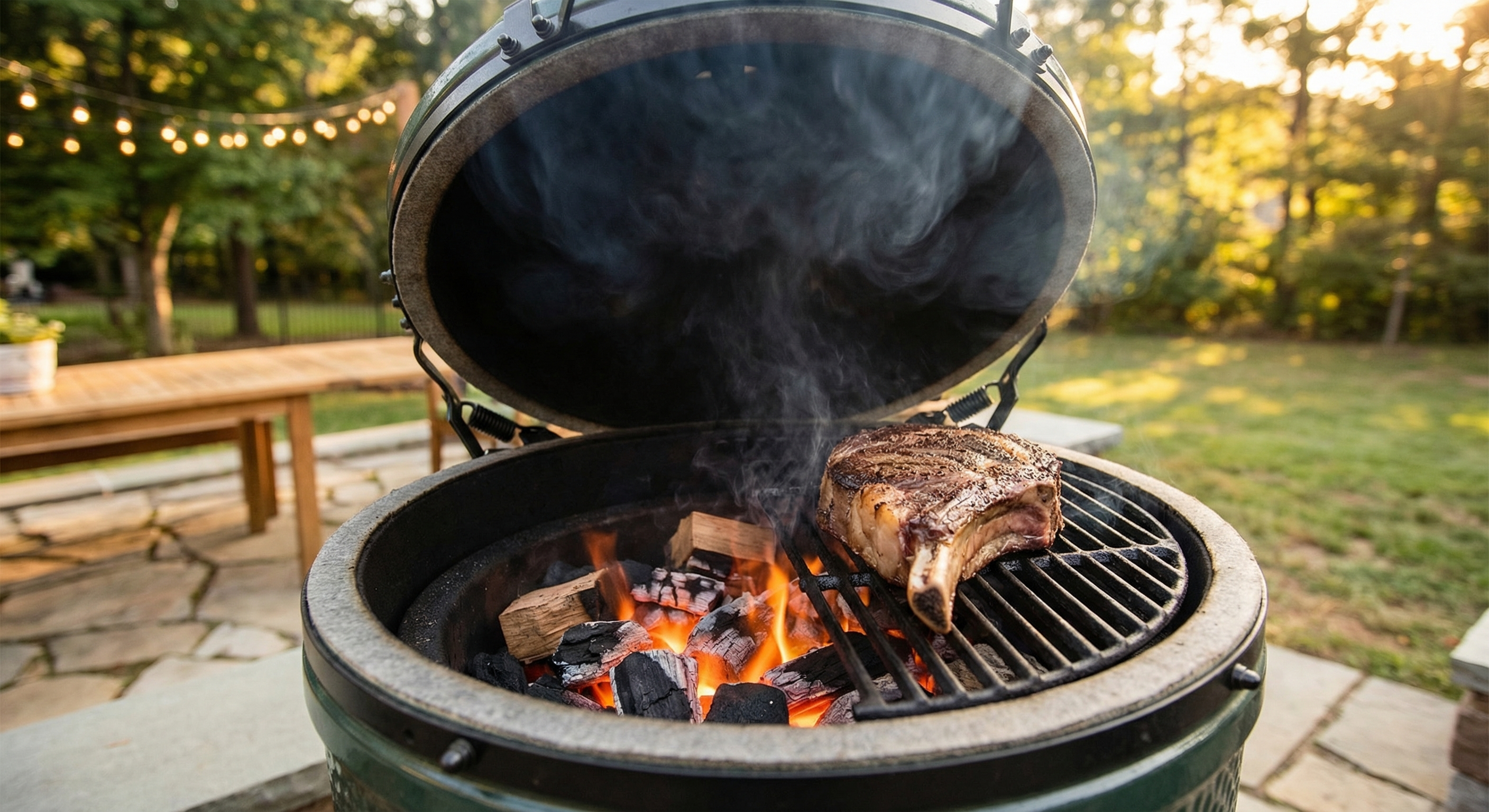
The kamado grill — a ceramic, egg-shaped cooker with roots in ancient Japanese rice steamers — has become the most talked-about piece of outdoor cooking equipment in the last decade. Brands like Big Green Egg, Kamado Joe, and Primo have turned what was once a niche curiosity into a mainstream phenomenon.
But the kamado isn't popular because of marketing. It's popular because the physics of ceramic cooking produce measurably different results than steel, aluminum, or cast iron grills. The thick ceramic walls create a thermal environment that no kettle grill, gas grill, or offset smoker can replicate.
This guide explains exactly what's happening inside a kamado — from heat transfer mechanics to moisture dynamics — and why it matters for the food you cook.
Thermal Mass: The Core Advantage
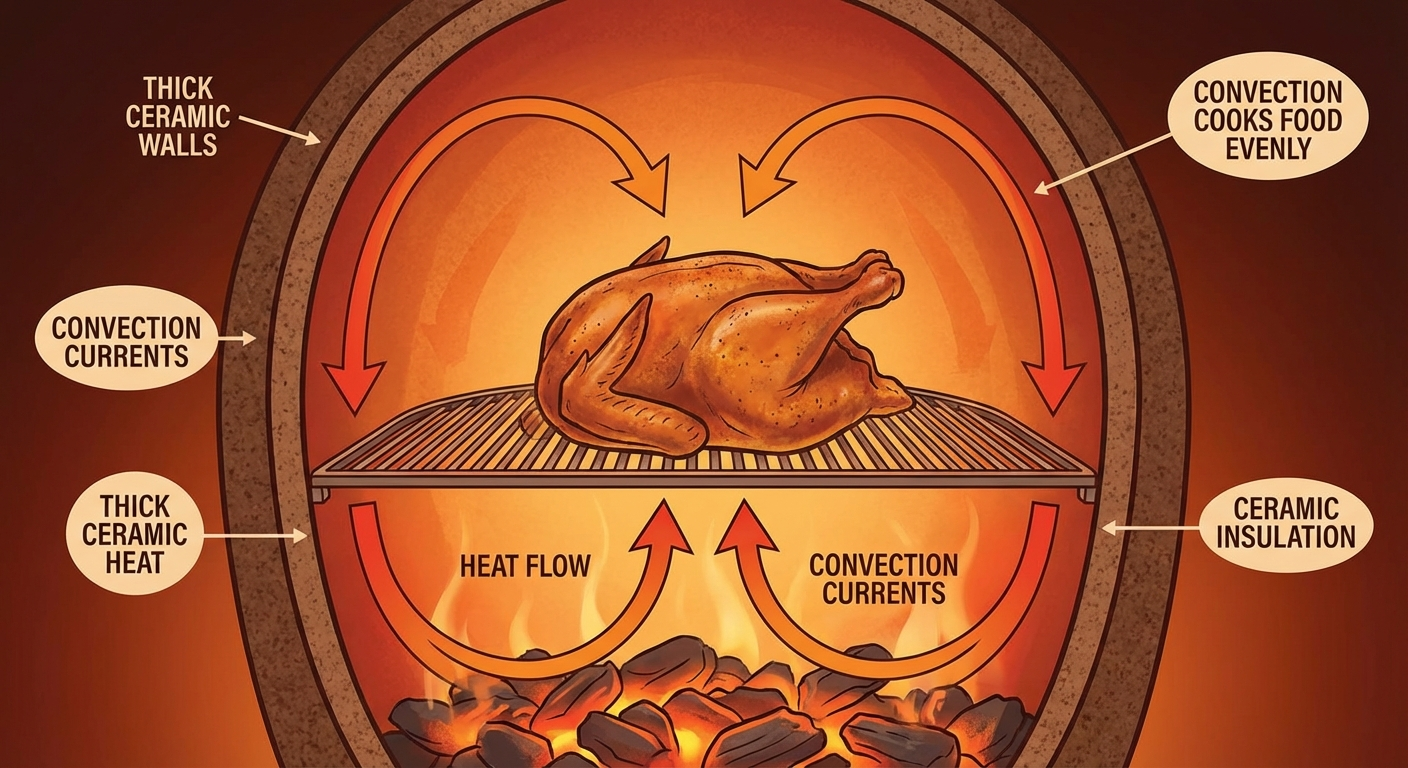
The single most important property of a kamado grill is thermal mass — the ability of a material to absorb, store, and slowly release heat energy.
A standard kamado's ceramic walls are 1 to 1.5 inches thick. Ceramic has a specific heat capacity roughly 2–3 times higher than steel by volume, which means it takes more energy to heat up — but once hot, it stores far more energy and releases it slowly and evenly.
In practical terms:
- A steel kettle grill reaches target temperature quickly but loses heat rapidly when you open the lid. Recovery takes minutes.
- A kamado takes longer to reach target temperature but barely drops when the lid opens. Recovery happens in seconds.
This thermal stability is why kamados excel at long cooks. A kamado set to 225°F will hold that temperature for 12–18 hours on a single load of lump charcoal with minimal adjustment. Try that with a Weber kettle.
Why Thermal Stability Matters for Food Quality
Temperature stability isn't just convenient — it directly affects food quality. When a cooker's temperature swings ±25°F every time you open the lid (as most metal grills do), the food experiences alternating periods of stalling and overcooking at the surface. The result: uneven bark formation on brisket, inconsistent smoke absorption, and a wider gray band on steaks.
A kamado's tight temperature control (typically ±5°F during a stable cook) means the thermal gradient through the meat develops more predictably. You get a thinner gray band, more uniform doneness, and less carryover cooking because the surface temperature never spikes.
Three Types of Heat Transfer in a Kamado
Every grill uses three modes of heat transfer: conduction, convection, and radiation. What makes a kamado different is the ratio between them — and how the ceramic walls amplify all three.
1. Conduction (Through Direct Contact)
When food touches the grill grate, heat transfers by conduction. This is what creates grill marks. In a kamado, the grates (usually ceramic or cast iron) absorb heat from the surrounding environment and hold it with high thermal mass. The result: deeper, more consistent sear marks with less temperature drop when cold food hits the grate.
2. Convection (Through Moving Air)
Kamados are designed as natural convection ovens. Air enters through the bottom vent, passes over the charcoal, rises through the food, and exits through the top vent. The ceramic walls heat the air evenly, and the egg shape promotes a circular convection pattern that wraps around the food from all sides.
This is fundamentally different from a gas grill, where convection comes primarily from below (hot air rising from burners), or a kettle grill, where convection is disrupted every time the wind blows. The kamado's sealed, insulated chamber creates laminar airflow — smooth, predictable convection that cooks more evenly.
3. Radiation (Infrared Energy)
Here's where ceramics truly separate themselves. The thick ceramic walls absorb radiant energy from the charcoal, store it, and re-radiate infrared energy in all directions — including back toward the food. This means the food in a kamado is receiving infrared radiation from the charcoal below and from the walls and dome above.
In a metal grill, thin steel walls reflect some radiation but don't store or re-radiate meaningful energy. The food cooks primarily from below. In a kamado, the food is surrounded by radiant heat — cooking more like a tandoor or brick oven than a conventional grill.
This 360-degree radiant heat is why kamado-grilled pizza rivals wood-fired ovens: the dome radiates enough infrared energy to cook the top of the pizza while the bottom sears on a hot pizza stone.
Moisture Retention: The Sealed Environment Effect
Metal grills leak air — through loose-fitting lids, thin walls, and imprecise vents. A kamado, by contrast, is essentially a sealed ceramic vessel with precision-machined vents and a gasket seal on the lid.
This seal does two things:
- Controls oxygen precisely. Temperature in a charcoal grill is governed by oxygen supply. The tighter the seal, the more precisely you can control airflow, and therefore temperature. Kamados can run stable at 200°F (minimal airflow) or 800°F (vents wide open) — a wider range than any other charcoal cooker.
- Retains moisture. Less air leakage means less evaporative moisture loss. The humidity inside a closed kamado is measurably higher than inside a steel grill at the same temperature. This moisture slows the formation of bark on the meat surface, which means the BBQ stall is less severe — and the interior stays juicier.
Research from meat science labs has shown that pork butts smoked in kamado-style cookers retain 3–5% more moisture by weight compared to identical cuts smoked in offset steel smokers at the same temperature for the same duration. That's the difference between "juicy" and "transcendent."
Fuel Efficiency: Why Kamados Use Less Charcoal
A kamado uses 50–75% less charcoal than a comparable metal smoker for the same cook duration. The reasons are straightforward:
- Insulation. Ceramic is a poor thermal conductor (good insulator). Heat stays inside the chamber instead of radiating through the walls into the atmosphere. Touch the outside of a kamado running at 500°F — it's barely warm. Touch the outside of a steel grill at 500°F and you'll need medical attention.
- Restricted airflow. Less oxygen reaches the charcoal, so it burns slower. A kamado set to 225°F is literally starving the fire — which means the charcoal lasts dramatically longer.
- No air leaks. Every air leak in a metal grill is uncontrolled oxygen feeding the fire and uncontrolled heat escaping the chamber. Kamados have neither.
A full load of lump charcoal (roughly 10–12 lbs) in a large kamado can maintain 225°F for 18–24 hours. The same amount of charcoal in a Weber Smokey Mountain lasts 8–12 hours. In a standard kettle, maybe 4–6 hours.
Kamado vs. Other Cooker Types: A Physics Comparison
| Property | Kamado (Ceramic) | Kettle Grill (Steel) | Gas Grill | Offset Smoker (Steel) |
|---|---|---|---|---|
| Thermal mass | Very high | Low | Low | Moderate |
| Temp recovery (lid open) | Seconds | 3–5 minutes | 1–2 minutes | 5–10 minutes |
| Temp range | 200–800°F | 250–600°F | 250–550°F | 225–350°F |
| Moisture retention | Excellent | Poor | Poor | Moderate |
| Fuel efficiency | Excellent | Moderate | N/A (gas) | Poor |
| Radiant heat (360°) | Yes | No | No | Partial |
| Smoke flavor | Clean, subtle | Moderate | Minimal | Heavy |
| Weight | 150–250 lbs | 20–30 lbs | 40–80 lbs | 100–300 lbs |
What Kamados Do Best (and Where They Fall Short)
Where Kamados Excel
- Low-and-slow smoking. The thermal stability and moisture retention make kamados exceptional for brisket, pork butt, ribs, and any cook over 4 hours. The fuel efficiency means one load of charcoal covers the entire cook.
- High-heat searing. With vents wide open, kamados reach 700–800°F — rivaling commercial infrared sear stations. The Maillard reaction happens faster and more aggressively.
- Pizza and bread. The radiant dome heat and pizza stone combination mimics a wood-fired oven at a fraction of the cost.
- Roasting. The convection environment roasts chickens, turkeys, and vegetables as well as any oven — with added smoke flavor.
Where Kamados Struggle
- Cooking for large groups. The egg shape limits grate space. A large kamado (24-inch) has roughly 400 sq in of cooking surface. A large offset smoker can have 1,000+ sq in.
- Quick-fire grilling sessions. The high thermal mass means it takes 15–20 minutes to reach high heat — longer than a gas grill. If you want to grill four burgers on a Tuesday night, a gas grill is faster.
- Extreme portability. A large kamado weighs 200+ lbs. It's not going to a tailgate.
- Heavy smoke flavor. The sealed environment and efficient combustion produce clean smoke. If you want heavy, bark-staining smoke flavor like a stick burner produces, a kamado won't deliver it.
Temperature Control: The Vent Science
Kamado temperature control comes down to two vents: bottom (intake) and top (exhaust). The physics are simple but counterintuitive for gas grill converts:
- More open = hotter. Opening both vents increases airflow, feeds more oxygen to the charcoal, and raises temperature.
- Bottom vent is the throttle. The bottom vent controls how much fresh oxygen reaches the fire. This is your primary temperature control.
- Top vent is fine-tuning. The top vent controls how quickly hot air exits the chamber. Closing it slightly creates backpressure that slows the fire. Opening it increases draw (like a chimney).
- Small adjustments only. Because of the high thermal mass, temperature changes are slow. A 1/4-inch vent adjustment might change the target temperature by 25°F — but it takes 10–15 minutes for the change to stabilize. Make small moves and wait.
The most common mistake new kamado owners make is overshooting. They open the vents too far, the ceramic absorbs the excess heat, and then when they try to close down to a lower temperature, the stored energy in the walls keeps the temperature elevated for 30–60 minutes. Always approach your target temperature from below.
Lump Charcoal vs. Briquettes in a Kamado
Kamado manufacturers universally recommend lump charcoal over briquettes. The science supports this:
- Ash production. Briquettes contain binders (starch, borax, limestone) that produce 2–3x more ash than lump charcoal. In a kamado's tight airflow system, excess ash can block the bottom vent and choke the fire. Lump charcoal burns cleaner.
- Off-gassing. The sealed kamado environment traps more combustion byproducts near the food. Lump charcoal (pure carbonized hardwood) produces cleaner smoke than briquettes with added chemicals.
- Temperature response. Lump charcoal responds faster to airflow changes because it has no binder buffer. This gives you more precise temperature control — which is the kamado's whole selling point.
Use natural lump hardwood charcoal. Avoid self-lighting briquettes, instant-light charcoal, or any fuel with added chemicals. The kamado's sealed environment will trap those chemicals and deposit them directly onto your food.
Practical Cooking Tips Based on the Science
- Preheat slowly. Let the kamado come up to temperature over 15–20 minutes. Rushing the preheat by opening all vents leads to overshoot.
- Burp the lid. At temperatures above 400°F, crack the lid 1–2 inches before opening fully. The rush of oxygen into a hot, sealed environment can cause a flashback (fireball) that singes arm hair. This is not a myth — it's a real pressure differential phenomenon.
- Use a deflector plate for indirect cooking. The ceramic heat deflector (also called a plate setter or ConvEGGtor) blocks direct radiant heat from the charcoal and converts the kamado into a convection oven. Essential for smoking and roasting.
- Don't peek. Every lid opening in a kamado is less disruptive than on a metal grill, but the biggest benefit of a kamado is that you don't need to peek. Use a wireless meat thermometer through the vent hole and trust the thermal stability.
- Shut it down properly. Close both vents fully after cooking. The remaining charcoal will self-extinguish (no oxygen) and can be reused next time. This is a significant cost savings over grills where you burn through the entire load.
The Verdict: Is a Kamado Worth It?
From a pure physics standpoint, a kamado is the most thermally efficient and versatile charcoal cooker available. The combination of high thermal mass, sealed combustion, 360-degree radiant heat, and superior moisture retention produces measurably better results for most cooking applications.
The tradeoffs are real: cost ($800–$3,000+), weight, limited capacity, and a learning curve for temperature management. But if you cook on charcoal regularly and value precision, fuel efficiency, and versatility, the science is unambiguous. Ceramic wins.
Pair a kamado with quality cuts — American wagyu steaks for high-heat searing, or a Japanese A5 wagyu strip for a quick, delicate cook — and you have a system capable of producing restaurant-quality results in your backyard.
Frequently Asked Questions
Why do kamado grills hold temperature so well?
Kamado grills use thick ceramic walls (1-1.5 inches) with high thermal mass. The ceramic absorbs and stores large amounts of heat energy, then releases it slowly and evenly. Combined with a sealed gasket lid and precision vents, this creates temperature stability within plus or minus 5 degrees Fahrenheit during a stable cook.
Can you use briquettes in a kamado grill?
While briquettes technically work, kamado manufacturers recommend natural lump charcoal. Briquettes produce 2-3 times more ash which can block the bottom vent in a kamado's tight airflow system. They also contain binders that produce off-flavors in the sealed ceramic environment.
How hot can a kamado grill get?
With both vents fully open, a kamado can reach 700-800 degrees Fahrenheit. This makes them capable of serious high-heat searing for steaks and Neapolitan-style pizza. The wide temperature range (200-800 degrees F) is broader than most other grill types.
How long does charcoal last in a kamado?
A full load of lump charcoal (10-12 pounds) in a large kamado can maintain 225 degrees F for 18-24 hours. This is 2-3 times longer than most steel smokers due to the kamado's superior insulation and restricted airflow design.
What is a kamado flashback and how do you prevent it?
A flashback occurs when you quickly open the lid of a hot kamado (above 400 degrees F). The sudden rush of oxygen into the sealed, superheated environment can ignite gases and create a fireball. Prevent it by burping the lid: crack it 1-2 inches, pause for 3 seconds, then open fully.
More Expert Guides
Brisket Flat vs Point: Anatomy, Flavor Differences, and How to Cook Each Cut
A whole packer brisket contains two distinct muscles with radically different properties. Understanding the flat and the point — their fiber direction, fat distribution, and collagen content — is the difference between great barbecue and dried-out disappointment.
15 min readSteak Doneness Temperature Guide: The Science of Every Level from Rare to Well Done
Every degree matters. This science-backed guide covers the exact internal temperatures for every steak doneness level, why each temperature produces a different texture, and how to nail your target every time.
14 min readDirect vs Indirect Heat Grilling: The Science of Two-Zone Cooking
Direct heat sears. Indirect heat roasts. Understanding the physics of each — and when to combine them — is the foundation of every great grilling technique.