Pulled Pork Temperature Guide: The Science of When Pork Butt Is Actually Done
Pulled Pork Temperature Guide: The Science of When Pork Butt Is Actually Done
Every barbecue forum has the same debate: "What temp do you pull your pork butt?" Answers range from 195°F to 210°F. Some people swear by 198°F. Others won't touch it below 205°F. The disagreement seems arbitrary until you understand what's actually happening inside the meat at each of those temperatures.
The answer isn't a single number. It's a window — and the science of collagen-to-gelatin conversion explains exactly why that window exists, why it varies between cuts, and how to hit it consistently.
Why Pork Butt Is the King of Low-and-Slow
Pork butt (technically the upper portion of the pork shoulder, not the rear end) is one of the most forgiving cuts in barbecue, and that's entirely because of its composition. A typical bone-in pork butt contains:
- Intramuscular fat: 8-12% by weight, distributed throughout the meat
- Collagen: Dense connective tissue networks running between and through muscle fibers
- Multiple muscle groups: 6-8 distinct muscles with different fiber orientations
- A fat cap: External layer of subcutaneous fat (typically 1/4" to 1/2" thick)
This combination of fat and collagen means pork butt has a massive thermal buffer. Unlike a lean cut where 5°F of overcooking turns dinner into shoe leather, pork butt improves as it cooks past the traditional "done" temperature for pork (145°F per USDA). That improvement is entirely about collagen breakdown.
The Temperature Zones: What Happens at Each Stage
Understanding pulled pork means understanding what's happening inside the meat at each temperature milestone. Here's the complete breakdown:
Room Temperature to 100°F: The Warmup
Nothing dramatic happens here. The meat is absorbing heat, surface moisture begins to evaporate, and bacteria on the exterior start dying. The important thing at this stage is that your smoker temperature is stable at 225-275°F before the meat goes on.
100°F to 140°F: Protein Denaturation Begins
Myosin — one of the two primary muscle proteins — begins to denature around 104°F. By 122°F, myosin denaturation is well underway, and the meat starts to firm up. Actin, the other major muscle protein, remains stable. The meat is transitioning from raw to cooked, and the internal color shifts from pink to gray-white.
At 130°F, the meat is technically safe to eat (at this temperature for extended time). But it's nowhere near pullable.
140°F to 160°F: The Squeeze and the Stall
This is where things get interesting — and frustrating. Around 150-160°F, collagen fibers begin to contract, squeezing moisture out of the muscle fibers like wringing a sponge. This is why pork (and beef) can actually seem drier at 160°F than at 140°F. The meat has expelled liquid, but the collagen hasn't yet broken down enough to replace that moisture with gelatin.
This zone also produces the BBQ stall — that maddening plateau where the internal temperature flatlines for 2-6 hours. Evaporative cooling from surface moisture balances the heat input from your smoker. The meat sweats, and the sweat cools it at the same rate you're heating it.
Many cooks panic here and crank the heat. Don't. The stall is normal, and if you're wrapping (the Texas Crutch), this is when you'd do it — typically at 160-170°F internal.
160°F to 185°F: Collagen Conversion Begins
Now the magic starts. Collagen — those tough, chewy connective tissue strands — begins converting to gelatin. This process is both temperature-dependent and time-dependent. At 160°F, the conversion is slow. At 180°F, it's accelerating significantly.
The key insight: collagen doesn't convert at a single temperature. It's a gradual process that happens faster at higher temperatures. The conversion requires both sufficient heat AND sufficient time at that heat. This is why a pork butt that reaches 195°F in 8 hours may pull differently than one that reaches 195°F in 12 hours — the slower cook gave collagen more time to convert.
185°F to 195°F: The Transition Zone
At this point, significant collagen conversion has occurred, but the meat may not be fully pullable. If you probe the pork butt with a thermometer or toothpick, you'll feel some resistance. The meat will come apart in chunks rather than shredding easily.
Some competition cooks actually prefer this zone for sliced pork — the meat holds together in slices while still being tender. But for pulled pork? Keep going.
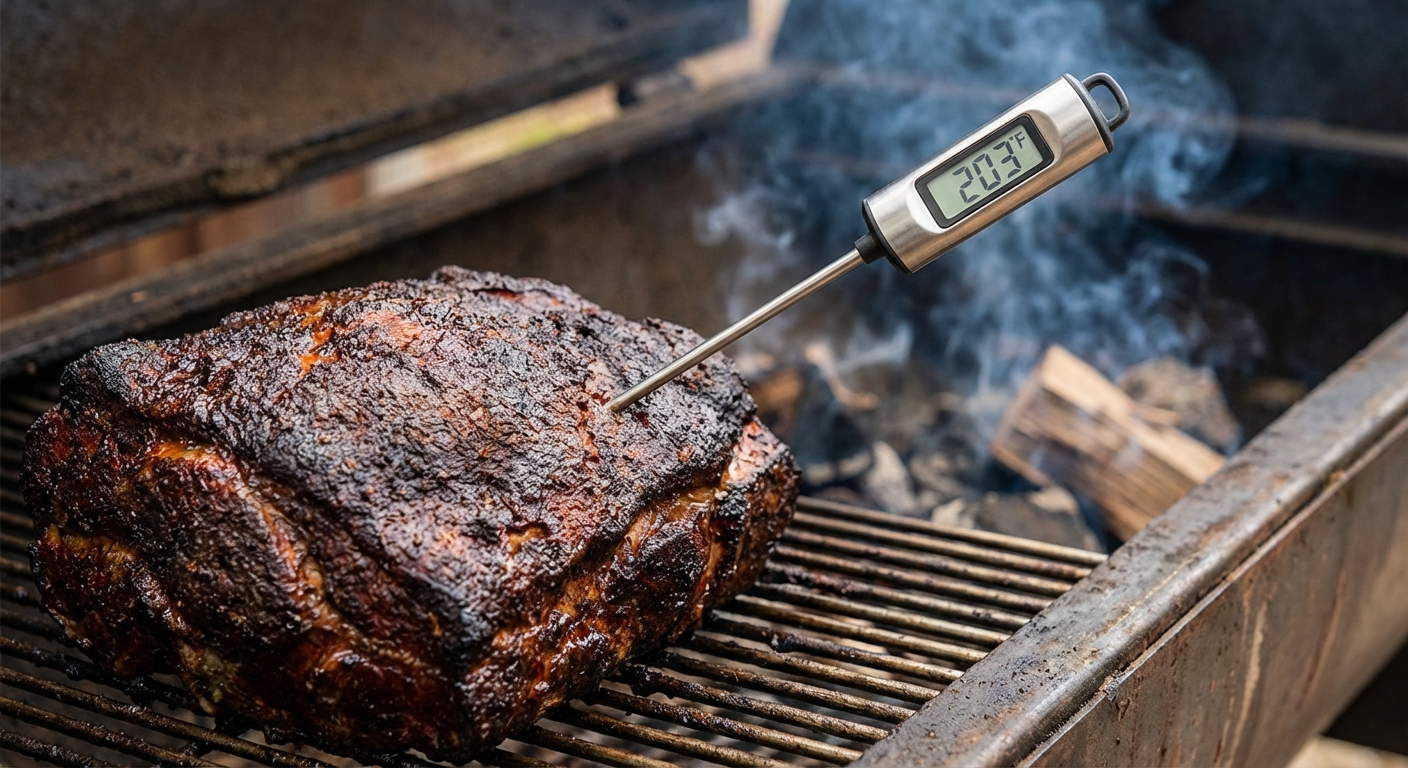
195°F to 203°F: The Sweet Spot
This is where most pitmasters land, and for good reason. By 195°F, the majority of collagen has converted to gelatin. The meat's internal structure has fundamentally changed — those rigid collagen networks that held muscle fibers together have melted into rich, viscous gelatin that lubricates every strand of meat.
The classic test: insert a probe thermometer or a wooden skewer into the thickest part of the butt. If it slides in with virtually no resistance — "like a hot knife through butter" — the pork is done. Most butts reach this texture between 198°F and 203°F.
Why the variation? Different pork butts have different collagen densities, fat content, and muscle fiber structures. A heavily marbled Berkshire butt might probe tender at 197°F. A leaner commodity butt might need 205°F. The probe test matters more than the number.
203°F to 210°F: Diminishing Returns
Above 203°F, you're in diminishing returns territory. More collagen converts, but the meat is also losing more moisture. The texture shifts from "pulls into long, juicy strands" to "falls apart into mush." Some people prefer this ultra-tender texture. Most find it crosses from succulent into paste-like.
Above 210°F, you're actively degrading the meat. Muscle fibers are drying out faster than gelatin can compensate, and the bark may char beyond pleasant bitterness into burnt.
The Collagen Conversion Science
Collagen is a triple-helix protein — three amino acid chains wound around each other like a rope. When heated, the chains unwind (denature) and break into shorter fragments. Those fragments are gelatin.
The conversion rate depends on three factors:
- Temperature: Higher temperature = faster conversion. At 160°F, conversion is minimal. At 180°F, it's significant. At 200°F+, it's rapid.
- Time: Even at optimal temperature, conversion takes hours. This is why low-and-slow works and high-heat doesn't — you need extended exposure time.
- Moisture: Collagen converts faster in wet environments. This is one reason the Texas Crutch wrap speeds cooking — the trapped moisture creates a braising environment that accelerates collagen breakdown.
The practical takeaway: a pork butt smoked at 225°F will take longer to reach 203°F than one smoked at 275°F, but it also spends more time in the collagen conversion zone, potentially producing more tender results. Many pitmasters compromise at 250°F — fast enough to finish in a reasonable timeframe, slow enough for thorough conversion.
Smoker Temperature: 225°F vs 250°F vs 275°F
Your smoker temperature determines two things: how long the cook takes and how much bark develops. Here's how the math works for a typical 8-pound bone-in pork butt:
- 225°F: 12-16 hours total. Maximum bark development, longest stall, most collagen conversion time. The purist's choice.
- 250°F: 10-14 hours total. Good bark, shorter stall, still plenty of conversion time. The most common compromise.
- 275°F: 8-11 hours total. Thinner bark, shortest stall, adequate conversion time. Works well for weeknight cooks or when time is limited.
The one temperature you should never ignore is the danger zone floor. USDA guidelines say meat should pass through 40-140°F within 4 hours. At 225°F+ smoker temp, a typical pork butt hits 140°F internal in about 3-4 hours — safely within the window. Don't smoke below 225°F unless you've verified your cook time accounts for food safety.
To Wrap or Not to Wrap
Wrapping (the Texas Crutch) is the biggest variable in your pulled pork cook. Here's what each option gives you:
No Wrap (Naked)
Pros: Maximum bark — thick, crunchy, deeply flavored. More smoke flavor penetration throughout the cook. True competition-style bark.
Cons: Longest cook time. Stall can last 4-6 hours. More moisture loss from the surface. Greater risk of drying out if you overshoot temperature.
Butcher Paper Wrap (at 160-170°F)
Pros: Speeds through the stall by 1-2 hours. Retains moisture while still allowing some bark formation. Breathable paper lets smoke continue to penetrate. This is the "best of both worlds" option and what most award-winning competition teams use.
Cons: Bark softens slightly compared to naked. Requires pink butcher paper (not wax-coated).
Foil Wrap (at 160-170°F)
Pros: Fastest through the stall. Maximum moisture retention. Creates a braising effect that accelerates collagen conversion. Reliable results.
Cons: Bark becomes soft and steamy — you lose the crunch. Can taste slightly braised rather than smoked. Some people call this "pot roast texture."
The Rest: Why It's Non-Negotiable
You've spent 12 hours smoking a pork butt. It probes tender at 203°F. You want to pull it immediately. Don't.
Resting is critical for pulled pork — arguably more critical than for any other cut. Here's why:
- Temperature equalization: The exterior is hotter than the interior. Resting allows heat to distribute evenly, finishing the collagen conversion in the center.
- Moisture redistribution: As the meat cools slightly, gelatin thickens and reabsorbs into the muscle fibers. Pull immediately and that gelatin runs out as liquid.
- Carryover cooking: Internal temperature will rise 3-5°F during rest, completing the cook. If you pulled the butt at 200°F, it'll peak at 203-205°F — right in the sweet spot. Learn more about carryover cooking science.
How to rest: Pull the pork butt off the smoker, leave it wrapped (or wrap it if you cooked naked), then place it in a preheated cooler (no ice) lined with towels. It will hold at serving temperature for 2-4 hours. Minimum rest: 30 minutes. Ideal rest: 1-2 hours.
The cooler method isn't optional — it's what separates good pulled pork from great pulled pork. That extended rest in the "faux Cambro" finishes the collagen conversion in any stubborn spots and produces the most uniformly tender result.
Pulling Technique: The Final Variable
Once rested, pulling technique matters more than most people think:
- Remove the bone: If it's bone-in, the bone should slide out with zero resistance. If it doesn't, the pork wasn't done.
- Remove large fat deposits: Pull out any chunks of unrendered fat. The fat cap, if still intact, should peel off easily.
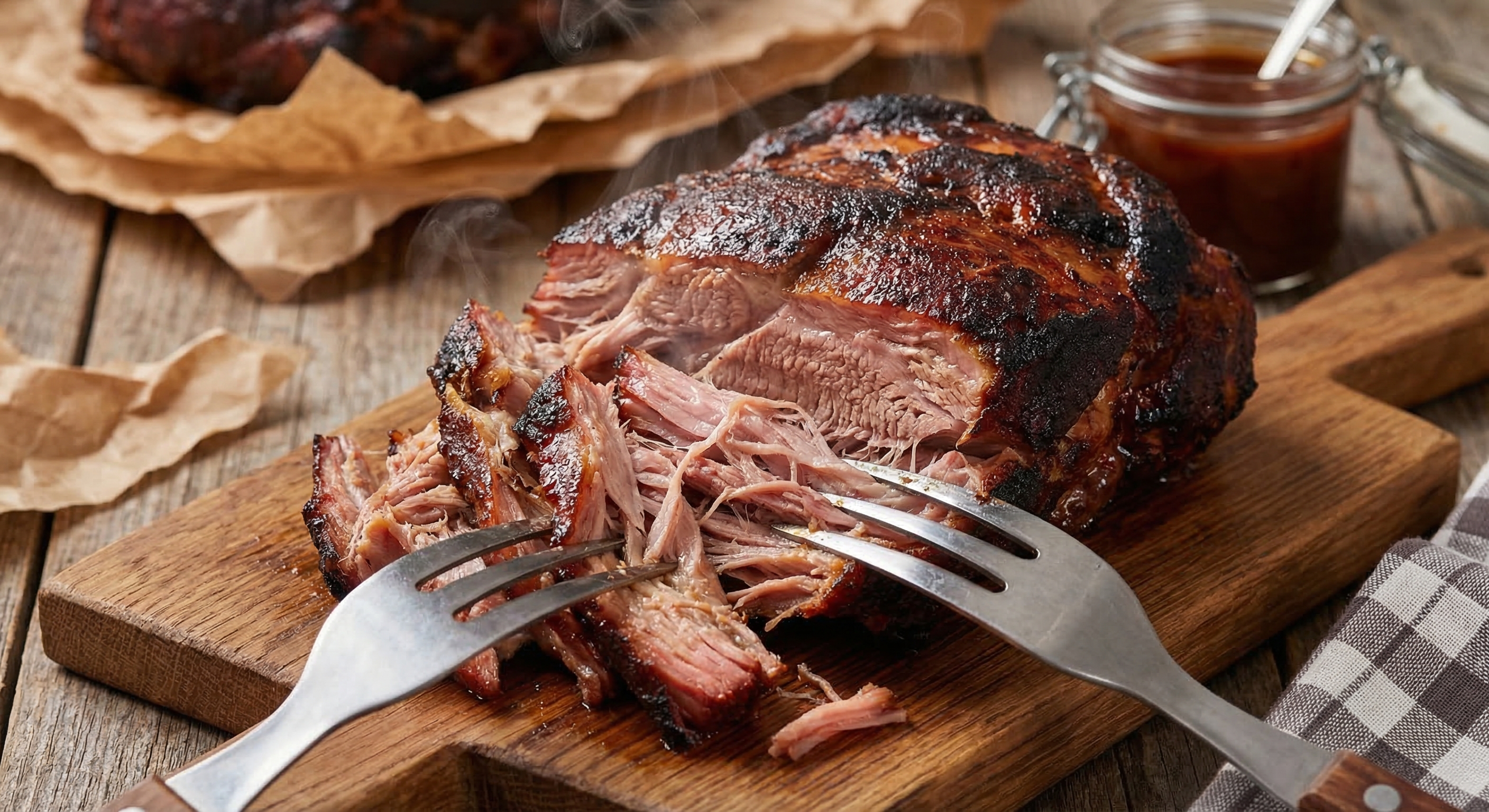
- Pull, don't chop: Use two forks, bear claws, or gloved hands to pull the meat along its natural grain into shreds. Chopping creates a uniform mush; pulling creates varied textures — some stringy, some chunky — that's more interesting to eat.
- Mix the bark in: Don't separate bark from interior meat. Tear the bark into pieces and mix it throughout. Every bite should have some bark and some tender interior.
- Season immediately: Toss with your finishing sauce, vinegar mop, or dry rub while the meat is still hot. Hot meat absorbs seasoning better than cold.
Troubleshooting: When Things Don't Go Right
Pork hits 195°F but won't probe tender: Keep cooking. The number doesn't matter — the probe feel does. Some butts are stubborn. It might need 207°F or even 210°F. Trust the probe test.
Pork probes tender at 190°F: Pull it. If it's tender, it's done. Don't chase a number you read online. The probe feel is the ultimate test.
Pork is dry after pulling: Three possible causes: you overshot temperature past 210°F, you didn't rest long enough, or the butt was too lean (look for better marbling next time). Fix: mix in some reserved drippings or a splash of apple cider vinegar and broth.
Bark is too soft: You probably wrapped too early or used foil. Next time, try butcher paper or go naked. You can also unwrap the butt for the last 30 minutes of cooking to firm up the bark.
Cook time is wildly off your estimate: Pork butts vary. A lot. Two 8-pound butts from the same store can differ by 3-4 hours in cook time. Always cook to temperature and feel, not time. Start earlier than you think you need to — a pork butt wrapped in towels in a cooler will hold beautifully for hours.
The Complete Temperature Cheat Sheet
- Smoker temp: 225-275°F (250°F is the sweet spot)
- Wrap temp: 160-170°F internal (if wrapping)
- Pull off smoker: 198-203°F internal (when probe tender)
- After rest: Will peak at 201-208°F
- Serving temp: 180-200°F (cooler rest maintains this for hours)
- Minimum rest: 30 minutes (ideal: 1-2 hours)
Final Thoughts
Pulled pork is forgiving, but it's not foolproof. The science is clear: you need enough temperature and enough time for collagen to convert to gelatin. The magic window is 198-203°F for most pork butts, but the probe test trumps any number. Cook to feel, rest generously, and pull — don't chop — the meat.
If you want to put your temperature knowledge to work with premium pork, The Meatery's heritage pork selection features breeds like Berkshire and Duroc with the intramuscular marbling that makes the collagen conversion window even more forgiving. Better fat distribution means a wider margin for error — and a more flavorful result.
Now go smoke something.
Frequently Asked Questions
What internal temperature is pulled pork done?
Most pork butts are done between 198°F and 203°F internal temperature, but the probe test is more reliable than the number. Insert a thermometer or wooden skewer into the thickest part — if it slides in with no resistance, the pork is done regardless of the exact temperature reading.
Can you overcook pulled pork?
Yes. Above 210°F, muscle fibers lose moisture faster than gelatin can compensate, and the texture shifts from tender shreds to dry mush. If you overshoot, mixing in reserved drippings or a splash of apple cider vinegar and broth can help recover moisture.
How long does it take to smoke a pork butt?
At 250°F smoker temperature, plan roughly 1.25-1.75 hours per pound for a bone-in pork butt. An 8-pound butt typically takes 10-14 hours. However, cook times vary widely between individual cuts — always cook to internal temperature and probe feel, not time.
Should I wrap my pork butt?
Wrapping in butcher paper at 160-170°F internal is the most popular method — it speeds through the stall while preserving bark. Foil wrapping is faster but softens bark significantly. No wrap produces the best bark but takes longest. All three methods produce excellent pulled pork if you nail the final temperature.
How long should pulled pork rest before pulling?
Minimum 30 minutes, ideally 1-2 hours. Wrap the finished butt in towels and place in a cooler (no ice) to hold temperature. This extended rest allows gelatin to thicken and redistribute, producing juicier results. A pork butt can hold safely in a cooler for up to 4 hours.
More Expert Guides
Offset Smoker Temperature Control: The Science of Fire, Airflow, and Consistency
Offset smokers are the most rewarding — and most demanding — way to cook barbecue. Temperature control comes down to three variables: fuel, oxygen, and exhaust. Master the physics and you will hold rock-steady temps for 12+ hours.
13 min readGrilling Frozen Steak: The Science of Why It Actually Works Better
Everything you've been told about thawing steak first might be wrong. The science of heat transfer explains why frozen steaks can outperform thawed ones on a hot grill.
14 min readBone-In vs Boneless Steak: The Grilling Science That Settles the Debate
The bone-in vs boneless debate has divided grillers for decades. Here's what the science actually says — and it's more nuanced than you think.