BBQ Spritz and Mop Science: Does Spritzing Actually Help Your Barbecue?
BBQ Spritz and Mop Science: Does Spritzing Actually Help Your Barbecue?
Walk into any barbecue competition or online forum and you will find a heated debate: should you spritz your meat while smoking? One camp swears by spraying apple cider vinegar every 45 minutes. The other insists that opening the smoker lid destroys the cook. Both sides have strong opinions. Neither side tends to explain the actual physics.
This guide breaks down the science behind spritzing and mopping — what it does to surface temperature, bark formation, smoke adhesion, and total cook time — so you can make an informed decision for every cook.
What Is Spritzing and Mopping?
Both spritzing and mopping accomplish the same basic goal: applying liquid to the surface of meat during a low-and-slow cook. The difference is the tool and the volume of liquid delivered.
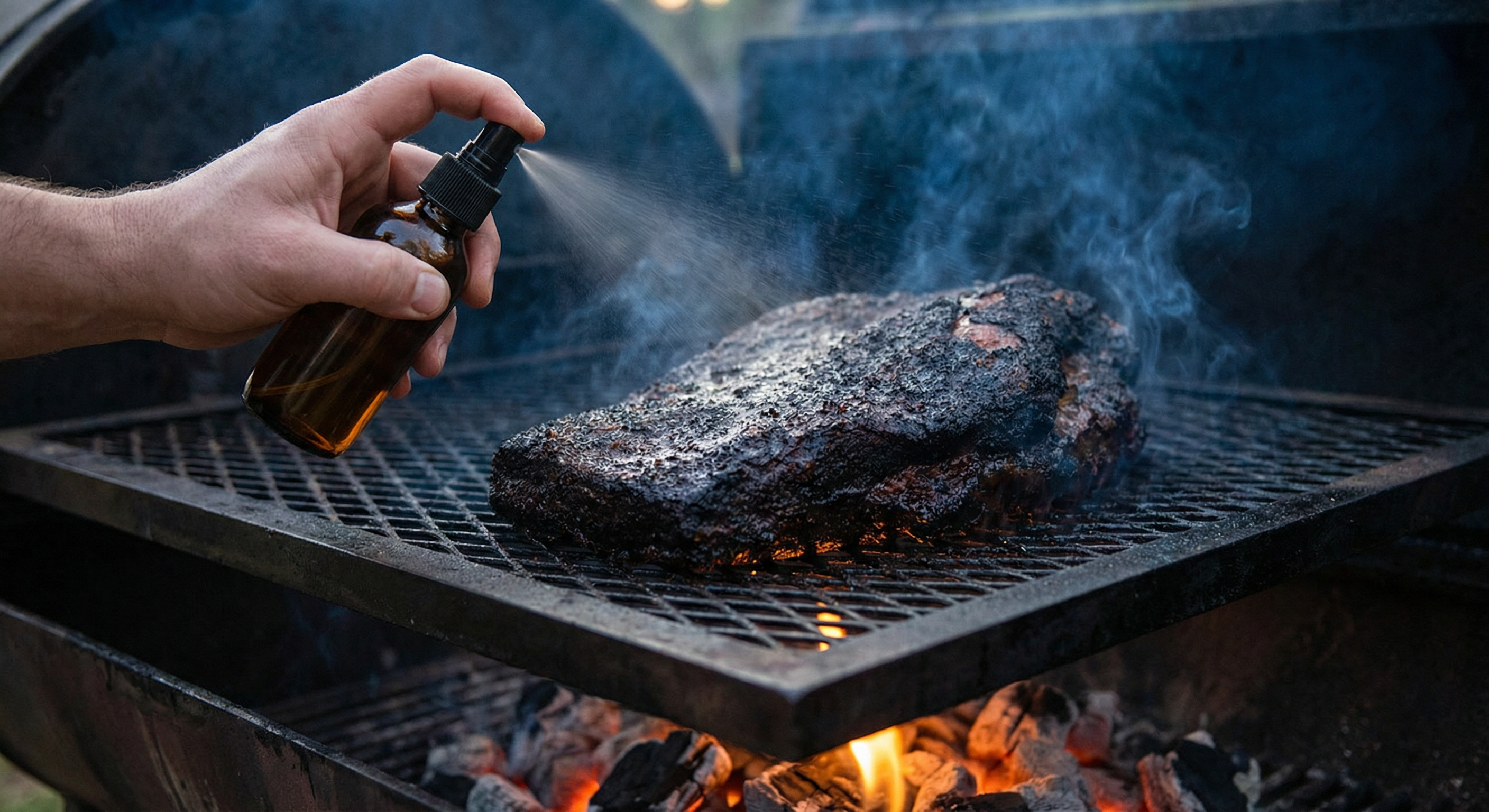
Spritzing uses a spray bottle to mist a thin, even layer of liquid across the meat surface. It delivers a small amount of moisture quickly and can be done with the lid open for just a few seconds.
Mopping uses a small cotton or silicone mop (or basting brush) dipped in a thin sauce or liquid, then applied across the meat surface. It delivers more liquid per application and takes longer, meaning the lid stays open for a longer period.
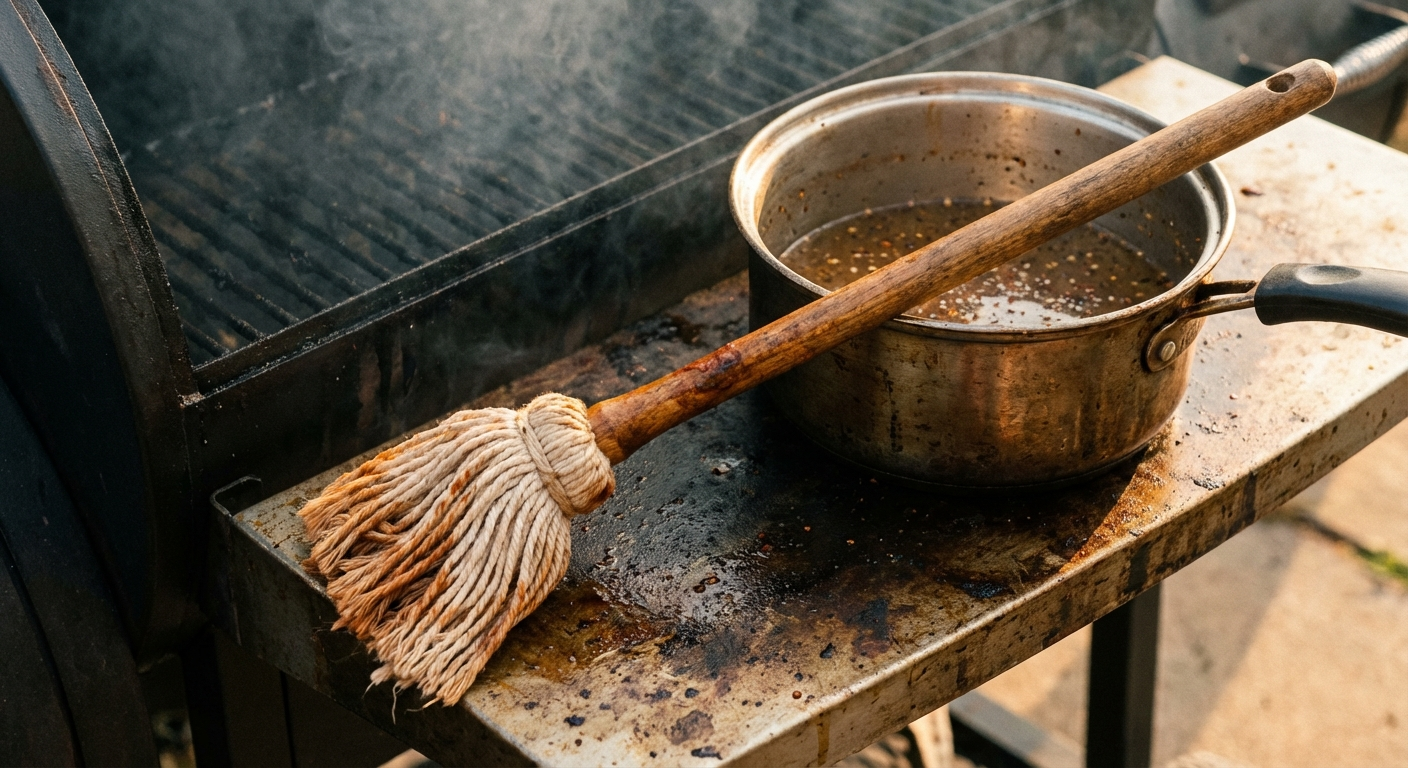
Common spritz and mop liquids include:
- Apple cider vinegar — the most popular choice, adds slight acidity that can enhance bark formation
- Apple juice — adds sugars that caramelize on the surface
- Beer — adds maltose sugars and bitter hop compounds
- Beef broth — adds umami compounds (glutamates) to the surface
- Butter and oil mixtures — fat-based, used more with mopping than spritzing
- Water — the simplest option, pure evaporative cooling with no added flavor
- 50/50 ACV and water — a balanced approach that many competition teams use
The Evaporative Cooling Effect
The most significant effect of spritzing is evaporative cooling — and this is where the science gets interesting.
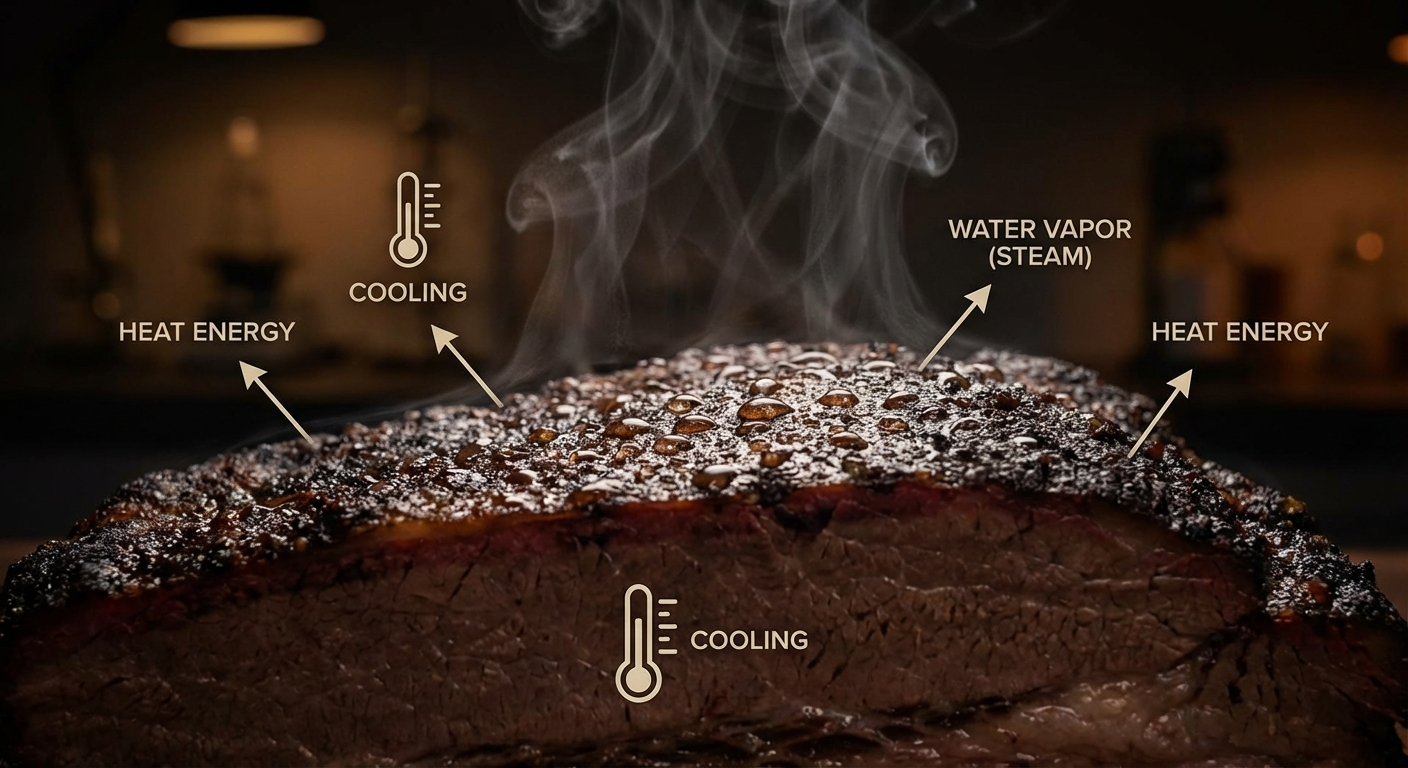
When liquid hits a hot meat surface, it absorbs thermal energy as it transitions from liquid to vapor. This phase change requires significant energy — the latent heat of vaporization for water is 2,260 kJ/kg. That energy comes directly from the meat surface, cooling it.
This is the same mechanism behind the BBQ stall. During the stall, moisture from inside the meat migrates to the surface and evaporates, creating a cooling effect that temporarily matches the heat input from the smoker. When you spritz, you are adding external moisture to a surface that may already be experiencing evaporative cooling.
What This Means for Your Cook
The evaporative cooling from spritzing has three measurable consequences:
- Lower surface temperature. The meat surface stays cooler than the ambient smoker temperature. On an unspritzed brisket at 250°F, the surface temperature might reach 280–300°F in spots. Spritzing keeps the surface closer to 200–220°F during the early hours.
- Delayed bark formation. The Maillard reaction requires surface temperatures above 280°F to accelerate significantly. By keeping the surface wet and cool, spritzing pushes bark development later in the cook.
- Extended cook time. A wet surface absorbs heat energy for evaporation rather than transmitting it into the meat's interior. This can add 30–90 minutes to a long smoke, depending on frequency.
This does not make spritzing bad — it makes it a tool with tradeoffs. The question is whether those tradeoffs work in your favor for a given cook.
Spritzing and Bark Formation: Help or Hindrance?
Bark is the prized, dark, flavorful crust on smoked meat. It forms through a combination of Maillard reactions, fat rendering, spice dehydration, and smoke compound deposition. Spritzing interacts with bark in two opposing ways.
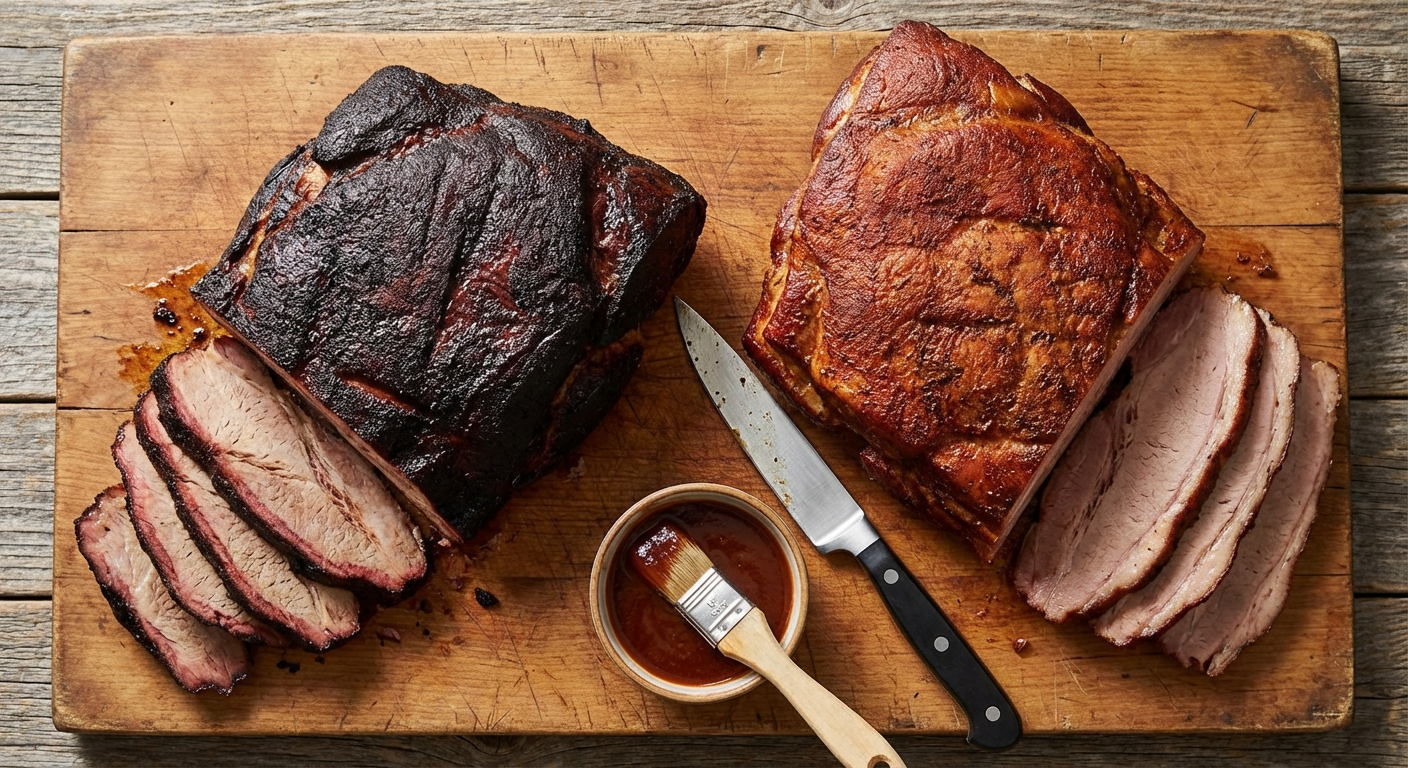
The Case Against: Washing Away Progress
During the first 2–3 hours of a smoke, the rub on the meat surface is still hydrated and loose. Aggressive mopping (not light spritzing) during this phase can literally wash rub particles off the meat. The physical action of a mop brush across a wet rub disrupts the layer that will eventually become bark.
Additionally, keeping the surface constantly wet delays the dehydration necessary for bark. Bark forms when the surface dries out enough for temperatures to climb past the boiling point of water. As long as liquid water is present, the surface temperature is capped near 212°F — well below the 280–310°F range where bark formation accelerates.
The Case For: Building Layers
Here is where it gets nuanced. While constant heavy mopping delays bark, periodic light spritzing can actually enhance bark quality through a layering mechanism.
When you spritz with a liquid containing dissolved sugars (apple juice) or acids (vinegar), each application adds a thin layer of flavor compounds to the surface. As each layer dries and caramelizes, it creates a stratified crust — similar to how lacquer builds up in coats. The end result is a bark with more complex flavor and deeper color than one formed by dry heat alone.
The key is timing and volume: light spritz, not heavy mop, and only after the rub has set (typically 2+ hours into the cook).
Smoke Adhesion: The Moisture Advantage
This is perhaps the strongest scientific argument for spritzing: a wet surface captures more smoke compounds than a dry one.
Smoke is a complex aerosol containing hundreds of compounds, but the flavor-active ones fall into two main categories: phenols (responsible for smoky, bacon-like flavors) and carbonyls (responsible for sweet, caramel-like flavors). Both are water-soluble and fat-soluble.
When smoke passes over a moist meat surface, these compounds dissolve into the moisture film and adhere. On a dry surface, many smoke particles simply bounce off or pass by without sticking. Research in food science has consistently shown that moist surfaces absorb smoke flavor compounds more efficiently than dry surfaces.
This is why the first 2–3 hours of a smoke (when the meat surface is still wet from its own moisture) produce the most smoke ring development and smoke flavor penetration. Spritzing extends this window of enhanced smoke adhesion.
However, there is a ceiling. Once bark has formed and the surface has dehydrated, smoke adhesion drops regardless of spritzing. The practical window for smoke-enhancement spritzing is roughly hours 2 through 5 of a typical brisket cook.
When to Spritz: The Science-Based Timeline
Based on the physical and chemical processes involved, here is a timeline that maximizes the benefits of spritzing while minimizing the downsides:
Hours 0–2: Do Not Spritz
During the first two hours, leave the smoker closed. The rub needs time to hydrate with the meat's own moisture, then begin setting. The surface is already wet from the meat itself — adding more moisture is redundant. Opening the lid during this phase bleeds heat (you lose 20–50°F per lid opening) and does not improve smoke adhesion because the surface is already moist.
Hours 2–5: Spritz Window
This is the optimal spritzing window. The surface has begun to dry, so added moisture enhances smoke adhesion. The rub has set enough to resist being washed off. Spritz every 45–60 minutes with a fine mist — you want a thin film, not dripping puddles.
Keep each lid opening under 15 seconds. Have the spray bottle in hand before you open the lid. Spray, close, done.
Hours 5+: Stop Spritzing (or Wrap)
By hour 5, bark is forming in earnest. Continuing to spritz at this point only delays bark completion and extends cook time without meaningful smoke benefits. If you are wrapping (Texas crutch), this is typically when you do it. If you are running unwrapped, let the bark develop undisturbed.
Spritz vs. Mop vs. Water Pan: Comparing Moisture Methods
Spritzing is not the only way to maintain surface moisture. Here is how the three main methods compare:
Spritzing (Spray Bottle)
- Moisture delivered: Very light, fine mist
- Lid time: 5–15 seconds per application
- Surface disruption: None — spray does not physically contact the rub
- Flavor addition: Moderate — each spray adds a thin layer of dissolved compounds
- Best for: Brisket, pork butt, ribs — anything with a dry rub you want to preserve
Mopping (Brush or Mop)
- Moisture delivered: Heavy, saturating coat
- Lid time: 30–60 seconds per application
- Surface disruption: Significant — bristles can move rub particles
- Flavor addition: High — mop sauces are often complex recipes with multiple ingredients
- Best for: Whole hog, large cuts without a delicate rub, Texas-style traditions where mop sauce is part of the flavor profile
Water Pan
- Moisture delivered: Ambient humidity increase (passive)
- Lid time: Zero — operates without opening the smoker
- Surface disruption: None
- Flavor addition: None (unless you add aromatics to the water)
- Best for: Long cooks where you want stable humidity without lid openings; convection-style cookers and pellet grills
A water pan achieves many of the same benefits as spritzing — humidity stabilization, evaporative cooling, enhanced smoke adhesion — without the temperature disruption of opening the lid. For smokers with good seals, a water pan may be the scientifically superior choice.
The Best Spritz Liquids: What Science Says
Not all spritz liquids are created equal. The composition of your spray determines what it does to the meat surface beyond simple cooling.
Apple Cider Vinegar
ACV contains acetic acid (typically 5% concentration). Acetic acid at this dilution has two effects: it slightly denatures surface proteins (enhancing browning) and it lowers the pH of the surface, which can shift the Maillard reaction products toward different flavor compounds. Lower pH tends to produce more fruity, bright Maillard flavors rather than heavy, roasted ones.
ACV also evaporates faster than water (acetic acid's boiling point is 244°F vs. water's 212°F, but in dilute solution, the mixture evaporates similarly to water). It leaves behind trace flavor compounds with each application.
Apple Juice
Apple juice contains fructose and sucrose (about 10–12% sugar by weight). These sugars caramelize at 320–340°F, adding color and sweetness to the bark. However, because sugars can burn above 350°F, apple juice spritzing works best at smoker temperatures of 250°F or below. At higher temperatures, the sugar residue can create bitter, acrid spots.
Beer
Beer adds maltose (a sugar that browns at lower temperatures than sucrose) and hop-derived bitter compounds. The carbonation is irrelevant by the time it hits the hot meat surface — CO2 escapes instantly. Beer spritzing produces a slightly different bark character: more malty and complex. Dark beers like stouts add more sugars and color compounds than light lagers.
Plain Water
Water provides pure evaporative cooling with zero flavor addition. It is the control variable. If you want to test whether spritzing helps your cook without introducing flavor variables, use water. Many competition pitmasters who spritz actually prefer water because it lets their rub and smoke do all the flavor work.
The Heat Loss Problem: Is Opening the Lid Worth It?
Every time you open a smoker lid, you lose heat. How much depends on the smoker type:
- Offset smoker: 15–30°F drop per opening, recovers in 3–5 minutes
- Kamado (ceramic): 10–20°F drop, recovers in 2–3 minutes due to thermal mass
- Kettle grill: 30–50°F drop, recovers in 5–8 minutes
- Pellet grill: 20–40°F drop, recovers in 4–6 minutes (fan-assisted recovery)
- Cabinet/vertical smoker: 40–60°F drop, slowest recovery due to convective draft disruption
If you spritz every 45 minutes for a 12-hour brisket cook (starting at hour 2, stopping at hour 5), that is roughly 4 lid openings. At 30°F loss and 5 minutes recovery each, you have added about 20 minutes of sub-optimal temperature to your cook. This is meaningful but not dramatic.
Contrast this with aggressive mopping every 30 minutes for the entire cook — that could be 20+ lid openings, adding 1–2 hours to cook time from heat loss alone. The more often you open the lid, the stronger the case for using a water pan instead.
The Verdict: When Spritzing Helps and When It Hurts
Based on the science of evaporative cooling, Maillard reactions, and smoke compound adhesion, here is when spritzing earns its place in your process:
Spritz When:
- You are cooking at 275°F or higher and want to moderate surface temperature to prevent bitter bark
- You are cooking unwrapped for the entire cook and want extended smoke absorption
- Your smoker runs dry (no water pan) and ambient humidity is low
- You want to add flavor layers through acidic or sugary liquids
- The rub has set (2+ hours in) and you are using a fine mist spray
Skip the Spritz When:
- Your smoker has a water pan already maintaining humidity
- You are wrapping at the stall (the wrap provides moisture retention)
- You are cooking at 225°F or below — surface temperatures are already moderate
- Your smoker has poor heat recovery (vertical cabinets) and cannot afford lid openings
- You are in the first 2 hours of the cook
- You are cooking poultry and want crispy skin (moisture is the enemy of crispy skin)
The science is clear: spritzing is not magic, and it is not pointless. It is a surface moisture management tool with specific, predictable effects on temperature, bark, smoke, and cook time. Use it when the physics favor it. Skip it when they don't.
Frequently Asked Questions
Should I spritz my brisket while smoking?
It depends on your setup. Spritz if you are cooking unwrapped at 275°F or higher without a water pan — the evaporative cooling moderates surface temperature and enhances smoke adhesion. Skip spritzing if you use a water pan, wrap at the stall, or cook at 225°F where surface temperatures are already controlled.
What is the best liquid to spritz BBQ with?
Apple cider vinegar and plain water are the most popular choices. ACV adds slight acidity that enhances browning and produces brighter Maillard flavors. Apple juice adds sugars that caramelize for deeper color. Plain water provides pure evaporative cooling without flavor interference. Many competition pitmasters prefer water to let the rub and smoke do the work.
When should I start spritzing brisket?
Start spritzing at hour 2 of the cook, after the rub has set and bonded to the meat surface. Spritzing before this point can wash loose rub particles off the meat. The optimal window is hours 2 through 5 — after that, let the bark develop undisturbed or wrap if desired.
Does spritzing make brisket cook longer?
Yes. Spritzing adds 30 to 90 minutes to a typical brisket cook through two mechanisms: evaporative cooling lowers surface temperature, and opening the lid causes heat loss of 15 to 50 degrees depending on your smoker type. However, if you limit spritzing to the 2-to-5 hour window with only 4 applications, the added time is modest.
What is the difference between spritzing and mopping BBQ?
Spritzing uses a spray bottle to apply a fine mist in 5 to 15 seconds with minimal surface contact. Mopping uses a brush or mop to apply a heavier coat of liquid over 30 to 60 seconds. Mopping delivers more liquid and flavor but physically disrupts the rub, takes longer with the lid open, and causes more heat loss. Spritzing is better for preserving delicate rub crusts.
Is a water pan better than spritzing?
For many setups, yes. A water pan increases ambient humidity passively without opening the lid, provides consistent evaporative cooling, and enhances smoke adhesion — achieving most of the same benefits as spritzing without heat loss. It is the scientifically superior choice for smokers with good seals and long cooks.
More Expert Guides
Brisket Flat vs Point: Anatomy, Flavor Differences, and How to Cook Each Cut
A whole packer brisket contains two distinct muscles with radically different properties. Understanding the flat and the point — their fiber direction, fat distribution, and collagen content — is the difference between great barbecue and dried-out disappointment.
15 min readSteak Doneness Temperature Guide: The Science of Every Level from Rare to Well Done
Every degree matters. This science-backed guide covers the exact internal temperatures for every steak doneness level, why each temperature produces a different texture, and how to nail your target every time.
14 min readDirect vs Indirect Heat Grilling: The Science of Two-Zone Cooking
Direct heat sears. Indirect heat roasts. Understanding the physics of each — and when to combine them — is the foundation of every great grilling technique.