How to Smoke on a Gas Grill: The Complete Science-Backed Guide
How to Smoke on a Gas Grill: The Complete Science-Backed Guide
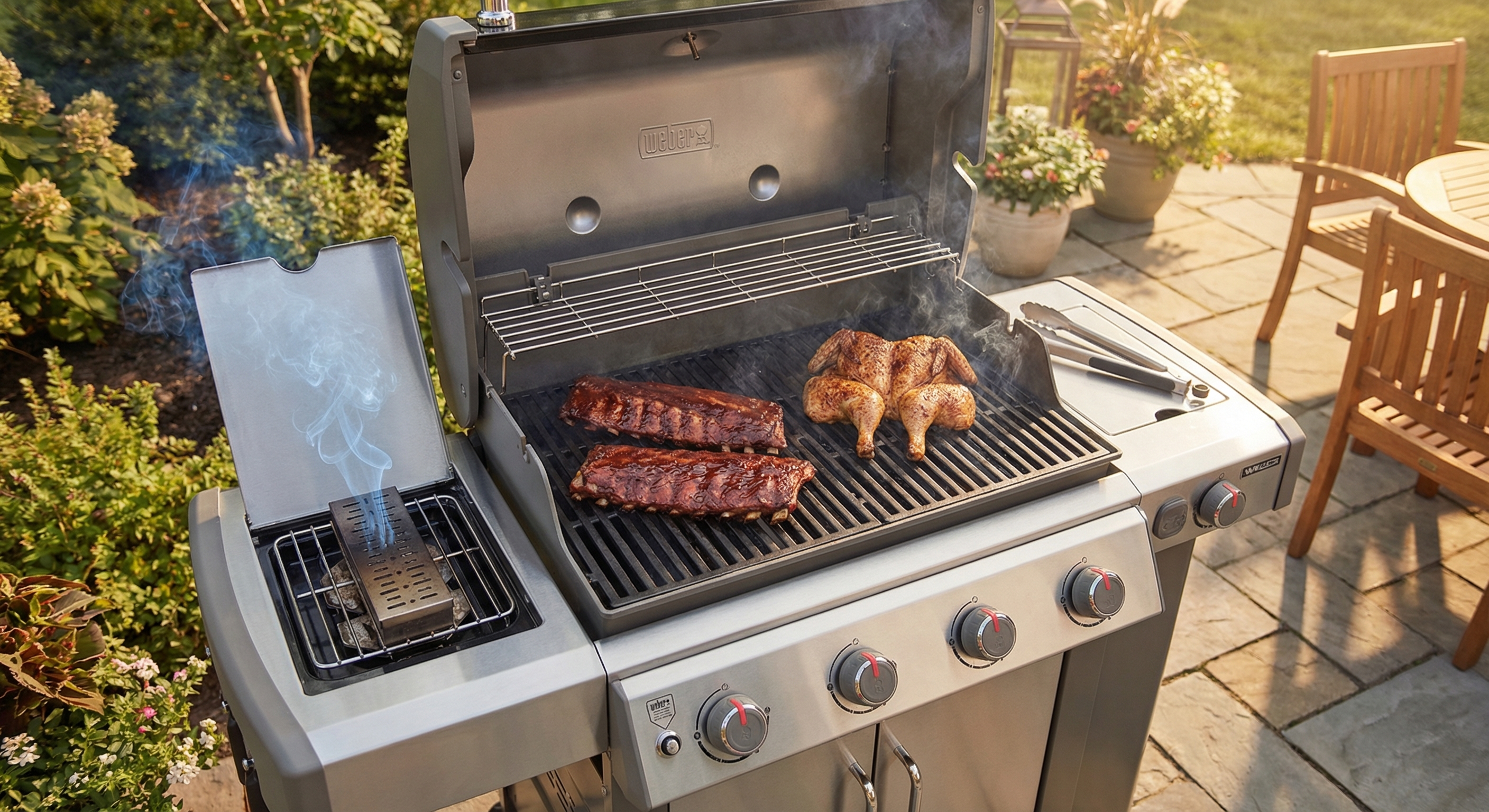
Most backyard grillers assume you need a dedicated offset smoker or pellet grill to produce real smoked meat. That assumption is wrong. A standard two- or three-burner gas grill can generate authentic smoke flavor — complete with bark formation, smoke penetration, and even a visible smoke ring — when you understand the science behind it.
The key is converting your gas grill into an indirect-heat smoking chamber. This guide covers exactly how to do it: the two-zone setup, wood chip selection, temperature management, and the combustion chemistry that makes it all work.
Why Gas Grills Can Smoke Meat (The Science)
Smoke flavor comes from the thermal decomposition of wood — a process called pyrolysis. When wood reaches 400–500°F, its cellulose, hemicellulose, and lignin break down into hundreds of volatile compounds. The key flavor compounds include:
- Syringol and guaiacol — responsible for the classic "smoky" aroma (derived from lignin)
- Organic acids (formic, acetic) — contribute tartness and complexity
- Carbonyls — produce the golden-brown color on smoked meat surfaces
- Phenolic compounds — act as preservatives and add depth
None of this chemistry requires a specific type of cooker. It requires wood reaching pyrolysis temperature and the resulting smoke contacting meat. A gas grill can deliver both conditions — you just need the right setup.
The critical distinction is thin blue smoke versus thick white smoke. Thin blue smoke indicates clean combustion with a high ratio of desirable flavor compounds. Thick white smoke means incomplete combustion, which deposits bitter creosote and soot. Gas grills actually have an advantage here: the consistent heat output from gas burners makes it easier to maintain the wood chip temperature in the optimal pyrolysis range.
Essential Equipment
You need surprisingly little gear to smoke on a gas grill:
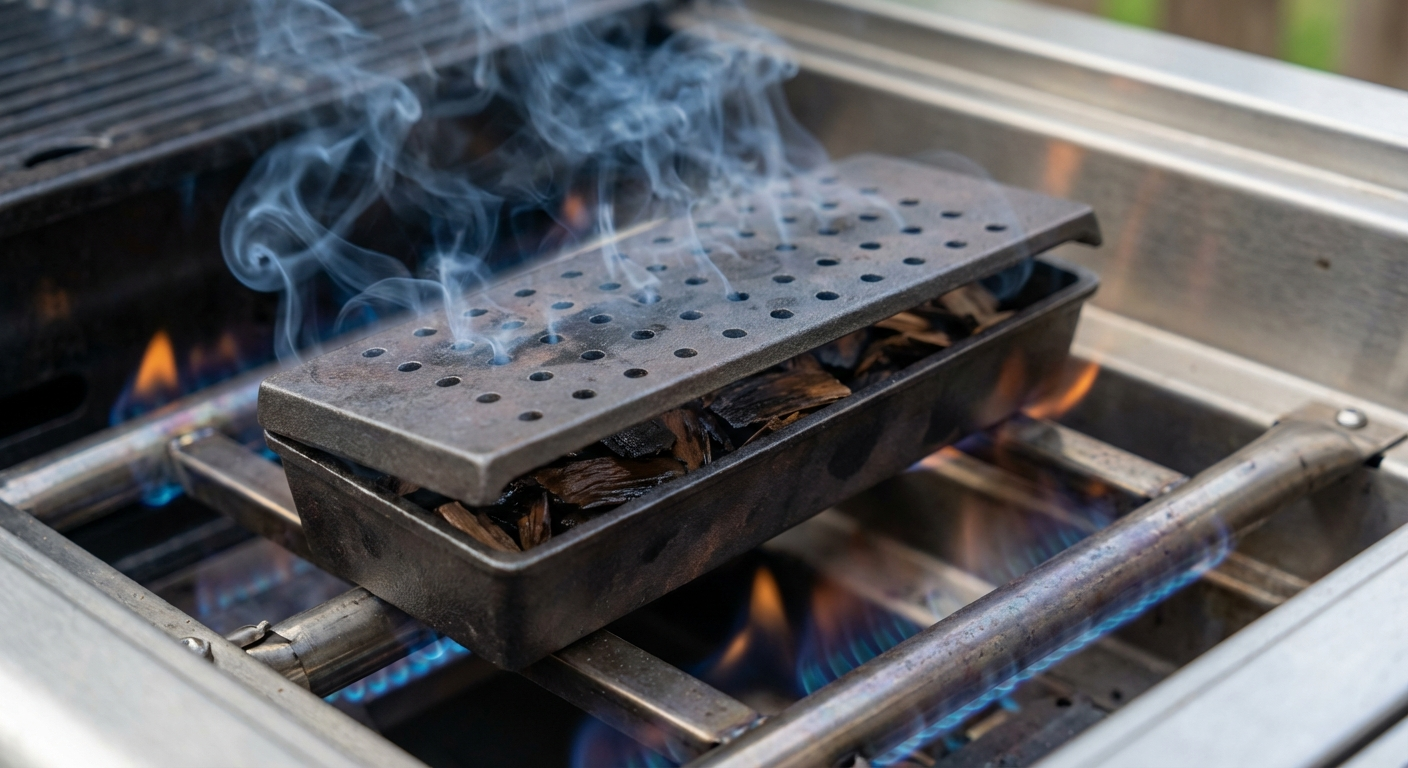
- Smoker box (cast iron or stainless steel) — sits directly on a burner or heat deflector. Cast iron retains heat better and produces more consistent smoke. Stainless is easier to clean.
- Wood chips — not chunks. Chips have more surface area relative to volume, which means faster pyrolysis at the lower temperatures a gas grill generates compared to a firebox.
- Instant-read thermometer — essential for monitoring grill chamber temperature and meat internal temp.
- Aluminum drip pan — placed under the meat on the cool side to catch drippings and add humidity.
If you don't have a smoker box, a foil pouch works. Place a handful of wood chips on heavy-duty aluminum foil, fold into a sealed packet, and poke 6–8 small holes in the top with a fork. The holes control airflow and smoke release rate.
The Two-Zone Indirect Setup
This is the foundation of gas grill smoking. The principle is identical to two-zone grilling — you create a hot side and a cool side — but for smoking, the temperature target is much lower (225–275°F) and you add a smoke source.
For a Two-Burner Grill
- Light one burner on low to medium-low.
- Place the smoker box or foil pouch directly over the lit burner.
- Place an aluminum drip pan on the unlit side.
- Put the meat on the grate above the drip pan (unlit side).
- Close the lid.
For a Three-Burner Grill
- Light one end burner on low to medium-low.
- Place the smoker box over the lit burner.
- Leave the center and opposite burners off.
- Place the meat on the far end, opposite the heat source.
- Close the lid.
The goal is to maintain a chamber temperature of 225–275°F at grate level where the meat sits. This is lower than most gas grills' minimum setting when all burners are on, which is exactly why you only use one burner.
Temperature Control: The Biggest Challenge
Gas grills leak heat. They're designed for high-heat grilling with generous ventilation, not low-and-slow retention. This makes temperature control the main challenge when smoking.
Strategies for Maintaining Low Temperatures
- Use only one burner on the lowest stable setting. If your grill runs hot even on low, prop the lid open with a wooden spoon (about 1 inch) to vent excess heat. This is not ideal but works.
- Monitor at grate level, not the dome. Built-in lid thermometers read 25–50°F higher than actual grate temperature. Place a probe thermometer at grate level on the cool side for accurate readings. See our guide on thermometer accuracy.
- Minimize lid openings. Every time you lift the lid, you lose 50–100°F of chamber heat. Gas recovers faster than charcoal, but frequent openings still disrupt the smoke environment.
- Use a water pan. A pan of hot water placed next to the drip pan acts as a heat sink. Water cannot exceed 212°F at sea level, so it moderates temperature spikes and adds humidity — which improves smoke adhesion to the meat surface.
Why Humidity Matters for Smoke Flavor
Smoke compounds dissolve more readily in moisture. A wet meat surface absorbs more smoke than a dry one. This is why the first few hours of smoking — when the meat surface is still cool and damp from condensation — produce the most flavor penetration. It's the same principle behind spritzing and mopping.
Wood Chip Selection and Management
Different wood species produce different flavor compounds because their lignin composition varies. Here's what the science says about the most common smoking woods:
- Hickory — high syringol content. Strong, bacon-like flavor. Best with pork and beef. Can turn bitter if over-smoked.
- Mesquite — burns hot with intense, earthy flavor. Use sparingly on a gas grill — the confined space concentrates the smoke.
- Apple and cherry — fruiting woods with lower lignin density. Mild, sweet smoke. Excellent for chicken, turkey, and fish.
- Oak — medium intensity, balanced flavor profile. The default choice for Texas-style brisket. Blends well with other woods.
- Pecan — similar to hickory but milder. Good all-purpose wood for beginners.
For more detail on flavor chemistry, see our smoking wood flavor science guide.
To Soak or Not to Soak?
The soaking debate is largely settled by science: soaking chips is mostly unnecessary. Water only penetrates about 1–2mm into the wood surface. The soaked exterior must dry and heat to pyrolysis temperature before smoking begins, which means soaking just delays smoke production by 10–15 minutes. It doesn't make chips last longer in any meaningful way.
The one exception: if your gas grill runs very hot and chips ignite too quickly, a brief 15-minute soak can slow initial combustion enough to prevent flare-ups inside the smoker box.
Replenishing Chips
Wood chips on a gas grill burn through faster than chunks in a dedicated smoker — typically every 30–45 minutes. Plan to replenish chips 2–3 times during a 3–4 hour smoking session. Add fresh chips to the smoker box quickly and close the lid immediately to minimize heat loss.
After the first 2–3 hours of smoking, most meat has absorbed the majority of smoke flavor it will take. The myoglobin near the surface has reacted with nitric oxide from the smoke to form the pink smoke ring. Additional smoke after this point adds diminishing returns and risks bitter over-smoking.
Smoke Ring Science on a Gas Grill
Yes, you can get a smoke ring on a gas grill. The smoke ring forms when nitric oxide (NO) in wood smoke reacts with myoglobin in the meat surface. This reaction only occurs when the meat is below about 140°F — which is why the low-and-slow start is critical.
Gas grills actually have a small advantage here: the combustion of propane or natural gas itself produces trace amounts of nitrogen dioxide (NO₂), which converts to nitric oxide in the presence of moisture. This means even without wood smoke, a gas grill can produce a faint pink ring — though adding wood chips dramatically increases it.
For maximum smoke ring development, keep the meat cold when it goes on the grill (straight from the refrigerator) and maintain high humidity in the chamber during the first 2 hours.
What to Smoke First: Best Cuts for Gas Grill Smoking
Not every cut makes sense for gas grill smoking. The limited smoke output and less precise temperature control compared to dedicated smokers means some cuts work better than others:
Best Choices (Shorter Smoking Times)
- Baby back ribs — 3–4 hours at 250°F. Forgiving cut that works beautifully with the 3-2-1 method adapted for gas.
- Chicken (whole or quarters) — 2–3 hours at 275°F. The higher temp keeps skin from getting rubbery.
- Pork tenderloin — 1.5–2 hours at 250°F. Quick smoke, great flavor absorption due to lean surface.
- Salmon fillets — 1–2 hours at 225°F. Delicate smoke flavor with apple or alder wood.
- Sausages — 2–3 hours at 225–250°F. Already seasoned, just need smoke flavor.
Advanced (Longer Smoking Times)
- Pork shoulder — 8–10 hours at 250°F. Doable but requires patience and chip replenishment. Will hit the stall around 155°F.
- Beef brisket (flat only) — 6–8 hours at 250°F. A full packer brisket is risky on a gas grill due to temperature inconsistency — start with just the flat. See flat vs. point differences.
Step-by-Step: Smoking Ribs on a Gas Grill
Here's a complete walkthrough for baby back ribs — the ideal first smoke on a gas grill:
- Prep (30 min before): Remove membrane from the bone side. Apply a dry rub (salt, pepper, paprika, garlic powder, brown sugar). Let the rub set while the grill preheats.
- Preheat (15 min): Light one burner on medium. Place smoker box with hickory or apple chips over the lit burner. Close lid. Wait for thin blue smoke.
- Set up indirect zone: Turn the lit burner down to low once you see smoke. Place a drip pan on the unlit side. Target 250°F at grate level.
- Smoke (2 hours): Place ribs bone-side down on the cool side. Close the lid. Resist opening for the first hour. Replenish chips at the 45-minute mark.
- Wrap (1.5 hours): After 2 hours, wrap ribs in foil with a splash of apple juice. This is the Texas crutch — it powers through the stall and tenderizes.
- Unwrap and finish (30–45 min): Unwrap, brush with sauce if desired, and place back on the grill for 30–45 minutes to set the bark. The Maillard reaction at the surface creates the caramelized crust.
- Rest (10 min): Remove when internal temp hits 195–203°F between the bones. Rest for 10 minutes before cutting.
Common Mistakes and How to Avoid Them
- Too much smoke. More smoke is not better. If you can't see through the smoke, it's too heavy. Bitter creosote buildup ruins meat. Use less wood and aim for thin, barely visible blue smoke.
- Opening the lid too often. You lose heat, smoke, and humidity every time. If you're lookin', you ain't cookin'. Use a leave-in probe thermometer instead.
- Cooking over the lit burner. This is grilling, not smoking. The meat must be on the indirect side, away from direct heat.
- Using chunks instead of chips. Chunks need higher sustained temperatures to pyrolyze properly. On a gas grill with one burner on low, chips are far more reliable.
- Ignoring carryover cooking. Pull meat 5°F before target temp. The residual heat will carry it the rest of the way.
Gas Grill Smoking vs. Dedicated Smokers: Honest Comparison
Let's be honest about the tradeoffs:
- Smoke intensity: A dedicated smoker produces heavier, more sustained smoke. Gas grill smoking is lighter — which some people actually prefer.
- Temperature stability: Offset smokers and kamado grills retain heat better. Gas grills fluctuate more, especially in wind or cold weather. See our kamado grill science guide for comparison.
- Convenience: Gas grills win. Push-button ignition, easy cleanup, and you already own one.
- Capacity: Most gas grills have ample grate space. You can smoke and have room to spare.
- Results: For 1–4 hour smokes (ribs, chicken, fish), gas grill results are nearly identical to dedicated smokers. For 8+ hour cooks, dedicated smokers have a real advantage in consistency.
Frequently Asked Questions
Frequently Asked Questions
Can you really smoke meat on a gas grill?
Yes. Any gas grill with at least two burners can smoke meat using indirect heat and a smoker box or foil pouch filled with wood chips. The science of smoke flavor — pyrolysis of wood producing volatile flavor compounds — works the same regardless of the heat source.
Do you need to soak wood chips before using them on a gas grill?
Generally no. Soaking only wets the outer 1-2mm of the chip surface, which must dry before pyrolysis begins. This delays smoke production by 10-15 minutes without significantly extending smoke duration. The exception is if your grill runs very hot and chips ignite too quickly — a brief soak can slow initial combustion.
How long do wood chips last in a smoker box on a gas grill?
Wood chips typically last 30-45 minutes on a gas grill before burning out. Plan to replenish 2-3 times during a smoking session. After 2-3 hours total, most meat has absorbed the majority of smoke flavor it will take.
What temperature should a gas grill be for smoking?
Target 225-275°F at grate level on the indirect (cool) side. Use only one burner on low to medium-low. The built-in lid thermometer reads 25-50°F higher than actual grate temperature, so use a separate probe thermometer for accuracy.
Can you get a smoke ring on a gas grill?
Yes. The smoke ring forms when nitric oxide in wood smoke reacts with myoglobin in the meat surface below 140°F. Gas combustion also produces trace nitrogen compounds that contribute. For the best ring, start with cold meat straight from the fridge and maintain high humidity during the first two hours.
More Expert Guides
Pulled Pork Temperature Guide: The Science of When Pork Butt Is Actually Done
The difference between stringy pork and melt-in-your-mouth pulled pork comes down to about 8 degrees. Understanding the collagen-to-gelatin conversion window explains why temperature — not time — is the only metric that matters.
14 min readOffset Smoker Temperature Control: The Science of Fire, Airflow, and Consistency
Offset smokers are the most rewarding — and most demanding — way to cook barbecue. Temperature control comes down to three variables: fuel, oxygen, and exhaust. Master the physics and you will hold rock-steady temps for 12+ hours.
13 min readGrilling Frozen Steak: The Science of Why It Actually Works Better
Everything you've been told about thawing steak first might be wrong. The science of heat transfer explains why frozen steaks can outperform thawed ones on a hot grill.